John B. Ravenal is an independent curator and art historian based in Cambridge, Massachusetts. He was formerly executive director of the deCordova Sculpture Park and Museum in Lincoln, Massachusetts, and served before that as curator of modern and contemporary art at the Virginia Museum of Fine Arts.
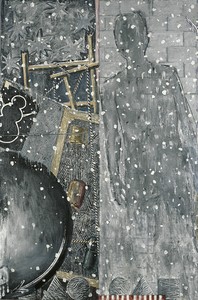
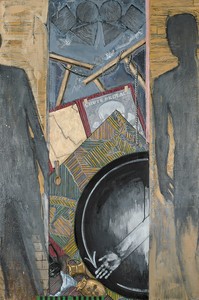
In the mid-1980s, between making the first and last of the “bath pictures”—works he based on the bathroom in his home in Stony Point, New York—Jasper Johns introduced a new motif: a nearly full-length figure based on his own shadow. The shadow appears life-size in the four Seasons paintings (1985–86). Surrounded by Johns’s possessions and in environments depicting the changing times of year, the motif has been widely understood as a meditation on the passage of time and the stages of human life.
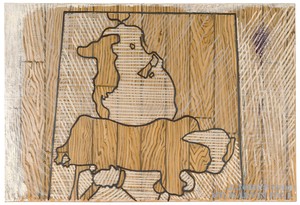
Each of the four backgrounds behind the shadow refers to a place where the artist lived and worked, including the horizontal wood planks in Fall, which recall his Manhattan studio on Houston Street.1 Woodgrain also appears in the boldly grained picture frame within Winter. But its most unusual appearance in The Seasons occurs in the assertive pattern that fills the triangles, squares, and circles in three of the four paintings. Clustered at the bottom or top and mirrored across the vertical center lines of the paintings, these geometric forms have been variously seen as inspired by Dürer’s engraving Melancolia I (1514);2 Cezanne’s dictum to “treat nature by the cylinder, the sphere, and the cone”;3 and an early-nineteenth-century brush painting,Circle, Triangle, and Square (also known as The Universe), by the Japanese Zen master Sengai Gibon.4
Whatever the source, most notable is that filling these shapes with woodgrain represents the pattern’s first appearance entirely free from a descriptive role. It may still retain allusions to Johns’s living spaces, whether Houston Street or Stony Point, but it no longer describes a wall, floor, door, table, or even a hypothetical shop sign, as in the artist’s poster for the Whitney Museum of American Art (1977). In The Seasons, the geometric forms that enclose the woodgrain now declare the pattern’s independence. Building on his prior juxtapositions of the organic and the geometric in the 1977 Savarin print (see part one), Johns here binds the two more closely together. He creates a new form that joins a symbol of nature with the purity of geometry, perhaps in fulfillment of Cezanne’s statement.
I would also propose that this union of opposites represents woodgrain shedding its vestiges of literalism and attaining the neutrality that Johns prized in his early motifs. Johns famously described his flags, targets, numbers, and letters as “things the mind already knows.”5 As a found image, woodgrain shares with these other, already known subjects the quality of being at once familiar and overlooked. It also offers Johns the elasticity he seeks in his motifs, exemplified by a decade of hatchmark paintings (1972–82), a pattern he described as having “all the qualities that interest me—literalness, repetitiveness, an obsessive quality, order with dumbness, and the possibility of complete lack of meaning.”6
Jasper Johns, Winter, 1986, encaustic on canvas, 75 × 50 inches (190.5 × 127 cm), Art Institute of Chicago. Photo: Jamie Stukenberg, Professional Graphics, Rockford, Illinois
Woodgrain may seem only partly to share these qualities with hatchmarks, but in its many iterations in his work, Johns has pushed it increasingly in this direction. He seems to value it precisely for its lack of resistance to the repetition, variation, and mutation that distinguish his practice. By the time of The Seasons, after nearly two decades of permutations, woodgrain had shed its need for an external referent and come close to resembling “an image of pictorial technique,” as Rosalind Krauss once described Johns’s hatchmarks.7
Even this notion of extreme neutrality, however, offers only a partial understanding of the function of woodgrain in Johns’s work. Further consideration of his deep reworking of figure/ground relationships provides a fuller picture. Thomas Crow has described “Johns’s ability and desire to promote his ground to the status of a figure, not just by making figure and ground mechanically equivalent, as high Modernism sought to do, but by endowing his grounds—harlequins, hatchings, and flagstones alike—with aspects of character, identity, and capacity for action that the term ‘figure’ carries in traditional art.”8 The same is true of simulated woodgrain. Johns uses this motif to complicate figure/ground relations, sometimes with optical illusions and spatial disorientation, as when floorboards seem to tip upright and become a wall, at other times by disconnecting the pattern from its referent altogether, then shifting and mutating what is commonly understood as ground so that it takes on the role of figure.
By contrast, Mirror’s Edge and Mirror’s Edge 2, a pair of large, complex paintings from 1992 and 1993, use a wood element to anchor rather than disrupt space. The paintings layer ever more imagery onto the familiar setting of the studio wall, including new motifs: a plan of Johns’s grandfather’s house that he reconstructed from memory, a stick figure derived from a mural by Pablo Picasso, and a swirling galaxy that Johns found in a photograph. A faux-wood strip runs the full height of each painting. In their narrowness, lack of seams, and position at the vertical edge, these strips echo the real wood batons leaning out from other Johns paintings, such as Perilous Night (1982). Those actual strips, by projecting into the viewer’s space, had counterbalanced the pictorial illusion of shallow depth. Johns could have used the same means in the two Mirror’s Edge works, but instead he painted faux-wood strips. Their format matches the real batons but their painterly grain emphasizes their pattern over their location in space. Kirk Varnedoe described these two dense paintings as “symphonic in their orchestrations and dreamlike in the variety of their floating juxtapositions.”9 Unmentioned and seemingly unnoticed in this visual symphony is the role of woodgrain: flush with the picture plane, the faux strips anchor the surface while the swirl of images opens up illusionistic depths ranging from centimeters to light-years.
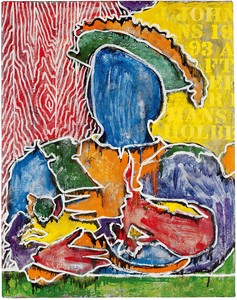
In another pair of paintings from 1993, Johns again began by linking woodgrain to a plausible referent but then stretched it far beyond. The colorful fragmented figure in After Hans Holbein is based on Holbein’s chalk-ink-and-watercolor drawing Portrait of a Boy with a Marmoset (c. 1532/35; Kunstmuseum Basel).10 Johns faithfully recorded many details of the original work, even outlining small missing sections of paper from its top and right edges. When it came to the original work’s light blue background, however, he replaced it entirely. Johns had traced the image from an exhibition poster that hung in his New York City townhouse,11 and the poster’s large text may have encouraged him to add, in stenciled letters in the upper-right quadrant of the painting, the title and date of his own work and his own name, also recalling his poster for his 1977 exhibition at the Whitney. He filled the remaining background with assertive woodgrain in a light tone on red, organized in vertical planks of varying widths, like the barn-board walls at Stony Point.
In After Holbein, a grisaille version of the painting, the stenciled text gives way to columns of black sperm shapes on a gray ground. Across the entire image, sperm and woodgrain vie for prominence: it is unclear whether these patterns have transgressed their role as background to fill the puzzle-piece-like sections of the boy’s figure or whether the boy has become see-through, allowing glimpses of the ground behind him with even more transparency than the shadows do in The Seasons. In either case, the flipping back and forth here merges figure and ground, negating the distinction between the two.
John Yau has described this collapse of figure and ground as a meditation on mortality, with the youth forming and disappearing before our eyes, as if between birth and death. He goes on to say that the “wood grain (or ground) evokes time beyond our demise, and our absence from it.”12 His observation underscores the capacity of woodgrain to reference issues of temporality and existence. A growing tree’s continual laying down of new fibers and cells in an orderly pattern of light and dark rings presents a graphic record of both its vitality and the passage of time. In addition, each new ring responds to changes in temperature, precipitation, and other external conditions, altering the regular growth pattern of a particular species or tree and recording information about past climate, ecosystems, and even galactic events.13 In this way the final pattern stands at once for past and present, life and death, timelessness and ephemerality.
The year after Johns made the Holbein paintings, he explored a new variation on the relationship between the figure and woodgrain. In Untitled (1994), a field of floorboards provides the ground for a contour drawing that Johns based on Auguste Rodin’s plaster assemblage of a minotaur holding the torso of a female centaur (c. 1910; Musée Rodin).14 Johns traced the contour from a photograph, but the figure in his painting appears a step further removed from the sculpture, reading as if it were a framed image laid flat on a wood floor. Closer looking, however, reveals that the frame doesn’t align with the floor. While the floorboards run parallel to the sides of the actual painting, creating an edge-to-edge field, as in Johns’s early flag works, the internal framed image has a gently trapezoidal shape, indicating slight recession into space. Rather than lying on a floor, it is better seen as leaning against a wood-paneled wall. In addition, the framed image’s transparency allows woodgrain to fill some of the figure’s puzzle pieces with great clarity, while in other areas hatchmarks obscure the background. Johns once again confounds the distinctions between floor and wall and melds figure and ground, allowing the image to flip back and forth in spatial confusion.
Dizzying Complexity
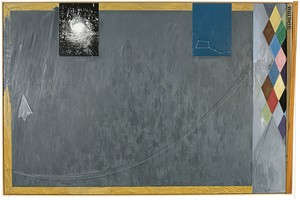
In 1997, Johns began a series distinguished by the new motif of a draped string spanning the painting’s surface in a catenary curve. These works also reintroduced the actual wood strip leaning out from the picture plane that had first appeared fifteen years earlier in works such as Perilous Night. Over the span of a decade and across eighty paintings, drawings, and prints, the Catenary series elevates the play between real and faux wood to new levels of convolution. The first painting in the series, Bridge (1997), set the tone on a grand scale. Across a ten-foot expanse, a field of gray brushstrokes replaces the densely layered imagery of Mirror’s Edge and related works of the previous few years. Only a few images remain, clinging to the perimeter, including the spiraling galaxy and a new motif of the Big Dipper constellation. A real wood slat at the right edge, leaning into the viewer’s space, has an eyehook screwed into it that secures one end of the catenary string. Along the other three edges of the painting runs a faux wood frame.
Johns had depicted woodgrained frames before—in Winter, for example—but they were always contained within the image rather than forming the image’s actual border. And wood strips, both real and faux, had formed a single edge of many other earlier paintings and works on paper. But the faux strips in Bridge are the first illusionistic frame to surround most of a work. At the lower left, Johns screwed a second real eyehook into this faux frame, where it supports the other end of the catenary string and presents a playful inversion of a nearby painted nail. The eyehook’s concreteness lends validity to the faux wood, increasing the illusionism of the painted frame. But higher up along this same edge, the gray field of paint spills onto the fake frame, undercutting the illusion.
In a further play of true and false, behind the real wood slat at the right Johns painted a mirror image of its back side, including the stenciled title. This implies that the slat has imprinted itself on the painting’s surface. Scott Rothkopf has described the “complicated reciprocity that [Johns] develops between the architecture of his slats and their painted surfaces” as part of the overall “reflexive visual logic” of the Catenary series. While familiar from Johns’s earlier work, he notes, it now takes on an “almost dizzying complexity.”15 The play of real and fake woodgrain serves as an essential, if largely unacknowledged, component of this intricate construct, contributing to the fluctuation between a two-dimensional surface, a shallow optical space, and hints of infinite depth.
Simulation and/as Translation
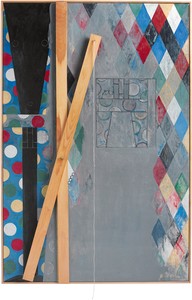
During the early 2000s, Johns continued to use the motif of wood slats to probe the relationship between reality and simulation. Two Bushbaby paintings, from 2003 and 2005, feature tall, vertical wood batons. The first painting is the size of a person; the second replicates the first painting’s composition while nearly doubling its size. In both works a wing nut fixes an outer slat with a dangling string to an inner slat. The arrangement recalls other such devices in Johns’s work, where wooden sticks and batons imply rotation or lean away from the surface. Referring to the movable slats in the Catenary series, Johns had said, “It’s important that one sees the instability of what one is looking at—that it could be changed. I like that you’re aware of other possibilities, whether you set them into motion or not.”16 The statement could apply to Johns’s entire practice, with its embrace of mutation, contingency, and instability.
Breaking with his usual practice of making finished drawings after his paintings, Johns developed the Bushbaby imagery first in a watercolor-and-graphite version. The drawing shares most of the paintings’ motifs, but the greater separation between the black shapes, which suggest a rudimentary figure, offers even less clarity about the nature of this ambiguous form.17 Johns’s careful delineation of the slats’ woodgrain pattern—present in many of the nearly forty related works on paper—suggests a level of commitment that seems to exceed merely the effort to make a convincing representation of a real material. On a formal level, the precisely rendered woodgrain sharpens the juxtaposition of the organic pattern and the nearby geometries. This contrast is amplified in a small inset image at the upper right, where tight cropping accents the play between the woodgrain, polka dots, and quadrilaterals. The careful translation from one medium to another—from real wood to encaustic, watercolor, or graphite—also elevates the status of woodgrain. Verisimilitude here not only confers fidelity but underscores the role that woodgrain plays as one of the principal motifs in this hermetic series.
An untitled watercolor from 2006, based on an untitled painting from the same year, offers further insight into how instances of “faithful” translation convey additional meanings beyond the initial act of representation. The painting belongs to a group of seven made between 2004 and 2012 that combine the slat-and-string constructions with the flagstone motif. The untitled drawing—here, in Johns’s usual practice, made after the finished painting—carefully re-creates the look of the painting, including the shading around the canvas andslats.18 And while the woodgrain is a freehand invention, it, too, conveys an aura of exactitude. The care taken in its rendering establishes it as a twin, though not a true copy, of the actual wood strip in the painting. Johns both takes a liberty and counters that impression by the heightened level of finish.
Despite the creative liberty Johns introduced into this supposed translation, he could never be accused of exhibiting what Vladimir Nabokov colorfully described as the translator’s “three grades of evil”—which boil down to ignorance, laziness, and arrogance.19 Rather, Johns seems to court what Nabokov might have agreed was a fourth, counterintuitive risk of translation, were he to have considered it further. This is the risk of creating the impression that a meticulous rendering, whether textual or visual, offers a transparent window onto the original—a deception that may inform the enigmatic Italian saying Traduttore, traditore, or “The translator is a traitor.” One is reminded of Johns’s keen interest in the ambiguity surrounding Edvard Munch’s adoption of a woodcut aesthetic for his lithograph of The Scream (see part one). For Johns, fidelity serves as another ploy in a repertoire full of such devices. It bolsters the impression of his faux-wood slats and batons as proxies for the real thing, while in truth problematizing the equation.
In general, incorporating a found object, such as a real wood slat, into a painting highlights the artist’s acts of selection and recontextualization. The found object’s change of location and function calls attention to its materiality, which is accentuated by its juxtaposition with the painted surface. Carefully re-creating the color, form, and pattern of that found object in a different medium might seem merely to validate the relocation of the object to its new setting, that is, the initial act of appropriation. And Johns’s practice of making drawings and prints after his finished paintings seems to align with this notion, as if he were enshrining or memorializing the original painting. But in creating a simulation, in whatever medium and to whatever degree of finish, Johns also activates long-standing questions about the complex relationship between the original and the translation.
Even setting aside what one translator describes as the myth of “forensic fidelity,” an ontological problem remains.20 In “The Task of the Translator,” Walter Benjamin memorably described an unbridgeable gap between the original and the translation: “Whereas content and language form a certain unity in the original, like a fruit and its skin, the language of the translation envelops its content like a royal robe with ample folds. For it signifies a more exalted language than its own and thus remains unsuited to its content, overpowering and alien.”21 No matter its fidelity, then, the translation would be considered inherently superfluous, and would carry this superfluity within it as a distinguishing feature.
Similarly, the more carefully and convincingly Johns makes his simulated woodgrain, the more it stands as a “supplement,” to apply Jacques Derrida’s term for an addition to something thought of as complete and an origin—an addition that usurps the position of that supposed origin in order to question the binary logic of an original and a copy.22 A seemingly innocuous aspect of Johns’s work, then, woodgrain comes to serve as a decoy—a concept woven throughout Johns’s art—carrying within itself the kernel of a deconstructive logic.
Jasper Johns, Bridge, 1997, oil on canvas with objects, 78 × 117 inches (198.1 × 297.2 cm), Art Institute of Chicago. Photo: Jamie Stukenberg, Professional Graphics, Rockford, Illinois
Conclusion
Identifying the sources of Johns’s woodgrain pattern no more explains his imagery than uncovering the origin of any of his motifs. His works, like those of most artists, are not codes to be deciphered with a special key, or reduced to fixed meanings. But this line of inquiry does provide a fruitful starting point for deeper understanding. The significance of Johns’s motifs lies in their ever-shifting characters and interrelationships. Tracing the paths by which a new image enters his work, and then closely tracking its evolution, offers insight into the complex and intuitive way he works, layering observation, memory, and invention. That this process sometimes functions beneath Johns’s consciousness seems clear. Yet as images rise to his level of awareness, they unleash new meanings and new possibilities for further exploration.
Woodgrain, in its union of literalness and elasticity, has offered Johns a generative motif for probing some of his central and enduring concerns: the links between figure and ground, past and present, and reality and imagination. In discussing one of his most celebrated motifs—crosshatching—Jennifer Roberts revealed how the “seemingly chaotic arrangements of marks . . . are in fact governed by print-based patterns of reversal, repetition, and rotation.”23 Woodgrain too, over the course of its life in Johns’s work, undergoes such varied and complex deformations. But unlike crosshatching or other better-known subjects of his, its manipulations are less overtly on display. Woodgrain is first and foremost a pattern we know from myriad natural and artificial surfaces in our surrounding environment. This familiarity has inhibited inquiry: woodgrain’s persistent legibility, paradoxically, has contributed to its invisibility.
That woodgrain spans fifty years of Johns’s career owes, at least in part, to this phenomenon of hiding in plain sight. Unlike woodgrain, many of Johns’s motifs make time-limited appearances in his work. They are used intensively and then retired, their possibilities seemingly exhausted. Crosshatching was the exclusive subject of his painting from 1972 to 1982; it has rarely reappeared since its culmination in the three large paintings titled after Munch’s Between the Clock and the Bed. Other motifs play out over even more limited time frames, such as Holbein’s boy with a marmoset, only in use from 1990 to 1993. Still others, however, may extend over decades, as with the “green angel,” based on Rodin’s minotaur and centaur. Woodgrain, too, appears in clusters, but with greater regularity than almost any of his other motifs, populating his work nearly every year or two from the mid-1960s to 2018. True, it usually plays a supporting rather than a leading role, but it always contributes something essential to the meaning of the work. Woodgrain’s cloak of neutrality, then, has not only kept it under the radar but has fostered its staying power. Again and again, in widely different works and across all of Johns’s media, woodgrain has recurred, fitted into images in a way that often seems natural and unremarkable, but that upon closer looking displays the complexity, the nuance, and, ultimately, the strangeness that attend the more celebrated of Johns’s motifs. This Zelig-like act of mutation and self-perpetuation is anything but neutral.
Excerpted from an unpublished essay. Part one appeared in the Fall 2024 issue of Gagosian Quarterly.
I wish to thank colleagues for help with my research: Carlos Basualdo, Roberta Bernstein, Barbara Bertozzi Castelli, Harry Cooper, Sarah Eckhardt, Bill Goldston, Larissa Goldston, Jennifer Gross, Stephanie Guttman, Emily Handlin, Rebecca Rabinow, Maryhelen Murray, Shelley Langdale, Robert Lazzarini, Catharina Manchanda, Donna McClendon, Christopher Pye, Eva Respini, John Henry Rice, Jennifer Roberts, Scott Rothkopf, Chris Santa Maria, Patterson Sims, Deborah Solomon, David Swetzoff, Michael Taylor, Ann Temkin, Jacqueline Tran, Jim Webb, and Joni Moisant Weyl. Special thanks to Alison McDonald, Wyatt Allgeier, and David Frankel at Gagosian Quarterly. Deepest gratitude to Jasper Johns and Maureen Pskowski for their support of my research. As ever, love to Virginia Pye.
1 The other three surfaces are terra-cotta tile from St. Martin (Spring), brick from Stony Point, New York (Summer), and stone from the courtyard of Jasper Johns’s Upper East Side Manhattan townhouse (Winter). See Barbara Rose, “Jasper Johns: The Seasons,” Vogue, January 1987, pp. 259–60.
3 See Roberta Bernstein, “Seeing a Thing Can Sometimes Trigger the Mind to Make Another Thing,” in Kirk Varnedoe, Jasper Johns: A Retrospective, exh. cat. (New York: Museum of Modern Art, 1996), p. 57.
5 Johns, quoted in “Art: His Heart Belongs to dada,” Time, May 4, 1959, p. 58.
6 Johns, quoted in Sarah Kent, “Jasper Johns: Strokes of Genius,” 1990, in Jasper Johns: Writings, Sketchbook Notes, Interviews, ed. Kirk Varnedoe, compiled by Christel Hollevoet (New York: Museum of Modern Art, 1996), p. 259.
7 Rosalind Krauss, “Jasper Johns: The Functions of Irony,” October 2 (Summer 1976): p. 95.
8 Thomas Crow, “Moving Targets: Change and Renewal in the Art of Jasper Johns,” in Jasper Johns: Drawings 1997–2007, exh. cat. (New York: Matthew Marks Gallery, 2008), n.p.
9 Varnedoe, Jasper Johns: A Retrospective, p. 359.
10 The sitter for Portrait of a Boy with a Marmoset was long identified as the young Edward, Prince of Wales, but this identity is no longer accepted. See Bernstein, “Seeing a Thing,” p. 74 n. 126. The pet has been variously called a marmoset, lemur, and monkey.
14 Johns first used this motif four years earlier and it appeared in dozens of paintings, drawings, and prints over more than three decades before its source was identified and the connection made to his interest in the pathos of damaged and broken figures. See Yau, “Jasper Johns: Hiding in Plain Sight,” Hyperallergic, May 29, 2021. Available online at https://hyperallergic.com/649178/jasper-johns-hiding-in-plain-sight/ (accessed August 30, 2024). See also Greg Allen, “Jasper Johns Fan Dance,” greg.org (blog), May 31, 2021. Available online at https://greg.org/archive/2021/05/31/jasper-johns-fan-dance.html (accessed August 30, 2024).
15 Scott Rothkopf, “Suspended Animation,” in Jasper Johns: Catenary, exh. cat. (New York: Matthew Marks Gallery, 2005), p. 10–11.
17 Gary Garrels and Bernstein read the black shapes as a totemic figure inspired by Pablo Picasso’s Harlequin of 1915, and the smaller rectangles as genitals. See Garrels, “The Bushbaby Series,” in Jasper Johns: Seeing with the Mind’s Eye, exh. cat. (San Francisco: San Francisco Museum of Modern Art, in association with Yale University Press, New Haven, 2013), pp. 150–56, and Roberta Bernstein, Jasper Johns: Catalogue Raisonné of Paintings and Sculptures (New York: Wildenstein Plattner Institute, 2016), pp. 296–97.
18 Thanks to Bernstein for this observation, and for looking at her notebooks to confirm that the drawing was made after, not before, the painting. Emails to author, January 21 and 26, 2022. In the photograph of the painting in Bernstein’s catalogue raisonné (p. 339), the slats overlap; in the drawing, they are spread apart.
21 Walter Benjamin, “The Task of the Translator,” in Selected Writings, vol. 1, 1913–1926, 5th ed., ed. Marcus Bullock and Michael W. Jennings (Cambridge, MA: Belknap Press, 2002), p. 258.
22 See Jacques Derrida, “Part II: Nature, Culture, Writing. Introduction to the ‘Age of Rousseau.’ ‘. . . That Dangerous Supplement . . . ,’” in Of Grammatology, Corrected Edition, trans. Gayatri Chakravorty Spivak (Baltimore and London: Johns Hopkins University Press, 1997), pp. 141–64 passim.
23 Jennifer Roberts, “The Printerly Art of Jasper Johns,” in Jasper Johns/In Press: The Crosshatch Works and the Logic of Print (Cambridge, MA: Harvard Art Museums, 2012), p. 34.
John B. Ravenal is an independent curator and art historian based in Cambridge, Massachusetts. He was formerly executive director of the deCordova Sculpture Park and Museum in Lincoln, Massachusetts, and served before that as curator of modern and contemporary art at the Virginia Museum of Fine Arts.