John B. Ravenal is an independent curator and art historian based in Cambridge, Massachusetts. He was formerly executive director of the deCordova Sculpture Park and Museum in Lincoln, Massachusetts, and served before that as curator of modern and contemporary art at the Virginia Museum of Fine Arts.
It may seem unlikely to discover a readily visible but almost entirely neglected motif spanning more than fifty years of an artist’s work, especially an artist as well studied as Jasper Johns. But this is the case with simulated woodgrain, a regular feature of Johns’s paintings, drawings, and prints from the 1960s through at least 2018. Woodgrain has effectively hidden in plain sight—an act of covert ubiquity well suited to Johns’s practice of appropriating and recasting familiar but overlooked bits of his surrounding environment.
Focusing on an underrecognized motif can fill in missing information and shed new light on familiar pieces. Tracing the arc of one visual element over half a century also offers a case study of how motifs function in Johns’s work, providing insight into his creative process, including his well-known openness to serendipity and unforeseen solutions. Describing this receptivity more precisely, Johns has said, “There are no accidents in my work. It sometimes happens that something unexpected occurs—the paint may run—but then I see that it has happened, and I have the choice to paint it again or not. And if I don’t, then the appearance of that element in the painting is no accident.”1 Even if the initial appearance of an image, pattern, or drip were unpremeditated, then, it must afterward earn its place. This happens largely by its capacity to suggest diverse and often ambiguous, even conflicting meanings while also allowing for future elaboration—in short, by a state of interpretive abundance.
Closely related to the question of chance in Johns’s work is the question of found versus invented imagery. In an early interview he described this dynamic as an opposition between things that are “taken” rather than “mine.”2 Emerging in the wake of Abstract Expressionism and rejecting its emphasis on personal expression, Johns preferred preexisting subjects. Using found motifs freed him from the burden of designing new imagery that might have to “carry my nature as part of its message.”3 The notions of “taken” and “mine,” however, ought not to be seen as antipodal but rather as on a continuum, with found images sliding toward personal symbols the longer they circulate in Johns’s orbit, as will be seen with woodgrain.
This progression has been well described in relation to Johns’s celebrated subjects: public motifs such as the American flag, targets, and numbers; mundane patterns that Johns encountered obliquely, such as crosshatching and flagstones;4 and images borrowed from his predecessors, including Pablo Picasso, Hans Holbein, and Marcel Duchamp. The pattern of simulated woodgrain, for all its humbleness, follows the same trajectory. That it hasn’t been acknowledged before as belonging to Johns’s established stable of motifs, even after decades of active use, underscores how woodgrain’s very commonness heightens its contradictory status. On the one hand it is highly visible in Johns’s work, and deeply interwoven with his other subjects; on the other hand, it continues to slide beneath the radar of conscious attention, for scholars, viewers, and even the artist.5
The representation of woodgrain—distinct from the use of actual pieces of wood—first appeared in Johns’s art during the 1960s with images of rulers that he incorporated into works such as the four-panel painting Harlem Light (1967) and the lithograph Pinion (1963–66). But in these and similar works, the ruler’s woodgrain is faint at best and secondary to the main event of its numbers and lines. The 1968 screenprint Target with Four Faces, which reproduces the 1955 painting of the same title, offers a more considered representation of woodgrain.6 Here Johns mechanically reproduced the grain of the actual boxes and lids included in the painting, inking strips of wood and applying them to the printing surface.7 He would use a similar process four years later to produce the woodgrain pattern in Device (1972), a lithograph that also looks back to an earlier, iconic painting, Device of 1961–62, which like Target with Four Faces contains actual wood attachments. In neither case does the woodgrain replicate that in the earlier painting, but each makes a convincing simulacrum while substituting an alternative pattern.
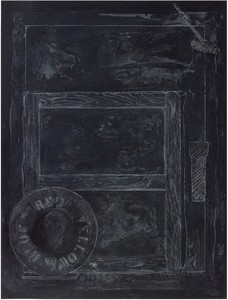
Jasper Johns, Souvenir 2, 1970, ink, white pencil, and pastel on plastic, 25 ⅜ × 19 ¼ inches (65.1 × 48.9 cm), Menil Collection, Houston; bequest of David Whitney. Photo: Thomas R. DuBrock, courtesy The Menil Collection, Houston
Johns soon began hand-drawing woodgrain, perhaps first in the drawing Souvenir 2 (1970). Again, the image doesn’t imitate the actual wood there in the source, a 1964 painting of the same title. Instead, it presents a loose, gestural grain in white pastel on a black ground.8 Two years later, Johns again turned to hand rendering for the fragment of floorboards that appears beneath the waxen hand, foot, and sock in the last panel of the four-part painting Untitled (1972; Museum Ludwig, Cologne).9 Johns recalls that he painted the grain into the mold from which the floorboards were to be cast, also in wax.10
The change from a transfer process to freehand drawing had important consequences for Johns’s work, as the remainder of this essay explores. But before moving on, it’s worth asking whether rubbing, imprinting, and related transfer methods impart any additional content to their subjects or are merely transactional means of reproduction characterized by expediency and accuracy. It’s tempting to connect Johns’s rubbings, especially of woodgrain, with the frottage technique that Max Ernst developed in 1925 by rubbing graphite on paper laid over rough floorboards. But rubbing is also one of the most elemental methods of drawing, at once childlike and ancient.11 In addition, lithography has long involved the use of transfer paper as a means of faithfully incorporating images, marks, and textures into prints.12 Moreover, Johns’s transferred woodgrain abstains from the transformational magic of Surrealism: no imagined plants or creatures emerge from the depths of his wood-grain pattern, whether through hand embellishment or layering of multiple textures. Johns’s transferred images focus on replicating an external object rather than forming new imagery.13
Johns’s initial experiments in representing woodgrain—whether mechanically or freehand—seem governed by a simple logic: rulers, wood slats, and floorboards usually have visible grain, and so should their likenesses. At this early stage, the pattern can’t be called a motif; it hasn’t yet attracted enough of Johns’s notice for him to begin altering, mutating, and shifting its appearance—that is, exploring the variations that will separate an image from its source. Just a few years later, however, woodgrain began to evolve into a vehicle for more complex meaning and with greater independence from its sources—a transformation from descriptive pattern to motif.
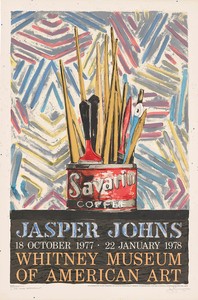
In 1977, New York’s Whitney Museum of American Art presented a midcareer survey of Johns’s work. While generally hands-off with the organization of his exhibitions, Johns did agree to design the show’s poster and the dust jacket of its catalogue. For both, he presented an image of his sculpture Painted Bronze (1960), in which a Savarin coffee can holds a clutch of paintbrushes, as a stand-in for an image of himself—a fitting substitution given the directness of paintbrushes as symbols of creativity.14
For the poster Johns signaled the retrospective nature of a career survey by placing an image of this early sculpture against a field of hatchmarks derived from a recent painting.15 The sculpture sits on a dark, narrow ledge. Beneath the ledge, a wider field houses the exhibition’s title, date, and location. Barely visible behind the stenciled text, a black wood-grain pattern inflects the warm gray ground. It seems a whimsical choice, as this part of the image doesn’t clearly represent an identifiable object. But one could imagine the overall work as a traditional wooden shop sign, and the experience of having a retrospective at the nation’s foremost museum may have put Johns in mind of this folksy reference.16
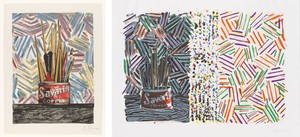
In Savarin (1977), a closely related print made at the same time as the poster, woodgrain comes out from behind the text to stand on its own.17 Here, Johns’s hand-drawn black-and-white rendering revels in the organic nature of the pattern and its contrast to the primary-colored geometric hatchmarks above it. The plank’s strong alignment with the image’s front plane also contrasts with the way the hatchmarks sit back behind the can and brushes. For the book jacket design, Johns also placed Painted Bronze in front of hatchmarks, and again the sculpture sits atop woodgrain, but now with no distinction between a ledge or table edge and a subsection. Instead, woodgrain here describes a receding surface that appears to support the can and brushes, while its loose swirls also suggest the instability of rippling water. These subtle variations show Johns exploring multiple ways to visualize woodgrain: exaggerated versus naturalistic, frontal and autonomous versus perspectival and integrated. Such modifications open divergent paths in Johns’s subsequent work, where woodgrain will attain the status of a full-fledged motif.
The act of drawing woodgrain freehand carries additional significance. Following Johns’s early embrace of recognizable subjects and his rejection of painting as an expression of individuality and interiority, artists such as Andy Warhol and Roy Lichtenstein pushed further in their use of popular imagery and their exclusion of gesture. In the early 1960s, Lichtenstein eliminated all signs of painterly process; Warhol emphasized process, but a mechanical process rather than a hand one. Johns never abandoned gesture, but he drained the Abstract Expressionists’ emotive freight from the touch and tactility of his strokes.18 His evolution with woodgrain from mechanical representation to hand drawing may seem a reversal of the art-historical trajectory of the 1950s and ’60s. But woodgrain, in effect, offered Johns a “handmade readymade”—a familiar subject whose instant recognizability was not compromised by his many invented versions.19 Over the course of decades, Johns has mined this flexibility to explore a wide range of formal and symbolic implications.
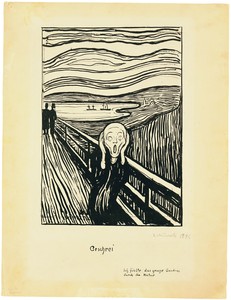
Johns’s receptivity in the mid-’70s to the pattern of woodgrain—a familiar element in an artist’s studio, from pencils and brush handles to stretcher bars and floorboards—may have been enhanced by his evolving interest in the art of Edvard Munch. Johns was familiar with Munch’s paintings and prints and may have had in mind his experimental uses of woodgrain in woodcuts such as The Kiss (1898), where the pattern forms a dramatic but ambiguous environment for the pair of lovers.20 In the print version of his most famous painting, The Scream, Munch used strong black lines and lack of shading to introduce a woodcut aesthetic into the medium of lithography. This cross-pollination of mediums confused his contemporaries, who from the start sometimes misidentified this litho as a woodcut.21 Munch’s bold foregrounding of woodgrain and his embrace of ambiguity may have encouraged Johns at a time of his own experimentation in printmaking, especially given his predilection for visual tricks and double readings.
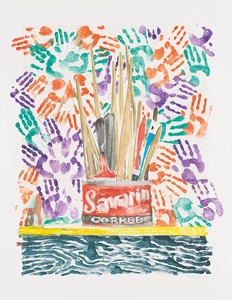
In his next prints using the Savarin-can motif, a pair of monotypes from 1978, Johns made clear his interest in the Norwegian artist by inserting the iconic skeletal arm from Munch’s 1895 self-portrait beneath the image of Painted Bronze, separated by a dark ledge with loosely scratched woodgrain. Commenting later, Johns acknowledged his fascination with Munch’s play with woodgrain: “You don’t really know what the connection between [the pattern in The Scream] and the woodgrain [in The Kiss] is, you don’t know which comes first in his mind. Whether this is because he’s been working with the wood or whether he’s attracted to the wood because it has these forms.”22 Johns’s remark is especially revealing for its focus on creative process, including the subtlety and, ultimately, the unknowability of the mind’s path from one idea, image, or process to the next.
Deepening the Meaning
Over the course of the next decade, Johns would make the pattern of woodgrain ever more visible while extending its capacity for signification. His acts of representation and transformation would bring woodgrain fully into his domain of privileged motifs, with their enigmatic union of clarity and obscurity and their penchant, as Thomas Crow writes, for “perpetual reuse, recirculation, and change over time.”23 A suite of Savarin monotypes from 1982 explores variations on the motif introduced in the Whitney poster—some with a red arm-print and Munch’s initials added to the image of Painted Bronze and the hatchmarks. More than half of these seventeen monotypes include images of woodgrain, ranging from attenuated and ghostly to painterly and conspicuous. One print includes thick brown woodgrain nearly obscuring the red arm-print. In another, where colorful handprints replace the hatchmarks, fluid, brushy strokes of woodgrain surrounding dark, jutting forms recall the stylized evocation of rock and sea in raked Japanese sand gardens.24
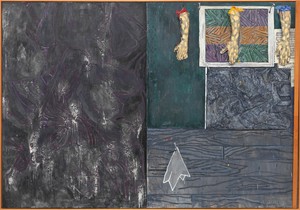
Jasper Johns, Perilous Night, 1982, encaustic and silkscreen on canvas with objects, 67 ⅛ × 96 ⅛ × 6 ¼ inches (170.5 × 244.2 × 15.9 cm), National Gallery of Art, Washington, DC; Collection of Robert and Jane Meyerhoff. Photo: National Gallery of Art, Washington, DC
In the same year that Johns made the Savarin monotypes, 1982, he completed the painting Perilous Night. It introduced a mysterious new image on the left side that was later identified as the flipped and rotated contour of two startled soldiers from the Resurrection panel of the Isenheim Altarpiece (c. 1512–16) by the German Renaissance painter Matthias Grünewald. These figures, who recoil at the sight of the risen Christ, also appear, with their orientation corrected, in a small image on the right side of the canvas that is painted illusionistically to seem nailed to a wall. Above it, three blotchy, grayish cast-wax arm fragments in graduated sizes dangle over a trompe l’oeil crosshatch painting on paper25 and the score of John Cage’s Perilous Night (1944)—a composition Cage linked to danger, misery, loneliness, and terror.26 Altogether these motifs contribute to a new, darker mood in Johns’s work, marked by themes of sex, death, and the cycle of life. Below the small image of the soldiers, wood planks fill nearly the bottom half of the right side. Cartoony in their exaggerated shorthand rendering, the planks are both distinct and confusing. One recognizes them as floorboards, but a dangling handkerchief nailed to their surface suggests an upright orientation. The illusionistic nail’s shadow offers no further clarity.
Johns painted Perilous Night at his home and studio in Stony Point, New York, a converted barn just outside the center of town with a rustic interior of hand-hewn timber posts and beams.27 The wide, vertical barn-board walls, though, don’t match the narrow, horizontal planking of Perilous Night. His East Houston Street studio, however, featured a large open floor with narrow planks, and Johns has confirmed that this floor was the source for the wood-grain pattern in at least one of his paintings from around this time—Fall (1986).28
Reality and Fantasy
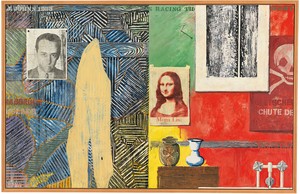
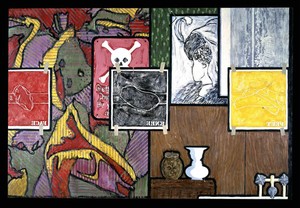
Over the next five years, Johns painted a number of works that did reference his Stony Point home, specifically the bathroom, in a view looking out from the tub. Each of these “bath pictures” includes the tub’s rim and fixtures at the lower right.29 The two paintings that begin the series, both titled Racing Thoughts—a brightly colored encaustic and a grisaille in oil—include the same four images affixed to the wall and door: a puzzle with the face of Johns’s art dealer, Leo Castelli; a reproduction of the Mona Lisa; a Barnett Newman print; and a Swiss avalanche-warning sign. A drooping tan form represents Johns’s pants hanging on the door against a jigsaw-puzzle pattern of bundled hatchmarks. This pattern hides the outline of a fractured image, again traced from Grünewald’s Isenheim altarpiece, but this time from the Saint Anthony panel and focusing on a diseased figure with webbed feet, swollen belly, and large red boils.
The Racing Thoughts paintings have been analyzed extensively for their mysterious references to other artworks, popular imagery, and objects from Johns’s own collection. Rarely mentioned, however, is the presence of woodgrain, which features prominently in many of the bath pictures.30 This near invisibility in the literature is in inverse proportion to woodgrain’s visibility in the images. Yet if decades of scholarly attention have taught us anything about Johns’s work, it’s that nothing there is arbitrary. In relation to the bath pictures, John Yau writes, “We must recognize that the artist’s placement of each ‘thing’ conveys a feeling of urgent necessity, and that for any of these sights (meanings) to become possible everything must be exactly where it is.”31 Woodgrain does not just fill space or neutrally denote a domestic interior; it conveys meanings and associations and undergoes the manipulations and displacements of Johns’s other motifs. In addition, woodgrain often grounds these other elements, lending them both an actual, descriptive basis and a way to measure their departure from the literal.
The horizontal strip behind the vases in the Racing Thoughts paintings represents an actual molding in the Stony Point bathroom. Horizontal and vertical boards on the left sides of the paintings reflect the real wood door and casing. Their grain would have been clearly visible at the time Johns made the paintings—as he recalls, “the bathroom door at Stony Point was not painted when I lived there. I don’t remember that anything made of wood, other than front and back doors, was painted.”32 The Racing Thoughts paintings represent the door’s boards selectively, and seem to shift the molding up from its actual location. But the fact that Johns chose to paint these strips of wood at all attests to his interest in depicting a specific place. Working in tandem with the hamper, ceramic vessels, drooping pants, and tub rim and fixtures, this specificity asserts his Stony Point bathroom as a solid grounding for the shifting phantasmagoria of images on the wall, creating a dynamic tension between real and imagined, or outer and inner, spaces.33
The presence of woodgrain also allows Johns to further the play between figuration and abstraction in the door’s puzzle pattern and its hidden Isenheim figure. In this setting, woodgrain competes, clashes, and causes confusion. Its proximity to the Newman print makes that abstract image read like a close-up of woodgrain or tree bark. And in relation to the puzzle pattern, it’s hard to tell where the woodgrain ends and the pattern’s dense clusters of hatchmarks begin.
Jasper Johns, Untitled, 1984, encaustic on canvas, 63 × 76 ¾ inches (160 × 194.9 cm), The Eli and Edythe L. Broad Collection. Photo: The Broad
Jasper Johns, Untitled, 1984, encaustic on canvas, 50 × 75 inches (127 × 190.5 cm), collection of the artist
Shifting the Ground
Two large untitled bath paintings from 1984 alter the ground on which the images are affixed by moving the woodgrain from the left side to the right. Now the pattern appears in wide vertical planks, which resemble Stony Point’s barn-board walls or the inset panel of the bathroom door. In either case, Johns makes the reference to his home overt, yet also shows the ground as mutable, shifting from left to right. Moving the woodgrain to the site formerly occupied by the smooth wall reflects the way Johns plays fast and loose with all his motifs—rotating, reversing, and recombining them to suit his needs and tease out new meanings.
On further inspection, the wood-grain wall in both of these untitled bath paintings gives way at its upper left to a mottled green area that reveals itself as a field of sperm. Johns had used this motif two years earlier in one of the Savarin monotypes, again reflecting his interest in Munch, who included images of large sperm around the edges of several prints showing the Madonna.34 In Johns’s paintings, it also adds to the unstable nature of the room, as patterns, images, and allusions pile on top of and slide beneath one another, creating a shallow space that shifts back and forth, much like the illusion contained within that flips between a young woman and an old woman as one stares at it. In this context, the familiar, homey pattern of woodgrain anchors the flux, helping it read as a display of images fixed to a vertical surface. The effect recalls Johns’s interest in nineteenth-century American trompe l’oeil paintings by William Harnett and John F. Peto, whose hyperreal assemblages of ordinary household things backed by wood surfaces also create a sense of spatial confusion.
Excerpted from an unpublished essay. Part two will appear in the winter issue of Gagosian Quarterly.
1 Jasper Johns, quoted in Paul Schimmel, “The Faked Gesture: Pop Art and the New York School,” in Donna De Salvo and Schimmel, Hand-Painted Pop: American Art in Transition, 1955–62, ed. Russell Ferguson, exh. cat. (Los Angeles: The Museum of Contemporary Art, 1993), p. 42.
2 Johns, quoted in Edmund White, “Enigmas and Double Visions,” Horizon 20, no. 2 (1977), quoted here from Jasper Johns: Writings, Sketchbook Notes, Interviews, ed. Kirk Varnedoe, compiled by Christel Hollevoet (New York: Museum of Modern Art, 1996), p. 154.
3 Johns, in Peter Fuller, “Jasper Johns Interviewed Part II,” 1978, in Writings, Sketchbook Notes, Interviews, p. 187.
4 Johns saw both patterns from a car—the flagstones on a wall in Harlem, the hatchmarks on a passing car while on the way to the Hamptons. See Michael Crichton, Jasper Johns, 1977 (rev. ed. New York: Abrams, 1994), pp. 52–53, p. 57.
5 Only three authors, to my knowledge, devote more than passing mention to images of wood and woodgrain in Johns’s work: John Yau, in “Jasper Johns’ Preoccupation (Part 2),” The American Poetry Review 35, no. 5 (September/October 2006): pp. 13–17, and A Thing among Things: The Art of Jasper Johns (New York: Distributed Art Publishers, 2008), pp. 159–61, p. 167; Charles W. Haxthausen, in “Translation and Transformation in Target with Four Faces: The Painting, the Drawing, and the Etching,” in Jasper Johns: Printed Symbol (Minneapolis: Walker Art Center, 1990), pp. 72–73; and Scott Rothkopf, “Suspended Animation,” in Jasper Johns: Catenary (New York: Matthew Marks Gallery, 2005), passim.
6 I have not seen this mentioned in the literature but in the screenprint, Johns seems to have replaced the painting’s four casts with the face of the dancer Merce Cunningham. Observation reveals that the faces in the print are not those of the painting and match Cunningham’s features. Johns made the print as a benefit for the Merce Cunningham Dance Company and a poster version was produced for the company’s use, making the insertion plausible, as Rothkopf concurred in an email to the author, February 3, 2022.
7 See Haxthausen, “Translation and Transformation,” p. 72. There is some question, however, whether the wood-grain pattern may result from a photographic rather than a manual transfer process. Shelley Langdale, telephone conversation with the author, April 13, 2022.
8 Johns also made a color lithograph version of Souvenir 2 in 1970, but with almost no discernible woodgrain beyond layering mottled tones of yellow and gray.
9 I previously proposed this as the first instance of simulated woodgrain in Johns’s work, but the current essay revises this history. See John B. Ravenal, Jasper Johns and Edvard Munch: Inspiration and Transformation, exh. cat. (Richmond: Virginia Museum of Fine Arts, and New Haven: Yale University Press, in partnership with the Munch Museum, Oslo, 2016), p. 18.
10 See ibid., and Johns studio, email to the author, December 16, 2014.
11 See Allegra Pesenti, Apparitions: Frottages and Rubbings from 1860 to Now, exh. cat. (Los Angeles: Hammer Museum, 2015), p. 11.
12 See Marjorie B. Cohn, “The ‘Freedom and Extravagance’ of Transfer Lithography,” in Cohn, Touchstone: 200 Years of Artists’ Lithographs, exh. cat. (Cambridge: Harvard University Art Museums, for the Arthur M. Sackler Museum, 1998).
13 What the French refer to as estampage or frottis in contrast to frottage, according to Pesenti; see her Apparitions, p. 12.
14 Johns based the image of the Savarin can and brushes on a 1977 drawing he had made of his sculpture (graphite pencil and crayon on plastic; private collection).
15 See Ravenal, Jasper Johns and Edvard Munch, pp. 12–15, for discussion of the identity of the background painting.
16 Haxthausen discusses woodgrain in the print Savarin, which closely resembles the Whitney poster but lacks the exhibition text, as a sign of temporality. “Translation and Transformation,” p. 72. To my mind, however, he misreads the woodgrain as a table rather than a separate plane from the narrow ledge above.
17 According to Bill Goldston of the print workshop ULAE, they worked on all three Savarin prints at the same time, although the Whitney poster was completed first. See Ravenal, Jasper Johns and Edvard Munch, p. 110 n. 52.
18 See Schimmel, “The Faked Gesture,” esp. pp. 40–49.
19 See David Deitcher, “Unsentimental Education: The Professionalization of the American Artist,” in De Salvo and Schimmel, Hand Painted Pop, p. 109 and passim.
20 See Ravenal, Jasper Johns and Edvard Munch, pp. 18–20.
21 See Ute Kuhlemann Falck, “Idea and Reality: Edvard Munch and the Woodcut Technique,” in Diana Dethloff, Tessa Murdoch, Kim Sloan, et al., Burning Bright: Essays in Honour of David Bindman (London: UCL Press, 2015), p. 243 and passim.
22 Johns, in conversation with the author, June 20, 2014. Quoted in Ravenal, Jasper Johns and Edvard Munch, p. 23.
23 Thomas Crow, “Moving Targets: Change and Renewal in the Art of Jasper Johns,” in Jasper Johns: Drawings 1997–2007, exh. cat. (New York: Matthew Marks Gallery, 2008), n.p.
24 Johns was stationed in Japan for the last six months of his military service, in 1951, and visited again in 1968. In the late 1970s and early ’80s he worked with Simca Press on the Japan-inspired suite of prints titled Usuyuki.
25 The same drawing is seen in In the Studio (1982). See Ravenal, Jasper Johns and Edvard Munch, p. 70, p. 115 n. 149.
26 See David Revill, The Roaring Silence: John Cage, A Life (New York: Arcade, 1993), p. 85.
27 Kirk Varnedoe, Jasper Johns: A Retrospective, exh. cat. (New York: Museum of Modern Art, 1996), p. 320.
28 See Barbara Rose, “Jasper Johns: The Seasons,” Vogue, January 1987, pp. 259–60. In an email to the author on October 27, 2021, Johns confirmed, “The wood pattern in Fall imitated the floor of my Houston Street studio.”
29 Fiona Donovan counts nine paintings and twenty drawings that feature both the bathroom wall and the tub fixtures. Donovan, Jasper Johns: Pictures within Pictures 1980–2015 (London: Thames & Hudson, 2017), p. 269 n. 36.
30 See Yau for the only discussion of the wood planks in the bath pictures that I know of: “Jasper Johns’ Preoccupation,” p. 16, and A Thing among Things, pp. 159–60.
33 Roberta Bernstein notes that all the images and objects in the bath pictures are things that Johns owns, even if they wouldn’t have been seen together in this location and these configurations. See Bernstein, “Seeing a Thing Can Sometimes Trigger the Mind to Make Another Thing,” in Varnedoe, Jasper Johns: A Retrospective, p. 54.
34 See Ravenal, Jasper Johns and Edvard Munch, pp. 40–50, pp. 66–67, p. 77.
John B. Ravenal is an independent curator and art historian based in Cambridge, Massachusetts. He was formerly executive director of the deCordova Sculpture Park and Museum in Lincoln, Massachusetts, and served before that as curator of modern and contemporary art at the Virginia Museum of Fine Arts.