Spring 2026 Issue

Jasper Johns:
Between the Clock and the Bed

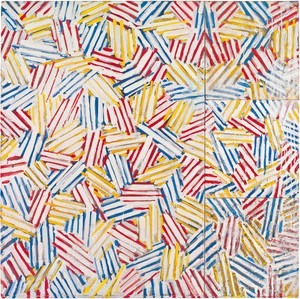
On January 22, Gagosian, in partnership with Castelli Gallery, opened an exhibition of historic works by Jasper Johns at the 980 Madison Avenue gallery in New York. A survey of the crosshatch paintings and drawings that dominated his practice from 1973 to 1983, the presentation united works that have rarely been seen with loans from sources including distinguished American museums. The exhibition commemorates the fiftieth anniversary of this body of work’s debut at Castelli Gallery in 1976. Here, Larry Gagosian speaks with the Quarterly’s Alison McDonald about the impetus for this project, his memories of seeing the exhibition in 1976, and the enduring impact of these paintings on artists and collectors.

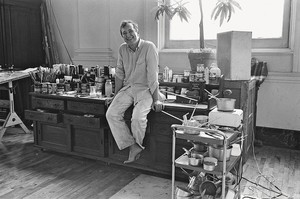
Black and white image of Jasper Johns sitting in his studio

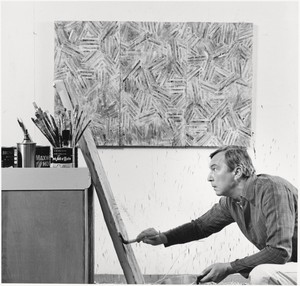
Jasper Johns in his East Houston Street studio, New York, 1973. Photo: © Nancy Crampton

Jasper Johns in his East Houston Street studio, New York, 1973. Photo: © Nancy Crampton

Alison McDonaldWhy mount an exhibition of Jasper Johns’s crosshatch works, and why now?

Larry GagosianFirst of all, because I want to look at them. The crosshatches are one of the most beautiful sequences in Johns’s body of work, and they really bring the complexity of his technique, and of his experimentation with medium and surface, right to the front. They’re physical and it’s confrontational and challenging, and you don’t get that from a reproduction in a book—you need to be with them in the room.

AMAnd how do you think that experience changes a viewer’s perception of the work?

LGIt’s been said before, but this guy can really paint [laughter]. It’s Johns’s processes of working with different materials that really inspire and make him so important to other artists, not just to art history. Richard Serra looked closely at Johns when he was starting out—and you may not think that because of what Richard would go on to create, but Johns’s method of experimentation triggered something in Serra. When Brice Marden was a young artist, he worked as a guard at the Jewish Museum during that early Johns retrospective there in 1964. He stood in the galleries all day looking at Johns’s surfaces, that real, deep looking that artists—and guards—do, and it’s through Johns that Brice discovers the possibilities of encaustic that are so important to his own early works. So bringing a large group of crosshatches together for folks to really see them in all their variety is always going to feel like an important thing to do. To get a new generation of artists and collectors excited.

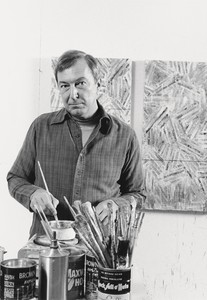
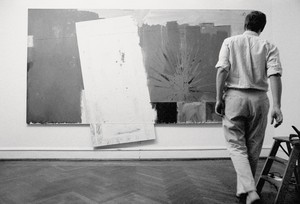
Jasper Johns in his studio, Stony Point, New York, 1976. Photo: © 1991 Hans Namuth Estate, courtesy Center for Creative Photography, University of Arizona

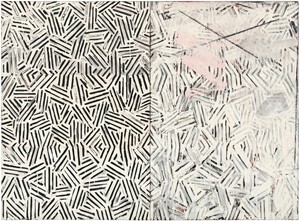
Jasper Johns, Corpse and Mirror, 1974, oil, encaustic, and collage on canvas, in 2 parts (joined), 50 × 68 ⅛ inches (127 × 173 cm), Private collection of David Geffen, Los Angeles. Photo: Jamie Stukenberg, Professional Graphics, Rockford, Ill. © The Wildenstein Plattner Institute, Inc., New York, 2025

AMWhen was the first time you saw the crosshatches?

LGI saw their debut at Leo Castelli’s in 1976. I was lucky: I was dating a dancer in Merce Cunningham’s company and had followed her to New York. I didn’t meet Jasper at the time, but I met John Cage and Merce and got to travel with them—I remember playing chess with Cage on a tour bus when the company was on the road. It was crazy and fun and my real introduction to the art scene in New York.

AMAnd was that your introduction to Leo?

LGNo, I opened my first gallery on Broxton Ave. in Westwood Village in Los Angeles in August of 1975 with a New York–based Castelli artist (Ralph Gibson), so we’d started doing business together. Leo and I just clicked, as the saying goes. He was very open to working with me and we became great friends. Jasper’s show at Leo’s in 1976 was a revelation—not just personally to me, it was a new direction for Johns that nobody expected. It was an exciting moment. The “overall” pattern of the crosshatch moved Johns beyond any association with Pop and showed him addressing both his AbEx predecessors and the minimalist moment of the 1970s at the same time in a shocking, inventive way. He didn’t just know how to paint, he knew how to make a painting do more.

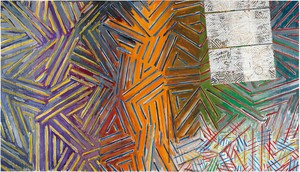
Jasper Johns, Between the Clock and the Bed, 1981, oil on canvas, in 3 parts (joined), 72 × 126 inches (182.9 × 320 cm). Photo: Jamie Stukenberg, Professional Graphics, Rockford, Ill. © The Wildenstein Plattner Institute, Inc., New York, 2025

The crosshatches are one of the most beautiful sequences in Johns’s body of work, and they really bring the complexity of his technique, and of his experimentation with medium and surface, right to the front.

Larry Gagosian

AMSo you worked with Leo as early as 1975, and on this current exhibition you’re still collaborating with Castelli Gallery.

LGBarbara Castelli and Jasper have been close friends for over thirty years. We cocurated this show, and though I’ve known Barbara for a long time, it’s our first time working on an exhibition in this way and it’s been fun. And we have Leo in common, so he’s kind of been present in the background through a lot of this, in a comforting way. Leo debuted the crosshatch works on 77th Street in January 1976, so our exhibition marks the fiftieth anniversary of that show, and it’s great that we get to do it right around the corner.

AMYou opened 980 Madison Ave. in 1989 with an exhibition of Johns’s Map paintings.

LGI did—that was a very difficult show to put together, but in the end, collectors and museums were generous and I was able to open this new space with this extraordinary body of work. It really put my gallery on the map, so to speak . . . [laughter]. In 2026 we’re moving into a brand-new gallery on the ground floor in the same building and winding down operations upstairs, so the crosshatch show feels like a nice bookend in relation to opening with Maps.

Jasper Johns in his studio, Stony Point, New York, 1976. Photo: © 1991 Hans Namuth Estate, courtesy Center for Creative Photography, University of Arizona

Jasper Johns, Untitled, 1975, oil, encaustic, and collage on canvas, in 4 parts (joined), 50 ⅛ × 50 ⅛ inches (127.3 × 127.3 cm), The Eli and Edythe L. Broad Collection. Photo: Jamie Stukenberg, Professional Graphics, Rockford, Ill. © The Wildenstein Plattner Institute, Inc., New York, 2025

AMYou’ve titled the show Between the Clock and the Bed. Why that title?

LGThe crosshatch shows up for the first time as a panel in a multipanel work in 1972, but the first solely crosshatch work was Scent, of 1973–74. It was titled after Jackson Pollock’s last painting, Scent, 1955—so that shows you where Johns was thinking. I owned Pollock’s Scent for many years, lived with it—I bought it from Marcia Weisman, who was Norton Simon’s sister. It’s a common misconception that Johns’s crosshatches were inspired by the Edvard Munch self-portrait Between the Clock and the Bed, 1940–43, but in fact Johns had been exploring the crosshatch theme for years before he encountered the Munch. But when he did, he painted six different versions of a composition inspired by the Munch, and we were able to bring all six together for this show—not an easy feat, as three of them are very large and difficult to lend, but the Museum of Modern Art in New York, the Virginia Museum of Fine Arts in Richmond, and the National Gallery in Washington, DC, have come through for us in an extraordinary way to make this happen. I’ve always felt that for a show like this you really need to dig deep and get as many significant loans as you could possibly get. It’s a once-in-a-lifetime chance to get to do a show like this, and I couldn’t be more thankful to Jasper for his enthusiasm in helping us to realize this exhibition.

Jasper Johns: Between the Clock and the Bed, Gagosian, 980 Madison Avenue, New York, January 22–April 24, 2026

Artwork © 2026 Jasper Johns/Licensed by VAGA at Artists Rights Society (ARS), New York

Black-and-white portrait of Alison McDonald

Alison McDonald is the chief creative officer at Gagosian and has overseen marketing and publications at the gallery since 2002. During her tenure she has worked closely with Larry Gagosian to shape every aspect of the gallery’s extensive publishing program.

See all Articles

Gagosian quarterly weekend reads

Get the best of the Quarterly in your inbox twice a month.

By subscribing you agree to our Privacy Policy.

Fizzles

Fizzles

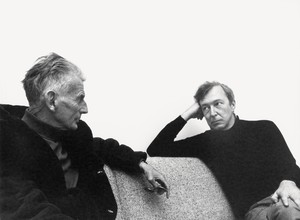
Nearly fifty years ago, Samuel Beckett and Jasper Johns met in Paris and began a collaboration on what would become Foirades/Fizzles, a deluxe limited-edition artist’s book published by Petersburg Press in 1976. Now, on the occasion of the Jasper Johns retrospective at the Philadelphia Museum of Art and New York’s Whitney Museum of American Art, Gagosian Quarterly looks back to the genesis of this project with a conversation between independent researcher Anthony Atlas and Gagosian director Bob Monk. Their discussion focuses on the creative encounter between the artist and the writer and on how the book and related works became a generative source in Johns’s art.

Hidden in Plain Sight: New Discoveries in the Art of Jasper Johns, Part Two

Hidden in Plain Sight: New Discoveries in the Art of Jasper Johns, Part Two

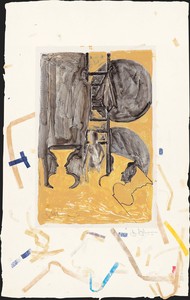
In the second part of a two-part essay, art historian John B. Ravenal considers Jasper Johns’s continued engagement with the motif of woodgrain.

A Living Symbol

A Living Symbol

As American identity once again comes into question during a politically charged election cycle, the Quarterly revisits the motif of the American flag in art. Here, John B. Ravenal contextualizes Robert Lazzarini’s new wall-based flag sculptures and elucidates the tensions they lay bare in the symbol of our nation.

Hidden in Plain Sight: New Discoveries in the Art of Jasper Johns

Hidden in Plain Sight: New Discoveries in the Art of Jasper Johns

In the first part of a two-part essay, art historian John B. Ravenal considers Jasper Johns’s continued engagement with the motif of woodgrain.

Flags

Flags

Gillian Pistell writes on the loaded symbol of the American flag in the work of postwar and contemporary artists.

Jasper Johns: Mind/Mirror

Jasper Johns: Mind/Mirror

Carlos Basualdo, the Keith L. and Katherine Sachs Senior Curator of Contemporary Art at the Philadelphia Museum of Art, and Scott Rothkopf, Senior Deputy Director and Nancy and Steve Crown Family Chief Curator at the Whitney Museum of American Art, New York, spoke with the Quarterly’s Alison McDonald ahead of the opening of the unprecedented collaborative retrospective Jasper Johns: Mind/Mirror to discuss the goals, revelations, and unique structure of the project.

The Generative Surface

The Generative Surface

Eileen Costello explores the oft-overlooked importance of paper choice to the mediums of drawing and printmaking, from the Renaissance through the present day.

Derrick Adams: View Master

Derrick Adams: View Master

On April 16, the Institute of Contemporary Art, Boston, opened the first midcareer survey of Derrick Adams’s multidisciplinary practice. Covering over twenty years of work, the exhibition, titled View Master, brings together the artist’s painting, sculpture, collage, performance, and video, as well as a vibrant new commission created for the museum’s façade. Ahead of the opening, Adams met with Tessa Bachi Haas, cocurator of the survey, to discuss his formative experiences with television, the impact of his work in arts education on his practice, and the importance of taking a more complex, more joyful, and more expansive approach to Black American life and culture.

Engaging with the Past: An Interview with Jenny Saville

Engaging with the Past: An Interview with Jenny Saville

On March 28, a major exhibition of Jenny Saville’s work opened at Ca’ Pesaro–Galleria Internazionale d’Arte Moderna in Venice, bringing together nearly thirty paintings from the 1990s to the present. The exhibition is curated by Elisabetta Barisoni, head of the museums division at Venice’s Ca’ Pesaro, Museo Fortuny, and head of MUVE in Mestre. Saville’s monumental canvases are set in dialogue with the great Venetian artists of the past, creating a unique encounter between contemporary painting and the city’s artistic heritage. Here, the artist speaks with Stefania Ventra, professor with Ca’ Foscari University of Venice, about her early trips to Venice, the radicality of Titian’s painting, and depicting emotional truth.

A Tremendous Generosity: Jeff Koons on Marcel Duchamp

A Tremendous Generosity: Jeff Koons on Marcel Duchamp

Jeff Koons tells Alison McDonald about his appreciation for the pioneering artist and thinker Marcel Duchamp.

Peter Hujar & Paul Thek

The Art of Biography
Peter Hujar & Paul Thek

Andrew Durbin’s dual biography, The Wonderful World That Almost Was: A Life of Peter Hujar and Paul Thek, published by Farrar, Straus and Giroux, tracks the convergences and divergences in the lives of the two artists, from their first meeting in Coral Cables, Florida, in 1956 through their generative romantic and creative partnership in New York, Italy, Fire Island, and beyond. Ahead of the release, Durbin met with the Quarterly’s Wyatt Allgeier to speak about the development of the project, the sublime noncompliance of these two artists, and the motifs of love, death, and rebirth that weave through the telling of their story.

Fashion and Art: Daniel Roseberry

Fashion and Art: Daniel Roseberry

Daniel Roseberry, the creative director of Schiaparelli, met with the Quarterly’s Derek C. Blasberg at the maison’s historic headquarters at 21 place Vendôme, Paris, following the Schiaparelli Fall/Winter 2026–27 ready-to-wear show. Since taking the helm in 2019, Roseberry has been credited with advancing the heritage of the house through unpredictable sculptural designs that carry Elsa Schiaparelli’s Surrealist spirit into a new century. The pair discuss the much-anticipated exhibition Schiaparelli: Fashion Becomes Art, now on view at the Victoria & Albert Museum, London, as well as Roseberry’s early exposures to art, his continued dedication to drawing, and the enduring legacy of Elsa Schiaparelli’s daring vision.