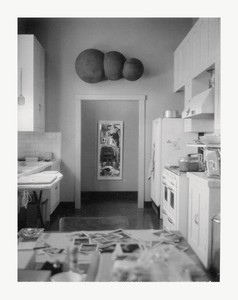
Robert Therrien: The Causal Link to the (Un)Real
In honor of the extraordinary life of Robert Therrien (1947–2019), Aimee Gabbard writes about her time with the artist and explores his lifelong interest in photography.
November 25, 2024
Robert Therrien’s Los Angeles studio is an awe-inspiring place. The artist lived and worked there, dedicating most of the two floors to gallery-style spaces where he would display massive fake beards, larger-than-life folding chairs, plates that towered over the viewer. Open a closet and find the Red Room (2000–2007), a sculpture where every object inside is red—an homage to Matisse. There is a sense of surprise and magic around every corner and an immersion into the thoughtful visual language he created over decades of art making. For the first time ever, his estate presents a collaborative exhibition in this space. Sculptor Isabelle Albuquerque kicks off a series of shows at the studio that place noteworthy voices in dialogue with Therrien’s practice. Here, Albuquerque speaks with Dean Anes and Paul Cherwick from the Robert Therrien Estate about the collaboration.
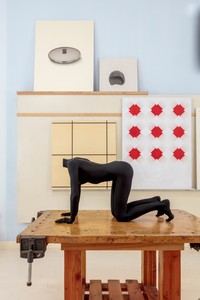
Installation view, Isabelle Albuquerque × Robert Therrien, the Studio of Robert Therrien, Los Angeles, October 26–November 23, 2024. Artwork, front to back: © Isabelle Albuquerque; © Robert Therrien/Artists Rights Society (ARS), New York
Installation view, Isabelle Albuquerque × Robert Therrien, the Studio of Robert Therrien, Los Angeles, October 26–November 23, 2024. Artwork, front to back: © Isabelle Albuquerque; © Robert Therrien/Artists Rights Society (ARS), New York
Dean AnesWe are sitting at the kitchen table in Robert Therrien’s studio in downtown Los Angeles. A space he built for himself 35 years ago. This was the location for many of my conversations with Robert over the years, and now I am speaking with you, Isabelle. You first visited early in the pandemic lockdown; you were part of a small group of people, and it was wonderful to have people here again, to share the space. I remember that you really responded strongly to it. Can you share some of what you were thinking and feeling?
Isabelle AlbuquerqueWhen I walked into the studio I was immediately quite moved. I’ve always loved visiting artist’s studios and homes. Some of my favorite places are the Frida Kahlo and Diego Rivera home and studio in Mexico City, as well as Luis Barragán’s home there. I had often wished that Los Angeles had a similar tradition of honoring where our artists live and work, so I was excited that all along this place had been here . . . just waiting to be stepped into. As I walked through Robert’s working space and the upstairs galleries, I found myself flooded with memories and have since learned and witnessed that this is an experience that many people feel when they come here. It’s a very generous place and acts almost as a portal. In some ways, the space itself is a sculpture.
DAPaul and I were struggling to figure how we could open up the studio to other artists in a way that felt right and respectful. It took us a while to get here, and we’re so glad that it all came together and that the first artist to share artwork in the space is you. We even took it further than that and played with the idea of using some of Robert’s collections of things—the many, many tables that he has, the carts, the chairs and stuff that were near and dear to him—in the exhibition. These quintessential hero pieces were an inspiration for so much of his artwork; it felt good to include them.
Paul CherwickThe table that we’re sitting at is in fact the table that was an inspiration for Bob’s large Under the Table (1994) sculpture in the Broad Collection. Bob had taken a series of photographs under this table before creating that sculpture, and you’ve said that your work has sometimes been inspired by photography.
I wanted to know each material like I know my own hand . . . to be in relationship with it. Therrien was doing something similar—a devotional process, almost spiritual.
Isabelle Albuquerque
IAI think one of our first conversations was about different sculptors’ relationship to photography. I learned that both Robert and I were influenced by Brancusi’s photographs of his own sculpture as a way of looking and understanding form. When I begin work on a sculpture, I set up a mirror and a camera, and I use this kind of looking to find the form or gesture. It’s a process akin to rehearsal or choreography where I photograph myself in states of transformation (often for many months) before beginning any material investigations. It was inspiring to learn that Robert also used a camera to find some of his works and a pleasure to get to spend time with his photo archive. I had not seen many of the Polaroids before this, and I too have a deep archive of photography that I don’t usually show but that influences how my sculptures become themselves.
DACan you speak a little bit about the materiality of your work?
IAWell, Therrien was such a material fetishist, right? Me too. I feel so connected to material. My early work was all in performance; I was really only interested in ephemeral work. I didn’t like objects. But then my family’s house burned in a fire, and we lost all the art objects from our matriarchal line of four generations of artists: the objects of my great-grandmother, my grandmother, my mother, and my sister. After the fire, I had a completely different relationship to materiality. One of the few things that survived the flames were these three bronze heads. When I started the Orgy for Ten People in One Body series (2019–), that was the first material language I engaged. Thinking through time and degradation, the materials evolved, and ultimately I worked with bronze, plaster, wood, rubber, flocking, resin, human hair, patinated bronze, and wax. I felt like I was breeding my body with the bodies of trees or the wax of bees. I wanted to know each material like I know my own hand, like I know my own leg—it was a kind of transmutation where I would work with my own body and then transmute it to that material and go through many processes to try and understand the material in my body—to be in relationship with it. Therrien was doing something similar—a devotional process, almost spiritual. That’s a weird thing to say, but seeing all the Shaker architecture that he’s incorporated into this space, when you work with material in this way, it gets to this meditative, transcendent space without answering any questions, without saying anything but by feeling it.
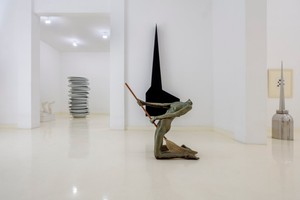
Installation view, Isabelle Albuquerque × Robert Therrien, the Studio of Robert Therrien, Los Angeles, October 26–November 23, 2024. Artwork, front to back: © Isabelle Albuquerque; © Robert Therrien/Artists Rights Society (ARS), New York
DAWhat were you thinking about when bringing your sculptures to a space that Robert built for himself?
IAThis is a really sacred space, and Therrien only passed recently. You can feel that, too. So I was nervous to bring any work in, honestly. But then as we got to know each other, as I got to know the works more, I kept saying to myself, “Did I make this work thinking about him?” Because it’s so deeply connected. Sometimes it’s almost like the two works complete each other. There are a lot of similar themes—the witch hat, for example, a super-heavy symbol, but both of us are working to reduce it to something more open.
PCI see similarities in both of you as artists being so consummate with your work. He was thinking about it constantly, and spending time with you, you’re completely engrossed in all of the work, the same way that he was, and living with it and working amidst it. Bob kept some aspects of his pieces vague to interpretation, and your pieces seem like they could possibly be direct, but there’s a lot of other connotations that could arise as a viewer spends time with them.
IAAbsolutely. That his bed is in his studio, my bed is also in my studio—I often sleep with my works for months to get to know them and to see what else they need. I like to fall asleep seeing them so that when I wake up, I know what to do next.
DAYeah, this was a very active space at night. Paul and others would leave work, and all kinds of creating would happen late at night, in a solitary way, which is something I feel you can relate to as well.
IAYeah and the life that’s in each sculpture. For my deer sculpture, I went full Method on it: I ate deer food; I lived in the deer meadow; I slept in caves. I was becoming a deer to make that piece. And hopefully no one’s thinking about that when they look at it, but you feel it a little bit. And I think, similarly, when he slept with those forms, at least with those clouds above the bed, you know, it’s totally integrated with his life. He’s putting so much in, but there’s so much reciprocity—we spoke about this earlier in the process, but how he had all the works untitled leaves so much space for the viewer to enter. And that’s really what I felt working with you guys and working here—reciprocity.
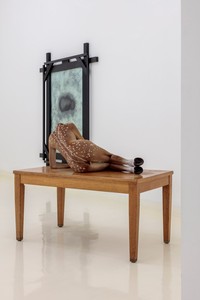
Installation view, Isabelle Albuquerque × Robert Therrien, the Studio of Robert Therrien, Los Angeles, October 26–November 23, 2024. Artwork, front to back: © Isabelle Albuquerque; © Robert Therrien/Artists Rights Society (ARS), New York
DAI’m curious about the decision to make small figures. Robert had his large pieces and the mini pieces, and scale was so important to him. It’s a key factor of experiencing the works. You started with life-sized figures, and now you’re making various-sized pieces. Was it a natural progression for you?
IAA couple of different things. With the half human scale, which is the scale of two of the figures that I made for this show, I was thinking of relics and why one would make a sacred object small. Wouldn’t you want to revere something big? But when something’s small it’s more vulnerable. It’s almost like a child. And so you look at it in a protective way and have a completely different relationship to it. Its vulnerability in turn allows your own. I’m also exploring acceptance of the body, so there is something in a size where you can see everything at once. It’s almost like when man went to the moon, and we looked back and saw the pale blue dot; you could see the whole planet. There’s something interesting in being able to take in a whole form, at least from the front, in one glance. And scale does that. And I find miniature and scale—there’s something erotic in it, in the transformation.
PCBob said that one of his smallest pieces, which is a keyhole that he would hang on the wall—
IALove that piece.
PC—he would always consider that to be his most monumental scale piece because it was blown up in scale versus a real keyhole. Its expansion was much larger than the large tables or chairs or the pots and pans or the stacked plates. There was a comedy to it, too. You both have humor and maybe even a dry or wry humor in the work that is an under layer. But you also both have this comfort with the preposterous [laughter]. Do you think of it that way? Some of the things being out of this world?
IAI think comedy is the highest art form, for sure. I love Duchamp for that, you know—who doesn’t? That’s the best way to [claps] trigger your brain into something else. And I don’t think of it as totally preposterous . . . I mean, it’s pretty funny to ride a broom. But it’s also not [laughter]. A lot of the reason I try to make the work so realistic and precise is so that you can imagine your wildest desire or dream becoming a reality. And the body is also just fucking funny [laughs]. There’s no way around it. It’s a mess, and you can’t speak about it without laughing. And humor helps defuse the assumed power in anything. If you make someone laugh, it flattens out the power. It goes from up-and-down hierarchical power to extended left-and-right power. You don’t laugh alone.
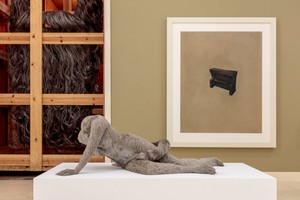
Installation view, Isabelle Albuquerque × Robert Therrien, the Studio of Robert Therrien, Los Angeles, October 26–November 23, 2024. Artwork, front to back: © Isabelle Albuquerque; © Robert Therrien/Artists Rights Society (ARS), New York
DAEverybody’s in on the joke.
IAEveryone’s in on it. It’s so much more generous to be funny. And I feel that way in his work, too—it’s very generous to get the joke and the wink. We’re both working in Hollywood, and it’s hilarious: the façade, the costumes, all of it. And then of course the humor can help balance the sadness.
DAOne of my favorite parts of this whole experience has been marrying your works with some of Bob’s artifacts: the tables and the carts and chair. It was incredible to see how some of your works charged each other when they were brought together. To see your deer on one of the Gunlocke tables and have it sit there so perfectly and comfortably and just hum. To see your on-all-fours figure, the rubber figure, perched up on the banged-up workbench that could be a hundred years old, for all we know, and has so much history. The surface has a story to tell on its own, and now it has this hovering black figure, like a deity to be worshiped. Did you enjoy the process of taking away what you had established as your beds and pedestals and considering another way to present your works?
IAThat was one of my favorite parts, too. I always want the work to feel alive, so putting it in the living parts of the studio did that. But I also have a very specific thing about beds and tables. I don’t tend to feel turned on by sculpture with women’s bodies under tables. I remember even when I was little it would drive me crazy that so much of sculpture is not from the perspective of the woman, that it was never from inside out; it was always outside in. But I don’t feel like that with Therrien’s tables. His tables are not about power. They seem to me to be about wonder. So to combine the female figure with beds and tables that are about wonder and opening and new kinds of perspective—it was totally thrilling. It kind of broke something in my mind—like a good joke would. When we first put one of my sculptures on one of Robert’s tables, I could hear singing. I hear singing a lot when I’m here.
Photos: Joshua White
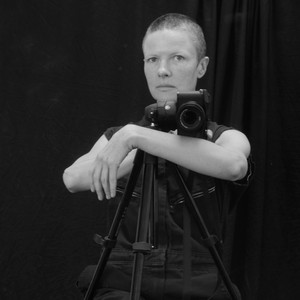
Isabelle Albuquerque’s formally powerful and psychologically charged sculptures probe the multivalent nature of identity, desire, and embodiment. In her series, Orgy for Ten People in One Body (2019–), she reimagines the nude to create a kind of feral art-historical timeline where women imagine themselves. A 450-page monograph on the series that includes conversations with the artists Miranda July and Arthur Jafa was released in 2023.
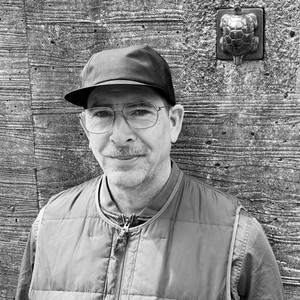
Dean Anes is the codirector of the Robert Therrien Estate. He previously worked at Gagosian, Beverly Hills, where he worked with Therrien and other artists for over a decade. In 2001, Anes arrived in Los Angeles, where he began working with regional artists, focusing on the work of contemporary sculptors.
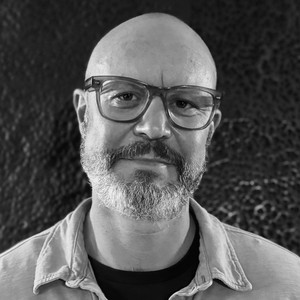
Paul Cherwick is the codirector of the Robert Therrien Estate. Prior to the artist’s passing in 2019, Cherwick worked closely alongside Robert Therrien for seventeen years, overseeing Therrien’s studio and coordinating fabrication of the artist’s work.
In honor of the extraordinary life of Robert Therrien (1947–2019), Aimee Gabbard writes about her time with the artist and explores his lifelong interest in photography.
The Fall 2019 issue of Gagosian Quarterly is now available, featuring a detail from Sinking (2019) by Nathaniel Mary Quinn on its cover.
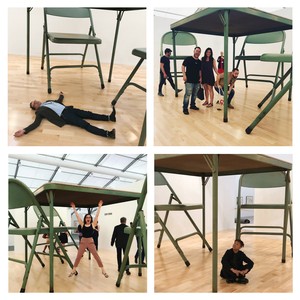
Robert Therrien’s investigations of form, perception, and subjectivity often isolate recognizable elements and objects from everyday life. Blake Gopnik challenges the traditional readings of transformation and the purpose of scale in Therrien’s No title (folding table and chairs, green).

Alexander Wolf discusses the recurring themes and symbols that have emerged throughout Robert Therrien’s artistic career.
Ahead of Alex Israel’s exhibition of four new Fin sculptures at Gagosian, London, the artist spoke with Susan Casey, author of The Wave: In Pursuit of the Rogues, Freaks, and Giants of the Ocean (2010), about the ocean, surfing, and Los Angeles.

On April 16, the Institute of Contemporary Art, Boston, opened the first midcareer survey of Derrick Adams’s multidisciplinary practice. Covering over twenty years of work, the exhibition, titled View Master, brings together the artist’s painting, sculpture, collage, performance, and video, as well as a vibrant new commission created for the museum’s façade. Ahead of the opening, Adams met with Tessa Bachi Haas, cocurator of the survey, to discuss his formative experiences with television, the impact of his work in arts education on his practice, and the importance of taking a more complex, more joyful, and more expansive approach to Black American life and culture.

Jeff Koons tells Alison McDonald about his appreciation for the pioneering artist and thinker Marcel Duchamp.
The Singular Experience at Gagosian’s Le Bourget gallery is the largest exhibition of Walter De Maria’s work in France in several decades. Organized by Donna De Salvo, senior adjunct curator at Dia Art Foundation, the exhibition marks the first time De Maria’s final sculpture, Truck Trilogy (2011–17), is being shown outside of the United States. Here, De Salvo speaks with artist Lucy Raven about her evolving kinship with De Maria and more.
Ed Ruscha sits down with the author and explorer Erling Kagge to discuss existence.
Following the debut of her Fall/Winter 2026 collection at Dia Chelsea, New York, Ulla Johnson met with Sarah Godfrey to discuss her recent collaborations with the Helen Frankenthaler and Lee Krasner foundations, her upbringing in and dedication to New York City, and her nonhierarchical approach to collecting.
Andrew Durbin’s dual biography, The Wonderful World That Almost Was: A Life of Peter Hujar and Paul Thek, published by Farrar, Straus and Giroux, tracks the convergences and divergences in the lives of the two artists, from their first meeting in Coral Cables, Florida, in 1956 through their generative romantic and creative partnership in New York, Italy, Fire Island, and beyond. Ahead of the release, Durbin met with the Quarterly’s Wyatt Allgeier to speak about the development of the project, the sublime noncompliance of these two artists, and the motifs of love, death, and rebirth that weave through the telling of their story.

On March 28, a major exhibition of Jenny Saville’s work opened at Ca’ Pesaro–Galleria Internazionale d’Arte Moderna in Venice, bringing together nearly thirty paintings from the 1990s to the present. The exhibition is curated by Elisabetta Barisoni, head of the museums division at Venice’s Ca’ Pesaro, Museo Fortuny, and head of MUVE in Mestre. Saville’s monumental canvases are set in dialogue with the great Venetian artists of the past, creating a unique encounter between contemporary painting and the city’s artistic heritage. Here, the artist speaks with Stefania Ventra, professor with Ca’ Foscari University of Venice, about her early trips to Venice, the radicality of Titian’s painting, and depicting emotional truth.