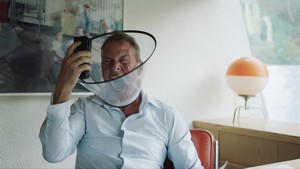
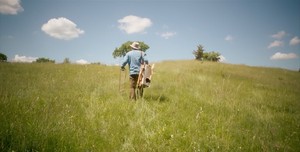
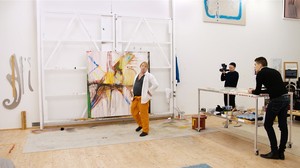
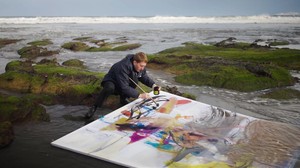
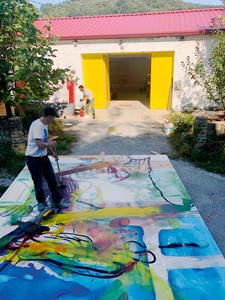
Still from The End (2025), a film by Albert Oehlen and Niklas Weise
Still from The End (2025), a film by Albert Oehlen and Niklas Weise
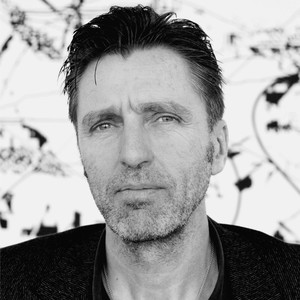
Max Dax is a German writer who investigates art, music, and pop culture. As editor-in-chief of the magazines Alert, Spex, and Electronic Beats, Dax has shaped pop journalism in Germany for more than three decades. His first novel, Dissonanz, was published in the spring of 2021.
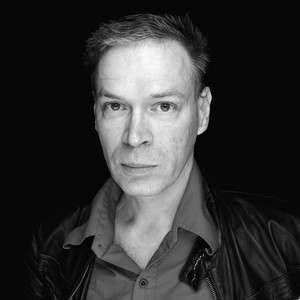
Albert Oehlen’s oeuvre is a testament to the innate freedom of the creative act. Through expressionist brushwork, surrealist methodology, and self-conscious amateurism he engages with the history of abstract painting, pushing the basic components of abstraction to new extremes. Photo: Oliver Schultz-Berndt
Max DaxYou began directing films in 2021 and have since completed four films about painting. Does this expand your range of expression?
Albert OehlenFirst, I wouldn’t describe myself as a director. I’ve received a lot of help, particularly from Oliver Hirschbiegel. He was the codirector of the first two films and Niklas Weise was the codirector and cameraman on The End [2025]. Over the years, people have repeatedly inquired if they could make a film about Albert Oehlen—a portrait of the painter. I’ve seen countless portrait films about other painters and almost all of them have been terrible. They’re just as bad as all those films about musicians where fellow musicians are asked why the master is so important. These generic productions are usually only watchable because of the subject’s charm. I enjoy archive footage of Nina Simone because I simply can’t get enough of her. So that was the starting point. I wanted to make a film that would allow me to turn down future requests: “Sorry folks, there’s already a film!”
MDIt seems as though you’ve essentially made the same film four times, sometimes even using the same lines of dialogue, while you’re portrayed by different actors: Udo Kier, Ben Becker, Nichole Galicia, and your daughter, Maya. Is this comparable to your work as a painter, where you explore an idea through a series of new canvases, knowing that none of them will be the final piece but that the process will always continue?
AOThat’s correct. The film Der Maler [The painter, 2021] has two levels of text: the dialogue and the off-screen narration by Charlotte Rampling. I swapped these two scripts to make a new one that I used for Bad Painter [2025]. I even thought about whether I should give the different films the same title, without “Part One” and “Part Two.”
MDIt seems that you discovered during the filming and editing process just how radically a narrative can be presented in a film. Your films are certainly becoming increasingly deconstructed.
AOThat’s mainly because of all the ideas that come to me while I’m filming and editing. I don’t plan much. My films are dominated by the impulse to pack in everything I can think of about painting. However, I see this more as rambling, and I’m less interested in conveying concrete information in a didactic way. It starts with the fact that there are always two image levels: the movie screen and the canvas on which the painting is painted.
MDIn fact, your films demonstrate how paintings can be created. As [Gilles] Deleuze and [Félix] Guattari would say, you open up access to mille plateaux.
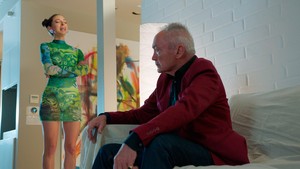
Still from Bad Painter (2025), a film by Albert Oehlen
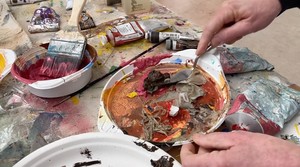
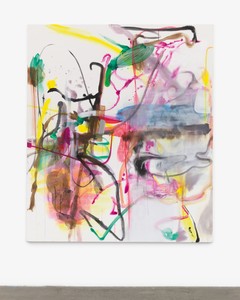
AOI must interrupt you there! These films might give people access to me and my paintings; perhaps they do. But other painters work differently. I’m not putting on a show by painting a picture in front of the camera. Picasso already did that; [in Paul Haesaerts’s Visit with Picasso, 1949,] with great skill, he creates elegant lines on a glass pane with grand, smooth gestures, a beautiful drawing seemingly emerges from nowhere, and when the masterpiece is complete, there is a sense of triumph. In The End, however, Nichole Galicia shows no love for the material or desire to show off her skills. You watch her paint the whole time, and suddenly a painting of mine, a painting by Albert Oehlen, appears. After seeing one idiotic painterly gesture after another, you can’t help but ask yourself as a viewer: Where did that beautiful painting come from?
MDIn The End, the question of when and whether a painting is finished is constantly discussed and debated.
AOIn fact that’s the question I’m most often asked by nonprofessionals: “How do you know when a picture is finished?”
MDThey don’t ask where you put the first brushstroke?
AONo, the question of the end appears to be much more significant than that of the beginning—which is completely justified, by the way. Of course there’s no reasonable answer to the question, but that’s exactly what I find exciting, and since the question obviously preoccupies everyone, it was a nice topic for a film. In the film, the painting is cursed because it’s not and will not be finished, and people eventually go crazy and die in droves.
MDYou say you’ve incorporated all your thoughts about painting over the years into your films. Were these the same ideas that you tried to convey to your students when you were a professor at the Kunstakademie in Düsseldorf? Or is it only through the films that your former students will learn the truth about you?
AOThis deconstructive approach was also reflected in what we did in class. At the academy we didn’t paint; we only spoke about art. When paintings were shown, nobody said what was “right” or “wrong” about them or their style; instead, we discussed what we saw. This naturally led us to consider what a painting is meant to be—in the sense of an attitude. You acquire an understanding of the pictures through a process of discussion.
MDThrough reflection and deconstruction.
AOYes. This is particularly evident in Der Maler, in which Ben Becker plays me and makes a painting. I had a canvas next to him, I painted and made comments, but you can’t see or hear me. His job was to repeat my brushstrokes and comments. I also encouraged him to add text and whatever entered his mind.
MDSo that’s where Becker’s seemingly endless monologues come from.
AOExactly. He copied what I painted and repeated what I said. At times he ignored me and said something completely different, adding things and improvising. On the canvas, though, I was able to maintain control of the painting he was creating as I could always react to what he had just painted. By the end, I had reduced the instructions to such an extent that he only had to paint a final black dot, and he could do that just as precisely as I would have.
MDUltimately, however, the documentary turned out to be highly cinematic. It became a feature film that has the look and feel of a documentary film.
AOExactly! That’s how it developed, but purely by chance. I happened to bump into Oliver Hirschbiegel, whom I studied with in Hamburg. I told him about the project, he came to take a look, and he ended up directing the shoot. I wouldn’t have known how to direct a camera crew. While editing, he realized that it was actually a film. I hadn’t noticed.
Still from Geel (2023), a film by Oliver Hirschbiegel and Albert Oehlen
MDBut why did you let an actor portray you when you yourself could have been the one painting?
AOI don’t want to be on camera. I’m not a good performer or speaker and I’m certainly not an actor. I find it more entertaining to watch someone else paint. I created my own avatars to entertain myself. This applies not only to Ben Becker but also to Udo Kier and all the films I make. Above all, I want to be entertained.
MDWas Becker your first choice to impersonate you? He embodies everything you’re not. He doesn’t just look different from you; in terms of temperament, he’s also completely different from the Albert Oehlen I know.
AOThat’s exactly right—it was just this dissimilarity that sparked the idea. I laughed out loud at the thought of him playing me, but that’s just why I eventually wanted him to do it. Someone told me: In a mathematical sense, Ben Becker is the absolute opposite of me. But many people tend to believe what they see on screen. In Venice he was repeatedly approached by people who had seen the film and thought he was Albert Oehlen. Others who have seen Der Maler now think I’m an asshole.
MDThat’s the power of film. The power of illusion works both ways. How did you manage to persuade Udo Kier to appear in Bad Painter?
AOAt some point, a long time ago, Udo said something to me like, “If you ever make a movie . . .” When I had the idea for Bad Painter I thought of him.
MDUnlike Der Maler, Bad Painter is no longer what you might call a “chamber piece.” Real locations and complex camera movements are now part of the film’s fabric. Los Angeles serves as the backdrop and the film features restaurant scenes and car rides. These elements contribute to the film’s elaborate nature.
AOI didn’t find it particularly elaborate: Everything fits together effortlessly. Udo Kier is great, of course, and he’s closely connected to the art world. He’s been friends with artists his entire life: David Hockney, Sigmar Polke, Andy Warhol, and Michael Buthe.
MDDoes painting still hold any secrets for you? Does the blank canvas intimidate you?
AOIt doesn’t intimidate me. Right from the start, as an art student, I asked myself why I had this particular selection of colors in front of me. Why do I have this brush in my hand? Why am I looking for a motif? Even with my first painting I had these analytical and hard-boiled thoughts that were far removed from any artistic romanticism. There was no particular motif close to my heart that I wanted to paint, nor was there a style I wanted to explore or worship. There was nothing. My relationship with painting was ice cold. I approached my work without feeling or love for the material or the medium. But I loved art. If I have a love for painting today, it’s something that’s developed over time, as I’ve become more and more immersed in it.
MDAlthough many of the scenes in your four films seem ironic, abstract, or exaggerated, you demonstrate the processes involved in your work as a painter, the chemicals and materials you use, and the techniques and methods you employ. You also hint at the reasons behind your painterly decisions, even though your avatars may execute them differently from the way you would have.
AOYes, but this is all nonsense. The precise point of these films is that the actions I perform are utter nonsense. They’re permitted, but at the same time they’re the most absurd thing. All these actions once again point to the fact that a painting is created in the mind. This is particularly evident in the first film with Ben Becker—it’s as if the film itself were proof of this.
Still from Der Maler (2021), a film by Oliver Hirschbiegel and Albert Oehlen
My films are dominated by the impulse to pack in everything I can think of about painting. However, I see this more as rambling, and I’m less interested in conveying concrete information in a didactic way.
Albert Oehlen
MDNevertheless, you reveal a little of the secret to your painting technique. Is it easier to copy or imitate your work now?
AOI doubt it. And if I think more about it, I would strongly disagree with you on that. I do my paintings entirely in my head while sitting on the sofa looking at the canvas, analyzing what I see and planning the next move. No film, no matter how ambitious, can deliver that. Instead, what’s shown is parodies of painting techniques. Der Maler features grotesque painting scenes that are pure slapstick. I might paint like this, and I have done, but what you see doesn’t explain anything.
MDAre you talking about this recurring scene when the painter is making repeated circular movements with his brush over an area the size of a postage stamp, insisting on continuing to paint this spot, as if it will change the picture?
AOWhat’s shown is an act of painting that’s disconnected from what could be called “purposeful” painting, where the picture visibly changes through the application of paint to a white space, creating a brushstroke where there was nothing before. But it’s actually very interesting to paint in the same spot because something definitely happens. Something unpredictable. Much more so than if you were to paint a random phrase in a blank space. In my opinion this raises new questions: Is the painter still painting? Or is he caught in a loop from which he can’t escape? As with humor or jokes, it’s about reaching a realization, about seeing or knowing something you didn’t before. You want to see something new. Art is thus akin to a joke whose punchline has the potential to unsettle you.
MDYour films are all about language. Does language come before the image?
AOI write a lot of text, some of which is then incorporated into the film as dialogue. By the time I start filming, I might have filled six A4 pages with text. I hold the sheets of paper in my hand and look from idea to idea to see how I can implement them. Often it’s not even clear who will deliver a piece of dialogue, or whether it will be spoken at all or read aloud off-screen afterward. Those decisions are made in the moment.
MDIs the line in Der Maler where Becker says “Painting is like kicking children around” improvised?
AOThat’s a quote from Markus Lüpertz. It was part of the notes I made on painting for the film.
MDYou appear at the end of the same film as a golden avatar, positioned on an altar in a church, resembling a character from a video game. It becomes clear at that point that nothing is real—it’s just a film. In Bad Painter you take it a step further: You can be heard giving orders and directions to Udo Kier out of shot.
AOYes, but that wasn’t planned either. We only realized how well it worked while we were editing.
MDIs filmmaking similar to painting, then?
AOIn my case, yes, in the sense that the film demonstrates the artist’s approach to the artwork as a mental process involving viewing, understanding, classifying, judging, and evaluating. This applies regardless of whether you’re in front of the canvas or the editing screen.
MDIt seems as though you limit your resources to what’s feasible. Is this comparable to selecting a few tubes of paint from a range of thousands to create your own palette?
AOThe colors! Oh yes, I could talk about those for hours. For me there’s clearly freedom in limitation. Limitation always sparks new ideas. Everything becomes much more interesting as a way of compensating for something or bridging a gap. In filmmaking in particular, I often realize after shooting a scene that I couldn’t have written it the way I filmed it. It would have been more banal.
MDIn Bad Painter the protagonist drives around LA beating up fellow painters. Is this a metaphor for a ruthless art world?
AOThere’s this cliché that artists are antisocial. Mike Hentz, who I studied with, once turned this into an art performance: He would pick artists from the telephone book and then lie in wait to slap them in the face. It was real. And it was funny. This is also addressed in the film: A woman asks Albert Oehlen why he hits artist friends whose work he likes. He replies, “The bad ones don’t deserve it.”
Still from The End (2025), a film by Albert Oehlen and Niklas Weise
I don’t want to be on camera. I’m not a good performer or speaker and I’m certainly not an actor. I find it more entertaining to watch someone else paint. I created my own avatars to entertain myself.
Albert Oehlen
MDIn The End the protagonists sometimes engage in truly absurd conversations. Is this also your way of dealing with the absurdity of the wildly overexcited art world?
AOI very much enjoyed writing the scene in which the gallery owner dies during the sales pitch with a “cone of shame” around his neck.
MDFilmmaking in general can be very time-consuming. One could argue that a lot of time is lost that could have been spent on other activities, such as painting a new picture.
AOThe End involved the least work of all the films so far; it felt more like a holiday.
MDHaving shot and edited four films in the past few years, I can imagine that it’s gotten easier for you to immediately sense whether something happening in front of your eyes could fit into your film or not.
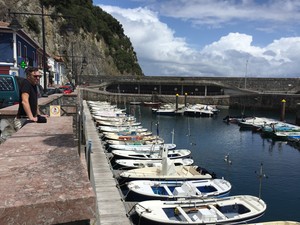
AOThat’s true. While we were filming in the Basque country, a painting competition took place. Suddenly we saw painters from all over the village at work. We had our equipment with us, so we filmed it and edited the scenes into the story. For instance, it seemed obvious that the instructions for the painting competition should be broadcast over loudspeakers set up around the area. We filmed whatever came our way. If the images fitted they became part of the story. It was also during editing that the idea that Nichole Galicia should not actually be me but should merely assume my identity came to us. Until then I’d thought it would be more radical if she simply played me as a woman, but I later decided that it was even more radical for her to assume my identity because it was more realistic and therefore more poignant. And suddenly I recognized myself. I would have been capable of calling myself Polke, even though the real Sigmar Polke taught at the academy just a few kilometers away. Of course that’s a ridiculous presumption, but presumption creates friction.
MDNow that you’ve finished The End, has your series of films about painting come full circle? Or is the subject so open and broad that you could shoot a fifth part at any time?
AOI don’t see the films as parts of a series, but I think it’s possible that I’ll be inspired to make another one at some point. Any new film would again have to be about painting, of course, otherwise it wouldn’t make sense. Apart from that, I’m neither a storyteller nor a filmmaker, nor do I aspire to entertain an audience or sell my films. If that were my goal I’d have failed miserably four times already. But in my films as in my paintings, I’m only accountable to myself.
Max Dax is a German writer who investigates art, music, and pop culture. As editor-in-chief of the magazines Alert, Spex, and Electronic Beats, Dax has shaped pop journalism in Germany for more than three decades. His first novel, Dissonanz, was published in the spring of 2021.
Albert Oehlen’s oeuvre is a testament to the innate freedom of the creative act. Through expressionist brushwork, surrealist methodology, and self-conscious amateurism he engages with the history of abstract painting, pushing the basic components of abstraction to new extremes. Photo: Oliver Schultz-Berndt