Marcel Duchamp resisted categorization and embraced self-contradiction. Fascinated by themes of time and motion, eroticism, and technology, he was not only an artist, but also an art advisor, curator, conservator, inventor, writer, and chess master. While exerting a critical, enduring, and frequently provocative influence on avant-garde tendencies, from Cubism, Dada, and Surrealism to Pop art, Minimalism, and Conceptual art, he was fond of referring to himself as simply a respirateur (“breather”), his epitaph reading “D’ailleurs, c’est toujours les autres qui meurent” (“Besides, it’s always the others who die”).
Duchamp was born in Blainville-Crevon, France, in 1887, and died in Neuilly-sur-Seine, France, in 1968. His brothers Jacques Villon (1875–1963) and Raymond Duchamp-Villon (1876–1918), and sister Suzanne Duchamp (1889–1963), were all also artists. Duchamp studied art at the Académie Julian from 1904 to 1905—though he preferred playing billiards to attending classes—then undertook compulsory military service, working for a printer in Rouen, where he learned typography and printing processes. He moved between France and New York repeatedly, finally settling in the United States in 1942 and working in New York thereafter.
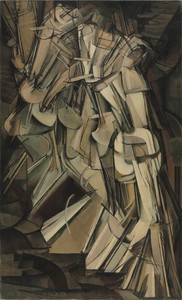
Duchamp began his artistic career by painting family portraits and local landscapes, later producing portraits and imagined scenes in a quasi-Fauvist manner. He first exhibited in 1909 at the Salon des Indépendants and the Salon d’Automne in Paris and moved to the French capital in the early 1910s, settling on a Cubist style characterized by machinelike interpretations of the body that is evident in such paintings as Nude Descending a Staircase (No. 2) (1912), whose abstract form and erotic theme scandalized New York’s Armory Show in 1913.