A Tremendous Generosity: Jeff Koons on Marcel Duchamp
Jeff Koons tells Alison McDonald about his appreciation for the pioneering artist and thinker Marcel Duchamp.
Installation view
Photo: Zarko Vijatovic
Installation view
Photo: Zarko Vijatovic
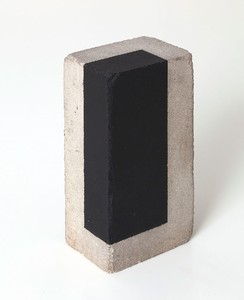
Carl Andre
Untitled, 1965
Concrete, 5 ⅞ × 5 ⅞ × 3 ⅞ inches (15 × 15 × 10 cm)
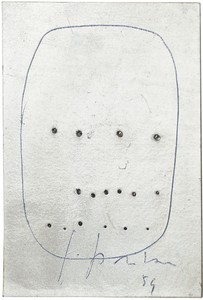
Lucio Fontana
Concetto spaziale, 1959
Pens on perforated silver foil mounted on gold foil backing, 4 ½ × 3 ⅝ inches (11.4 × 9.2 cm)
© Fondazione Lucio Fontana/ADAGP, Paris 2012
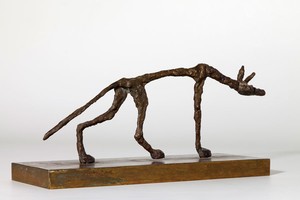
Alberto Giacometti
Dog, 1965
Bronze, 3 ½ × 9 × 1 ½ inches (9 × 22 × 3.8 cm)
© Alberto Giacometti Estate/Licensed by VAGA and Artists Rights Society (ARS), New York
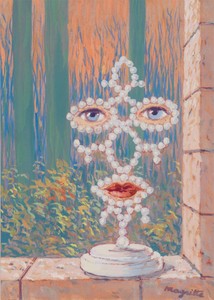
René Magritte
Sheherazade, 1947
Tempera on paper mounted on mat board, 7 × 5 inches (17.8 × 12.7 cm)
© ADAGP, Paris 2012
Where the telescope ends the microscope begins, and who can say which has the wider vision?
—Victor Hugo
Gagosian is pleased to present Micro Mania, an exhibition of the miniature in art featuring nearly sixty small masterpieces by a panorama of modern and contemporary artists including Alexander Calder, Joseph Cornell, Marcel Duchamp, Max Ernst, Yves Klein, Jasper Johns, René Magritte, Francis Picabia, Pablo Picasso, Andy Warhol, Cecily Brown and Rachel Whiteread.
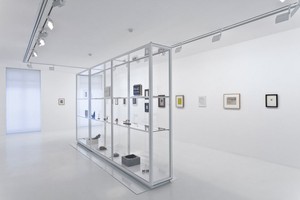
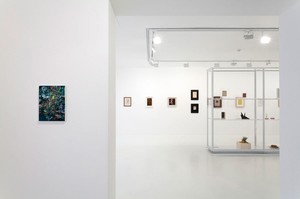
Accordingly, the Project Space has been transformed into a modern day cabinet de curiosités. A glass vitrine in the center of the gallery contains diminutive sculptures such as Claes Oldenberg’s Pancakes and Sausages (1962), Alexander Calder’s Untitled (Standing Mobile) (1955), Lucio Fontana’s Concetto Spaziale (1959) and Joseph Cornell’s Untitled (1933) which measures less than 3 centimeters in diameter. Among the intimate works that line the walls are Jasper Johns Map (1960), René Magritte’s Schéhérazade (1947), Marcel Duchamp’s Peasant’s Leg (1904–05), and Richard Prince’s Untitled (Fireman Joke) (1987).
These small-scale works seem to belong to a separate, otherworldly realm where the rules of the physical world may no longer hold. With proportions akin to those of a children’s toy, they may function as the starting point to a private narrative and act as an agent for nostalgia and fantasy. Taking inspiration from artist and poet Joe Brainard’s 1975 exhibition Think Tiny, as well as Voltaire’s science-fiction novella Micromegas—which strives to demonstrate that importance is not equitably reduced with size—Micro Mania explores the aesthetic and imaginative qualities unique to the craft of the miniature and creates a dialogue between artists working in very different time periods, mediums and agendas.
Artists included: Carl Andre, Jean-Michel Basquiat, Hans Bellmer, Dike Blair, Cecily Brown, Alexander Calder, Joseph Cornell, Marcel Duchamp, Hubert Duprat, Max Ernst, Hans Peter Feldmann, Urs Fischer, Lucio Fontana, Alberto Giacometti, John Giorno, Piero Golia, Douglas Gordon, Keith Haring, Jasper Johns, Paul Klee, Yves Klein, Franz Kline, René Magritte, Man Ray, Claes Oldenburg, Steven Parrino, Francis Picabia, Pablo Picasso, Richard Prince, Ed Ruscha, Kurt Schwitters, Charles Simonds, Elaine Sturtevant, Blair Thurman, Cy Twombly, Piotr Uklański, Andy Warhol, Tom Wesselmann, Rachel Whiteread
Jeff Koons tells Alison McDonald about his appreciation for the pioneering artist and thinker Marcel Duchamp.
Ed Ruscha sits down with the author and explorer Erling Kagge to discuss existence.
Helter Skelter—an exhibition at Fondazione Prada’s Venetian venue, Ca’ Corner della Regina—marks the first creative dialogue between two visionaries of American art, Arthur Jafa and Richard Prince. The show explores the grit, grift, violence, and ingenuity of American culture through more than fifty works, including photography, video, and large-scale installations that interrogate themes of race, gender, media, and politics. In the interview below, Nancy Spector, the exhibition’s curator, speaks about the shared motifs—from apocalyptic sunsets to a fascination with “monstrosity”—that led her to pair these artists for the first time.

The Spring 2026 issue of Gagosian Quarterly is now available, featuring Marcel Duchamp’s L.H.O.O.Q. (1964) on the cover.
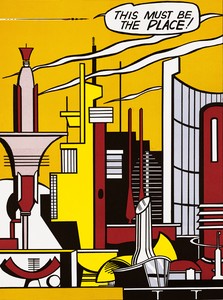
Avis Berman’s biography of Roy Lichtenstein, Becoming Roy Lichtenstein: The Path to Pop, will be published this fall by Abbeville Press, aligning with a major retrospective at the Whitney Museum of American Art, New York, in October. For the Quarterly she has adapted part of her text to focus on the artist’s formative experiences in New York in the 1920s and ’30s.

On January 22, Gagosian, in partnership with Castelli Gallery, opened an exhibition of historic works by Jasper Johns at the 980 Madison Avenue gallery in New York. A survey of the crosshatch paintings and drawings that dominated his practice from 1973 to 1983, the presentation united works that have rarely been seen with loans from sources including distinguished American museums. The exhibition commemorates the fiftieth anniversary of this body of work’s debut at Castelli Gallery in 1976. Here, Larry Gagosian speaks with the Quarterly’s Alison McDonald about the impetus for this project, his memories of seeing the exhibition in 1976, and the enduring impact of these paintings on artists and collectors.
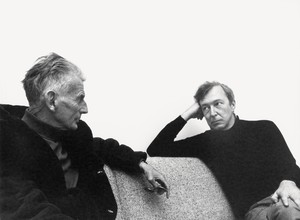
Nearly fifty years ago, Samuel Beckett and Jasper Johns met in Paris and began a collaboration on what would become Foirades/Fizzles, a deluxe limited-edition artist’s book published by Petersburg Press in 1976. Now, on the occasion of the Jasper Johns retrospective at the Philadelphia Museum of Art and New York’s Whitney Museum of American Art, Gagosian Quarterly looks back to the genesis of this project with a conversation between independent researcher Anthony Atlas and Gagosian director Bob Monk. Their discussion focuses on the creative encounter between the artist and the writer and on how the book and related works became a generative source in Johns’s art.
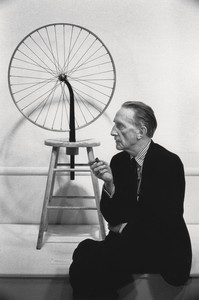
Don Quaintance’s new book Duchamp in California: Walter Hopps Curates a Retrospective (Menil Collection/König, 2025) details the rich history of the Pasadena Art Museum and the consequential Marcel Duchamp retrospective that Walter Hopps curated there in 1963. Here Quaintance gives the backstory to the monograph and shares an excerpt from the book’s fourth chapter.

The Fall 2025 issue of Gagosian Quarterly is now available, featuring Andy Warhol’s Blue Liz as Cleopatra (1962) on the cover.

Carlos Valladares tracks the artist’s engagements with Hollywood glamour, thinking through the ways in which the star system and its marketing engine informed his work.

Sydney Stutterheim traces the linkages and affinities between the work of Richard Prince and that of Bob Dylan. Using Prince’s Untitled (Dylan) as a starting point, she considers the artist’s enduring interest in questions of originality and authorship, as well as his sustained relationship with the worlds of American music and counterculture.

The Summer 2025 issue of Gagosian Quarterly is now available, featuring Pablo Picasso’s Nu accoudé (1961) on the cover.

Karen Wong charts the journey of Alexander Calder’s Quatre lances (1964) from its intended site at the Fondation Maeght, Saint-Paul-de-Vence, France, to the Centennial Hall in Monaco, and now to its permanent home in a new single-artwork museum designed by Renzo Piano at the Nouveau Musée National de Monaco. Wong examines the sculpture’s interaction with architecture and environment as part of a larger story of the artist’s relationship with architects.

From her Judenplatz Holocaust Memorial in Vienna to her casting of George Orwell’s World War II office at the BBC, Rachel Whiteread has long engaged with the emotional and historical complexities of addressing deeply troubling moments in human history through art. This month, Whiteread will debut a new work for the inaugural exhibition at the Goodwood Art Foundation in Sussex, England.

On April 18, the exhibition Picasso: Tête-à-tête opened at Gagosian, New York. Including works from 1896 to 1972, the full span of the artist’s career, the show is presented in partnership with Paloma Picasso, the artist’s daughter. Here, Michael Cary, one of the organizers of the exhibition, traces the historical precedents that informed the conversational nature of the curation. He also introduces a translation of a 1932 interview with Picasso by the publisher and critic E. Tériade, often quoted in English in part but not in full.

The Spring 2025 issue of Gagosian Quarterly is now available, featuring Cy Twombly’s Paesaggio (1986) on the cover.

Jenny Saville reflects on Cy Twombly’s poetic engagement with the world, with time and tension, and with growth in this excerpt from her Marion Barthelme Lecture, presented at the Menil Collection, Houston, in 2024.

In the second part of a two-part essay, art historian John B. Ravenal considers Jasper Johns’s continued engagement with the motif of woodgrain.

Gagosian director Jessica Beck speaks with Lee Mergner, author and publisher of JazzTimes, about Basquiat’s lifelong engagement with jazz on the occasion of “Bebop Revolution: JLCO with Wynton Marsalis,” two nights celebrating bebop and the genre’s influence on the painter at Jazz at Lincoln Center, New York.

Vincent Gardner, trombonist, composer, and arranger in the Jazz at Lincoln Center Orchestra, speaks about the bebop genre and Jean-Michel Basquiat with the Quarterly’s Alison McDonald on the occasion of “Bebop Revolution: JLCO with Wynton Marsalis,” two nights celebrating bebop at Jazz at Lincoln Center, New York.