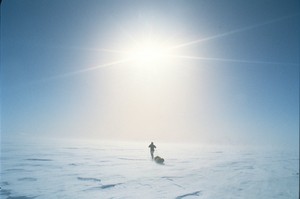
Ed Ruscha and Erling Kagge: Silence, Slowness, Exploration
Ed Ruscha sits down with the author and explorer Erling Kagge to discuss existence.
Extended through September 17, 2016
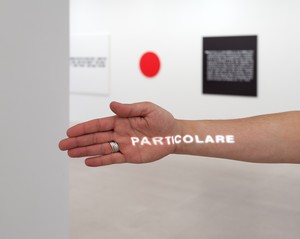
Installation view
Photo: Zarko Vijatovic
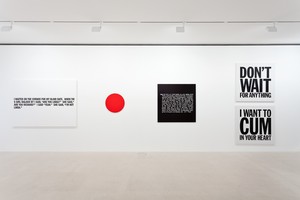
Installation view
Photo: Zarko Vijatovic
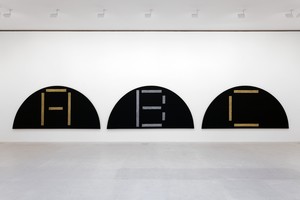
Installation view
Photo: Zarko Vijatovic
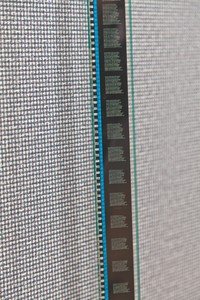
Installation view
Photo: Zarko Vijatovic
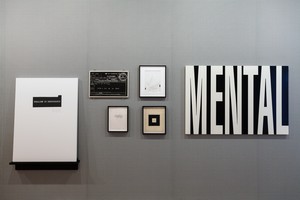
Installation view
Photo: Zarko Vijatovic
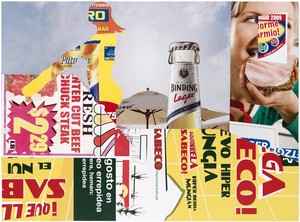
Albert Oehlen
I 11, 2009
Paper on canvas, 66 ⅞ × 90 ½ inches (170 × 230 cm)
© Albert Oehlen
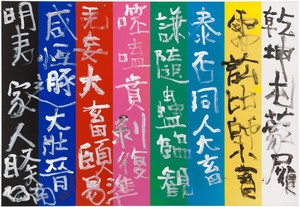
Nam June Paik
Untitled, 1998
Acrylic on canvas, 67 × 46 inches (170.2 × 116.8 cm)
© Nam June Paik Estate. Photo: Ben Blackwell
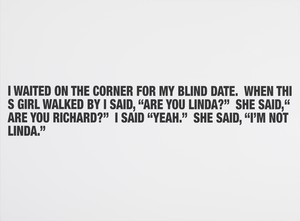
Richard Prince
Untitled (Joke), 2011
Inkjet print on canvas, 58 × 78 ¾ inches (147.3 × 200 cm)
© Richard Prince. Photo: Rob McKeever

Ed Ruscha
A, 1985–87
Acrylic on canvas, in 3 parts, each: 66 ¼ × 137 ¼ inches (168.3 × 348.6 cm)
© Ed Ruscha. Photo: Paul Ruscha
Words have these abstract shapes, they live in a world of no size.
—Ed Ruscha
Gagosian is pleased to present LEXICON, an exhibition of artworks that employ the written word.
A lexicon is a stock or inventory of systematized language, whether personal or belonging to a larger cultural context, which can be shared and deployed. Since the beginning of recorded history, language and art have collided and intersected. And from the modern era onward, artists have employed words and language to diverse effect, using writing as both act and subject—in print, light, sculpture, and paint on canvas. Works in the exhibition include Marcel Broodthaers’s Académie I (1968); Alighiero Boetti’s embroidered magic word squares (Arazzi) (1977–92); Ed Ruscha’s large-scale three-part painting A, B, C (1985–87); Jenny Holzer’s stone agit, Selections from the Living Series (Bench #9) (1989); Douglas Gordon’s text work for a television monitor, A moment’s silence (for someone close to you) (1998); Jean-Michel Basquiat’s cultural cryptograms; and Cy Twombly’s abstruse and airy scratchings. Lawrence Weiner has created a new site-responsive version of AT THE SAME MOMENT (2000) for the rue de Ponthieu gallery, and Piero Golia has designed a printed wallpaper especially for the exhibition.
Language and art have never lived too far away from one another: concrete poetry, propaganda, graffiti, and Pop art, among other genres, testify to their dynamic interplay over time. LEXICON presents works by artists who have made language and letters into what poet William Carlos Williams would have referred to as “the thing itself”: language becoming physical object.
The exhibition will include works by Carl Andre, Giovanni Anselmo, Julien Audebert, Robert Barry, Jean-Michel Basquiat, Alighiero Boetti, Joe Bradley, Marcel Broodthaers, Robert Filliou, John Giorno, Robert Gober, Piero Golia, Douglas Gordon, Loris Gréaud, Damien Hirst, Jenny Holzer, Emilio Isgrò, Neil Jenney, Jasper Johns, Joseph Kosuth, Barbara Kruger, Claude Lévêque, Glenn Ligon, Adam McEwen, Sarah Morris, Albert Oehlen, Nam June Paik, Steven Parrino, Richard Prince, Sterling Ruby, Ed Ruscha, Cy Twombly, and Lawrence Weiner.
Ed Ruscha sits down with the author and explorer Erling Kagge to discuss existence.
Helter Skelter—an exhibition at Fondazione Prada’s Venetian venue, Ca’ Corner della Regina—marks the first creative dialogue between two visionaries of American art, Arthur Jafa and Richard Prince. The show explores the grit, grift, violence, and ingenuity of American culture through more than fifty works, including photography, video, and large-scale installations that interrogate themes of race, gender, media, and politics. In the interview below, Nancy Spector, the exhibition’s curator, speaks about the shared motifs—from apocalyptic sunsets to a fascination with “monstrosity”—that led her to pair these artists for the first time.

On January 22, Gagosian, in partnership with Castelli Gallery, opened an exhibition of historic works by Jasper Johns at the 980 Madison Avenue gallery in New York. A survey of the crosshatch paintings and drawings that dominated his practice from 1973 to 1983, the presentation united works that have rarely been seen with loans from sources including distinguished American museums. The exhibition commemorates the fiftieth anniversary of this body of work’s debut at Castelli Gallery in 1976. Here, Larry Gagosian speaks with the Quarterly’s Alison McDonald about the impetus for this project, his memories of seeing the exhibition in 1976, and the enduring impact of these paintings on artists and collectors.
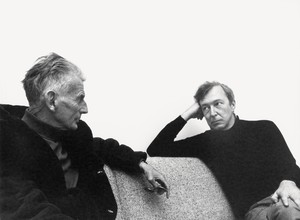
Nearly fifty years ago, Samuel Beckett and Jasper Johns met in Paris and began a collaboration on what would become Foirades/Fizzles, a deluxe limited-edition artist’s book published by Petersburg Press in 1976. Now, on the occasion of the Jasper Johns retrospective at the Philadelphia Museum of Art and New York’s Whitney Museum of American Art, Gagosian Quarterly looks back to the genesis of this project with a conversation between independent researcher Anthony Atlas and Gagosian director Bob Monk. Their discussion focuses on the creative encounter between the artist and the writer and on how the book and related works became a generative source in Johns’s art.
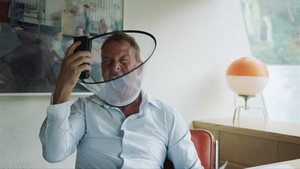
Albert Oehlen in conversation with Max Dax.

Sydney Stutterheim traces the linkages and affinities between the work of Richard Prince and that of Bob Dylan. Using Prince’s Untitled (Dylan) as a starting point, she considers the artist’s enduring interest in questions of originality and authorship, as well as his sustained relationship with the worlds of American music and counterculture.

On the occasion of Willem de Kooning: Endless Painting, curated by Cecilia Alemani and comprising paintings from 1944 through 1986 and two sculptures, the Quarterly revisits a conversation between Albert Oehlen and John Corbett from 2013. The pair reflect on de Kooning’s late work and its lasting influence on them.

The Spring 2025 issue of Gagosian Quarterly is now available, featuring Cy Twombly’s Paesaggio (1986) on the cover.

Jenny Saville reflects on Cy Twombly’s poetic engagement with the world, with time and tension, and with growth in this excerpt from her Marion Barthelme Lecture, presented at the Menil Collection, Houston, in 2024.

In the second part of a two-part essay, art historian John B. Ravenal considers Jasper Johns’s continued engagement with the motif of woodgrain.

Gagosian director Jessica Beck speaks with Lee Mergner, author and publisher of JazzTimes, about Basquiat’s lifelong engagement with jazz on the occasion of “Bebop Revolution: JLCO with Wynton Marsalis,” two nights celebrating bebop and the genre’s influence on the painter at Jazz at Lincoln Center, New York.

Vincent Gardner, trombonist, composer, and arranger in the Jazz at Lincoln Center Orchestra, speaks about the bebop genre and Jean-Michel Basquiat with the Quarterly’s Alison McDonald on the occasion of “Bebop Revolution: JLCO with Wynton Marsalis,” two nights celebrating bebop at Jazz at Lincoln Center, New York.

As American identity once again comes into question during a politically charged election cycle, the Quarterly revisits the motif of the American flag in art. Here, John B. Ravenal contextualizes Robert Lazzarini’s new wall-based flag sculptures and elucidates the tensions they lay bare in the symbol of our nation.

Jessica Beck addresses Jean-Michel Basquiat’s 1982 trip to Italy, considering the effects of the country’s art and history on the young painter’s process and iconography. She focuses in particular on the painting Untitled (1982).

In the first part of a two-part essay, art historian John B. Ravenal considers Jasper Johns’s continued engagement with the motif of woodgrain.
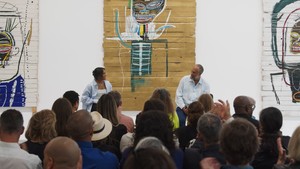
Join Gagosian for a conversation between director, producer, and writer Sophia Heriveaux and actor, director, and writer Roger Guenveur Smith inside the exhibition Jean-Michel Basquiat: Made on Market Street, at Gagosian, Beverly Hills. Heriveaux and Guenveur Smith both share a personal connection to Basquiat: Heriveaux is the artist’s niece and Guenveur Smith was one of his friends and collaborators. The pair discuss Basquiat’s work and legacy, as well as his lasting impact on contemporary art and culture.
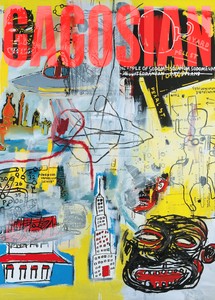
The Spring 2024 issue of Gagosian Quarterly is now available with a fresh cover design featuring Jean-Michel Basquiat’s Lead Plate with Hole (1984).
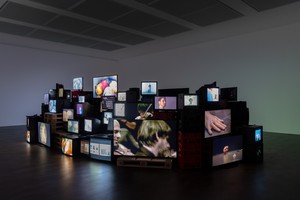
On the occasion of Douglas Gordon: All I need is a little bit of everything, an exhibition in London, curator Adam Szymczyk recounts his experiences with Gordon’s work across nearly three decades, noting the continuities and evolutions.
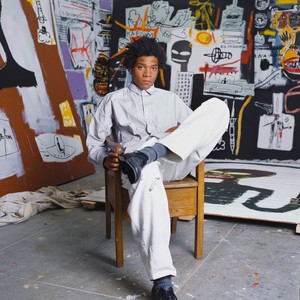
Jean-Michel Basquiat’s sisters, Lisane Basquiat and Jeanine Heriveaux, met with filmmaker Tamra Davis, art dealer Larry Gagosian, and author and curator Fred Hoffman to reflect on their experiences with the artist during the 1980s in Los Angeles.
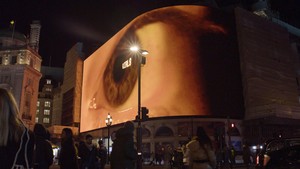
Douglas Gordon took over the Piccadilly Lights advertising screen in London’s Piccadilly Circus, as well as a global network of screens in cities including Berlin, Melbourne, Milan, New York, and Seoul, nightly for three minutes at 20:22 (8:22pm) throughout December 2022, with his new film, if when why what (2018–22). The project was presented by the Cultural Institute of Radical Contemporary Art (CIRCA) in conjunction with the exhibition Douglas Gordon: Neon Ark at Gagosian, Davies Street, London.