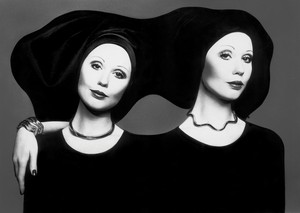
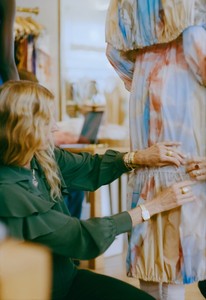
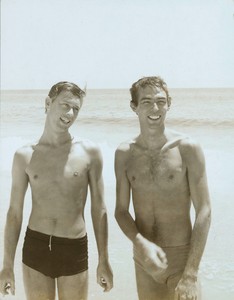
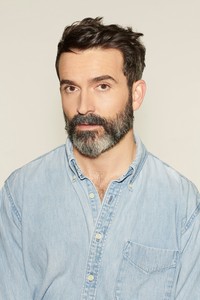
Derek Blasberg speaks with fashion designer Rick Owens, the American-born, Paris-based director of the eponymous brand, about his influences from the worlds of art and music, growing up without a television, and the sinister pleasures of the museum.
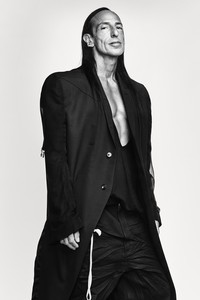
Rick Owens. Photo: Danielle Levitt, courtesy Owenscorp
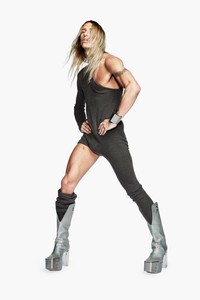
Rick Owens. Photo: Danielle Levitt, courtesy Owenscorp
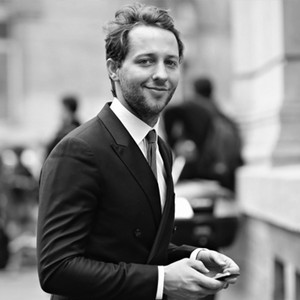
Derek C. Blasberg is a writer, fashion editor, and New York Times best-selling author. He has been with Gagosian since 2014, and is currently the executive editor of Gagosian Quarterly.
Derek Blasberg Hi Rick! Where am I finding you right now?
Rick OwensI’m in Italy, at the factory, but I’m leaving tomorrow morning for Los Angeles. I’m going to see [my wife] Michèle Lamy and my mom and my daughter and my granddaughters.
DBI don’t know if I was aware that Rick Owens is a grandpa.
ROI am. It’s only been a year, so everybody is letting it sink in.
DBWith everything that’s going on in the world, have you met your grandkids before this trip?
ROActually, I was there for both births. One was born in Italy, so that was easy, and then the other one was born in LA, when things had kind of opened up, so I was able to go there too.
DBI wonder if a Rick Owens Kids line is next.
ROActually, I just finished a little coat for the one-year-old, and it’s in pearl-gray shearling with matching goat-hair fringe and silver sequined stripes on the sleeves. And the baby gets a—what do they call that? It’s like a baby bag, you know, they call it a marsupial in Italian.
DBThat’s sweet.
ROIt matches—pearl-gray shearling with the goat-hair fringe and the silver sequins too.
DBPut those in production, Rick! These babies have to start earning their keep.
ROI released our Geobaskets [shoes] in baby sizes a couple of months ago and they sold out. They really went fast. So, maybe!
DBWe could talk about babies all day but right now I want to talk about how art and fashion intersect with what you do.
ROThey press the same button sometimes, if you’re lucky.
DBI’d say your designs and certainly your shows push both buttons.
ROFor our holiday party last year, the whole office took a field trip. We got in a bus playing loud disco and drove to Le Bourget airport [outside Paris] to go see the Richard Serra exhibit [at the Gagosian gallery there]. Then after that, we went to see the Alex Katz show at Thaddaeus Ropac. It was a really fun day.
DBGrowing up, were you a kid who was drawn to art and artists and museums?
ROI didn’t go to museums because my parents weren’t travelers. I lived in a really small town and we didn’t circulate that much. As far as we ever got was Los Angeles, three hours away, and we must have gone to the LA County Museum or something, but that was once every five years or so. But my dad had a huge library, with books on philosophy and theology and Japanese calligraphy and architecture, and there were museum books in there too. My dad was a really weird character, very pragmatic and blunt, like a militant conservative. He had a gun collection and he was fairly racist and homophobic too. But he also had this tender side. Every evening after dinner, he’d put on a silk kimono that he’d brought back from Japan when he was there during World War II, make tea, lie down in his music room, light incense, and listen to classical music for like two hours. That’s what he did every night.
DBReally?
ROYes! And the music filled the house. At first I used to resent it. I resented that we were forced to be part of his routine without our consent. But now classical music is a big part of my life. And, unknowingly, that’s where I learned to love opera.
DBI think all kids resent their parents to some extent.
ROI really resented that I didn’t get to watch TV like everybody else. We didn’t have a TV in the house.
DBNo TV at all?
ROFinally, when I was sixteen, he allowed mom and me to have a TV in the garage, but we had to go out there to watch it.
DBWow. My parents didn’t have cable when I was young, and I thought that was cruel and unusual punishment.
ROHa! At least you had a TV. You were spoiled.
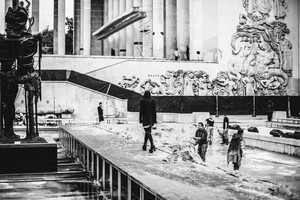
Spring/Summer 2020 Tecuatl menswear show, Palais de Tokyo, Paris. Photo: courtesy Owenscorp
DBYou once told me that when you graduated high school, you wanted to be an artist. Is that true?
ROYeah, I did. I went to Otis-Parsons in LA, which was right next to MacArthur Park in those days, and that’s when I became exposed to art theory. It’s where I discovered Joseph Beuys, who I can look back to now and say made a huge impact on my aesthetic choices. But there were some terribly pompous classes that kind of intimidated me, and ultimately I didn’t think I could be a real artist. So I dropped out.
DBDid you want to be a painter or a sculptor or a photographer or what?
ROWhen I started, I thought I was going to be a painter. I was doing David Salle–influenced painting, and looking back, David Salle and Julian Schnabel were what I was aiming for—grand, gestural, heroic, monumental, reckless, drippy painting.
DBAnd then you abandoned it?
ROYes. I was intimidated and I figured I needed a skill and a real job, so I decided to go to a fashion trade school where they taught you how to work in a fashion factory. To be clear, it’s not like I dreamed of one day becoming a big designer. I just thought, Here’s a school I can afford and this all makes sense to me. I learned pattern-making and how to construct clothes, and then I got a job as a pattern-maker at a couple of different factories, and I ended up doing patterns for Michèle’s company. That’s how I met Michèle.
DBWhen you transitioned from painting to fashion, was it a conscious decision or were you basically just looking for a job?
RONo, it was conscious. I was thinking, Art is too intellectually intimidating for me. I think I can do fashion.
DBDo you still feel like art is more intellectual than fashion?
RONot really. I guess I changed. But with art, you get to indulge in stretching one concept out through a very long time. After all these years, I realized that fashion is actually more rigorous, because you have to constantly try to get the same aesthetic attention from people. You have to be relevant and you have to respond to the times in a very smart way. And: you have to do this four times a year. You have to keep maintaining this dialogue with your audience at a really high level, a higher level than art. You have to participate in the world and converse with people. Or do you think I’m overestimating what it takes to be in fashion?
DBWell, a fashion designer can’t just hibernate for a few years, like some artists do, and come back with a new idea when they’re ready.
ROAbsolutely not. So there was something about having to be responsive continuously. At the same time, I think art can be more rigorous than fashion, more exhausting, in other ways. But all things said, I’m happy with the way it turned out.
I’m not a nightclub person, I’m not really a party person, but museums are my safe church. I love everything about museums. I love how sinister they are.
DBAs you made this conscious shift into fashion, did you make intentional parallels between what we would consider traditional art-world stuff and what your fashion-world stuff looks like? You’ve mentioned Beuys, who is clearly an inspiration in, among other things, your store aesthetics.
ROI rarely look at contemporary art and absorb it into what I do because what I think of when I look at art is a completed cycle. Michèle always tells me I’m only interested in dead artists, and I go, Yeah, that’s true, because I want to see how they committed themselves to the same standards throughout their lives. I want to see the finished story. I want to see a legend and a full story. My touchstones have always been artists like Beuys.
DBYou’re not interested in artists just starting out?
ROIt’s funny, all this conversation about NFTs, which I can’t really completely grasp myself, must be similar to the conversation in the 1970s when Land art was emerging: is it valid, how do you own it, what does owning it mean, is it real art? So it’s interesting to see how the NFT thing is going to turn out.
DBWow, I’ve never heard someone compare Land art to NFTs. But I see what you mean about the idea that people are skeptical or dismissive.
ROIt’s about the idea of taking art out of its usual compartment. Taking it out of the gallery and putting it into an earth piece in Nevada, like Michael Heizer does, that must have seemed ridiculous at the time, or at least hard to grasp.
DBDo you own any NFTs?
RONo. I don’t own that much art. I’m not a collector at all. I have a few things that I’ve wanted since I was young, and I got them, and then I didn’t get very much more acquisitive than that. I’m not impulsive at all. I guess I’m instinctive, which most collectors are, and there are moments when I’ve made leaps of faith that seemed impulsive, but they’re so far and few between.
DBI know this is a broad question and probably an annoying one for you to answer, but I’m going to ask it anyway: would you consider yourself an artist?
ROWell, yeah, that’s a hard one to answer, because art still has a mysticism associated with it that fashion doesn’t.
DBOh, that’s a good answer.
ROIt’s hard to credit yourself with having more of a shamanistic, mystical attribute than a designer would, supposedly. But after everything is over, when I look back, maybe I’ll see the arc of my work as a work of art. At that point I might consider it art, if it all comes out okay.
ROI’m watching Kanye [West] now, and everything he’s doing, and it’s actually impressive: his listening parties, his personal behavior where he’s really vomiting out anything that comes to his mind—it’s kind of like he’s doing modern couture. He’s been doing his fashion lines and everything, but he’s living his life as this couture show now. I mean, those listening parties were magical huge events. They were rallies! And then he satisfies everybody’s hunger for spirituality with his Sunday services, which blend everything including aesthetics, values about connecting, spirituality. He’s putting that all together! We’re all fascinated with his personal relationship with Kim [Kardashian] and how that works. If we’re talking about who’s an artist, he’s kind of turned his life into this performance that’s really impressive. You can’t help but wonder, What’s he going to do next? One day last year he set fire to himself in a rebuild of his family home in this huge stadium, with Marilyn Manson watching. What’s next?
DBYou know, I’ve conducted so many of these conversations around art’s and artists’ influence in the design space, and no one’s brought up Kanye. But you’ve made me think about it, and, totally, one could say that his whole life has become a performance.
ROAnd the people he’s drawn into his orbit and connected? Everything he’s interested in is pretty top notch. He’s got exquisite taste. I’m more impressed than ever!
DBEven if you’re not collecting contemporary art, do you still seek it out? Are you inspired by it?
ROTotally! I try to see everything that comes my way. It’s the best stuff in the world. I’m not a nightclub person, I’m not really a party person, but museums are my safe church. I love everything about museums. I love how sinister they are. I love how they’re built on stealing, lies, sex, war, corruption. But beauty too! I mean, I love all of that. It’s just like an orgy of salaciousness.
DBThat’s humanity, I guess, everything you just said. These are all human influences.
ROYes. But there’s corruption in a museum. A museum is so much about corruption!
DBYou mean because we’re finally wrestling with the fact that a great deal of the art that’s exhibited in museums has been pillaged or looted or—
ROYes! I’m not talking about the politics of buying art, I’m thinking about the history of the world, about how all of it has been pillaged. I actually see that now more than ever, more than even five years ago. There seems to be a vested interest in returning works of art to their rightful owners. You can’t get away with anything now. Everything is so exposed and people are so indignant about every single little thing.
DBSee, now you sound like your father. Are you wearing a kimono?
ROYes! And sipping my Japanese tea.
DBListening to classical music and burning some incense.
ROWhich I do too. I mean, that’s kind of what happened, to a certain extent. Maybe it’s true what people say and eventually we all turn into our parents.
Derek C. Blasberg is a writer, fashion editor, and New York Times best-selling author. He has been with Gagosian since 2014, and is currently the executive editor of Gagosian Quarterly.