Michael Craig-Martin’s sixty-year career is the subject of a retrospective at the Royal Academy of Arts, London, on view through December 10, 2024. Ahead of the exhibition’s opening, the artist met with his longtime friend, the novelist Colm Tóibín, to discuss his materials and the generative inquiries at the heart of his practice.
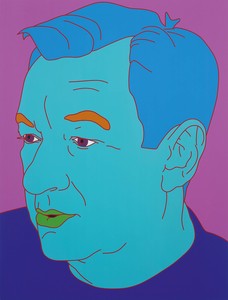
Michael Craig-Martin, Self-portrait (aqua), 2007, acrylic on aluminum, 48 × 35 ¼ inches (122 × 92 cm), The Royal Academy of Arts, London. Photo: Royal Academy of Arts, London/John Hammond
Michael Craig-Martin, Self-portrait (aqua), 2007, acrylic on aluminum, 48 × 35 ¼ inches (122 × 92 cm), The Royal Academy of Arts, London. Photo: Royal Academy of Arts, London/John Hammond
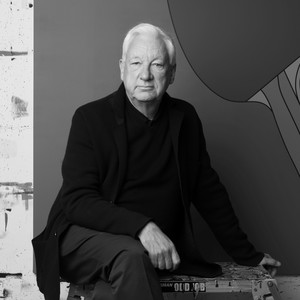
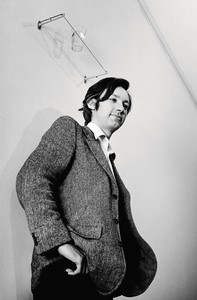
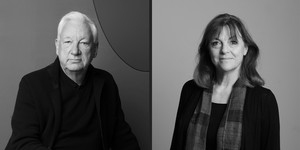
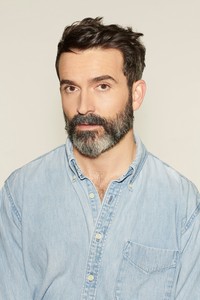
A principal figure of British conceptual art, Michael Craig-Martin probes the relationship between objects and images.The perceptual tension between object, representation, and language has been a central concern in his work over the past four decades. Photo: Caroline True
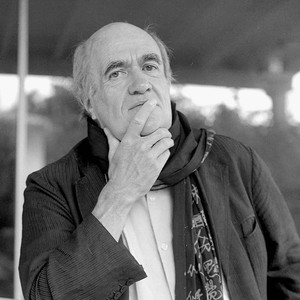
Colm Tóibín was born in Enniscorthy, Ireland, in 1955. He is the author of eleven novels, including The Master, Brooklyn, The Testament of Mary, Nora Webster, House of Names, and The Magician. His work has been shortlisted for the Booker Prize three times and has won the Costa Novel Award and the IMPAC Award. He has also published two collections of stories and many works of nonfiction. Photo: Reynaldo Rivera
I was invited to do an interview for the Quarterly in conjunction with my current retrospective at the Royal Academy of Arts in London. It was suggested to me that it be with an artist in a different field. I decided to take the opportunity to ask Colm Tóibín. I was delighted and touched when he agreed.
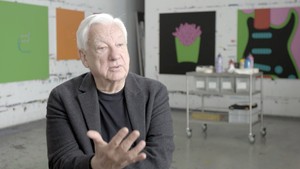
We were introduced some years ago by close mutual Irish friends. Colm and I were both born in Ireland, though our lives and worlds have been very different. Colm lives in Los Angeles now. In order to speak face to face we arranged to meet at a hotel in Barcelona, a city close to his heart. His conversation is personal, warm, relaxed, chatty, moving easily from subject to subject. He has a powerful presence, very animated both facially and physically, alert and engaged.
I had expected us to have something like a conversation and had prepared things to ask Colm. I had not expected him to have decided to genuinely interview me, but as you can see from the first question, that’s what he did. I have done numerous interviews, but this one was different. The extreme simplicity and directness of the questions are those of an artist, not a critic or commentator: not “What’s it about” but “How is it done.” A maker’s questions about materials and processes.
I am deeply grateful to Colm for the great compliment of this interview.
—Michael Craig-Martin
Colm TóibínI’m an outsider in this world of visual art, so there are certain things I need to clarify. I’m going to say a word, and could you just tell me what it’s meant to you and what it’s done for you? The first word is “acrylic.”
Michael Craig-MartinAcrylic is a kind of plastic paint. It’s unlike oil, and it has certain advantages and certain disadvantages. For me, one of acrylic’s big advantage is it dries very quickly, almost immediately. Also, I couldn’t do what I do with oil paint because in order to draw the lines on the surface, I use tape, paint over the tape, and then remove the tape to get the line. Oil paint would go under the tape and make it lift, whereas the acrylic paint seals the tape down.
CTSo take me through “tape,” the second word.
MCMI use this tape that I found in the ’60s, which was originally designed for the electronics industry. It’s very unusual because, first, it comes in every width: from unbelievably fine, like a hair, up to an inch. Second, it’s made out of crepe paper. And because of this you can make any kind of curve you want.
CTTell me exactly how you do that.
MCMYou just do it with your finger and you press it down. And what’s fantastic is, unlike a pen, if you get it a little bit wrong, you pull it off and do it again.
CTNow take me through another word, the word “paper.”
MCMWell, I use paper very little anymore because I do all my drawing directly into the computer, using a mouse. I don’t like using those stylus pens or anything like that.
CTBut before you had a computer—
MCMBefore that, I drew in pencil on paper, and then I put a sheet of clear acetate on top of the drawing. Using very thin tape, I would trace my own pencil drawing so as to get a perfect line drawing, because what I wanted, originally, was to have a kind of drawing that had no signature. With tape there’s no gesture in the line at all. But ultimately that process of pencil, acetate, paper was clumsy for my purposes, because what I wanted was to produce templates. So once I’d drawn a book, I never drew another book, because it wasn’t necessary. I used the same drawing again and again for everything—every time I needed a book, I had the template. The problem with the acetate was that the sheet is only one size. It was limiting. Then I got the computer and I could scan everything into the computer and change the size as desired.
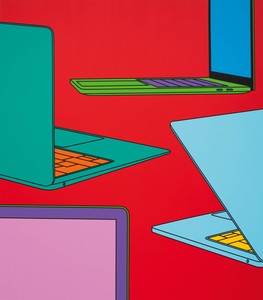
Michael Craig-Martin, Zoom, 2020, acrylic on aluminum, 89 ¾ × 78 ¾ inches (228 × 200 cm)
CTTake me through aluminum, your surface of choice now, compared to paper.
MCMI didn’t go directly from paper to aluminum. Originally I made paintings, like most people, on canvas. The problem was, I’m making paintings that need to have a flat and firm surface. Because I’m using tape, I have to push down to get the tape to stick; and in order to put the paint on, I use little rollers. I don’t need a surface that gives, like canvas. It was okay, but it wasn’t totally satisfactory. When I discovered that you could make paintings on aluminum, it was a great relief. The aluminum is so precise, and for the kind of extremely precise work that I do, it’s the perfect ground.
CTSo the aluminum and the computer both arrive to solve problems and create solutions for you.
MCMThis also coincided with a third factor, which is I suddenly discovered how to use color.
CTI want to go back a moment, to 2004, when I curated an exhibition in Dublin for the Chester Beatty Library. They asked me to select things from their collection. I came in as a nonscholar, noncurator, and I couldn’t work out what to do until I decided to just choose the color blue. I selected blue objects, but then the question was how to present this to the public. And one of the ways was to use you. So your work opened the exhibition. I bring this up because I’ve known people who were genuinely surprised when they learned that your relationship to color wasn’t merely uneasy, but that for many years you were unwilling even to entertain color. Now it’s so much a part of your work that people have a hard time believing that wasn’t always the case.
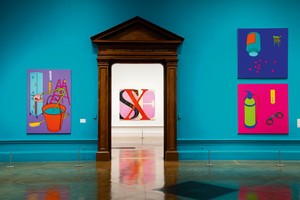
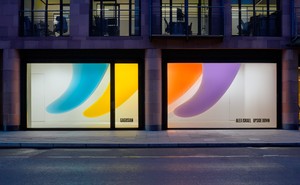
Installation view, Michael Craig-Martin, Royal Academy of Arts, London, September 21–December 10, 2024. Photo: David Parry, courtesy Royal Academy of Arts
MCMBefore I started to use color in such a big way, it was scary. I’m an almost excessively logical person; I set out on a track and I expect the track to take me in a logical direction. And color seemed so wayward. It wasn’t until the early ’90s that I suddenly started to use big color—red, yellow, blue, green, pink, orange—always the brightest hue of whatever color it was, and always a color you could name, just like the objects. I don’t use a mixed color, never grayish or bluish. No. It’s got to be blue, red, yellow, pink, purple, whatever.
The revelation was suddenly discovering that it didn’t matter what a color was when you painted it; what mattered was the colors together. Once you start to use certain colors, then other colors fall into place, of course, so it’s not as arbitrary as it sounds, but there’s a freedom of choice about such things. You don’t need to say, “This is an object that would be seen in green, that’s the natural color. Grass should be green.” But even grass, you can make a painting of grass and why not make it blue? In a painting it doesn’t matter; that’s a wonderful expressive freedom.
CTDo you remember exactly when this realization occurred?
MCMThat started in the early ’90s, with two exhibitions: one at the British School at Rome and the other at the Galerie Papillon in Paris [both 1993]. The installation in Rome was the first time I painted the walls a color. The space was an old room with two marble fireplaces. I was used to exhibiting in white-box galleries and suddenly I’m in a room with history, a room with character, a room that has a past. And this past is visible. So I thought, Well, I should play with the character and paint the walls with colors. The Papillon gallerist saw the show in Rome and said we should continue with color in Paris. Her gallery had six small rooms around a little courtyard—a very Parisian kind of thing—and I painted every room a different color. From the minute I did that, and saw the response to it, I never went back.
CTBut it was partly your own response to it too, wasn’t it?
MCMOh, I couldn’t believe it when I saw it. By doing this, the walls invited people to step inside the painting. The rooms became the painting.
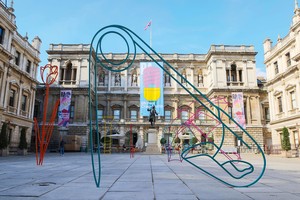
Installation view, Michael Craig-Martin, Royal Academy of Arts, London, September 21–December 10, 2024. Photo: David Parry, courtesy Royal Academy of Arts
CTIn your paintings, the object—if we can use the word “object” or “subject” or “thing” in this context—be it a pen, a ball, or whatever you’re putting at the center, it has no history, right? It has no personal dimension. You’re not expressing some immense thing using the object as the vehicle.
MCMNo. My idea with the objects is I treat them absolutely neutrally, and I treat them the same no matter what they are, whether it’s a grand piano or a safety pin. I draw it the same way and I treat them as equals. I have no hierarchy.
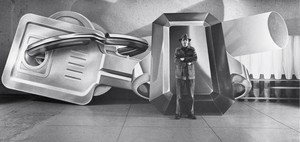
CTThere was a fascinating image in the catalogue for your exhibition at Chatsworth House [Michael Craig Martin at Chatsworth, Derbyshire, March 16–June 29, 2014] where this large pink high-heel-shoe sculpture is casting a shadow [laughs]. And I go, I found a shadow! But the important thing in the work is that the flatness is flatness is flatness, is that right?
MCMThat’s true. But of course, the wonderful thing about what you’re describing with the shadow is, it’s not a sculpture of a high heel or a pitchfork or whatever, it’s a sculpture of a drawing. And it’s the drawing that’s casting the shadow and the shadow is in a sense identical to the object because the shadow is also two-dimensional. It’s also an image.
CTI’m presuming that this doesn’t arise from a large philosophy of objects, but rather that it arises from some fastidious relationship to work, to the making of it. Help me.
MCMThe objects are the subject matter of what I do. When people look at my work, they see the subject matter. When people talk about artwork, generally they’re not talking about the work, they’re talking about its subject matter. Now the subject matter of the objects has allowed me to explore the world of image making, the world of two dimensions, the world of painting, the world of drawing, the world of sculpture. Those are my interests. After all, I don’t make the objects I draw; I make a different kind of object, which is an image object.
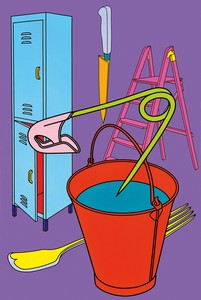
Michael Craig-Martin, Pricks, 2000, acrylic on canvas, 84 × 56 inches (213.4 × 142.2 cm)
CTIt’s fifty-one years now since An Oak Tree [1973], your celebrated installation that consisted of a glass of water on a wall-mounted glass shelf, accompanied by a text you wrote, in Q&A form, that states that you have transformed the glass of water into an oak tree. Could you tell me who you were then, where you were living, what was happening around you? Imagine you’re a novelist and take me through the character of you from those days.
MCMI’m in my early thirties. I’ve been working as an artist since I was about twenty-five, twenty-six when I left art school. I’m teaching a lot. And I’m at the ground level of Conceptual art, the beginnings of Conceptual art. A lot of Conceptual art was to do with language, but there were also many people who were interested in what art is: What’s the essence of it? What can be art and what’s not art? You have artists putting work on the floor, or artists doing giant things in the landscape. I’m one of the people who’s interested in a philosophical question: What’s the essence of art, what’s the bottom line? And An Oak Tree is my answer at thirty-three or thirty-two to what’s the bottom line, what’s the base, if you strip art to the bare minimum. I thought, since art is usually seen in terms of transformation, the ultimate artwork was one in which none happened at all. There’s no transfiguration, but there is transubstantiation—which, if I hadn’t been a Catholic, I wouldn’t even have known existed. There’s a change of the essence of something but not the appearance of it. I wrote the text that completes the work; I realized that if I said this is an oak tree, that’s the name change, but that’s not enough. I’m not saying it’s an oak, I’m saying it’s become something it doesn’t look like. For that I needed more words, and I decided to put it in the form of a discourse, so it’s question and answer. There’s the believer and the skeptic, the artist and the audience. That’s the text.
MCMI went to the Priory School in Washington, DC, an English Benedictine high school.
CTI mean, hello [laughter]. All of us who were brought up with transubstantiation, especially with the wine, where you lift the cup and say some words and from that moment on it’s the blood . . . it was the wine, now it’s the blood. Some words made it change. That idea of believing and not believing, of seeing and not seeing, that came to us who were Catholics.
MCMWe grew up with this. It was completely acceptable. And I realized that for works of art, there’s a way in which they don’t work if you don’t believe.
CTSo after that, between say ’74 and the early ’90s when you start to use color, aluminum, the computer—what’s happening in those years?
MCMWell, there’s a long period of me doing different things. Basically, what happens is when I do An Oak Tree, it’s such an absolute work that I realized that once I’d done it, there was no next piece.
CTYeah.
MCMI couldn’t go on from it. It was a dead end. I floundered for a little while. I saw the work as liberating, and yet I was being trapped by it. So I went back to basics: draw objects. I went from using objects, like the glass of water, to drawing them. I became more and more interested in the world of two-dimensional image making.
CTAre you still answering the question of what art is, or what can be done with the drawings, as much as you were with An Oak Tree? Is it the same question?
MCMI see it as the same question. Other people see a bigger difference between the work of the early period and the work of the later period. To me, all the work that I’ve done is consistent. Essentially, it’s asking why is one thing art and not another thing? What’s the role of image making in art? I’m still in that exploration. Every time I’ve thought that what I was doing had seized up on me and I couldn’t think of what to do next, a little door has opened somewhere. In some ways what I’m dealing with, these objects, is basic and small or stupid in a sense. But I have some weird belief that part of art is to make something that’s stupid not stupid. Or to make something that’s not important important. Of course you can see the objects—a pitchfork, a tape, a shoe—as symbols, as metaphors, but in the end it’s just a shoe. And that’s actually more interesting than all the other things that are supposed to make it interesting.
CTTo what extent are you doing something playful?
MCMI see it as totally playful; that’s the whole exercise. It’s not science, it’s play.
CTBut if you’re saying it’s not science, it’s also not art in the romantic sense of somber solemnity about emotion, sublimity via the image—you’ve taken so much out of that.
MCMYes. As with An Oak Tree, I’ve tried to strip away everything I thought was unnecessary and to see what happened. Over the years of working, the thing that continues to surprise me is that no matter how much I strip away, there’s always so much left. There was always plenty there even after I’d stripped away everything that I saw as marginal. You get rid of a certain kind of expression, you get rid of this, rid of that, and still it’s interesting.
Michael Craig-Martin, Royal Academy of Arts, London, September 21–December 10, 2024
A principal figure of British conceptual art, Michael Craig-Martin probes the relationship between objects and images.The perceptual tension between object, representation, and language has been a central concern in his work over the past four decades. Photo: Caroline True
Colm Tóibín was born in Enniscorthy, Ireland, in 1955. He is the author of eleven novels, including The Master, Brooklyn, The Testament of Mary, Nora Webster, House of Names, and The Magician. His work has been shortlisted for the Booker Prize three times and has won the Costa Novel Award and the IMPAC Award. He has also published two collections of stories and many works of nonfiction. Photo: Reynaldo Rivera