The Unauthorized Autobiography of Maurizio Cattelan by Francesco Bonami
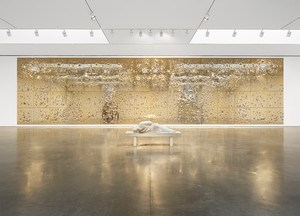
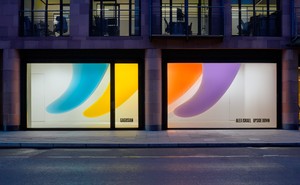
Coinciding with an exhibition at Gagosian, London, of new work by Maurizio Cattelan, a new English translation of Francesco Bonami’s 2011 “autobiography” of the artist is being published by Gagosian. Here, we share an excerpt that recounts—or reimagines, shall we say—Cattelan’s childhood and decision to become an artist.
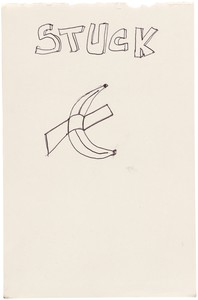
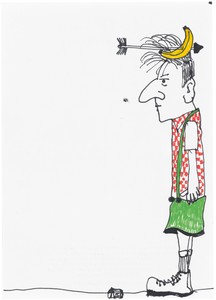
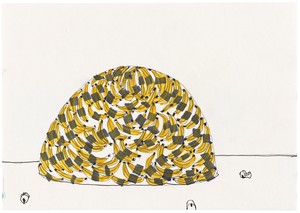
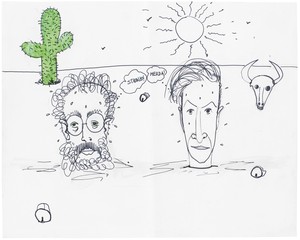
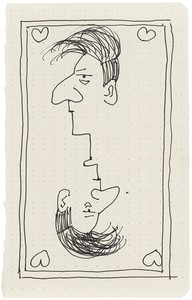
Drawing by Francesco Bonami
Drawing by Francesco Bonami
Francesco Bonami has curated more than one hundred exhibitions, among them the Biennale di Venezia of 2003 and the Whitney Biennial of 2010. He writes for ARTnews and Vogue Italia. His most recent books include Bello, sembra un quadro. Controstoria dell’arte (Feltrinelli, 2022) and The Spinster’s Poem: 101 Bonaku, with a forward by Richard Prince (2023).
This book is a myopic biopic of the life and art of Maurizio Cattelan, written by me, after listening to him for more than thirty years. Some events are semifictional, some are real, and some are pure imagination, based on what I have guessed Cattelan was thinking, feeling, or hiding. It is a book about an unlikely and unfinished friendship, about respect, lies, and truth. It is about communicating art, and the art of communication, about the skills of an artist that kills. This book is about an unforeseen chapter in the history of art in which a banana ended up inside a fountain—that is, Marcel Duchamp’s urinal. You may choose to call him a prankster, a joker, a comedian, or a clown, but Cattelan has redefined the concept of being a “master.” Here is my story of his story. You can believe it or not—it doesn’t much matter, just as long as you enjoy it, that’s enough. If cultivating “doubt” is essential to life . . . well, Maurizio Cattelan harvests doubts like nobody else.
—Francesco Bonami
Drawing by Francesco Bonami
The Liar’s Calling
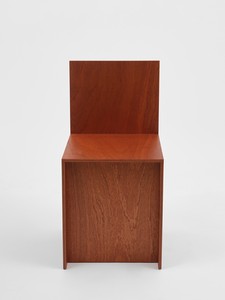
One day I came home from school, and climbing the stairs at Via dell’Ospedale in Padua I saw my mother waiting for me at the door. She never waited for me like that. Actually, I was often the one waiting for her on the landing, when she got back late from work. But this time she was standing there. Actually it was not my mom, but Signora Pierina Brillo who was waiting for Signor Maurizio Cattelan. Mom was inside. As soon as I came within reach she hauled me up and tried to whack me one, but I nimbly avoided the blow. “You broke the chair, you good-for-nothing!” she shouted. She didn’t usually smack me or yell at me, but this time she did. Also because there were five of us in the house—me, my two sisters, and my parents—and we had exactly five chairs, if one of them was broken, somebody would have to eat standing up or sitting on the couch. “But I didn’t break it,” I answered. “Don’t lie to me!” she yelled.
I really didn’t break the chair, but she didn’t believe me, and kept on asking me how it happened. I told her over and over that I hadn’t done anything, that somebody else must have broken the chair, maybe one of my sisters, who was heavier than me.
The more I denied it, and the more I tried to find someone else to blame, the more furious she became. “Breaking a chair is already bad enough, but continuing to lie to me and accuse other people, that’s just plain wretched!” I understood her viewpoint, but I didn’t know what to do about it, since I hadn’t done anything wrong. But the more I denied it the more Mom made it into a big deal. To try to make me confess, at a certain point she even started to cry, carrying on about one of her brothers who had died, I can’t remember how, who had told so many lies that no one would give him a job anymore. She didn’t want me to turn out like him, so she begged me to confess to the evil deed. I stood my ground, and though it wasn’t easy—tears have never come easily to me—I was forced to start crying to make her believe me. For Mrs. Brillo, instead of proving my innocence, my tears were a sure sign of my guilt. “He doesn’t just tell lies, he even cries about it! Scoundrel!” she yelled with all the anger she could muster. I sobbed and took the fifth, since I had no evidence, no proof, no alibi, though I really hadn’t committed the crime. She wasn’t about to change her mind. At a certain point, seeing no way out of the situation, I just decided to take the blame and put an end to it. “Yes Mom, I broke the chair. I stood on it and the leg bent; I tried to straighten it out and it broke off in my hand.” Hearing that, Mom sat down limply on the shabby sofa and sighed, “So you’ve finally made up your mind to tell the truth . . . come over here.” She pulled me to her and gave me a kiss of forgiveness, which I didn’t deserve, since there was nothing to forgive.
It goes without saying that I was the one who had to eat dinner standing up. Later, in bed, under the covers, breath fogging the cold air, I had a sort of vision, or I heard a voice that came out of the wall and said: “Maurizio, from this day forth you will be a lifelong liar. Truth is more dangerous than falsehood.” Ever since that day I have constructed most of my life around lies, climbing them as if they were ivy, covering them up to hide them from the world that was watching me.
In Padua the fog smells fishy. When it comes down and you can’t see anything in the streets, I have always smelled the stench of fish, which doesn’t happen when it is sunny. My sisters said I was dumb, that fog has no smell, and Padua is not on the sea, so the stink I was talking about was all in my mind. Maybe there is a bad smell in my head. I almost never open the windows of my cranium because I am afraid that the few ideas I’ve got up there will fly away like parakeets that find the cage door open.
Anyway, when I woke up that day in my rented flat on Via Foscolo, outside the window the fog was thick and there was the usual fishy odor. Not the smell of the sea, mind you, but the smell of fish. I had left my last job, determined to never work again in my life. Or, more precisely, to never work for anyone except myself. Down in the street, wreathed in fog, like a horse awaiting its master, was my Motobi 125 Sport. I thought I heard it whinny. I’ve always been obsessed with horses, even though I have never been on one. The 125 Sport neighed because of the cold, or maybe to tell me to get up, go out, go somewhere, to give its poor carburetor a chance to breathe. I dipped a big slice of rustic bread into a cup of caffè latte, and when I pulled it out, dripping, I was already seated on the scooter, motor running, and ready to go, wearing an orange windbreaker. I had no idea where I was going. The only thing I had decided was to go west, to get as far from the sea as possible, away from the stench of fish that had plagued me my whole life. The cod our mother made us eat with vegetable oil every damned blessed Friday.
I drove into the dense mist of the Po Valley plains—damp but finally aromatic. I crossed the border of Emilia Romagna and stopped for a mortadella sandwich. Back on the scooter, the fog was lifting and the flat landscape was becoming visible. The road was empty, but as soon as I passed the sign for Vernasca the motor of the 125 let out a dreadful moan and stopped. The scooter stuttered. I put it in neutral and pushed it, running, for a few dozen meters. Then I quit. I tried to start it, but nothing doing. My horse was done for. I too collapsed by the road, with no idea how to fix the situation.
The sun started to warm things up a bit. Every so often, a truck or a car went by. I thought about the art exhibition I had seen in Padua. I knew nothing, but what came to mind in just that moment, with almost no lire in my pocket and a dead scooter, were the works of an artist called Pistoletto. Mirrors with figures and objects. I remember seeing myself reflected in one panel, an unwitting and temporary character in an artwork, and it made an impression on me. It was hard to recall if the sensation was one of pleasure or curiosity. Anyway, lying there with nothing to do, nothing to hope for, nothing to look at—that was the sensation that made me decide that maybe art could become a job, the job that would give me the chance to work only for myself.
Drawing by Francesco Bonami
The only art I knew about was what I had found in an art history book by Argan, which I had bought secondhand after seeing the mirror exhibition. No one ever talked about art at home. The only music we listened to was on the radio, which played from morning to night, even when the house was empty. My mother said it would discourage burglars. Though no burglars would ever have targeted our building. If anything, they lived there. Had they shown up, the only thing of value they might have stolen was precisely that radio.
So art was not part of my vocabulary. And yet now, sitting by the road, something inside me had stimulated my appetite for it. I closed my eyes and thought about what it would be like to feel like an artist. I thought maybe musicians understand they are musicians because inside them they can hear music playing, like the radio in our house. But an artist? What can a person who has to make things hear inside? To be an artist, I thought, maybe you have to be able to see things inside you that don’t exist elsewhere. But that didn’t work, because the mirrors I had seen, with my image reflected in them, had certainly not been invented by that chap there. So what had that guy done, anyway? How had he become an artist? I just couldn’t understand it. But the less I understood it, the more I wanted to be an artist. Did people become artists just like that, in one stroke, without even knowing it? Your scooter breaks down and you realize you have to be an artist.
I wondered how the mirror guy had figured out that he was an artist. If I had had his phone number I would have called him from the first payphone and asked: “Sorry, but could you tell me exactly when you decided to be an artist, or to make art?” Because actually, I was also wondering something else: Do you become an artist, or are you simply an artist? The becoming option, that one chooses to be an artist, was better for my purposes. Because I definitely didn’t feel like an artist. The only artistic thing I had ever done was to use a marker to put mustaches on little statues of St. Anthony at the church where I was an altar boy on Sundays. When the pastor found out, he sent me home and didn’t allow me to be an altar boy anymore. That was the first time in my life that I got fired. At home I got the silent treatment that evening at dinner. I think that deep inside, my parents, Pierina and Paolo, sort of hoped I would become a priest, go to the seminary, and get rid of all their worries. My mother hoped I had a vocation. My expulsion from the parish sent all their dreams up in smoke. Well, maybe being an artist is a bit like becoming a priest or a monk. You have to have a vocation. So I was in trouble. Because I didn’t feel any calling, there on the ground on the road to Vernasca. Anything but St. Paul, I’m St. Peabrain, I said to myself. Even so, the image kept returning to my mind of my face, peering out from behind the shoulders of the two black-and-white figures on the mirror. I had been a work of art, but I couldn’t be an artist.
I was sitting there pondering these things when I heard a female voice with a Romagnolo accent: “Are you OK? Did you hurt yourself?” From the window of a Fiat 500 a young woman was worried about me, she thought I might have had an accident. Her name was Fabrizia. She offered to give me a lift, and since I didn’t really know where I was going she took me with her to Forlì.
Drawing by Francesco Bonami
The Devil’s Building
Fabrizia was sexy as hell at the wheel of her 500. She asked me what I did before she asked my name. I thought that was weird enough—someone who cares more about what you do than who you are. “I’m an artist,” I answered. And she turned to look at me, I can’t remember if it was with amazement or suspicion. I had decided to be an artist, there, beside the road, thinking about that guy’s mirrors. Fabrizia was my first chance to see if I could state my new profession. It just popped out of my mouth, “I’m an artist,” and I didn’t even know what it meant.
Things got problematic when after the amazement or suspicion, Fabrizia asked me what kind of art I made. Paintings? Sculpture? She had caught me off guard. “I make useless objects,” I replied. She didn’t get it and asked me to give her an example. I said I didn’t like to tell people about my ideas, that I was afraid they’d steal them and make the artwork in my place. Fabrizia called me an idiot, more than once, and said she couldn’t care less about my ideas and my art. She said she had other things on her mind. I figured she was talking about sex, but I was so shy when it came to such things that I made out I didn’t understand. In the end, Fabrizia kept on questioning me, so I had to come up with something. I told her the last thing I’d made was an old hat I had transformed into a pot by attaching the handle of a real pot. Fabrizia was really enthusiastic about this sculpture of mine, she said it was really cool, that I would have lots of success, and that one day I would have to show her that pot-hat.
I don’t know if that was the moment, maybe it wasn’t, but it definitely came shortly after: I thought I would like to invent things that are usually useful for something, but then wind up serving another purpose. Not even I really understood what I was thinking, but it seemed like a good first step in my career as an artist. In fact, then and there, I decided to hire myself as an artist. It would be my new job. Then I asked Fabrizia where we were headed. Forlì, she said. She lived there. I’d never been there.
Fabrizia lived in a place known as the Devil’s Building. I had wound up there, already in hell, without having done anything wrong.
Forlì is Not New York
I could say that Forlì put me under a spell. I had just decided to be an artist and there I was, having to prove it. In Forlì. Proving you are an artist in Forlì is not as hard as doing it in New York, but it isn’t all that simple either. In the Italian provinces, “artist” is a synonym for “dunce.” And in fact everyone looked at me as if I were stupid. The person who looked at me the most like a dunce was a photographer who did portraits and weddings. I would go to his shop every day, without fail, to get him to photograph what I thought might be art but actually was not, never has been, and never will be, though today some people would like to believe that what I did back then had to be, must be, should be art.
The trouble is, to make art, it is not enough to be an artist. I didn’t know that when I was in Forlì. I rode around on my bicycle all day, without imagining that I would make art for my whole life. It is no coincidence that my first sculptures were assembled bicycle frames. I thought they were just great. Even today I think they are great. But they seemed even better when, one day, I entered a well-known gallery in New York and found a sculpture by a famous artist made just like my bicycles. I felt both honored and sad. Really sad to have been so close to art and not taken advantage of it—in Forlì, not in New York. But I had already learned that before making art you have to find it, maybe steal it, never copy it. Picasso was right. Only the competent copy. Geniuses and failures steal. I added the failures because it’ll come in handy, but also because I think it’s true. The failed artist is closer to the genius than the good artist is. The good artist understands everything and tries to do the best thing that comes into his or her head. The genius and the failure understand nothing, absolutely nothing. They just do it. Still, not knowing I was a genius, I did it. I did, did, did.
But one day I got tired of doing. I was tired of the Devil’s Building, tired of Forlì, its streets. I got tired of the wedding photographer. I felt the temptation to be good. I decided on the day and the time. As I had already done before on my 125 Sport, and before that on my Califfo moped, I decided to set off for Barcelona. No matter what the weather, I would leave. But this time I was a pauper. No more 125, no more Califfo. Just my bicycle, the only one I hadn’t turned into a sculpture.
Seven in the morning on the appointed day. A hurricane outside. I ate my usual breakfast with the usual slice of bread, the usual cup of caffè latte. I looked at the yellow Formica kitchen table. My girlfriend had damaged it with a hot iron. I had fixed it by taking out the hole and joining the two halves. It was really small now. It was depressing. Everything was depressing. I made myself sad. The only thing that wasn’t depressing was my bike, waiting for me outside, like a faithful dog. Even if I had found it as a stray, abandoned on a street corner.
Drawing by Francesco Bonami
I put on my hooded rain cape and went outside. The bike was looking at me from the other side of the street, chained to a lamppost. I looked back. The rain was pouring down. It must have been a Tuesday. It must have been eight in the morning.
At noon I was still out in the rain, on the Adriatic state highway, pedaling. Every time a truck passed it drenched me with water and made me swerve. But I forged on. At 1:30pm I stopped for a bite to eat. The rain kept on. I kept on pedaling. I arrived someplace. The rain was over. The air was squeaky clean. The sea was choppy. The sun had come out. I remember that just like the time I was sitting by the road with my broken-down scooter, I thought again about the artist with the mirrors. Then I thought about a horrid fiberglass cactus that was supposed to be a fountain, called Adelina’s Anxiety, I had shown in my first exhibition, in a bar in Bologna. I don’t remember who Adelina was, but I remember the anxiety, which was my own. For the first time in my life as an artist, I felt a sense of shame. I would later feel ashamed, many times, looking at one of my works that had ended up in a museum or maybe the home of some collector.
Bad ideas have a more enticing voice than good ones. It is easier to listen to them. But when you go to bed with them you can never break free. I imagined one of those mirrors, and inside it, together with the figures seen from behind, there I was, in black and white, bare chested, looking back at myself with scorn. It started to get dark. The steam from my soaked clothing entered my nostrils. I sneezed violently. After that I spent a week in bed, with a high fever. When I next saw the sun, I was in Milan.
Intelligent Design
Nobody. I knew nobody in Milan at the end of the 1980s. I had “found” a bicycle as usual and I rode around the city like a poor jerk. Art, I thought, is bigger than I am. Being an artist, I reasoned, was a job I took without a contract, and now I didn’t know how to resign from it. At the time, the hottest thing in Milan was “design.” My cactus-fountain in Bologna was really design. Or at least the Bolognese critics who had seen it thought so.
Drawing by Francesco Bonami
I remember seeing my image reflected in the window of a design store in Milan. The window did something similar to the mirrors by that artist, whose first and last name I now knew: Michelangelo Pistoletto. They told me that I too could be part of this world of created and creative things and knickknacks. I looked at myself in the glass and it seemed like I was inside the store, in the midst of all those objects, furniture, sofas, tables, lamps, chairs. Those objects looked simple enough to think up and make. Then I saw the light. I had become an artist, and there was no need to resign from my job. I could just transfer to a new department. I remain an artist, but I become a designer. Which for me was more or less the same thing.
The problem wasn’t art, the problem was ideas, and it seemed easier to get an idea for a seat or a table than for a sculpture or a painting. I had always been around tables and chairs. I knew how tables talked and how chairs kept quiet. It was much harder to listen to a painting. Very hard indeed. In the end, when I had removed the hole made by the hot iron on the Formica table, I had done a design operation. Though the most designer-type thing I had seen was precisely the form of the iron that had made the hole. So my first creation as a designer was a series of placemats with the form of an imprint from an iron. Six burned imprints on which to set dishes. An American-style table service. I gave it a title: Sergio. What did that have to do with anything? Well, my girlfriend had cheated on me with a guy called Sergio. When she forgot the iron on the table in our kitchen, I think it was because she was dreaming about him.
I produced Sergio myself. I bought plastic and an iron, and I left the hot iron on the plastic until it burned, and the brand remained. I repeated the operation six times.
I returned to the store that had given me the idea. I went in and found the owner. He was affable enough, a little strange, but willing to listen. He ended up listening to me for the rest of his life, because from that day on, that gentleman became my manager, agent, and friend—the ideal spectator with whom I would test every artwork, every title, every dumbass idea that came into my head. As luck would have it, he too was named Sergio. He liked the idea, but thought the production was terrible, so he proposed doing a prototype. “Where do you live?” he asked me. “No place,” I replied. “If you like, when the store is closed you can sleep in here.” He showed me a storeroom with a window, full of sofas and beds. I chose the most comfortable of the lot. I lived in that store for one year. I kept on designing objects. Some of them, to my amazement, even sold. Others just sat there. I had become the company’s designer. Alongside the more conventional and commercial things, something more creative was needed. Milan was all creativity in those years, and if you didn’t give the impression of wanting to make something fun, light, humorous, brilliant, no one paid any attention to you.
Then at a certain point people stopped buying things in our store, and Sergio had to close. That was a big relief, because I had understood that I was no designer, or at least if I were, I was finding it boring. I had gone back to flirting with art, and things seemed to be coming out better than before. Society was changing around me. The magnificent 1980s were over. I was becoming more middle class. Middle-class girlfriends, middle-class friend-friends, middle-class needs, like a house to live in. Mamma mia, I thought at a certain point: if I keep it up, I’ll end up tying the knot. If I get married, that’s the end of everything.
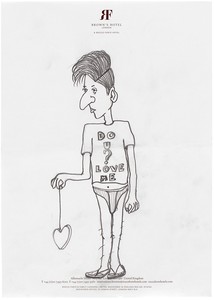
I didn’t marry, but I did make my first real work of art. It was about love, but at the same time it told love to go fuck itself. That bourgeois love, made of hypocrisy and little rules to be broken whenever necessary. Like holding hands—the signal in code to tell the others, the loners, the losers, the widows and widowers: “Look how much we’re in love . . . the two of us.” This physical, public, artificial union, with the illusion and the hope that thoughts would also go hand in hand, along with desires. I wasn’t cut out for that kind of love. Girls left me or I left them because I didn’t want to hold hands. I needed my hands to carry my bicycle, my true companion from which I could not be separated. Without the bike I felt really alone, truly disarmed. The bicycle was the best escape route from a relationship, an argument, a discussion. As soon as things went sour, I was already on the bike and pedaling for all I was worth, never looking back, deaf to insults, shouts, and sobs. Girls hated the fact that I showed up on dates with my bike. They always asked me to park it someplace, and I would invent all kinds of excuses to avoid the separation. Once, one of my girlfriends managed to chain the bicycle to a pole and steal the key, which she returned to me only the next morning. In short, the bike was my way of defying familiar, intimate, bourgeois conventions.
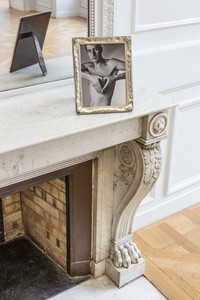
This is why the first work of art I made was called Lessico familiare (Family Syntax). That was in 1989. The Berlin Wall had been knocked down the previous evening. I stripped, and a friend of mine took a photograph of me holding my hands in front of my chest, imitating the form of a heart. Then one day I went to one of my girlfriends’ parents’ homes and saw an empty silver frame on a cabinet—one of those things people get as a wedding present. I stuck it in my bag and took it home. When I got back I inserted the black-and-white photo of me with my hands making a heart.
That was my first work of art. It was so simple. So immediate. So banal. It was 100% me—as I could never be again. The wall that divided my identity in two had been knocked down. On one side, the free loser, on the other, the artist, who would be chained to his ambitions from that moment on. Two Cattelans became one inside that silver frame. The silver frame was art, or the conventions of art, and I had put myself in there. I would always be trapped inside that frame. Two souls had become one. But I have always missed that twin who lived inside me, that second, wiser Cattelan who was hidden in my gut. As an artist, I would always talk to him. That Mini-Me, which would later also become one of my sculptures.
Francesco Bonami has curated more than one hundred exhibitions, among them the Biennale di Venezia of 2003 and the Whitney Biennial of 2010. He writes for ARTnews and Vogue Italia. His most recent books include Bello, sembra un quadro. Controstoria dell’arte (Feltrinelli, 2022) and The Spinster’s Poem: 101 Bonaku, with a forward by Richard Prince (2023).