On the occasion of the exhibition Francesca Woodman: Lately I Find a Sliver of Mirror Is Simply to Slice an Eyelid at Gagosian, Rome, Alyce Mahon explores the artist’s engagements and affinities with Surrealism, from the writings of André Breton to the photographs of Hans Bellmer. Mahon focuses on the time Woodman spent in Rome while she was a student at the Rhode Island School of Design.
Alyce Mahon is Professor of Modern and Contemporary Art History at the University of Cambridge. She is the author of Surrealism and the Politics of Eros, 1938–1968 (2005), Eroticism & Art (2005), The Marquis de Sade and the Avant-Garde (2020), and Dorothea Tanning: A Surrealist World (2026), as well as of numerous essays.
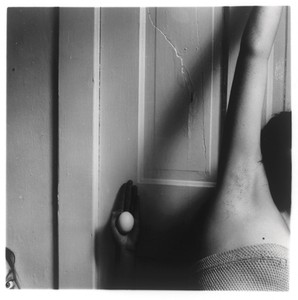
In her 1975 essay “My First Brush with Infinity,” Francesca Woodman writes of brushing in temporal terms, as unbounded, and in physical terms, in relation to objects including “hairbrushes, shoebrushes, snaggletoothed toothbrushes, brushes for paint.”1 The verb and object “brush” perfectly encapsulates Woodman’s work in this exhibition as her camera lightly touches time and things, uniting diverse mise-en-scènes through a consistently sensual play. In Untitled (c. 1975–78) we find a female nude tumbling out of a closet where the curious motif of a door set ajar adds an erotic frisson—it is neither open nor closed; in Untitled (c. 1979–80) we see an egg delicately held in the palm of one person and in proximity to the raised arm of another, such that the mood of presence and absence is poetically staged across the cupped egg and the concave armpit.
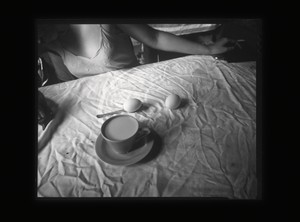
Woodman does not stage commonplace things—whether “careless crockery,” florid wallpaper, or fish and lemons—as dream objects in themselves but as objects that spark the dream.2 She brings together random objects, animate and inanimate, in a peculiarly surrealist appreciation of how “two different bodies, rubbed one against the other, attain through that spark their supreme unity in fire,” to borrow words from André Breton.3 In his novel Nadja (1928), which Woodman loved, Breton applies this sense of the “rubbed” to people, places, and objects in order to explore the creative tension between the real and the imaginary. He writes, for example, of a woman’s blue glove as the personification of both the fulfillment and the loss of desire: It suggests not only the lady’s hand it could warm but “leaving that hand forever.”4 Breton’s seemingly random use of some forty-four photographs in Nadja inspired her, and her expressed ambition to create “images as an alternative to everyday life: Places for the viewer to dream in” echoes his aesthetic in the novel.5 Her eye sought out the unconscious in the conscious world—the essence of surreality. Through compositional approaches and techniques including long exposure and slow shutter speeds, she appreciated and extended how photography could stage “another nature that speaks to the camera [rather] than to the eye: other in the sense that a space informed by human consciousness gives way to a space informed by the unconscious,” as Walter Benjamin described the medium.6
Many of the works in the Rome exhibition were produced while Woodman was living in that city in 1977–78, as a participant in the Rhode Island School of Design European Honors overseas-study program. Her friendship with the circle around a bookstore called the Libreria Maldoror, run by Giuseppe (Cristiano) Casetti and Paolo Missigoi, and her use of the store as a kind of curiosity cabinet of books, journals, and postcards from which to glean new aesthetic ideas, would prove critical for her engagement with Surrealism. The bookstore’s name was an homage to the poet Isidore Ducasse, who wrote under the name Comte de Lautréamont and whose curious description of the beauty of a young Englishman named Mervyn as “the fortuitous encounter upon a dissecting table of a sewing machine and an umbrella” long intrigued the Surrealists.7 The element of near and possibly violent contact between these two objects—a running sewing machine could break an umbrella if they came in contact—serves as a poetic metaphor for the ways in which pairing can be both pleasurable and painful and is always performative.
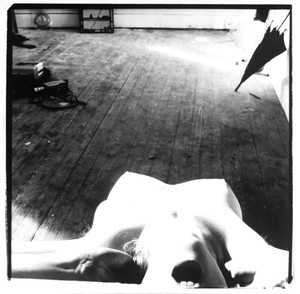
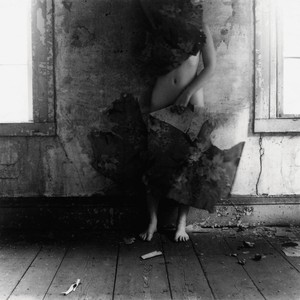
Woodman’s knowledge of Lautréamont is evident in earlier work, reminding us of her wide reading and of the powerful dialogue between her images and certain texts. In Untitled (c. 1977), her naked torso and open mouth reach back almost orgasmically out of the picture frame while a prominent and clearly lit black umbrella stands propped against the wall, marking a direct visual line to her breasts. Objects are not owned but are malleable in Woodman’s work, serving to bring the surreal into the lived space, whether it be the studio, an abandoned house, or nature. In this way their usefulness takes on a new understanding: They morph into vessels for novel encounters between strangers or strange things. This again complements Breton’s advice in his text “Crisis of the Object” (1936) that “objects seen in dreams should be manufactured and put into circulation . . . however unusual their appearance might turn out to be,” and, critically, that he hoped this would “entail the depreciation of those objects of often dubiously accepted usefulness which clutter up the so-called real world.”
Food is equally open to Woodman’s sense of surreal play and exchange, and to the way she situates objects in their geographic locale, as if the viewer were a fellow surrealist. In the Fish Calendar photograph series (1977) she uses six fish, three lemons, and her body to enact a symbolic play in which beauty and violence again weave in and out of each other under the wider conceptual challenge of a diaristic exercise concerning a week in March. Within this fixed temporal system, she stages the gradual disrobing of her own body and the skin of the lemons such that the touch of time is palpable; in turn, the silver fish serve as witnesses that both mark the date and extend Woodman’s subversive play with the memento mori tradition. In a letter she notes the burgeoning stench of fish across the week of the exercise, a detail revealing her sense of both dedication and humor.
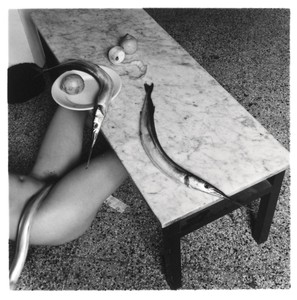
Two untitled works and Anguilla #2, all of 1978, see her pairing her body with a further Roman delicacy: a bowl of eels, or capitoni, purchased at a local market. Black and white film allows her camera lens to linger over the tension between crisp and blurred forms (the black and white floor, the white bowl, the coiled black eels), willing the viewer in turn to linger over the touch of the warm and cold, dry and wet surfaces. The composition invokes Surrealist metamorphosis and the mythological figure Mélusine, half woman, half serpent, beloved by the Surrealists as a symbol of the magical within the everyday.8 In a notebook Woodman sketched a body, eels, and a bowl in three stamp-sized line drawings in pencil. Above, she wrote “Eels, go get eels in the bucket at 7.00. Arrange white plate and lemon,” yet the final photographs rely on lighting, use of close-up, and cropping to go beyond the arrangement of materials and enact an open conceptual play.9 Woodman’s body blurs in each picture and the eels are systematically staged to defy any pinhole, central view. Together, form and framing defy a controlling optical perspective, favoring instead a gaze best understood as “haptic” where “the eyes themselves function like organs of touch,” as defined by Laura Marks.10
A page in Woodman’s 1976 notebook includes a sketch titled “my photo with glass.” Viewing this sketch alongside the photograph series that she developed out of it, in which she poses naked in a chair with a pane of glass pressed against her flesh, demonstrates how she repeatedly and attentively pursued this haptic gaze.11 While she was ostensibly working with the classical subject matter of a female nude in an interior, the glass allowed her to defy the expectation of mimesis, in which art is seen as a window on the world. The hair on her head meets her pubic hair, her navel and stomach are abstracted into a treelike column, and there is a sense that the unruly female body is encasing the glass rather than submitting to it.
Hard Edge and Breast (1976) uses the same location, chair, and glass pane to again refuse stillness or fixity. The edge of the glass plane flattens Woodman’s left breast, as if it were a specimen under magnification, making a jarring contrast with her pert, relaxed right breast; in this simple but stark way Woodman makes artifice and nature literal. Her use of the glass pane has been compared to Ana Mendieta’s Untitled (Glass on Body Imprints) of 1972, in which Mendieta pressed a pane of glass against her face and naked body in a performance traced in thirty-six slides; but where Mendieta’s work drew attention to the regulation, distortion, and pain of the female body, Woodman’s explores the idea of two states slipping between each other—imprisoned and liberated, hard and soft.12 As she wrote, “Glass makes a nice definition of space because it delineates a form while revealing what is inside. It is also a cold and somewhat harsh material.”13 If Rosalind Krauss reads this series as a formal exploration of the self “as a medium, a conduit, a plane of passage,” I suggest that the glass must also be appreciated as an erotic conduit, exploring the pleasure of looking as well as of being looked at.14 Through Woodman’s compositional play with a glass frame within a photographic frame, interior and exterior interpenetrate.
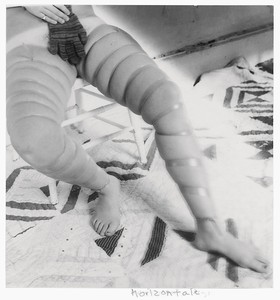
Woodman’s interest in the camera as an extension of the haptic eye is evident in works that precede and follow her time in Rome, but the ancient city undoubtedly encouraged her to draw out the themes of phantasmagoric desire and the sexual dynamics of display. In Horizontale or Horizontal Legs (1976) we see her binding her flesh with tape—probably in homage to Hans Bellmer’s collaborative photographs of his lover Unica Zürn from 1958—but her Roman works take these experiments in new directions.15 Witness her reference to Max Klinger’s Symbolist etching series Paraphrase über den Fund eines Handschuhs (Paraphrase on the Finding of a Glove, 1877–78), which she discovered at the Libreria Maldoror, in the photographs she enacted in the historic Bar Fassi with her friend the artist Sabina Mirri and a pair of black leather gloves. The gloves gesture across the photographs as they first cover and then uncover hands, titillatingly suggesting the performative nature of desire in a subtle yet stripteaselike fashion. Where Klinger used the glove as a fetishistic reference to the desired, passive woman, Woodman allows it to return the sexual gaze, activating new, unwritten stories for and by females. In this respect these photographs recall Meret Oppenheim’s Object (1936), in which a dainty teacup, saucer, and spoon are clothed in soft gazelle fur, defying the Freudian conception of fetishism that constructs woman as passive, castrated, and receptacle only.16 In the public space of the Bar Fassi, Woodman also plays with the common “feminine” object and allows it to take on an anamorphic agency—it becomes its own protagonist. The male flaneur gives way to the female flaneuse, creatively free to wander the streets and café world (the haunt of the avant-garde) in a way impossible for the young Nadja in the late 1920s but perfectly possible for the young Woodman in the late 1970s.
Woodman’s work references the avant-garde with the benefit of the advances of first-wave feminism, when both art historians and women artists focused on representations of the female body as a means either to repress or to assert agency. At the same time, she was adamant that her work was not activist but rooted in the poetic. As she explained in a letter to the Italian photography-magazine editor Alberto Piovani in 1979, “The allusions to sex in my work do not stem from any modern political or feminist concerns but from a more general preoccupation with morals—often in a literary sense.”17 Yet her focus on the still-life object, as well as on woman as still life, allows us to appreciate how her “literary sense” always retains a subversive edge. As Norman Bryson reminds us, “Still life bears all the marks of this double-edged exclusion and nostalgia, this irresolvable ambivalence which gives to feminine space a power of attraction intense enough to motor the entire development of still life as a genre, yet at the same time apprehends feminine space as alien, as a space which also menaces the masculine subject to the core of his identity as male.”18 Woodman’s work subtly engages with such cultural associations just as her compositions nostalgically echo vestiges of the past.
Woodman invites the viewer to move across time, objects, morals, and their literary and visual representation. She knows the particular symbolism involved in the dynamic between space and sexuality around the objects on which she focuses—namely, how the nude as a form of art has a “certain timeless, personal but allegorical quality,” as she wrote in a letter of 1979.19 Equally in staging the body beside commonplace still-life objects that seem to morph into surrealist ones, and in antique or ruined sites with antiquated or crumbling walls, her camera lens refutes the work of the photograph as document and instead enjoys its painterly potential. Most of all she imbues the medium with a literary quality, uniting what she termed “an allegorical quality” with photography’s potential for “the rough edge.”20 This sense of the roughness, the brushing, of edges holds firm. She wrote of the academic or museum-style display case as “a container to be looked into” in contrast to her own work, which explored the idea of “enclosing” the looker and the looked at.21 Woodman defies the objectifying vision of strangers in favor of strangers coming together, if only for a moment.
1 Francesca Woodman, “My First Brush with Infinity,” c. 1975. Francesca Woodman Collection, Woodman Family Foundation Archives, New York.
3 André Breton, Les Vases communicants, 1932, Eng. trans. as Communicating Vessels, trans. Mary Ann Caws and Geoffrey T. Harris (Lincoln and London: University of Nebraska Press, 1990), p. 109.
4 Breton, Nadja, 1928, Eng. trans. Richard Howard (London: Penguin Books, 1999), p. 56.
5 Woodman, draft of application for a Fulbright for graduate study abroad, 1980. Francesca Woodman Collection, Woodman Family Foundation Archives, New York.
6 Walter Benjamin, “Kleine Geschichte der Photographie,” 1931, Eng. trans. as “A Small History of Photography,” in One Way Street and Other Writings, trans. Edmund Jephcott and Kingsley Shorter (London and New York: Verso, 1997), p. 243.
7 Isidore Ducasse, Les Chants de Maldoror, 1869, Eng. trans. Guy Wernham (New York: New Directions, 1965), p. 205.
8 Since Breton writes of “the elusive character Melusina” in Nadja, we know that Woodman was familiar with the mythology. Breton, Nadja, p. 106.
9 Woodman, notebook entry, c. 1978. Francesca Woodman Collection, Woodman Family Foundation Archives, New York.
10 Laura U. Marks, Touch: Sensuous Theory and Multisensory Media (Minneapolis: University of Minnesota Press, 2002), p. 2.
11 Woodman, notebook entry, 1976. Francesca Woodman Collection, Woodman Family Foundation Archives, New York.
12 See, for example, Helaine Posner, “The Self and the World: Negotiating Boundaries in the Art of Yayoi Kusama, Ana Mendieta, and Francesca Woodman,” in Whitney Chadwick, ed., Mirror Images: Women, Surrealism, and Self-Representation (Cambridge, MA: MIT Press, 1998), pp. 156–71.
13 Woodman, notebook entry, 1976. Francesca Woodman Collection, Woodman Family Foundation Archives, New York.
14 Rosalind Krauss, Bachelors (Cambridge, MA: MIT Press, 1999), p. 173.
15 Scholars who have made the formal comparison between Woodman’s photographs and Hans Bellmer’s and Unica Zürn’s have overlooked the collaborative nature of the earlier couple’s works, a necessary consideration for a more nuanced reading of Woodman’s engagement with them. See Alyce Mahon, “Hans Bellmer’s Libidinal Politics,” in Raymond Spiteri and Donald LaCoss, eds., Surrealism, Politics and Culture (Aldershot, Hants., and Burlington, VT: Ashgate, 2003), pp. 246–66. For a Bataillean reading of Woodman’s interest in the formless see Isabella Pedicini, Francesca Woodman. The Roman Years: Between Flesh and Film (Rome: Contrasto, 2012), pp. 88–93.
16 On Meret Oppenheim’s engagement with Sigmund Freud see Alyce Mahon, Eroticism and Art (Oxford: Oxford University Press, 2005), pp. 136–38.
17 Woodman, draft correspondence to Alberto Piovani, 1979. Francesca Woodman Collection, Woodman Family Foundation Archives, New York.
18 Norman Bryson, Looking at the Overlooked: Four Essays on Still Life Painting (London: Reaktion Books, 1990), pp. 172–73.
Alyce Mahon is Professor of Modern and Contemporary Art History at the University of Cambridge. She is the author of Surrealism and the Politics of Eros, 1938–1968 (2005), Eroticism & Art (2005), The Marquis de Sade and the Avant-Garde (2020), and Dorothea Tanning: A Surrealist World (2026), as well as of numerous essays.