Richard Serra: Steve Reich’s “Music for Pieces of Wood”
In this video, musical ensemble Sō Percussion performs Steve Reich’s “Music for Pieces of Wood” inside the exhibition Richard Serra: Running Arcs (For John Cage), 1992, at Gagosian, New York.
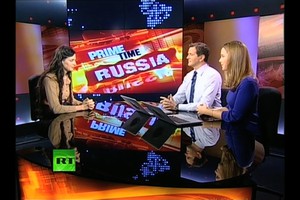
Taryn Simon
Cutaways, 2012 (still)
Single-channel video, color, sound, 3 min. 4 sec., edition of 3 + 2 AP
© Taryn Simon
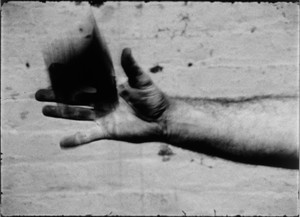
Richard Serra
Hand Catching Lead, 1968 (still)
16mm film, black and white, silent, 3 min., Circulating Film and Video Library, Museum of Modern Art, New York
© 2020 Richard Serra/Artists Rights Society (ARS), New York
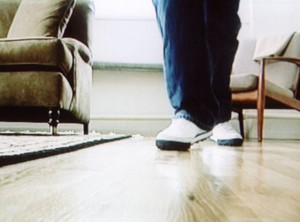
Douglas Gordon
Domestic (as long as it lasts), 2002 (still)
Single-channel video (color, silent, 13 min. 58 sec.) and monitor, edition of 3 + 1 AP
© Studio lost but found/VG Bild-Kunst, Bonn, Germany, 2020
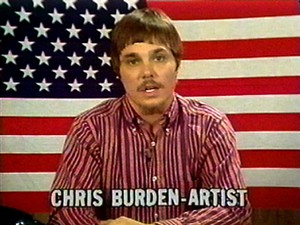
Chris Burden
The TV Commercials 1973–1977, 1973–77/2000 (still)
Video, color, sound, 3 min. 46 sec.
Edited by Peter Kirby, Media Art Services
© 2020 Chris Burden/Licensed by the Chris Burden Estate and Artists Rights Society (ARS), New York. Courtesy Electronic Arts Intermix (EAI), New York
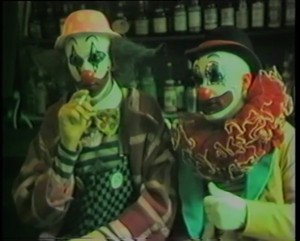
Damien Hirst and Angus Fairhurst
A Couple of Cannibals Eating a Clown (I Should Coco), 1993 (still)
Video, color, sound, 22 min. 10 sec.
© Estate of Angus Fairhurst, courtesy Sadie Coles HQ, London, and © Damien Hirst and Science Ltd. All rights reserved, DACS 2020
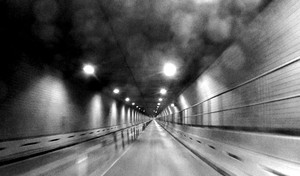
Adam McEwen, “Lincoln Tunnel,” from Escape from New York, 2014 (still)
Four-channel video projection, black and white, silent, 2 min. 42 sec. (looped), edition of 2 + 1 AP
© Adam McEwen
You’re only as young as the last time you changed your mind.
—Timothy Leary
Broadcast: Alternate Meanings in Film and Video employs the innate immediacy of time-based art to spark reflection on the here and now. Looking to the late 1960s—a historical moment marked by deep uncertainty, social unrest, and radical transformation—Broadcast loosely adopts famed psychologist and countercultural icon Timothy Leary’s mantra “turn on, tune in, drop out” as a guide for negotiating our present moment.
The opening chapter features six artworks that, despite their varied inspirations and contexts, share a desire to explore differing experiences of reality. The series “turns on” with a video by Taryn Simon and a film by Richard Serra that present distinct approaches to developing self-awareness, either through interrogations of mass-media conventions or by staging actions that test the limits of the body. In the second section, Douglas Gordon and Chris Burden “tune in” to external surroundings and circumstances, whether one’s immediate environment or the thrall of broadcast television, respectively. Finally, Damien Hirst and Adam McEwen each present durational work that stages mechanisms to “drop out” of the norms and confines structuring daily life.
Each chapter of Broadcast will introduce a new set of films and videos on Tuesdays. The next chapter will debut on June 2.
“Turn On”
Taryn Simon
Cutaways, 2012
At the close of the taping of a video interview for Prime Time Russia in Moscow, Simon was asked to sit in silence and stare at the newscasters for several minutes so that the producers could gather additional footage for the editing process. Cutaways (2012) presents this footage as an autonomous work.
Richard Serra
Hand Catching Lead, 1968
Serra’s first-ever film, Hand Catching Lead (1968), comprises a set of repetitive actions centered on a human fist attempting to grasp—and therefore manipulate—pieces of lead dropped from above the camera frame. According to the artist, the film came about following a request to make a documentary about the construction of his sculpture House of Cards (1969). Recognizing the limitations of the documentary genre as purely illustrative, Serra was inspired by contemporary avant-garde films such as Yvonne Rainer’s Hand Movie (1966).
“Tune In”
Douglas Gordon
Domestic (as long as it lasts), 2002
Domestic (as long as it lasts) was made in 2002 in Gordon’s one-bedroom apartment in downtown New York City. It shows the artist’s foot repeatedly kicking the camera around a clean, quiet domestic space until the video blacks out. The victim of the booting, the camera itself, is recording the footage we see. The viewer is disoriented by the film’s upsetting of the conventional relationship between documenting and participating, which makes the camera complicit in the act.
Chris Burden
The TV Commercials 1973–1977, 1973–77/2000
The TV Commercials 1973–1977 (1973–77/2000) is a compilation of four video works—TV Ad (Through the Night Softly) (1973), Poem for L.A. (1975), Chris Burden Promo (1976), and Full Financial Disclosure (1977)—that were aired as purchased spots on television between 1973 and 1977. Burden notes: “During the early ’70s I conceived a way to break the omnipotent stranglehold of the airwaves that broadcast television had. The solution was to simply purchase commercial advertising time and have the stations play my tapes along with their other commercials.”
“Drop Out”
Damien Hirst and Angus Fairhurst
A Couple of Cannibals Eating a Clown (I Should Coco), 1993
Filmed by Gregor Muir, A Couple of Cannibals Eating a Clown (I Should Coco) (1993) centers on a conversation between Hirst and Fairhurst, who are dressed as circus clowns with makeup done by Leigh Bowery. Set in Green Street, a private club in Mayfair run by Orlando Campbell during the 1990s, the video is rife with contradictions as the beloved children’s characters chain-smoke, drink heavily, and spray each other with silly string while recounting gruesome and macabre stories of death and injury.
Adam McEwen
Escape from New York, 2014
Using looped footage shot on an iPhone camera, Escape from New York (2014) captures the monotonous, almost hypnotic experience of speeding outbound through the four major tunnels (Brooklyn Battery, Holland, Lincoln, and Queens Midtown) that act as central access routes to the island of Manhattan. Lulled by the rhythmic curves and uniform environment of such a setting, the viewer develops a sense of anticipation for the cathartic freedom from the repetitions of the closed surroundings. Yet with a literal light at the end of the tunnel, the video abruptly cuts to the beginning of the footage, circumventing the awaited effects of liberation. The excerpt shown here documents the entirety of a single outbound trip through the Lincoln Tunnel.
In this video, musical ensemble Sō Percussion performs Steve Reich’s “Music for Pieces of Wood” inside the exhibition Richard Serra: Running Arcs (For John Cage), 1992, at Gagosian, New York.

Tracking works by Chris Burden, Bruce Nauman, Maria Nordman, and Eric Orr as outliers and outcroppings of the California Light and Space movement, Michael Auping argues that darkness—the absence of light and space—is a key element of the aesthetic.

Last fall, Taryn Simon debuted an interactive sculpture entitled Kleroterion (2024). Based on a device from the beginnings of democracy in Athens, the work was installed at Storm King Art Center, New Windsor, New York. As part of that presentation, Simon participated in a panel discussion with Nora Lawrence, Tomás González Olavarría, and Philip Lindsay about democracy, sortition, and art’s place in politics.

As American identity once again comes into question during a politically charged election cycle, the Quarterly revisits the motif of the American flag in art. Here, John B. Ravenal contextualizes Robert Lazzarini’s new wall-based flag sculptures and elucidates the tensions they lay bare in the symbol of our nation.
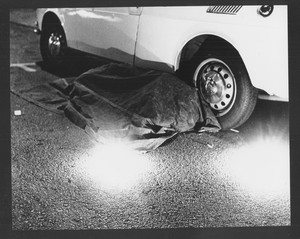
Sydney Stutterheim has published Artist, Audience, Accomplice: Ethics and Authorship in Art of the 1970s and 1980s (Duke University Press, 2024), a survey of performance art and related practices that involve, in various manners, the figure of the accomplice. To celebrate the publication, the Quarterly is publishing an excerpt that examines Chris Burden’s Deadman (1972).
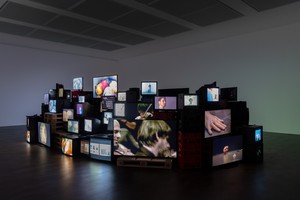
On the occasion of Douglas Gordon: All I need is a little bit of everything, an exhibition in London, curator Adam Szymczyk recounts his experiences with Gordon’s work across nearly three decades, noting the continuities and evolutions.
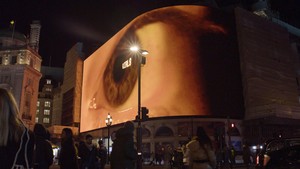
Douglas Gordon took over the Piccadilly Lights advertising screen in London’s Piccadilly Circus, as well as a global network of screens in cities including Berlin, Melbourne, Milan, New York, and Seoul, nightly for three minutes at 20:22 (8:22pm) throughout December 2022, with his new film, if when why what (2018–22). The project was presented by the Cultural Institute of Radical Contemporary Art (CIRCA) in conjunction with the exhibition Douglas Gordon: Neon Ark at Gagosian, Davies Street, London.
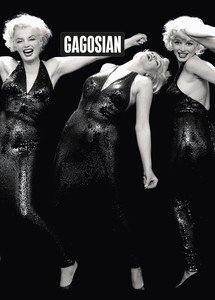
The Summer 2023 issue of Gagosian Quarterly is now available, featuring Richard Avedon’s Marilyn Monroe, actor, New York, May 6, 1957 on its cover.
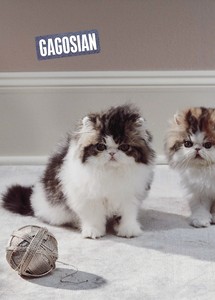
The Spring 2023 issue of Gagosian Quarterly is now available, featuring Roe Ethridge’s Two Kittens with Yarn Ball (2017–22) on its cover.
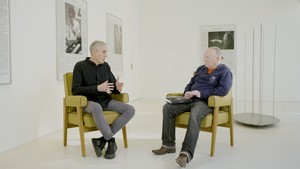
In conjunction with his exhibitions Adam McEwen at Gagosian in London, and Adam McEwen: XXIII at Gagosian in Rome, the artist sits down with author Ian Penman to discuss his new obituary works and graphite sculptures.
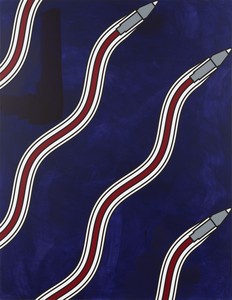
Contemporary artists Adam McEwen and Jeremy Deller met up online over the holiday season to discuss McEwen’s upcoming exhibitions in London and Rome. McEwen delves into the motivations and criteria behind his work, as well as the challenges and complexities of memorializing the living.
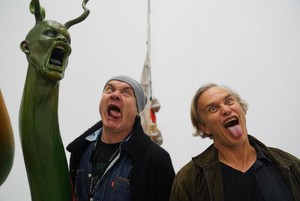
In conversation with James Fox, Damien Hirst reflects on the artwork of his longtime friend.
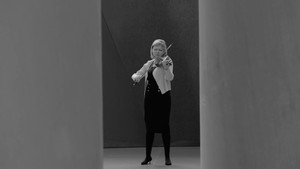
Violinist Alina Ibragimova performs Bach’s Sonata for Solo Violin No. 1 in G Major: Adagio (BWV 1001, c. 1720) from within Richard Serra’s sculpture Transmitter (2020) at Gagosian, Le Bourget. Organized by Bold Tendencies, a nonprofit organization that commissions artists to produce site-specific projects and present performances, in collaboration with Gagosian, this recorded performance took place on May 8, 2022 before a live concert of Olivier Messiaen’s Quatuor pour la fin du temps (Quartet for the End of Time, 1941).
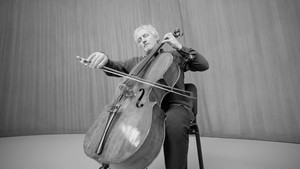
Cellist Mario Brunello performs Bach’s Cello Suite No. 1 in G Major: Prelude (BWV 1007, c. 1717–23) within Richard Serra’s sculpture Transmitter (2020) at Gagosian, Le Bourget. Organized by Bold Tendencies—a nonprofit that commissions artists to produce site-specific projects and present performances—in collaboration with Gagosian, this recorded performance took place on May 8, 2022, before a live concert of Olivier Messiaen’s Quatuor pour la fin du temps (Quartet for the End of Time, 1941).
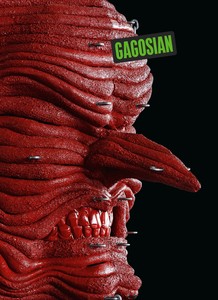
The Fall 2022 issue of Gagosian Quarterly is now available, featuring Jordan Wolfson’s House with Face (2017) on its cover.
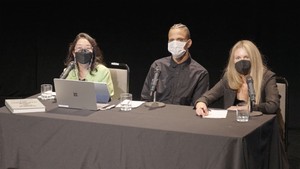
Join Gagosian to celebrate the publication of Poetic Practical: The Unrealized Work of Chris Burden with a conversation between American Artist, Yayoi Shionoiri, and Sydney Stutterheim presented at the Kitchen, New York. Considering the book’s sustained examination of sixty-seven projects that remained incomplete at the time of Burden’s death in 2015, the trio discuss the various ways that an artist’s work and legacy live on beyond their lifetime.
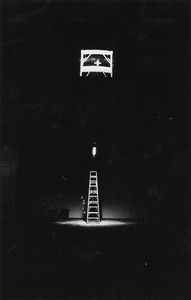
Michael Auping tells the Quarterly’s Alison McDonald about the preparations for a performance by Chris Burden at the Newport Harbor Art Museum in Southern California in 1974—and the event’s abrupt cancellation—providing a glimpse into the mindset of a young, aggressive, and ambitious artist in the early stages of his career.
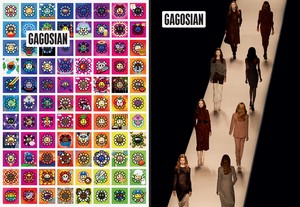
The Summer 2022 issue of Gagosian Quarterly is now available, with two different covers—featuring Takashi Murakami’s 108 Bonnō MURAKAMI.FLOWERS (2022) and Andreas Gursky’s V & R II (2022).
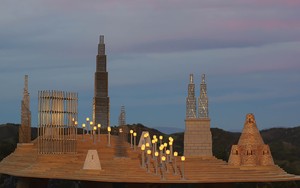
A new publication exploring the work that Chris Burden conceived but left unrealized delves into his archive to present sixty-seven visionary projects that reveal the aspirations of this formidable artist. The book’s editors, Sydney Stutterheim and Andie Trainer, discuss its development with Yayoi Shionoiri, executive director of the Chris Burden Estate.
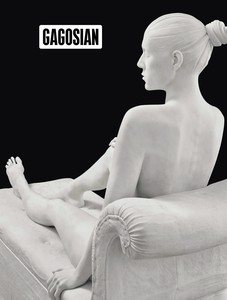
The Fall 2021 issue of Gagosian Quarterly is now available, featuring Damien Hirst’s Reclining Woman (2011) on its cover.