November 12, 2014

avedon/versace

In the history of photographer and fashion brand collaborations, the relationship between Richard Avedon and Gianni Versace stands out as pioneering. Derek Blasberg takes a moment to appreciate the collaboration between Richard Avedon and Gianni Versace for the 1993 Spring/Summer Versace campaign.

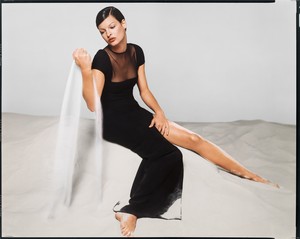
Richard Avedon, Linda Evangelista, Versace Spring/Summer 1993 campaign, New York, November 1992, 1992

Richard Avedon, Linda Evangelista, Versace Spring/Summer 1993 campaign, New York, November 1992, 1992

Richard Avedon, Linda Evangelista, Versace Spring/Summer 1993 campaign, New York, November 1992, 1992

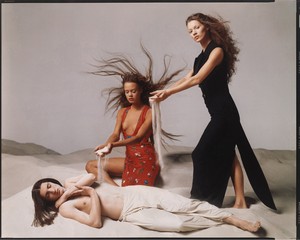
“I can remember that shoot like it was yesterday,” pronounces Naomi Campbell, about the Spring/Summer 1993 Versace campaign, which was lensed by the groundbreaking Richard Avedon, and was photographed in November of 1992, in New York City. “I know it was a long time ago, but even in that moment you knew you were creating something special.” In the history of fashion photography, special may be an understatement. The campaign, which imagines the 1990s supermodels as glamorous female warriors trudging through a graying desert adorned only in their decadent Versace, remains one of the most memorable—and most emulated—series of fashion images. “It’s an absolute surrender to glamour,” Glenda Bailey, editor in chief of Harper’s Bazaar, says of the campaign. “It is both powerful and sensual. It perfectly summed up the spirit of that moment, of the sort of powerful and sexy person that women still want to be.

Gagosian quarterly weekend reads

Get the best of the Quarterly in your inbox twice a month.

By subscribing you agree to our Privacy Policy.

Richard Avedon, Nick Moss, Aya Thorgren, and Kate Moss, Versace Spring/Summer 1993 campaign, New York, November 9, 1992, 1992, color coupler print

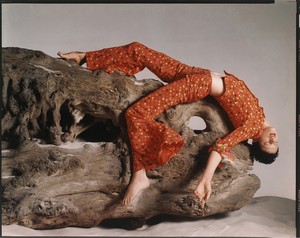
Gagosian is honored to show, as part of Paris Photo 2014, the thirty-two images by Avedon that record this collection. All prints are unique, and they are signed by the photographer. This particular grouping is special as it was one of the few times that Avedon printed his photographs in color, although many of his images were reproduced in vivid hues within the many magazines with which he worked during his lifetime. This series is one of the best examples of the sheer ambition and scale of Avedon’s legendary campaigns with Gianni Versace. (In addition to Campbell, other 1990s supermodels featured in the campaign include Linda Evangelista, Shalom Harlow, Kristen McMenamy, Kate Moss, Nick Moss, Stephanie Seymour, Aya Thorgren, Christy Turlington, and Yvette.)

Avedon, the lifelong New Yorker with an exacting eye, and Versace, the flamboyant Italian fashion designer known for his baroque flair, may not have seemed likely collaborators. But, says Bailey, when they came together lightning struck. “They both had this tremendous energy. They were unbounded in the passion for all things beautiful. They were indulgent in the passion and the freedom to enjoy the moment.” She recalls Versace at the dinners he would throw in his Milan mansion after his fashion shows, picking up a guitar and leading a sing-along. “And Avedon created the party too. He had a fabulous sense of humor, and both of them had the energy to create a special world. These pictures represent the perfect experience of absolute joy and beauty.”

Richard Avedon, Kristen McMenamy, Versace Spring/Summer 1993 campaign, New York, November 9, 19921992, color coupler print 

It appears that everyone on set that day felt like they had experienced a creative epiphany. Seymour says it’s one of her most memorable photo shoots, and she still recalls how Avedon would incorporate a special narrative into each shot. “Before each picture, Dick would get us all together and describe the ‘story’ and what parts he wanted us each to play. That’s why all the pictures turned out so dramatic.” Campbell remembers what it was like on that set too, “That was a major production. We would be dressed, we would be positioned one by one, and then they’d have to set up the sand and the set, then he’d adjust that beautiful Avedon lighting that he was so famous for,” she says. Further, Campbell jokes that only Avedon could get her off the telephone, “You won’t believe this, but for him I would turn my phones off. He would come into the dressing room and sit down next to you, he wanted to know what was going on. He would tell you funny stories from the past and make you feel comfortable.”

Warmth, and the ability to make a woman feel confident, were qualities that Versace and Avedon had in common. After all, a remarkable aspect about this series is how the pictures can evoke the spirit of a fashion brand, beyond the clothes themselves. According to Bailey, “It was about taking the clothes off. He could sell the spirit of the lifestyle without even showing the clothes, and that says as much about the brand as keeping the clothes on. Only Avedon could get that.”
Artwork © 2014 The Richard Avedon Foundation

Black-and-white portrait of Derek C. Blasberg

Derek C. Blasberg is a writer, fashion editor, and New York Times best-selling author. He has been with Gagosian since 2014, and is currently the executive editor of Gagosian Quarterly.

See all Articles

Inez van Lamsweerde

In Conversation
Inez van Lamsweerde

The photography duo Inez & Vinoodh switched gears to guest edit an issue of Aperture magazine. Not only did they submit work, they mined their own creative influences and inspirations to produce what they refer to as “what it’s like to get in their head.” Derek Blasberg spoke to Inez about the process of their work, as well as the process of editing the magazine.

Alex Israel: Upside Down

Alex Israel: Upside Down

Ahead of Alex Israel’s exhibition of four new Fin sculptures at Gagosian, London, the artist spoke with Susan Casey, author of The Wave: In Pursuit of the Rogues, Freaks, and Giants of the Ocean (2010), about the ocean, surfing, and Los Angeles.

Simon Hantaï: The Paradox of the “last studio”

Simon Hantaï: The Paradox of the “last studio”

On July 9, Simon Hantaï: the last studio opens at Gagosian, Gstaad. Curated by Anne Baldassari, the show comprises sixteen of the artist’s dernier atelier (last studio) paintings of 1982–85. The exhibition is accompanied by an illustrated catalogue, copublished by Gagosian and Skira, which features an essay by Baldassari and an extensive portfolio of previously unpublished photographs by Édouard Boubat. Here, we share the introductory chapter from the publication.

Giuseppe Penone: The Reflection of Bronze

Giuseppe Penone: The Reflection of Bronze

Adam D. Weinberg has been working with Giuseppe Penone on an exhibition of the artist’s new sculptures, The Reflection of Bronze, that opens at Gagosian, New York, on April 22. The works explore the character and possibilities of bronze. Here, Weinberg considers Penone’s enduring engagement with the alloy and addresses the conceptual underpinnings of the exhibition’s three-room structure.

Henry Moore: Monumental Nature

Henry Moore: Monumental Nature

Laura Bruni writes about a major exhibition celebrating the work of the British sculptor Henry Moore at the Royal Botanic Gardens, Kew, London.

A Revolution in Jewels: Pomellato at Palais de Tokyo

A Revolution in Jewels: Pomellato at Palais de Tokyo

The exhibition Pomellato, Le Joaillier Révolutionnaire opened at Palais de Tokyo, Paris, on June 24. The Italian jewelry house’s trailblazing advertising campaigns—created by some of the most consequential names in photography—act as the narrative arc of the exhibition, curated by Alba Cappellieri. Here, Sarah Godfrey tracks Pomellato’s history, speaks with Cappellieri about what drew her to this project, and examines some of the key photographs from the show.

Georg Baselitz and the Possibilities of Print

Georg Baselitz and the Possibilities of Print

On the occasion of Baselitz: AVANTI! at the Museo Novecento in Florence, Italy, Holly EJ Black considers the roots and reverberations of Georg Baselitz’s printmaking.

Portrait of the Artist as a Young Choreographer: Emily Coates Dances Early Balanchine

Portrait of the Artist as a Young Choreographer: Emily Coates Dances Early Balanchine

Mark Franko considers how Emily Coates resurrects the spirit of George Balanchine’s American beginnings through archival research, spoken dialogue, and movement in her performance Tell Me Where It Comes From.

Savor “The Moment”

Savor “The Moment”

Carlos Valladares wades through the discourse around the musician and actress Charli XCX’s mockumentary, guiding us through its myriad references, from the Spice Girls to Andy Warhol.

Tradition and Innovation: The 2026 Loewe Foundation Craft Prize

Tradition and Innovation: The 2026 Loewe Foundation Craft Prize

The Loewe Foundation Craft Prize celebrates its ninth edition with an exhibition at the National Gallery Singapore.

Donald Judd: Patiently Constructed

Donald Judd: Patiently Constructed

From the perspectives of their respective fields, three international cultural figures—artist and designer Ronan Bouroullec, fashion visionary Michèle Lamy, and chef and restaurateur Enrique Olvera—reflect on Donald Judd’s work in furniture, the subject of recent exhibitions in South Korea and Japan.

Divine Emanations: Nymphs, Poets, and the Painter’s Palette

Divine Emanations: Nymphs, Poets, and the Painter’s Palette

Janne Sirén considers Anselm Kiefer’s new paintings, the subject of an exhibition at Gagosian, New York, entitled Seal My Ears Shut and I Shall Hear You Still.