This summer, the International Center of Photography, New York, is presenting Love Songs: Photography and Intimacy. Featuring the work of sixteen contemporary photographers, the exhibition is a “remix” of an earlier iteration at the Maison Européenne de la Photographie, Paris, organized by Simon Baker with curator Frédérique Dolivet and Pascal Hoël. The curator for the New York presentation, Sara Raza, met with one of the participating artists, Aikaterini Gegisian, and the Quarterly’s Wyatt Allgeier to discuss the distinctions between the two shows and the importance of—and complexities around—visual pleasure.
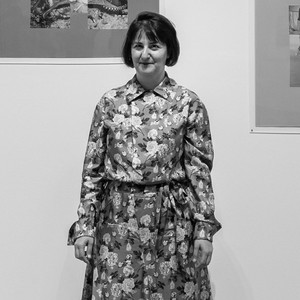
Aikaterini Gegisian is a visual artist and researcher. Her expanded photographic and moving image practice examines the role of diverse image histories in the production of gender and cultural identities. In 2015, she was one of the exhibiting artists at the Armenian Pavilion, 56th Biennale di Venezia, which received the Golden Lion for best national participation.
Sara Raza is an award-winning curator and writer specializing in global art and visual cultures from a postcolonial and post-Soviet perspective and is the author of Punk Orientalism: The Art of Rebellion (Black Dog Press, 2022). Raza has curated exhibitions and projects for international museums, biennials, and festivals including the Solomon R. Guggenheim Museum, New York; Galleria d’Arte Moderna, Milan; and the 55th Biennale di Venezia, among many others.
Wyatt AllgeierSara, could you speak about the genesis of this iteration of Love Songs? How did this project come to you, and what was your strategy for adapting it from the original presentation at the Maison Européenne de la Photographie in Paris?
Sara RazaThe original Love Songs exhibition at the MEP was initiated by Simon Baker and his colleagues. Many years ago, he and I worked together at Tate Modern, so we’re familiar with each other’s practice and interests. Subsequently, ICP [International Center of Photography] invited me to be the guest curator for the New York iteration. My task was to augment the exhibition, both making it more specific to New York audiences and expanding the international purview in terms of the artists included.
The idea of the love song and the lover’s mixtape, which was already embedded in the original selection of works and the curatorial thesis, was immediately appealing. I found it an attractive idea to think of an exhibition as a remix and about how, in my role as a second curator or guest curator, my hand would become an important tool for reordering. Several artists were removed and five new artists were added: Ergin Çavuşoğlu, Fouad Elkoury, Aikaterini Gegisian, Sheree Hovsepian, and Clifford Prince King.
WAThe metaphor of the mixtape is evocative. Not only is it about remixing, but it also evokes a gift to a lover. Does this idea of gifting—an exhibition as gifting, or an artwork as an intimately created and bestowed object—resonate with your respective practices?
Aikaterini GegisianIn art historical narratives, there is often an association between the “gift” and the idea of the muse, or the idea of the artist—male artists, usually—receiving inspiration through the muse in a relationship of love and exchange. But really, this is only part of the story; in the process of making art, there are elements that are related to love and to dedication, to commitment to one’s subject. I think during COVID there was a shift in thinking about artistic practices and the way that we relate to each other—the relationship of care and love became much more prominent in general. And for me specifically, it is critically important to present my work as a kind of gift rather than an intellectual or formal exercise.
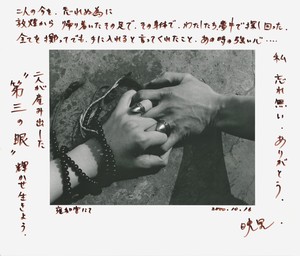
SRYou can see these themes within the show, particularly the idea that Aikaterini just mentioned of the muse. Many of the works actively subvert the male gaze or emancipate their subject from the male gaze. The work of Collier Schorr—particularly within the Angel Z body of work that is on view—focuses on queer bodies and subverts that standard idea of the female muse as an object captured by the male artist’s will.
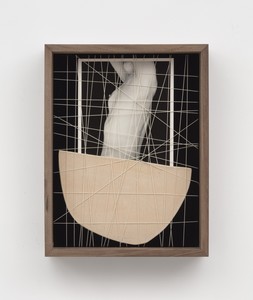
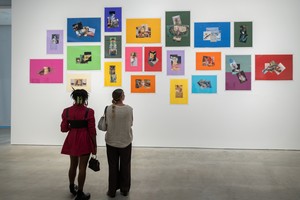
This approach to art historical references arises in different ways throughout the exhibition. In Aikaterini’s work, adult material produced largely for the consumption of male audiences is also intentionally subverted; she actively remixes it, pairing images of female and male bodies with images of nature, machines, and other materials found in books and magazines. New relationships start to emerge, which becomes interesting in the way we start to think about what gifts artists give us: new ways of thinking, multiple truths, and so forth.
AGMy practice is based in found material. From the beginning, what I was interested in were not official archives; I was interested in the books that circulate in people’s houses and end up in flea markets or secondhand bookshops. These are things that people see, an expression of popular culture—they create a sense of collective memory and maybe certain types of identities. If we are continuously surrounded by particular types of images, we identify with them. They become part of our lives and our way of thinking.
WAThere is a shifting threshold between an image that is intimate, erotic, amorous, and something that is more exploitative or fetishistic or made to be titillating. A lot of the works in the show plays with that boundary and push it or recoil from it or lean into it. From both of your perspectives, how does an artist maintain the complexity and seriousness of the topic without tipping over into something more tawdry?
SRWell, the idea of visual pleasure is important. We can’t pretend that engaging with the work in this show is devoid of any enjoyment. Like love, which certainly involves pleasure, there is always the possibility of distortion, contortion, and discomfort. It can be painful and sometimes violent. There’s a voyeuristic element, which is maybe perverse sometimes as well, that we take pleasure from somebody else’s story or somebody else’s pain, but I think that those emotional, somatic reactions leave an impact on the viewer. So there is power and responsibility involved in making images that exist on that threshold; the artists in this show do this extremely well.
AGThere is a specific acknowledgment in my practice of the images as sources of pleasure. That’s why you have these exuberant colors, especially in the collage series included in the exhibition, Handbook of the Spontaneous Other. My collage practice is an image-making process that draws from the formal, painterly aesthetic languages from East and West, from vernacular cultures, from feminist avant-garde practices, and beyond. In the West, we have learned to associate images with tools of propaganda or manipulation, with commodification, the fetishization of bodies, the objectification of female bodies, or the extraction of the bodies of others in colonial contexts. Within this kind of environment, images are always bad; they control us.
But how could it be so simple? I acknowledge that these critical practices investigate how images produce certain types of identities, but I’m also always interested in presenting or allowing for the idea of visual pleasure to enter back into conversation with my relationship to the audience and my relationship to the images themselves. For me, photography is not this kind of freezing of a moment by the violent act of the shutter clicking, which extracts and fixes images in time and space and produces that control; rather, I think of photography as the continuous creation of images, of images creating images creating images. Through pleasure, we find something generative and metamorphic—the process of different bodies coming into relationship with diverse environments, with other bodies, with the animal world, with nature, with technology. This continuous coming together opens all the possibilities of being intimate.
WAWhat do you hope audiences walk away with after seeing the exhibition, whether spiritually, intellectually, or emotionally? What kinds of shifts do you think are available for the audience encountering this exhibition?
SRI really hope that they’re able to see love as something that is not one-dimensional. Perhaps questions can begin to surface, like: What constitutes a relationship? What is the relationship with the other? What is it with the self? We’re in an unusual moment in our lives; we’ve just come out of this global pandemic during which the idea of human touch took on new meaning because we were deprived of it. For such a long time, our lives were relived through other people’s images, via social media, via Zoom. I think that’s going to play a role in the way people see this exhibition.
AGThat this exhibition includes such a multiplicity of viewpoints is very important. Some of them may be disturbing or not aligned with certain ways of thinking, but they are there, and they demand an opening up. If the exhibition can provoke that empathetic opening to otherness, then I think that is a success, especially in the polarized world we exist within.
SRAbsolutely. We are in a highly fraught time; the laws around gender and sexuality and families that are being enacted right now are harmful. Who you love, how you love, is being policed in a dangerous way. And this isn’t just happening in the United States. This is, unfortunately, a global phenomenon. I hope that these artists provide a sort of avenue into challenging that in both subtle and subversive ways. There are going to be some people who disagree. But then that’s why entering the exhibition at various vantage points is essential.
Aikaterini Gegisian is a visual artist and researcher. Her expanded photographic and moving image practice examines the role of diverse image histories in the production of gender and cultural identities. In 2015, she was one of the exhibiting artists at the Armenian Pavilion, 56th Biennale di Venezia, which received the Golden Lion for best national participation.
Sara Raza is an award-winning curator and writer specializing in global art and visual cultures from a postcolonial and post-Soviet perspective and is the author of Punk Orientalism: The Art of Rebellion (Black Dog Press, 2022). Raza has curated exhibitions and projects for international museums, biennials, and festivals including the Solomon R. Guggenheim Museum, New York; Galleria d’Arte Moderna, Milan; and the 55th Biennale di Venezia, among many others.