Herbie and Dibi Fletcher have been central members of the American surfing tradition since the 1960s. They met with Gagosian director Ken Maxwell to discuss the early, pure days of surfing in Hawaii, the evolution of the industry, and the connections between surfing and art.
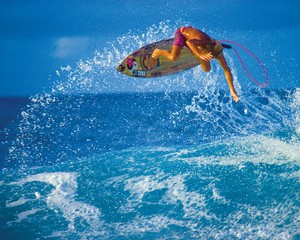
Nathan Fletcher, Indonesia, 2011. Photo: Herbie Fletcher
Nathan Fletcher, Indonesia, 2011. Photo: Herbie Fletcher
Ken MaxwellYou’ve told me some great stories about leaving the crowded, bustling California of the mid-’60s to find perfect waves, and I can’t help but be reminded of Gauguin leaving Paris for Tahiti in his search for paradise.
Herbie FletcherIn 1964, when I was sixteen, I got hired by Hobie Alter to be in a short film that was being shot by Bruce Brown. It was the first time I’d been paid to surf. I earned $250 and bought myself a plane ticket to Hawaii. I landed with a bedroll, a surfboard, and 150 bucks in my pocket. It took hours to hitchhike out to the North Shore on the two-lane highway with almost no traffic. I finally reached Sunset Beach and my old friend Dewey Weber said I could sleep in the backseat of his Cadillac, which was parked on the point looking down the lineup. The sleeping conditions weren’t great but the surf was perfect, no footprints in the sand and only a handful of surfers on the seven-mile stretch of the world’s greatest surf. My idea of paradise.
KMYour Blood Water series seems to be reflective of this time in your life. The works seem to resonate with the relationship between man and nature. You said you stained them with iron oxide from the mud in the Waimea River. Can you explain that process?
HFIn the early years on the North Shore, the rivers would bust out during the heavy winter rains and mineral-rich red earth would flow into the ocean, staining everything a soft reddish brown. “Waimea” means “Red Water” and it’s the largest river on the North Shore. I used to explore it when the rain stopped and I saw how the banks were constantly changed by the water flow and islands were formed from the earth being washed to sea from the north end of the Ko’olau Mountains on the windward side. The local people always considered Waimea Valley a sacred place, and when I paddle up the river with raw canvas on the nose of my surfboard to stain in the iron-rich banks, I feel a sense of timelessness, repeating a process that has been done since man’s beginning.
KMYour arrival in Hawaii, Dibi, was a bit earlier than Herb’s, is that correct? Can you tell me something about what it was like?
Dibi FletcherI think my first trip was in 1963. My older sister, Joyce [Hoffman], was competing for the Women’s World Surfing title. My dad, Walter Hoffman, was a longtime big-wave rider and was judging the Makaha contest on the West Side, where I met Herbie for the first time in 1965. My dad had won the tandem event there in ’51 and ’52. He was in the Navy and stationed in Honolulu, where he had night duty. He spent his days on the beach shaping surfboards, surfing, and playing music under the palms.
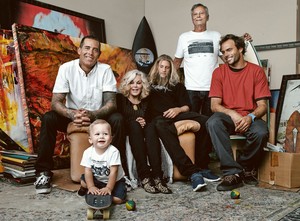
The Fletcher Family, Astrodeck, San Clemente, California, 2015. Photo: Rafael Pulido
KMYou can’t imagine what the early years were like from just reading surfing magazines or seeing heavily narrated films. Would you tell me a little about your early years in the surfing community?
DFMy dad started surfing as a teenager growing up in the Hollywood Hills in the ’40s. Boards were solid wood and weighed close to a hundred pounds. By the early ’50s my dad had the first board built using materials from the aerospace industry, with a foam core, wood veneer, fiberglass, and resin. This new, semilightweight model, which weighed around forty pounds, opened surfing to a whole new generation, which captured the imagination of a nation after two world wars and the Korean War. People in California were ready to go surfing, and a whole new industry was created with entrepreneurial zeal to feed the fast-growing appetite of the midcentury modern family for the new recreational outdoor lifestyle.
KMDo you think your father’s generation, after going through the trauma of war, was instilled with a sense of fearlessness?
DFI think they’d gained a great appreciation of life and wanted to embrace it. There was a new sense of affluence and optimism in California. Industry that had been geared to making faster, lighter-weight fighter planes were now making molded chairs, catamarans, dune buggies, mobile homes, and everything imaginable to make life fun and easy.
KMSo you meet each other in 1965, at the Makaha surf contest?
HFYes, I was there to compete, but I had to hitchhike to the West Side from the North Shore and I missed my heat. I was looking for my surfboard, which Corky Carroll had given to Joyce, Dibi’s sister, to keep for me, and that’s how we met the first time. We would see each other at all the big surf competitions and started dating on and off, but I didn’t want to get hung up with a girlfriend—I wanted to surf perfect waves, and that meant spending most of my time in Hawaii.
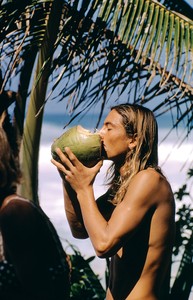
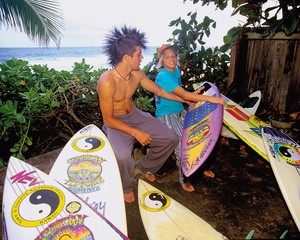
Christian Fletcher, Tahiti, 1988. Photo: Herbie Fletcher
Herbie Fletcher, North Shore, Hawaii, 1969. Photo: Art Brewer
KMHow did you eventually get together?
HFI was living in Laguna Canyon for a couple of months in the summer of ’67 and Dibi knocked on the door and said she’d left home. It was wild times: Laguna Beach was the Haight-Ashbury of Southern California and Laguna Canyon was the epicenter, with small wooden beach bungalows home to what would become one of the most notorious American drug-smuggling rings, which a friend named “The Brotherhood of Eternal Love.”
KMHow did that turn out?
HFIt was time to get out and get back in the water. So Dibi and I flew to Maui. I had a couple of new surfboards, my shaping tools, a bag of buds, and a few hundred doses of mescaline.
DFWhat could go wrong?
KMIs that when you started shaping seriously?
HFAfter we left Maui for the North Shore, and rented Dibi’s dad’s house on the beach at Pupukea, I built a shaping room in the back with tin I collected from the old military camp in the hills above Sunset Beach. It was great to get to experiment with design and have the instant feedback by riding the new shape. I could tell exactly how to tweak it to achieve what I was looking for, whether speed down the line or change the shape of the rail to hang high in the wave before releasing it to slide down the face. It’s all about the aerodynamics.
KMWhen did you start thinking about making the sculptures you call Wrecktangles?
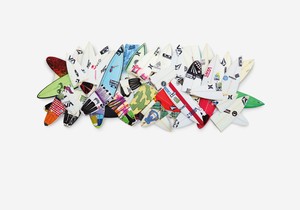
HFIn the ’80s, with [the surfer] Gerry Lopez, I bought the third story of a house at the Pipeline. Dibi and I had two sons, Christian and Nathan, who were completely surf stoked, and I was making the Wave Warriors series of surfboards. Those boards were designed to showcase the greatest tube riders of a wave considered to be the proving ground for the new breed of fierce young surfers. I worked with them, testing the traction pads I made for the decks of their boards: I felt the pad was the final touch to a perfectly shaped board, which gave the surfer more fin and rail control than they could ever have with wax alone. It was a natural progression from my shaping of the early ’60s, from the turned-down rails and concave nose to working directly on the deck, allowing the surfer to stay on the board in critical conditions. Boards had gotten so light for speed and maneuverability, they broke like Popsicle sticks when the lip of a huge wave came crashing down on the deck. Surfers were unable to hold their position tucked safely back in what’s been called the “green room” before being spat out into the light with the wave’s last powerful surge of energy as it came to its natural end and dissolved back into the sea. The surfers would throw the broken pieces of their boards in the yard, many grabbing another from their quiver to charge back out into the lineup. I’d look down from my deck and see all these fascinating shapes, colors, logos, personal drawings, and musings scrawled across the jagged remains of these once perfect, custom-made artifacts of the challenge that makes surfing at that level a mystical experience, and I realized I was seeing something worth preserving.
KMSo all the boards in the Wrecktangles have a connection to your years at the Banzai Pipeline?
HFYes, I used to crawl under the houses and collect the broken boards my friends would stash during the surf season. Now they save them for me and give me a call to come pick them up and share stories with me about the ride that broke the board, their injuries, the crowds, the companies, and we usually end up talking surfboard design.
Christian and Nathan, North Shore, Hawaii, 1990. Photo: Tom Servais
KMThat brings up the similarity with the Wall of Disaster series, which I believe is a more recent body of work?
HFYes, it’s a continuation for sure. I collect the broken pieces of skateboards just like I do the surfboards. It’s like collecting a part of the rider’s life experience. It’s great that the skaters have started saving their boards for me like the surfers. The look of the boards after being thrashed, with the logos barely visible, reminds me how things have changed and how the act of skateboarding has managed to stay the same. It’s still cool, even with big corporate takeover like I’ve seen in surf—surfers and skaters are still pushing the boundaries on what can be done in a freestyle environment, and I love that.
KMThe Wrecktangles’ evolution into the Wall of Disaster series makes perfect sense when seeing those early pictures of you pool skating barefoot in 1963. It’s reminiscent of how many artists work in a reflective process throughout their careers, going back to the beginning and making something new for the present, where you have that lineage, that common thread where the art is all a part of the same life story and one couldn’t exist without the other.
HFIt’s been important for me to stay engaged, it keeps me really pumped. Making these pieces keeps me connected to all the new surfers and skaters who are friends with Christian, Nathan, Greyson—and we have our grandchildren Lazer and Jetson who will keep the family story going.
KMHerbie, you talk about acquiring boards—whether it’s crawling under decks or surfers and skaters saving them to give you, it’s a multigenerational collecting process. These objects that you’ve accumulated over a lifetime embody actual memories from different people’s lives that you’re preserving through your artmaking, re-presenting them and sharing them with the public. In previous conversations you both have said, “These pieces all belonged to our friends.” I find that an incredibly interesting story.
Dibi, let’s talk about the book Fletcher: A Lifetime in Surf.
DFHerb and I have lived a long life together, we’re having our fiftieth wedding anniversary this year. There’s been a lot written about us in the past, but I believe my perspective is completely unique. I’ve had the opportunity to live the most extraordinary life during the greatest time in California beach culture. The book is a wonderful collection of photos that define six decades of surfing, beginning with black and whites of my dad and his friends shaping surfboards on the beach at Makaha. Seeing those images gives me a feeling of nostalgia for a world that’s slipped away.
KMThe action of surfing is still the same today, so how do you mean that?
DFWhen my dad’s generation were young, they surfed for the pure joy of surfing, so that aspect seems very real to me. As they matured and wanted to continue enjoying the beach lifestyle, they started creating the businesses that would become the “surf industry” of today, and would change surfing like all things change when they become monetized.
KMTalking with you both about your early years in Hawaii makes the photos in the book really come to life.
Nathan Fletcher, Pipeline, 2017. Photo: Zak Noyle
DFYes, those were fun times. In the late ’60s Herb was completely averse to having his photo taken for any of the surf publications, but after the birth of our son Christian the responsibility of being a dad set in. He started working with all the great surf photographers to organize surf trips with a few other fearless young surf enthusiasts, traveling to exotic locations to catch the perfect wave.
KMIt’s interesting to watch the progression of the decades unfold through the photos, each depending on the one before to get to the one after.
DFI always thought of the story as a fragment when it was just about one of the decades. My dad’s style of surfing was called “trimming”: surfers stayed out in front of the white water as far as they could and rode the wave to the beach. In Herb’s generation the boards had gotten shorter and faster and the surfers were riding as far back in the tube as possible. Christian has grown up surfing, skateboarding, and being whipped around behind Herb’s Jet Ski. He was ready to take surfing out of the tube and into the air.
KMWhen you watch professional surfing now that’s all you see.
DFAt the time it wasn’t considered surfing and created quite a controversy. It was new, brash, punk rock, and the industry that was trying to sell clothes for back-to-school wanted none of it.
KMHow was that for Nathan?
DFNathan put on a helmet and went motocross racing. The anonymity gave him the chance to become his own man, out from under the shadow of Herb, my dad, Christian, and the industry. He loved it and helped start the Metal Militia until the siren song called him back to the sea. He carved out a place for himself as one of the world’s most respected big-wave riders.
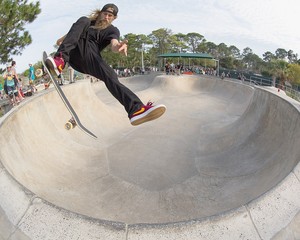
Greyson Fletcher, Jacksonville, Florida, 2015. Photo: John Bradford
KMDo you think Greyson became a skateboarder to find his own voice?
DFGreyson didn’t grow up at the beach, he lived with his mom in Anaheim. Herb would pick him up on the weekends and take him surfing, skating, and snowboarding. He was a natural at everything he tried, but living inland he spent all his free time at the Vans Skatepark and just naturally gravitated toward skateboarding. When you see him skate a big bowl, he has the most beautiful surf style. I guess it’s just in the genes.