Artist and designer Harumi Klossowska de Rola gained recognition for her jewelry; she has since expanded her practice into sculpture and unique decorative objects. Here she meets with Olivier Gabet, director of the decorative arts department at the Musée du Louvre, Paris, to discuss the centrality of the natural world in her approach to artmaking and the evolution of her practice and engagement with materials.
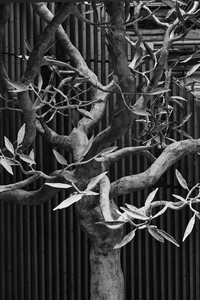
Harumi Klossowska de Rola, Tree with bird, 2022 (detail; work in progress for private stairwell), bronze, 227 ½ × 74 ¾ × 74 ¾ inches (578 × 190 × 190 cm)
Harumi Klossowska de Rola, Tree with bird, 2022 (detail; work in progress for private stairwell), bronze, 227 ½ × 74 ¾ × 74 ¾ inches (578 × 190 × 190 cm)
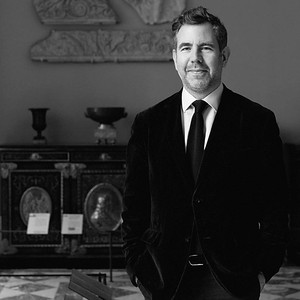
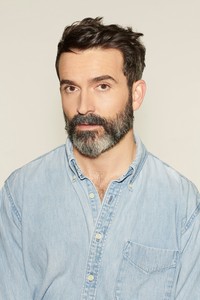
Olivier Gabet is general curator of heritage and director of the Département des Objets d’art of the Musée du Louvre, Paris, a post he took in September 2022. After starting his career as a curator at the Musée d’Art Moderne de la Ville de Paris (2002–04), he joined the Musée d’Orsay (2005–07) as a curator.
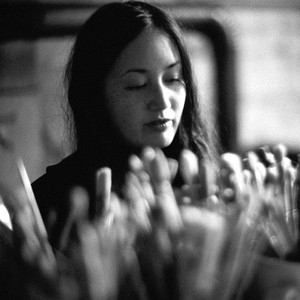
From her childhood in the Villa Medici, Rome, to a chalet in Rossinière, nested among the forests and mountains of Switzerland, Harumi Klossowska de Rola grew up in an extraordinary artistic universe. It was through these ageless places, with their poetic atmospheres brimming with aesthetic creations, that Harumi discerned the mysterious power of true masterpieces: timelessness.
Olivier GabetHarumi, could you describe your journey? What led you to art?
Harumi Klossowska de RolaMy journey started by designing jewelry. I started young with drawings, watercolors, and sketches, but over the years I grew interested in translating my drawings into the actual objects, the jewels. So I went into materials and textures, mixing them by listening to them. I really focused my energy on that space where a drawing becomes an object, so I took sculpting classes with a sculptor. That process not only helped me in jewelry but slowly started to lead me into what I really enjoy, which is the physical, the manual, the technical. The sculpting in my studio, whether it’s in wax, plasticine, plaster, wood, or alabaster, and the technical translation at the foundry, have taken over the drawings for quite a while now.
I’ve been surrounded by art since I was born. I was privileged to grow up in Rome, at the Villa Medici; the building structure and the architecture of the gardens probably had a fundamental influence on me. I remember spending time in the gardens, searching for treasures such as small wooden sticks, stones, leaves, old pieces of mosaic glass. Their shapes or colors had to be intriguing enough for me to collect them. I built collections.
Later we moved to Switzerland, to a small village in the mountains. It was a completely new world to me to be surrounded by forests, water, mountains, snow and ice, and wild animals. I also spent a lot of time at a relative’s house by Lake Geneva, where they had this very intriguing wiry furniture that I loved; I learned later it was Diego Giacometti’s.
OGLooking at your work, especially over the layers of time, what often strikes me is how the critics and commentators have talked about its connection with the animal, the vegetal, et cetera. That’s obviously in the work, but what always impresses me, including in your recent exhibition, is that there’s something that transcends those literal motifs in a way that’s much more meaningful. There is a sensuality as it relates to objects. That is, when we’re faced with works of art that are alive, there’s a sensuality there that doesn’t necessarily relate in that pure sense to the body, or eroticism, but to the material. And if I understand correctly, for you it’s not necessarily about being a work of art because it’s a work of art; it’s more that it’s a work of art because it’s an object, because it can be touched, it’s material, and it’s a technique.
HKdRThat’s exactly it. It’s about the physicality of things—to manually make them with my own hands, and to give them a specific texture. But I should add that what I love the most about sculpture is that I’m not the only one involved in the making. I’m part of a process, which may be originated by me but depends just as much, if not more, on the know-how of the craftsmen at the foundry that makes my pieces. More than anything else, I value that conversation with the people who work on the mold, the wax, the metal chasing, and the final touch of the patina. Is it perhaps the true creative act?
For the sculpture to truly exist, for its sensuality and spirit to come fully alive, it requires a certain space. A physical space but also a mental one. That subtle balance between the visble and the invisible, between fullness and emptiness, is also very important to me.
OGAnd what I find refreshing, in the sense that it’s truly an art form, a personal vision that’s yours alone, is that if you put different works by Harumi in one room, they’ll echo off each other. It’s true, there’s a spirit there. But at the same time, all these pieces are very different, from your screens, which express something unique, to the sculptures—I mean, those huge ibex stags, they’re extraordinary, but they’re also quite far removed from some of the panthers, which are almost like benches, and even farther from the jewelry you donated to the Musée des Arts Décoratifs a few years ago. I get the impression that there are multiple Harumis in one, that you’re able to bring together these fairly different worlds by way of the nature of the works in which you express yourself. Is that a conscious choice? Or is it just part of the artistic process and you don’t think about it?
HKdRI never thought about it, and to be honest I’m not sure. But obviously I’m not in the same operating mode when I’m working on a screen or drawing as when I’m working on a sculpture. Drawing is a solitary act for me, it requires concentration and no distractions. It takes a while for me to get into it. It’s like an edge, and once I find it, I need to keep going, as it’s easy to lose that state of mind. Whereas with sculpture, I can go in and out, even if the surrounding is noisy, busy. The soul, the spirit, of the animals or the plants emerges slowly, almost on its own. Somewhere deep within me I’m trying to connect my soul, the world, and the spirit of animals and plants to find the space where those three can live together. We’re part of the animal world, but I think we’re moving farther and farther away from that connection. And maybe it’s out of a desire to reconnect with how it was for ourselves, for ancient native civilizations, for animists in a living world that is one.
OGEach work is at once at the confluence of a practice and each practice is different. And at the same time, it’s also in a context. Do you work equally well in different spaces? Do you work during your travels? Do you work in one dedicated space that’s your workspace? Because when you speak, in listening to you, in reading your words, you get a sense of a sort of porosity toward the world. You were talking before about animism, but it seems that there’s also a side to you that’s celestial and terrestrial at the same time. You let that in as well, you’re awake to all that. Is there a particular place where that awakening happens? Or are you more of a Baudelairean flaneuse, who wanders around always on the lookout for things?
HKDRI don’t travel much, but I do enjoy going for walks. My studio is the center of my world, where I live surrounded by mountains, trees, water, and wild animals too. It’s my everyday life. And then I have my own animals that come and go in my studio.
For the sculpture to truly exist, for its sensuality and spirit to come fully alive, it requires a certain space. A physical space but also a mental one.
Harumi Klossowska de Rola
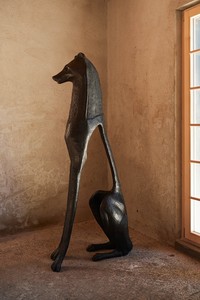
OGThe word “animal” has always been ambiguous in art history, because on the one hand it has the merit of clarity, but at the same time, it’s reductive, and sometimes I’d even say it suggests a certain superficiality, a “virtuosic” aspect, let’s call it—the virtuosity of realism in representation. And that’s what really struck me in your last exhibition; you’re not at all in a natural history museum, you’re in something transcendent, something deeply poetic, something a little bit unsettling. But that’s what we want from artists, to unsettle us. It’s that abrupt thinness of the central body, like a comma between the front and the back, while the proportions are the proportions of the animal—that’s very powerful. What’s your artistic genealogy?
HKdRSeveral impactful travels awakened my sensibilities: Luxor, Kyoto, Kenya, California, New Mexico, Saint Petersburg, Guilin, and Argentina left a deep impression on me. The objects that have interested me the most are “primitive” or autochthonous. I have friends who are avid collectors of African art. Others have artifacts from Papua New Guinea, Egypt . . . sometimes with a combination of artworks by the Giacomettis, the Lalannes, Giorgio Morandi as well. When it comes to colors and patina, an important inspiration is Balthus, especially the walls of the castle of Montecalvello and of course the Villa Medici.
OGFollowing up on that, what’s your literary genealogy? What are the texts, the artworks, the civilizations, that are fundamental for you? Your work clearly doesn’t exist in a vacuum.
HKdRFirst and foremost, the mythologies, Egyptian, Greek, and Roman. I’ve read Ovid’s Metamorphoses many times. There are also important books about animals, especially by Melanie Challenger [How to Be Animal, 2021] and Barry Lopez [Of Wolves and Men, 1978]. Lopez’s book tells a story that I love: the Indigenous peoples of North America have noticed that the gaze between wolves and their prey is decisive; they call it the “conversation of death.” If the prey is ready to die, the hunt will begin; if not, the wolves will not engage. In most of my objects the eyes are empty. I want them to convey all the possibilities through an invisible gaze. Apart from that, my thoughts often circle around texts by Kawai Kanjirō and Ananda Coomaraswamy.
OGWhat I also found very striking the first time I saw your work, and now that I’m seeing it progress, is your attention to words, to titles—that relationship to the word, the precious word, the rare word.
HKDROf course. Language is the source of most things for us humans, but I only retain history, science, and poetry.
OGWhat’s your view on the contemporary art world today?
HKDRListen, it depends. I struggle a little bit with contemporary art. The hand versus the idea is a strange formulation to me; they go together. But that’s really a personal matter. For me the intellectual idea and the practical craftmanship have to be aligned, because without one you don’t have the other. There’s a depth to working with molten metal, like lava flowing from a volcano; there’s an inherent depth in the natural world and in the intellectual world. The communion of the three is timeless and it’s what I’m seeking. One finds it sometimes in contemporary art. I really like, for example, Georg Baselitz, Giuseppe Penone, Peter Doig, Kawai Kanjirō, Peter Lane, and Jean-Marie Appriou.
OGWe’re all products of our time, obviously, but today your work is looked at very closely because we’re in a time when there’s suddenly a great resurgence in painting and sculpture, after years when it was more about video, installation, photography, and so on. There’s also a renewed attention to artistic craft. There’s one area you excel in that’s perhaps less known (because people talk a lot about sculpture), and that’s your screens, which I feel always create a more peaceful world, and at the same time there’s often a powerful iconography that forms a bit of a contrast with that peaceful two-dimensional world. Can you tell us a bit about that?
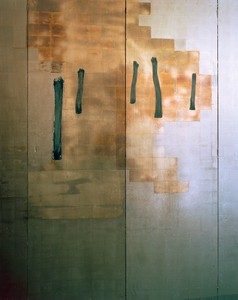
HKdRThe screens are fundamentally about simplicity. With one of my latest screens, I wanted to keep it as simple as possible to try to evoke a photograph I saw of three or four pillars standing in the water, in the mist; it looked like calligraphy and as a child I had to take calligraphy lessons, every Sunday I had to do my Japanese calligraphy. On my first trip to Japan, when I was eleven, I went to Kyoto. That left a significant impression on me, and a few years ago I went back with my son, who was seven years old at the time. I revisited the gardens and saw different temples again. The fusumas—sliding doors painted with gold or silver leaf, and their effect in a room, the light they bring to a room—made a deep impression on me. It was just the feeling of that golden color. How does that come out? How does it live in a space?
OGWhat’s always struck me about Japan is that the artistic practices are just as important as the philosophy of art. There’s an absence of hierarchy: a calligrapher is just as important as a ceramic artist or potter, who’s just as important as an architect, who’s just as important as a lacquerer, who’s just as important as a musician or a poet. That obviously goes completely against long-held views in the West, which are fairly restrictive. Do you think that heritage is comforting to you in this way? Because being a museum guy specializing in this area, I’m always a bit dismayed to see that we’re still struggling and still fighting to make people understand that this philosophy of art is fundamental.
HKdRIt’s true—in Japan, once you’re at the master level in a particular craft, such as bonsai or ceramics, there’s no hierarchy between masters. But what’s interesting is that on the other hand, Japan is a very, very hierarchical country. Within each field, there’s a clear hierarchy based on skills. Something I really had a hard time with was being told I was no good and so on, it’s not easy to take. But if you want to be excellent at something, in order to learn you need to be humble.
OGYou earlier mentioned Giacometti and the Lalannes. Having studied and written on the art of the Lalannes, shockingly, I’ve never made the connection between their work and yours—this idea of wear, of passing time. But I find that when we talk about patina, it’s patina in the sense of the patina of time. Looking at your objects, I don’t get the impression of something current or totally contemporary, because there’s that sense of the passage of time.
HKdRThis sense of the passage of time holds great significance for me, particularly through the materials I work with. Bronze embodies timelessness. I made a table with bog oak, an ancient oak that dates back more than 2,000 years. The wood has naturally turned black over time, and even if you carve it, it’s completely black inside. I combined it with bronze to make water lilies, frogs, and dragonflies. I’ve always enjoyed the combinations of materials. The deep black of the bog oak, a touch of warmth with the bronze, and a sprinkling of gold, not too much, just to bring out that warmth, the contrast of the two—that’s probably not “new,” but “new” is not my material.
OGWhat challenges would you like to take on in terms of new art forms to explore, new techniques, new kinds of objects, perhaps other sources of inspiration you’d like to pursue and explore in the coming years?
HKdRThere’s plenty I have left to learn. I aspire to deepen my knowledge in patinas, metal repoussé, new materials to combine with bronze. Because bronze will stay.
Translation: from the French by Eriksen Translations
Olivier Gabet is general curator of heritage and director of the Département des Objets d’art of the Musée du Louvre, Paris, a post he took in September 2022. After starting his career as a curator at the Musée d’Art Moderne de la Ville de Paris (2002–04), he joined the Musée d’Orsay (2005–07) as a curator.
From her childhood in the Villa Medici, Rome, to a chalet in Rossinière, nested among the forests and mountains of Switzerland, Harumi Klossowska de Rola grew up in an extraordinary artistic universe. It was through these ageless places, with their poetic atmospheres brimming with aesthetic creations, that Harumi discerned the mysterious power of true masterpieces: timelessness.