Ashley Overbeek tells the story behind the Art and Antiquities Blockchain Consortium (AABC), cofounded by Susan de Menil. The story begins with a famous pair of Byzantine frescoes once hosted by the Menil Foundation in Houston, passes through the repatriation of a group of Bura funerary objects to Niger, and explores how new technologies are helping to resolve the world’s oldest cultural disputes.
Ashley Overbeek is the founder and CEO of the kombu caviar company Pearle. She is the former director of strategic initiatives at Gagosian, where she had the pleasure of working with artists on innovative digital projects.
It started with two frescoes cut into thirty-eight pieces.
In June of 1983, Dominique de Menil sat in her Paris apartment, studying two grainy photographs depicting a pair of Byzantine frescoes. The works had been offered to her for sale by Aydin Dikmen, a Munich-based Turkish collector who would later be arrested for trafficking looted antiquities, having systematically concealed the provenance of his stolen works.
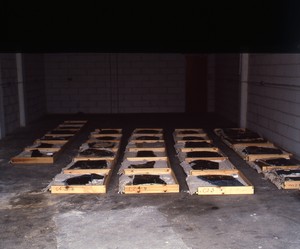
De Menil and associates quickly traveled to Munich to see the frescoes in person. They were taken to a shabby one-bedroom apartment with no electricity. Inside, illuminated only by the light of two candles, were the two frescoes, cut into thirty-eight plaster fragments, two of them propped up to view and the others stacked in a crate in a corner. Dikmen provided detailed provenance documentation and a remarkable story to support his claims of legitimate acquisition; on paper, everything appeared in order. In reality, something felt profoundly wrong.
Rather than proceeding with the purchase, de Menil insisted on a level of due diligence far more rigorous than that of many of her contemporaries, who at the time were still acquiring antiquities with minimal scrutiny. She began working with Herbert Brownell Jr., the US attorney general under President Dwight D. Eisenhower and then in private practice. Intent on uncovering the true history of the objects, she shared images of the fragments with authorities in the countries that could potentially claim ownership. Three nations stepped forward but only one produced proof: Officials in Cyprus sent photographs from the chapel of Saint Euphemianos in the village of Lysi, taken in 1974 and showing the frescoes in situ. But in 1983, all that remained on the ceiling of the holy site were two jagged voids.
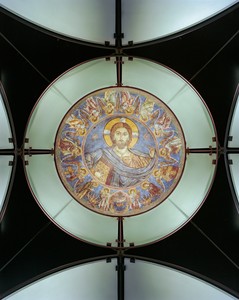
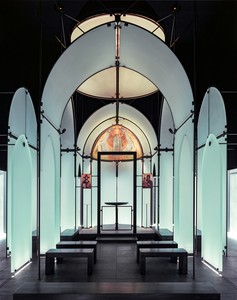
From that moment, de Menil and the Menil Foundation in Houston began developing a plan for retrieving, restoring, and responsibly stewarding the work, in collaboration with the Cyprus government’s Department of Antiquities and the Church of Cyprus. The frescoes were transferred to London, where conservators painstakingly stabilized and restored them. A consecrated, purpose-built chapel was constructed on the Foundation campus and over the next fifteen years more than 450,000 visitors came to see it. In 2012, when that stewardship agreement concluded, the works were returned home to Cyprus.
Fragments of the frescoes in individual trays at a warehouse in Greenwich, South London, 1984. Photo: Laurence J. Morrocco, courtesy the Menil Collection
After de Menil’s passing in 1997, it was her daughter-in-law Susan de Menil who guided the nuanced conversations around the fresco’s final journey home and the responsibilities that would follow once it left Houston. For Susan, the Lysi frescoes revealed an often overlooked truth: Cultural-heritage disputes do not need to be zero sum. For centuries, ownership has been framed as a matter of physical possession, yet the Lysi project showed that the rights surrounding an object can be shared. “If restitution to the source country is the starting point, what else can museums steward?” Susan asked. Conservation rights, display rights, academic research rights, reproduction rights, and long-term stewardship can be negotiated in parallel to repatriation and physical ownership. The fresco demonstrated that a single object can generate many forms of value that can in turn be allocated among stakeholders.
When Susan de Menil explored whether this model could scale, she was confronted with a structural problem: Many countries that had been the sources of cultural artifacts were wary of entering complex negotiations over repatriation without a neutral arbiter. Even when parties reached an agreement, there was no system to ensure follow-through as government ministers, museum directors, and governing bodies changed over time. No one wanted to rely on costly, unpredictable litigation; what was needed was trust. And what was missing was a mechanism to guarantee that trust.
Technology has long allowed us to solve problems that otherwise seemed intractable, and our century is nothing if not a period of enormous technological change. In that context, Susan wondered why cultural institutions and governments were still navigating the repatriation of artifacts with tools that had not evolved in half a century. She began thinking about a specific new piece of the puzzle: blockchain technology.
Blockchain tends to dominate headlines through stories of speculative currency trades and nonstop hype cycles. At its core, though, blockchain is a tool that enables groups of people to come to agreement across borders without relying on a single centralized authority. At a high level, blockchain creates a shared ledger that many parties can access but no single party controls. Once information is written onto the ledger, it cannot be erased. New details can be added as amendments but the original record remains intact. In the context of cultural heritage, this means that provenance data, conservation reports, legal agreements, and negotiated rights can be recorded in a way that all stakeholders must approve before the entry is finalized. With objects whose provenance is usually listed only in museums’ private databases, making this kind of information much more accessible globally, and setting it beyond the ownership or control of a single entity or country, is pretty revolutionary.
The same structure also allows complex rights to be divided with clarity. Physical ownership, display rights, conservation responsibilities, reproduction permissions, and research access are just some of the many rights that can be defined as separate entries in the ledger.
Blockchain is only one part of the toolkit. Other technologies, including photogrammetry and high-resolution spectrographic imaging, allow objects to be captured in precise three-dimensional form. These digital twins can be used for conservation planning, research access, virtual display, or comparative study without requiring the physical object to cross borders. Digital models can also be attached to the blockchain record so that every update to an object’s condition or scholarship is anchored to the same shared source of truth.
Together, these tools create something cultural-heritage negotiations have long lacked: They allow stakeholders in different countries, operating under different laws, to work from a single transparent system that records provenance, defines rights, and preserves that information securely.
Susan de Menil and a group of other women have recognized the potential of contemporary technology (including but definitely not limited to blockchain) for artifact and antiquities stewardship. “Instead of using Web3 to speculate on the future, we propose using it to reconcile the past,” Susan told me. They founded a 501(c)3 nonprofit, the Art and Antiquities Blockchain Consortium (AABC), with the mission of applying new technology to some of the world’s oldest stewardship challenges and unlocking stymied repatriation efforts through research, education, and advice.
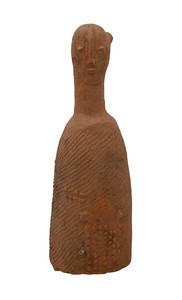
Bura funerary object, reliquary figure, Volta, Niger, c. 2nd–11th century, ceramic, 16 ¼ × 6 inches (41.3 × 15.2 cm). Photo: Timothy S. Y. Lam Museum of Anthropology, Wake Forest University, Winston-Salem, North Carolina
In a recent initiative, AABC partnered with the Lam Museum of Anthropology at Wake Forest University, Winston-Salem, North Carolina, to pilot this model through the repatriation of a group of Bura funerary objects to their source country. The Bura civilization flourished between the third and thirteenth centuries in what is now southwestern Niger. Its terracotta vessels, equestrian figures, and funerary urns are among the most significant archaeological materials in West Africa. Many of these objects left the region through illicit excavation and opaque private sales, creating fractured provenance histories that have made repatriation nearly impossible to navigate. The objects held by the Lam Museum are representative of this broader problem: They are culturally consequential but their provenance is incomplete and their legal status ambiguous, placing them in a kind of institutional limbo. Dr. Andrew Gurstelle, academic director of the Lam Museum, elaborates, “The Bura objects represent some of the only known artifacts from the early Iron Age of the Sahel. Their forms match artifacts excavated from burial contexts, which means that the faces, bodies, and patterns are meaningful windows into these ancient cultures. As an archaeologist, my professional training included ethics of using museum collections and repatriation. It was coincidental that my research was in West Africa, near to the Bura site, and I happened to be familiar with the objects and their history of looting. When I became the academic director of the Lam Museum, I immediately recognized the objects and knew that repatriation was the direction to go.”
For this project, AABC began by providing contextual research to support a dialogue between the Lam Museum and Niger’s Ministry of Culture, with the shared goal of repatriating more than one hundred Bura funerary objects from the museum back to Niger. The consortium helped to establish a collaboration with the Factum Foundation, whose technicians used photogrammetry to create high-fidelity digital twins of the works. Students at Wake Forest were trained to conduct additional scans, turning the project into a form of capacity-building as well as of conservation. Each digital model was then minted as a noncommercial NFT containing key metadata, including the object’s agreed-upon provenance and its archaeological context. These files can be accessed by researchers anywhere in the world with an Internet connection, which allows the objects to remain available for study even after they physically return to Niger. “AABC and blockchain technology have provided a pathway to actively record information about the Bura objects while negotiating the terms of repatriation,” observes Gurstelle. “Because it is transparent and decentralized, blockchain has been useful to build trust between stakeholders. This has been especially helpful to bolster support for traditional, physical repatriation.”
Nigerien architect and professor Mariam Issoufou, who is working closely with AABC and the Lam Museum on the project, notes the thoughtfulness of AABC’s approach. “There is a level of humility that is rare,” she said. “A desire to do the right thing, even while acknowledging you may not know exactly what that is . . . and that begins the process on equal footing. What I find incredible is how technology is being used to even the playing field, to inject some justice into a process that is usually full of inequities. Blockchain helps ensure the objects are not resold later and that their paths remain transparent. That is one of the main issues with museums and the objects they hold.”
Repatriation alone is not the end of the story: AABC has placed equal emphasis on outreach and community-led education in the source countries to which objects are returned. In partnership with AABC and the Lam Museum, Issoufou has been convening a series of focus groups in Niamey with some of Niger’s most visible artists, filmmakers, musicians, and cultural thinkers, including filmmaker Aïcha Macky, poet Abdoulaye Saidou Souleymane, satirist and comedian Mamane (Mohamed Mustapha), photographer Aboubacar Magagi, and musician Abel Zamani. Their task is to ask how the history of the Bura civilization should be shared within Niger and how future generations might engage meaningfully with their heritage.
Issoufou describes the stakes clearly. “After repatriation, what does that actually mean for people? What does it mean for the population? How do you raise awareness about these objects, about this civilization? Once objects are taken away and sequestered elsewhere, you are cutting source communities off from their own history.” Reaching people across the country also requires navigating linguistic and cultural inclusion. “Niger has seven major languages. I speak three, but that is still only a fraction,” she says. “It was crucial that the creatives involved carry different linguistic and cultural layers and speak to the nation as a whole, not just to one ethnic group. Of course ethnic identities matter. They shape the languages we speak and the food we eat. But we also have to build a shared national story. Restitution gives us the opportunity to have the most meaningful conversations about what it means to belong to the same country.”
Just as the Lysi frescoes returned home more than twenty years ago after their period of shared care in Houston, the first of the Bura objects will return to Niger in 2026. But countless objects remain displaced. “The Restitution of African Cultural Heritage: Toward a New Relational Ethics” (2018), a report written by Senegalese economist Felwine Sarr and art historian Bénédicte Savoy on commission from the French government, estimates that more than 90 percent of Africa’s cultural artifacts reside outside the continent. AABC is working to develop new pathways to increase accountability and shared stewardship, including ongoing research with several universities on ways in which technology can support these goals, such as using blockchain to create on-chain revenue sharing from museum admissions and blockchain wallet programs that give source communities direct participation in stewardship.
As Issoufou puts it, “I think too many times, when we realize we do not know the answer to something, we assume it means the answer does not exist. I feel the opposite. I think there could be something amazing there. The question is whether we can excavate it.”
Ashley Overbeek is the founder and CEO of the kombu caviar company Pearle. She is the former director of strategic initiatives at Gagosian, where she had the pleasure of working with artists on innovative digital projects.