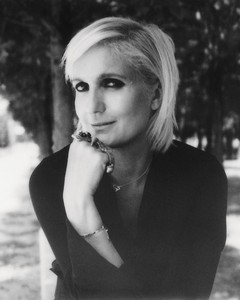
Maria Grazia Chiuri has been the creative director of women’s haute couture, ready-to-wear, and accessories collections at Dior since 2016. Beyond overseeing the fashion collections of the French house, she has produced a series of global collaborations with artists such as Judy Chicago, Mickalene Thomas, Penny Slinger, and more. Here she speaks with the Quarterly’s Derek Blasberg about her childhood in Rome, the energy she derives from her interactions and conversations with artists, the viral “We Should All Be Feminists” T-shirt, and her belief in the role of creativity in a fulfilled and healthy life.
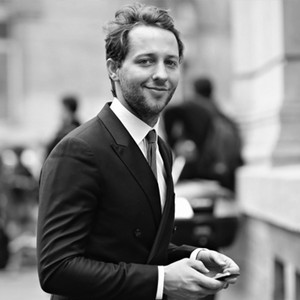
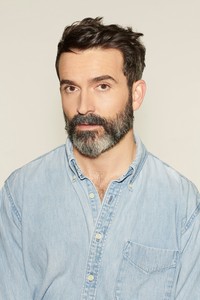
Derek C. Blasberg is a writer, fashion editor, and New York Times best-selling author. He has been with Gagosian since 2014, and is currently the executive editor of Gagosian Quarterly.
Derek BlasbergLet’s make it easy and start at the very beginning. When you were young, was art a big part of your life?
Maria Grazia ChiuriI was born in Rome, where art is everywhere, so it would be impossible for me not to be interested in it. In Italy we start to study art in primary school; it’s part of our public program. And not only would we study the history of art but we’d spend hours making it—we also used to sketch every day in class. Immediately from when I was a child, I liked to draw, and after I grew up, that became more mature and evolved into design. Also, in secondary school I had very good teachers who organized Saturday visits to the museums and galleries, which helped me build this passion.
DBIn Rome, art feels historic–
MGCSometimes too much so!
DBIt’s called the Eternal City for a reason, I guess.
MGCBecause we were surrounded by so many different artists, and their histories are so grand, it’s possible to think that you can’t be an artist. It can be a limit because the past is so present.
DBAnd so big!
MGCSo big that you think that it’s probably impossible to create something new and interesting. Going to New York for the first time, in the 1980s, helped me to discover Pop art and modern art, which really helped show me art from a different point of view. It opened my eyes to the contemporary world. That was interesting, because later in my career I was lucky to meet contemporary artists in Rome, who we didn’t promote so much—we didn’t have much space in the museums and galleries because, of course, the very famous artists are all artists from the past. I began to think, How do we support new names in this world at a time when there are so many huge names from our history?
DBThe relationship between Dior and contemporary art is not new: before he was a designer, Christian Dior was an art dealer and worked with artists like Man Ray and Marcel Duchamp. When you started at Dior and looked at the codes of the house, did you know there’d be such a link with art?
MGCI was surprised—and very happy—to discover that Christian Dior had a gallery. His family didn’t want the name “Dior” on the gallery, because they found work in art inappropriate, but I found in the archives images of him with famous artists, the ones you mention and also Alberto Giacometti and Salvador Dalí. I was fascinated by this aspect of him and I was very happy to continue with this incredible background of the history of Dior through my personal point of view. I decided to work more with women artists, because I discovered, when I was young, that the women artists weren’t always given big opportunities, not only in Italy but around the world. I was honored to be able to say we could share this incredible opportunity in Dior.
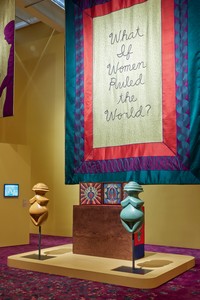
Installation view, Judy Chicago: Herstory, New Museum, New York, October 12, 2023–March 3, 2024. Photo: Reed Young
DBAs we know, this is when you sought out artists like Judy Chicago and Mickalene Thomas.
MGCOne of my favorite museums is the Brooklyn Museum, and I remember the first time I went there I was fascinated by [Chicago’s] The Dinner Party [1974–79]. At the time, I never in my life imagined there could be a time when I could collaborate with her. And I remember the first time I asked if we could try to contact her, I was a little bit scared, especially at the beginning, about what she should think of working with a fashion brand. There is this idea that fashion is more marketing, and I was worried about the artist getting upset if they thought we only wanted to collaborate with them as a marketing excuse.
DBYou wanted them to understand it was about supporting their work, not legitimizing your industry. I get it.
MGCI was super happy when she decided to come to Paris and see the show that we worked on with the artist Penny Slinger, and to see what we did with art in our space on the avenue Montaigne. She understood that my idea was to utilize the space like a gallery and produce exhibitions. And that’s it. We wanted to promote female artists, I was very honored to have her with me, and it was a beautiful show. Same thing with Mickalene Thomas: I went to her studio in New York, I saw her work, I explained to her that we would like to collaborate. It’s something very personal when you can build a strong relationship with an artist.
DBIs it inspiring to work with these artists?
MGCI think it’s another kind of work. It feels like my passion, actually. I know what my work at Dior is, but in many ways [working with artists feels] more my passion, not real work.
DBThe artists are the fantasy.
MGCYes, and the hard work is the collection. The art part is my pleasure.
DBLast year Dior hosted the opening of Judy’s exhibition at the New Museum in New York. I thought it was incredible to see many of the banners that she created for Dior in the show. How did it feel to see work that you had helped inspire in a museum context?
MGCI was so happy for Judy! I am very honored that they made a big retrospective on her work. For me, the goal is to promote women artists. Judy is well known in the United States, but hopefully our platform promotes her in Europe, and puts this different art in conversation there. I really like this community that we now have around all these artists who know each other. Some of these artists meet at the show, speak about their work. This is very good energy to me, personally, for my pleasure, but also for what it creates in the world in general.
DBYou were the first woman to hold the top job at Dior in the seventy years since its founding. That was a very big deal in 2016. Do you still think about that now, when you’re eight years into the job? And, as you support female artists, are you aware of your own role as a boundary-breaking female?
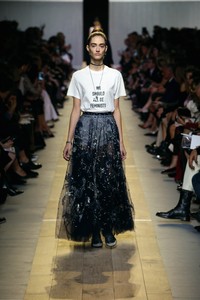
“We Should All Be Feminists” shirt at the Dior ready-to-wear, Spring/Summer 2017 show
MGCWhen I went to Dior, everybody was so surprised that there was a woman there and nobody spoke about my previous career. I was not so young when I arrived at Dior: I’d worked twelve years at Fendi, seventeen years at Valentino, but nobody spoke about that. It was like I was an up-and-coming designer! We have to recognize that we often associate creativity with male figures. The “genius” is normally a man. That idea was probably stronger in 2016 than now, but if I remember the art history that I studied in school, not many females were included. [The seventeenth-century painter] Artemisia Gentileschi is very well-known now, but the first exhibition of her work in Italy was in 1978, because nobody promoted her. There has been this problem in the art world—in many industries, by the way, but here we are only talking about fashion and art—and we have to recognize it.
DBFamously, in your debut collection for Dior you showed T-shirts that said “We should all be feminists,” which became such a big deal, a huge talking point not only in the fashion press. Did you know that was going to happen?
MGCAbsolutely not!
DBI saw those shirts everywhere.
MGCI never imagined that Dior was so well-known around the world. Of course it’s a brand that you know, that the fashion world knows, and that’s my comfort zone. But I had no idea how much more famous the brand was, how very well-known all around the world. When I came to Dior my approach was very easy: I did what was in my heart. I didn’t realize that the Dior audience is really huge, really international. So it was shocking for me to see the reaction. I think it was a strong message for the time, but I also think that it was so strong because it was Dior. I really love the novelist Chimamanda Ngozi Adichie, who published an essay with that title.
DBDid you reach out to her before the show?
MGCYes, and when I tried to contact her, she at first said no, because she has no idea about fashion. The second time I said, Okay, I want to write a letter, and it was very fun with the press office because I said I wanted to write a letter to explain to her because I wanted to have her involved in some way. And after the letter she said yes. She never went to a fashion show before that, she didn’t know anything about fashion. She had no idea—“I don’t want to come to Paris.” Which of course we laugh about now, and we’ve become very good friends.
DBNow she knows more about your world?
MGCI think she appreciated it, and she also understood the fashion world more. A lot of people don’t know our industry and probably have a superficial vision of our industry. This is normal. Because now everybody’s interested in art, you know, in fashion, in literature. But it was really a special, special moment for me.
DBWith ready-to-wear, couture, resort shows, travel, collaborations, you’re a busy woman. When do you find time now to look for new art or new artists?
MGCLike fashion, art is a real part of my life. On a work trip I make a personal choice to go see a gallery or make a studio visit. When I started this job, I never imagined that my personal hobby and passion could be so fundamental to my work. Tomorrow, when I leave Paris and go back to Rome, I will make a studio visit with a friend. Of course in some places, like Italy or France, it’s simpler for me, but the last big trip I took was for a holiday at Christmastime and I went to Thailand, where I went to see an artist I was interested in and discovered there was a biennale there. So I immediately changed my plans and went to check the biennale in Thailand. I said, Oh cool, we can go there.
DBDo you find that when you meet artists and go to studios or biennales, it has a direct impact on the way you work? How does it affect your design process?
MGCThe most important artists who influenced my work were artists I discovered many years ago, like Frida Kahlo, who is very famous, of course, because she speaks about the body, self-representation, and the relationship with the body. That is the argument for why I work in fashion. Now, as I’ve become more mature in my work, art for me is something that speaks to me about myself and also—because it speaks about my body—in some ways speaks of the way I want to give back in my work, making other women feel well with their body. It’s very personal. It’s not because I want to use an artwork for a pattern or a print, it’s more because it speaks to me about something that I feel is part of my personal history. And probably that helped me to translate it in my work, giving back what it gives me.
DBThat’s an important distinction. When people ask how an artist affects fashion, they often assume that the artist makes a painting, it becomes a print, and the collaboration ends there. For many designers it’s not as literal as that. It’s more complex.
MGCYes! I sometimes spend time with the artist, I speak with the artist, because there’s an analogy with the analyst.
DBIt’s like therapy.
MGCYes, the conversation with an artist can be like seeing an analyst. It’s a pleasure for me to reflect about life, our life, and what we’re doing. They give me a point of view where I immediately say, Oh, I never thought about that—and of course I translate that. Probably that influenced me in my work too.
DBI know this can be a tricky question but we ask everyone: do you think fashion can be art, and can art ever be fashion?
MGCI don’t know if it’s possible to define fashion as art. I think there are moments with some fashion designers where they made art, from my point of view. With Alexander McQueen, honestly, some shows are performance art. But not all fashion is art, for sure. Fashion is done to be sold, to be worn, to be consumed. It’s an industry.
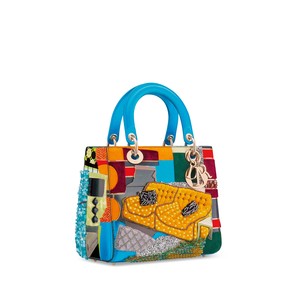
DBWhen you started in 2016, Dior started the Lady Dior art project, which I think is an interesting way to meld the worlds of fashion and art. This is where you invite artists to design their own version of the iconic Lady Dior handbag.
MGCThat’s a really big project because it’s a way to be in conversation with artists, and to ask them to realize their point of view in a completely independent way. That’s also what I do for the setup of the show: I say, “I want to give you a giant room and all I need is a runway where the model can walk.” Ha! Then they can decide what they want to realize. I think that when you collaborate with an artist, you try to realize what they want from their point of view. This is another important aspect for me. I think it helps us to have good relationships with artists, because we always show them the process step by step—each single moment in realizing the idea, they are to approve. They check the mockup. It’s not that they give us a drawing and that’s it. No, it’s really a production for artists.
DBI guess, in many ways, it’s like when Mr. Dior had a gallery and invited artists to fill it.
MGCExactly. I remember with Judy Chicago, we went to her studio in Santa Fe. We met her, she showed us the prototype. She asked us to make a specific jacquard fabric, so we made it. We were quick and responsive. Often, for an artist who works by herself, to have the big machine that is Dior behind them is a change. It’s really like a factory. We’re a big team and we want to execute their vision. For Judy Chicago, when she made The Dinner Party, to realize all the embroidery was a nightmare because she didn’t have one atelier, she had different embroideries around the world. So it was very difficult for her to coordinate that. For us—
DBIt took ten minutes.
MGCSnap! That’s normal. To realize the different brocades, we can do it. We work in a very short time all the time. Our reaction is completely different. That’s the idea, to be in the service of art.
DBSo if any other female contemporary artists need tapestry or embroidery, they’ll call you. That’s the takeaway.
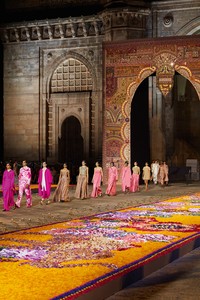
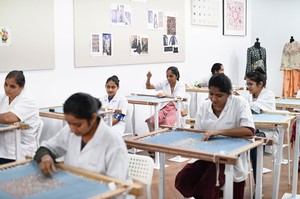
MGCAbsolutely. In India we are doing this collaboration with a school there, the Chanakya School of Craft, [Mumbai,] which focuses on hand embroidery and helps train women in the crafts. That is magnificent. The women at the school now understand that they can use their capacity and their creativity, and this is something that can inspire them not only to be very good embroiderers for fashion but to become artists too. I think probably that is the big project, bigger than I ever imagined could be possible.
DBI was in India and saw that show. It was marvelous.
MGC: It was a very special moment, especially for those women to see their hard work displayed at a venue like that. It was a very big deal in the city. I really like the idea of community art, and it’s validating in my work. Working together gives me energy—it’s beautiful that everyone feels part of the creativity inside this big project. I think that’s very, very important.
DBMaybe you need a new shirt that says “We should all be female artists.”
MGCYes! I think everybody can be an artist. I don’t mean everyone can be famous, I mean they can create and express their creativity. To me, that’s what you need to be a healthy person.
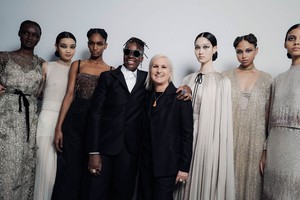
All photos courtesy Dior
Derek C. Blasberg is a writer, fashion editor, and New York Times best-selling author. He has been with Gagosian since 2014, and is currently the executive editor of Gagosian Quarterly.