Curator Hans Ulrich Obrist traveled to Sabine Moritz’s studio in Germany to learn more about the painter’s latest series August, exhibited in 2023 in Rome. The pair discuss the development of the series, the relationship between coincidence and control, and the importance of trees.
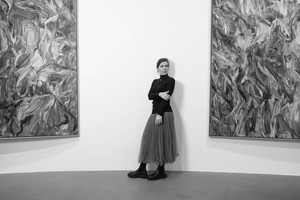
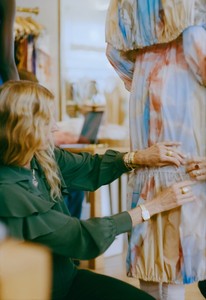
Sabine Moritz inside her exhibition August at Gagosian, Rome, 2023. Photo: Leonardo Cestari
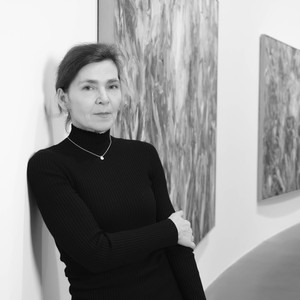
Sabine Moritz inside her exhibition August at Gagosian, Rome, 2023. Photo: Leonardo Cestari
Sabine Moritz’s paintings, drawings, and prints represent a succession of suspended moments, juxtaposing interpretations of her immediate surroundings and the natural world with deconstructed documentary images. Adapting and repurposing a catalogue of symbolic and abstract motifs, she ponders the mercurial dynamics of transience and decay. Her works enhance our sensitivity to the passage of time, locating personal experience within shared narratives. Photo: Leonardo Cestari
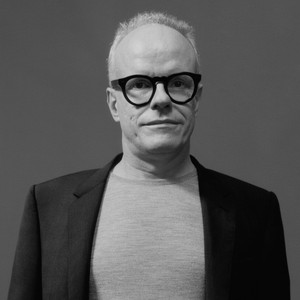
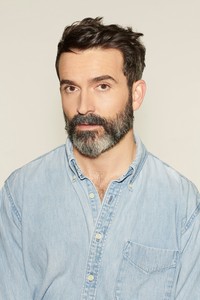
Hans Ulrich Obrist is artistic director of the Serpentine, London. He was previously the curator of the Musée d’Art Moderne de la Ville de Paris. Since his first show, World Soup (The Kitchen Show), in 1991, he has curated more than 350 exhibitions. Photo: Tyler Mitchell
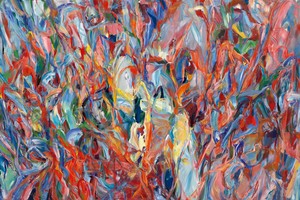
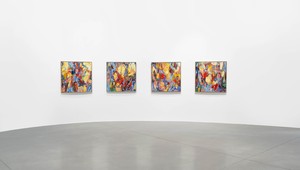
Hans Ulrich ObristThe exhibition in Rome started with four large-sized two-by-three-meter paintings, right? The canvases had been sitting in the studio for some years, just waiting . . . or did you wait for them? Can this perhaps be read in both directions?
Sabine MoritzThey are the largest and also the most difficult pieces of the exhibition. But perhaps it only seems that way to me because it’s the first time I’ve worked in this format.
HUOWere all of them created this summer?
SMYes, all of them were created over the course of the summer, between mid-June and quite precisely at the end of August. Only microcorrections of additions were made during the early days of September.
HUOYou once told me the original title of these works. It was very somber.
SMThe original working title was gloomy: The Dying World. It was good as a working title, but finally it was too narrow.
HUOYou’ve said that your exhibitions evolve one from the other: groups, series, and cycles continue, finding their sequels in the next exhibition. The Pilar Corrias Gallery in London hosted a dual exhibition during the spring. Do the pieces in Rome reference these works, or even earlier ones?
SMLet me think about this for a moment. As you said, there are paintings that continue a series or a group, and this holds true for this exhibition. But this group, which has now finally received the title Ferragosto [an annual public holiday on August 15 in Italy], is completely new. And it may even be a cohesive group all by itself, I’m not sure yet.
HUOFerragosto is in fact a moment when Italy’s cities are suddenly totally empty.
SMYes, this usually hot day signals the turn of summer in Italy. But the Ferragosto is also an important Catholic holiday, commemorating the Assumption of Mary into Heaven. It was originally a day of celebration of the conquest of Egypt by the Roman Emperor Augustus. Only later did it become a Christian holiday.
HUOThe light in the paintings in the Rome exhibition is different from in the previous ones, but in fact you were already getting ready for this in the spring. T. S. Eliot said “April is the cruelest month,” and these twelve paper works were created in April, in diverse colors: red, yellow, and blue. Were they the precursors?
SMPerhaps subconsciously. Back then, I was working on many paintings simultaneously, mostly for the exhibition in London. I also created the paintings referencing February, a precursor to the four August pieces in Rome. Both are a continuation of the series with the names of months as their titles, each comprising four pieces measuring one by one meter. The different groups and exhibitions are therefore always linked to each other.
HUOIt’s a relational field where everything refers to everything else.
SMYes. At times, a general idea emerges suggesting, say, a play with something more two dimensional, or something more elegiac, or a particular color tonality. But in those instances the act of painting generally takes on a life of its own and morphs into something totally different.
HUOYou said once it was like having a conversation with a painting. Does this mean that at the end of the day, we’re seeing the beginning of a conversation that’s been captured inside a frame?
SMI always intend to make a more complicated or perhaps a more complex statement within a painting—seemingly as if I actually know what I’m searching for, but can’t describe it. I then keep on working until I reach the point when I sense that the piece has somehow taken on a life of its own.
HUOThat’s when the painting is completed?
SMThat’s when I stop.
HUOIt’s also a matter of time, isn’t it? You say that you always reflect on the meaning of time. The studio also has a lot to do with time. You waited long until you were ready for the large canvases; that’s time, indeed. The most varied aspects of time are important to you: the freezing, expanding, and passing of time, in part also the suspension of time.
SMIt’s as if the chronology of time inside the studio followed different conventions. A synchronicity emerges, also between older and current paintings. Some works take me a lot longer to finish; this is also when they strike me as being much younger. Others, in contrast, are completed more quickly.
It’s also important to note that while I’m painting I forget time. It can expand indefinitely. And I can lose myself in it.
HUOOften you don’t consider a painting unfinished because something is still missing. Correct? Something is missing.
SMYes, something’s always missing. For me, a painting must have density, cross-references, or complexity. I often sit here in my studio studying the paintings through observation, even while I’m speaking, reading, or entertaining company. Many believe the paintings are complete: [pointing to one painting] an arc topped by a strange triangle, two green sections, and below, a spot that’s been scratched open . . . possibly evoking associations with water. But that wouldn’t be enough for me, nor would I like letting go of the piece at this stage.
HUOFrom inside the studio, you have a view to the outside, over to a tree in the courtyard below. Agnès Varda said that any day without seeing a tree is a wasted day indeed.
SMI would agree.
HUOThis quote could be from you, couldn’t it?
SMYes, perhaps. I’ve always given tremendous attention to trees—they’re very important.
HUOIn this context there’s a remarkable piece, an early abstract work from 2015. In Heaven the picture is basically visible through a tree, similar to the view we have from the studio, of the neighbor’s house through that tree. In fact, this is how the abstract pieces initially came about in the first place.
Back then I gave a talk in your exhibition at Pilar Corrias. It was a representational exhibition except for this not-very-large abstract piece. It was like a clearing. Perusing the new August pieces, isn’t it as if the act of painting becomes frozen in a clearing? While the actual paintings never become frozen themselves—again and again, the observer detects other things as well. Even though I already see a clearing in the second painting now. The idea still persists, doesn’t it?
SMPerhaps it’s because the piece frees itself from the idea of depicting an existing state in nature. Every painting should allow permeability, or offer the possibility of sensing the same—as if the observer were being afforded the possibility of breathing through it.
HUOThis first abstract piece was created in the context of the Harvest cycle, which depicts a crop scene in Ukraine after World War II. Painted from photographs by Robert Capa, the pieces have now acquired a totally different urgency through the ongoing war in Ukraine.
SMYes, there always exists the hope that people will find escape routes, even from horrific situations. Even though they’re unable to leave in body, they can travel in spirit and transport themselves to other worlds. I came to imagine that this playing, bored child, appearing in different paintings, still too small to help with chores or exempted from helping with the work, nonetheless appears a bit lost trying to have a good time. Meaning: playing.
HUOSo, nature and trees have been an important theme for you throughout.
SMIf the tree at my window no longer existed, I would lose the joy of spending time at the window.
HUODoes this mean working here would be difficult for you?
SMYes. It always consoles me when I can’t be outside because I’m working.
HUOIn an interview with Etel Adnan in 2016, on the occasion of the exhibition Storm at the Marian Goodman Gallery in Paris, you note that you had a view of a tree on a mountain top from your childhood room, just as you do here.
SMIt was my fixed point. I always let my eyes wander along the mountain chain when I was quietly sitting and looking out the window . . . and a tree was still standing there, erect. This was always my anchor.
HUOBut you couldn’t find it on the mountain itself?
SMNo. The paths didn’t extend along that location. I always wondered what it would be like knowing this particular tree—I mean, knowing which one of the trees along the mountain chain it actually was. It was a European black pine, same as all the trees up there.
HUOI recently arrived from Düsseldorf, where an exhibition featuring some of your early pieces is currently open. It’s about the Lobeda series [1992–93]—drawings of your childhood environment and home town, made from memory, now acquired by the Kunstsammlung Nordrhein-Westfalen. The presentation is actually a precise reversal of the Rome show because the Düsseldorf venue has primarily representational works on view, and almost entirely drawings. There’s just a single abstract painting, Family. In Rome, on the other hand, the only representational piece features skulls and the series of the three red roses; otherwise, the works are abstract. So, an exact reversal, in two exhibitions running simultaneously. This is very interesting, no?
SMEach offers a window into different levels or different spheres of my work, like a counterpoint in perpetual opposition. The Düsseldorf exhibition is very important to me. All the works on view, except for the one abstract piece, are over thirty years old.
HUOIn fact, you and I have also known each another for almost thirty years. This means that this interview is our anniversary interview! We met briefly in Hamburg in the fall of 1993, at the premiere of the Zerbrochenen Spiegel (Broken mirror) exhibition, with Kasper König and Gerhard Richter.
SMThis calls for a celebration, later today!
HUOThe skull painting in Rome had a precursor at the exhibition in London. Isn’t that correct?
SMYes, I painted the new picture as recently as early September.
HUOVery quickly?
SMVery quickly. The other paintings always take a lot of time. What I wanted to do here was something that took less time and was more immediate.
HUODoes it have a title?
SMMeeting, like the still life in London, because three skulls are visible.
HUOA posthumous meeting indeed!
SMIt’s a typical vanitas image or memento mori, as is its precursor. Here you see what I mentioned earlier, these threads extending throughout the exhibition. The groups are carried along, refined, and continued.
HUOIt’s incredible that the piece was created in a single day, and that you found the experience recreational.
SMYes, suddenly you’re given a different guideline or nexus, a different kind of freedom, so to speak. The main painting was created in a single day. Afterward I kept making small changes; ultimately I’m not at all sure whether it qualifies as a real painted work or remains a sketch. I’ll have to study it some more.
Installation view, Sabine Moritz: August, Gagosian, Rome, September 22–November 18, 2023. Photo: Matteo D’Eletto, M3 Studio
HUOHow important is studying a picture through observation?
SMIt’s very important. But I don’t spend much extra time on it. Studying through observation is always done incidentally. It’s not a separate task.
HUOIn the new pieces, the largest you’ve ever painted, you create the impression that studying a piece close-up, compared to studying it from a distance, results in differences in how it’s experienced. How important is this for the painting process?
SMYou move around a lot, coming closer, stepping back farther. That’s also due to color changes: I often hold brushes with different colors in my hand, in different sizes, or different paint containers. A lot of movement indeed.
HUOYour 2016 exchange with Etel Adnan is interesting: she said that she never made corrections, nor did she correct her poems. She applied the paint directly from the tube to the canvas and then was done with it. You responded at the time that you always make changes—you wipe, you modify, you try again. Was that true for these pieces as well?
SMMy “conversation” with the paintings is always built on statements and replies. The result is a grown texture. It’s mostly an addition, always paint layer upon paint layer, but at times it’s simultaneously an act of obliteration, of making something disappear and then recapturing it. Yes, correcting is important for me. Sometimes it’s exploration with an artistic eye. When is a piece a painting? When is it a drawing? Does it work to apply dry paint to dry paint, wet paint to dry paint, leave empty spaces, render paint completely opaque? Is it possible to draw with paint? There are often many contradictory steps in the painting process.
HUODrawing with paint?
SMYes, it happens. This is an interesting difference.
HUOThe interview also contains this exciting passage where you remark, “In life, you need a compass.” Etel comments that in fact we have a compass but that we often extinguish it so as to keep control. What about these large Ferragosto paintings? What’s the relationship here between coincidence and control?
SMIt has quite a lot to do with intuition, something not directed by consciousness. Many things are happenstance to which we respond. In the beginning, a piece can be casually beautiful, but then we must still labor tediously through ugliness, which is always a fine line. Recently I was told that it’s a fine line that separates kitsch from an ugly painting. I thought that was food for thought.
HUOAnd this ugliness, this process of working through it, is that documented? Do you take photos of the states that the painting goes through?
SMYes, it’s the idea of fractured beauty. It’s important. I believe that beauty is one of the most complicated things.
HUOWhat were your sources of inspiration for the exhibition in Rome? We had record heat this summer, a climate catastrophe.
SMIt was simply summer in and by itself that inspired me. The paintings took shape very quickly, which is why the inspiration was actually the present, a response to the present at large.
HUOIn abstract works, the observer always looks for representational elements: flowers, figures, sometimes faces. But the paintings never freeze completely. You say that this is actually unavoidable.
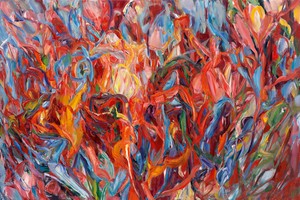
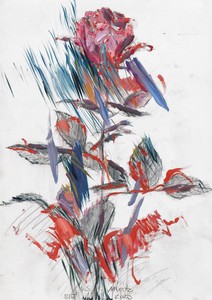
Sabine Moritz, The three sisters 5/5/2023, 2023, oil on lithography, 16 ⅝ × 11 ¾ inches (42.1 × 29.7 cm). Photo: Georgios Michaloudis, farbanalyse, Cologne, Germany
SMYes, abstraction touches the imagination of every person differently and is experienced differently by different people. I remember from my childhood that when I was sent to bed early while it was still light outside, and I was bored, I would inspect the marks in the wood of the cabinets and the wardrobe and would find figures, animals, shapes I was very familiar with after a while. Many people probably had similar experiences. In my painting I usually try to avoid any such associations completely, but right now I’m intentionally experimenting with combining configurations and abstractions inside the same painting. In still lifes, for example, this is always already in place, as a close look at the background will demonstrate. But I’m not there yet. I look forward to continuing at this point.
HUOWell, this is the next step. We haven’t talked about the works on paper on display in Rome. Let’s return to the series of twelve abstract works in oil on paper. They were created in the spring. Would it be correct to view them as an antecedent, perhaps on a subconscious level?
SMYes, because I always work on several projects simultaneously. You learn from one what you can apply to the other, ranging from paper to canvas, from canvas back to paper. Every task comes with other challenges. I’m still missing a title for this group. I’m envisioning a poem that formally harmonizes with the pieces, a poem of twelve lines—three verses with each verse having four lines. I may have an idea, but I must first check it out. . . . I’ve reflected on this one often [hands over a book]:
HUO[reads] “To the Fates.” Could that be the title?
SMGrant me a single summer, ye mighty ones!
Grant me an autumn’s ripeness of melody,
That less reluctant, being sated with the
sweet
Playing, my heart may perish!
Souls, if denied their sacred inheritance in
life,
Are unquiet too in the underworld;
I, though, achieved ere now the holy
Poetry, close to my heart, the poem
Then be you welcome, stillness and shadow
world!
I’ll be content, no less, should my minstrelsy
Not guide me down: time was, when I have
Lived like the gods: nothing more is needed.
HUOYou know it by heart!
SMFriedrich Hölderlin. “To the Fates” [1799]. They are the goddesses of destiny. Perhaps this is a beautiful arc. Exactly three verses, each with four lines. Each sheet can be given a line of the poem.
I had the poem in my head all the time and wanted to incorporate it. It matches the small series and thereby remains a bit more apropos.
HUOIs it true that these cycles actually also address repetition and difference?
SMIt’s always about the paradox of repetition and renewal, a contradiction by its very nature. On the other hand, it also comes from practice, as the new is always achieved by working with the same old hands, eyes, brushes, paints, canvas or paper.
HUOThis can also be seen in the rose series on view: prints of three charcoal drawings are the foundation that you paint over again and again in sets of three, as triptychs. They are similar, belong together like a family, but still differ from each other.
SMThe title is The Three Sisters because they resemble each other, like the members of a family.
HUORoses are strong, Etel thought. This again is a paradox: they are strong while also being fragile. The fragrance is strong but delicate.
SMYes, some people hate roses with a passion because they’re associated with the most tiresome platitudes. But at the same time, they’re always a challenge. The rose simply functions as a tremendously strong symbol. It can function as a metaphor for so many things.
HUOI have one more question in relation to the pieces in Rome. From our last interview I remember one sentence that I didn’t understand: what is “the texture that the picture seemingly wants to have”?
SMLooks like I expressed myself once again very hypothetically. I look at the piece and I see this texture. I respond to it and try to create or reveal it. Sometimes I have a different idea beforehand. For example, two of the Ferragosto paintings gave me the idea that they form a group together; I thought the other two were more a kind of drawing. But it didn’t work out that way and turned into something else.
HUOThe four pieces belong together.
SMYes, four pieces that are similar yet different. It’s ultimately up to the observer.
HUOThe four pieces could actually be a single work.
SMIt’s also an idea I often have, namely that the paintings converse with each other.
HUONot only the dialogue you have with the paintings, but the dialogue of the pictures with each other.
SMLike people in a group. Everybody makes a different contribution. The painting is a contention, and more of them are more contentions. Naturally there is also the possibility that one contention eliminates another contention.
Sabine Moritz’s paintings, drawings, and prints represent a succession of suspended moments, juxtaposing interpretations of her immediate surroundings and the natural world with deconstructed documentary images. Adapting and repurposing a catalogue of symbolic and abstract motifs, she ponders the mercurial dynamics of transience and decay. Her works enhance our sensitivity to the passage of time, locating personal experience within shared narratives. Photo: Leonardo Cestari
Hans Ulrich Obrist is artistic director of the Serpentine, London. He was previously the curator of the Musée d’Art Moderne de la Ville de Paris. Since his first show, World Soup (The Kitchen Show), in 1991, he has curated more than 350 exhibitions. Photo: Tyler Mitchell