In 2024, Sabine Moritz debuted new paintings at Gagosian, Beverly Hills. This exhibition, her first on the West Coast, precedes an upcoming show at the Olivia Foundation, Mexico City (February 5–June 8, 2025). Here, novelist Francine Prose looks back to some of Moritz’s earlier graphite drawings, thinking through their relationship to the more recent explorations of color in oil paint.
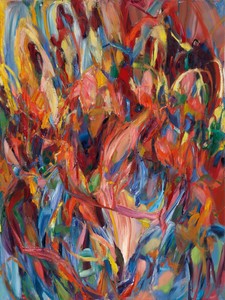
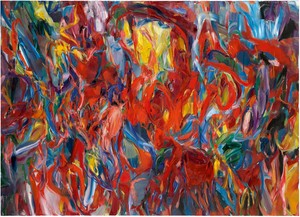
Sabine Moritz, Conquistador, 2024, oil on canvas, 47 ¼ × 35 ½ inches (120 × 90 cm)
Sabine Moritz, Conquistador, 2024, oil on canvas, 47 ¼ × 35 ½ inches (120 × 90 cm)
Francine Prose’s most recent novel is The Vixen (2022). Her other books include Caravaggio: Painter of Miracles, Peggy Guggenheim: The Shock of the Modern, Reading Like a Writer, and Lovers at the Chameleon Club, Paris 1932. The recipient of numerous grants and awards, she often writes about art. She is a distinguished-writer-in-residence at Bard College.
Something about Sabine Moritz’s paintings reminds me of a late afternoon, more than a decade ago, watching the winter light fade in a publishing office in Prague. Two Czech friends spoke very softly—spoke as they hadn’t in years, they said—about life under Eastern Bloc communism. One recalled that as a young woman, she had been forced to give up her job in the film industry because she refused to “report” on her colleagues. The other had been followed by the secret police because she borrowed a copy of Moby-Dick from the American Library.
Both agreed, slightly surprised, that their memories of that era were remarkably monochromatic. The buildings were gray, the stairwells were gray, the meat (when you could get it) was gray, the neighbors’ faces, et cetera. Even the sunny summer days could barely manage a cold pastel.
My Czech friends had reservations about the Disneyfication of Prague. So many houses had been painted green, pink, and yellow! But overall they were happy that color had entered their lives.
I mention this because Sabine Moritz, born in 1969, spent her childhood and early adolescence in East Germany. She and her family lived in a Soviet-style concrete housing block in Lobeda, not far from the city of Jena. Her parents were chemists. Her father was seriously injured in a laboratory accident. They moved to Jena before emigrating to West Germany in 1985.
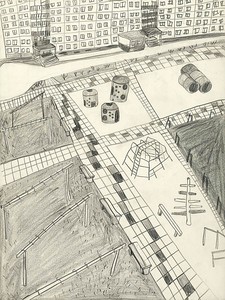
Published in 2010, Lobeda is an evocative, affecting collection of Moritz’s pencil drawings of the neighborhood, the city, and the area where she grew up. These works, which she began making in the 1990s, echo both the bleakness and the tenderness with which my friends summoned the past.
Sabine Moritz, Lobeda 102, 1991–92, crayon on paper, 22 ⅞ × 16 ½ inches (58 × 42 cm)
Memory
Moritz’s renderings of childhood memories recall the great works of Czech and Romanian New Wave cinema. We know that the places she draws were real, and may still exist, yet somehow they seem like the sets for black-and-white science fiction films: Alphaville (1965) with more subtle lighting and a somewhat less threatening atmosphere. These roadways, squares, interiors, and facades are dreamscapes: at once specific and unplaceable, mysterious and familiar.
Over time, people and a bit of color edge their way into the drawings: playground equipment, fragments of interiors, children dressed up for the first day of school. But somehow the children seem like overdressed, edgy tourists in a deserted city. In one drawing two little girls seem to be playing, until we realize that this is more likely a statue of two little girls playing—a halfhearted invitation, an unconvincing signal that this is where little girls play.
Aggressively plain and weirdly lovely, these unprepossessing domestic and industrial exteriors float up out of the pages of Moritz’s book Jena Düsseldorf (2011). In reality such places insist on their utilitarian solidity, their ideological refusal to be comfortable or pretty—to mimic a bourgeois aesthetic. But on the page they’re more tentative, less sure, more melancholy, than in life. We’re reminded that they were someone’s home (in this case the artist’s). They seem to be waiting to come back to life, waiting for their long-lost residents to return.
Most of the scenes are rendered in that Soviet winter-landscape gray. As Moritz says in Jena Düsseldorf, “At that time everything was the same. . . . These new residential areas seem to me like the depiction of ‘the new socialist human being’ with channeled desires and controlled needs which have been transformed into an infrastructure.”
When color appears in the drawings, it’s a little muted; the red/orange vests worn by the schoolgirls aren’t clamoring for our attention. They speak of a world where the human desire to stand out was sensibly tempered by the need to keep one’s head down. And when something bright insists on itself—a red chair, a colorful bathroom wall—it’s isolated, singular.
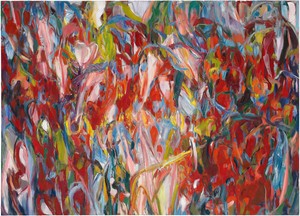
Sabine Moritz, New World III, 2024, oil on canvas, 70 ⅞ × 98 ½ inches (180 × 250 cm)
Life and Art
I’m never entirely comfortable connecting an artist’s life to the art. How much can a purely abstract painting be autobiography in disguise? Possibly the past—childhood, history, experience—means everything and nothing. All these elements are aspects of the self, the prison of the self. If art is an escape from that self, that doesn’t mean that the walls and the bars of the cell no longer exist. Charles Dickens told no one but his wife and one friend that his father had been in the Marshalsea debtors’ prison, but actual or metaphorical jails appear in book after book after book.
I can’t help feeling that the headlong, joyous passion for color in Moritz’s paintings might be less available to an artist who hadn’t spent a certain amount of time amid a certain . . . grayness. Would an artist who had lived (as it were) in color since birth take the same delight in the freedom that color allows and inspires? Perhaps it seems like an odd association, but comparing the subdued tones of Moritz’s Lobeda drawings to the volcanic eruption of pigment in her paintings, I think of that moment in The Wizard of Oz (1939) when Dorothy, airlifted by a tornado, leaves black-and-white Kansas and steps out into the Technicolor-rainbow world of Oz. Of course, amid all that beauty, there’s a wicked witch to dispatch and a cohort of needy traveling companions—just as in Moritz’s paintings, hints of nightmare, or at least unease, occupy the spaces between the brushstrokes and the swirls of riotous color.
Sabine Moritz, New World I, 2023–24, oil on canvas, 70 ⅞ × 98 ½ inches (180 × 250 cm)
The Seasons
If we have lived with seasons, we can’t look at Moritz’s paintings without noting how deftly they observe and reflect the natural world: the ways nature’s palette changes over time. Moritz has noted that one of her interests in the seasons, and in weather more generally, is that they are constants while all aspects of humanity shift, have different imprints and experiences. One series of 2023 is entitled Ferragosto, the name of an annual Italian holiday, a word that conjures up the harvest before the harvest—the red of ripe tomatoes, the yellow/orange of zucchini flowers, the healthy green of basil. But it is also a time when cities empty out, when people flee the urban heat for the cooler air of the seashore and mountains. The hot, empty cities take on a deserted, interplanetary feel, which brings us full circle back to Lobeda.
These reds and yellows and oranges, the defiantly blue sky, those brave holdouts of green, evoke the glories of the end of summer: they’re imprinted on our brains. Ferragosto, the 15th of August, is also the Feast of the Assumption, a celebration of the miraculous way in which the Virgin Mary was assumed bodily into heaven, to become eternal, immortal, but no longer on Earth. And Moritz’s brushstrokes often convey the fiery, upward trajectory we associate with ascension.
Other paintings of Moritz’s take their titles from “large” and “small” natural phenomena, from topography and geography, from the months of the year, the times of the day, aspects of the weather (one series is entitled Frost, 2024), and offer abstract renderings of how differently the ocean appears in San Francisco and Los Angeles. In an interview she speaks of art and of paintings as being answers (or attempted answers) to questions. Among the questions these paintings ask is: How does it look and feel to be at the edge of the Pacific in two such different places?
Images
Moritz has said that she wants people to spend “an enormous amount of time” in front of her work. And she gives us reason to do so.
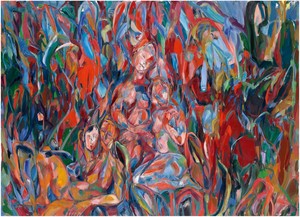
We can’t help seeing shapes that remind us of things until they don’t. When we lose sight of them and come back, we can’t find them again. In one of her paintings I saw, in bright orange, a postage-stamp-sized version of Goya’s Saturn Devouring His Son (1820–23). But where did I see it? Elsewhere I caught a flash of Tiepolo, not the pink clouds and cherubim but the darker chaos of The Fall of the Rebel Angels (1724–29), with which he decorated the stairwell in Udine’s Palazzo Patriarcale. We may not think at once of Monet, but his final paintings—rougher and looser than his better-known canvases—were done largely in reds, yellows, and greens, because his eyesight had weakened and those were the last colors he saw.
Sabine Moritz, Arcadia, 2024, oil on canvas, 70 ⅞ × 98 ½ inches (180 × 250 cm)
The figuration we may see in Moritz’s abstractions is as personal as it is fleeting: a private moment of communication with something that was—or more likely wasn’t—in the artist’s mind. It is a glimpse of something we have dredged up from our unconscious and pressed into the painting.
The Elephant in the Room
The elephant in the room for the modern German painter is modern German history. Obviously, every country has whole armies of skeletons in its closet, but twentieth-century Germany amassed an extraordinary number, separated from their bodies in especially horrific ways. Many artists—Georg Baselitz, Joseph Beuys, Christian Boltanski, Hans Hofmann, Anselm Kiefer, Felix Nussbaum, Sigmar Polke, Gerhard Richter, and countless others—have worked to acknowledge that era in ways that are powerful but unsentimental, fierce and original without tipping over into shock and exploitation.
In one series of Moritz’s drawings, the structure that rises out of the landscape could be any bell tower—except that it isn’t. The tower marks the site of the Buchenwald concentration camp. “It was visible from afar,” Moritz has said. “Starting from the bell tower, I tried to describe the place, this place with its shocking history of horror: in the Third Reich it was a gruesome concentration camp; but before it was turned into a memorial site it was also a Soviet reeducation camp that was never mentioned during East German times.” Art history is littered with skulls, but the ones in Moritz’s work seem to have an added significance.
Words
Perhaps I don’t know enough painters to be able to make a statistically conclusive statement, but among the artists I do know, there is an unusually high concentration of serious readers with excellent taste in books—by which I mean they like the books I like.
Moritz appears to be a broad and discerning reader of poetry. Scattered among the reproductions in August (2023) are works by poets ranging from Dylan Thomas to Friedrich Hölderlin to Gottfried Benn. In yet another volume, Moritz’s drawing of a rose appears side by side with an exceptionally beautiful poem by the great Polish writer Adam Zagajewski. “The Green Windbreaker” begins with a description of the poet’s father strolling through Paris, visiting the Louvre to stand in front of the paintings of Corot. Its final lines speak eloquently of many of the subjects that seem to animate and inspire Moritz’s paintings: the power of memory and time and beauty, the ongoing war that occurs when the bright triumphs and hopes of art come up against the darker plans that history has for us all.
Francine Prose’s most recent novel is The Vixen (2022). Her other books include Caravaggio: Painter of Miracles, Peggy Guggenheim: The Shock of the Modern, Reading Like a Writer, and Lovers at the Chameleon Club, Paris 1932. The recipient of numerous grants and awards, she often writes about art. She is a distinguished-writer-in-residence at Bard College.