Shiguéhiko Hasumi’s Directed by Yasujirō Ozu, published in Japan in 1983 and recently translated into English (University of California Press) for the first time, is recognized as a crucial part of the literature on the great director. Below, Carlos Valladares speaks by Zoom about the book with the critic and essayist Moeko Fujii, a longtime reader of both Hasumi and Ozu.
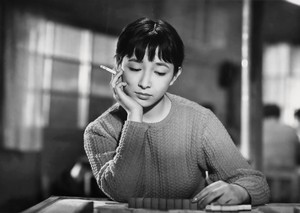
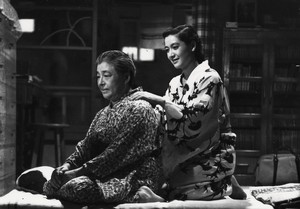
Still from Tokyo Twilight (1957), directed by Yasujirō Ozu. Photo: courtesy Everett Collection
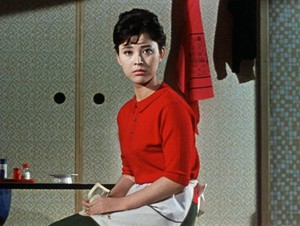
Still from Tokyo Twilight (1957), directed by Yasujirō Ozu. Photo: courtesy Everett Collection
Moeko Fujii is an essayist and critic whose work has appeared in The New Yorker, The New York Review of Books, Criterion, Aperture Magazine, and elsewhere. She currently writes a column on film for Orion Magazine.
Carlos Valladares is a writer and critic from Los Angeles. He studied film at Stanford University and began his PhD in History of Art and Film & Media Studies at Yale University in fall 2019. He contributes regularly to Art in America, n+1, and Frieze. He lives in New York. Photo: Jade Sacker
Although Shiguéhiko Hasumi is among the world’s great critics and philosophers of cinema, his writings are strangely hard to come by in the Anglosphere. This makes the University of California Press publication of his Directed by Yasujirō Ozu, translated by Ryan Cook and deftly contextualized in an introduction by Aaron Gerow, a publishing event of immense proportions. To English-speaking audiences, it introduces Hasumi himself: born in 1936 in Roppongi, Tokyo; the recipient of a PhD from the Sorbonne; a translator into Japanese of the French philosophers Roland Barthes, Gilles Deleuze, and Michel Foucault; one-time president of the University of Tokyo; a novelist awarded the Mishima Yukio Prize at the age of eighty; and a renowned writer on cinema and literature, the author of over thirty books over the course of six decades.
American readers may have happened sporadically on translations of individual essays of Hasumi’s, but his monograph on Yasujirō Ozu is his first book to appear in English. It is sure to change standard Anglophone interpretations of this central figure in the history of cinema. Ozu is often described as the director of “quiet,” “quintessentially Japanese” family melodramas, including consecrated masterpieces such as Tokyo Story (1953), Late Spring (1949), Good Morning (1959), and An Autumn Afternoon (1962). To read Hasumi, paradoxically, is to realize that surface interpretations of Ozu haven’t properly investigated the surface of the films themselves. Hasumi invites us to look deeper at Ozu: How is anger performed? Why does an actor move in this way and not that? When does it rain?
Hasumi’s Ozu book has drawn praise from the likes of such directors as Victor Erice (“intelligently challenges many of the conventional interpretations of Ozu’s work with his unusual critical insight”),1 Paul Schrader (“a definitive classic by a master in the field”),2 Pedro Costa (“he writes from a filmmaker’s point of view . . . he works just like a filmmaker”),3 and Ryusuke Hamaguchi, who has said that Directed by Yasujirō Ozu is “the most important book in my life” and that it “thoroughly changed my way of looking at films and formed my filmmaking practice.”4
—Carlos Valladares
Carlos ValladaresAs a result of my upbringing, there was something in Ozu’s films that appealed to me far more emotionally than the films of those directors with whom Western critics traditionally link him, Akira Kurosawa and Kenji Mizoguchi. Ozu always seems interested in modern, “everyday” situations, ones that I recognized among the women around me growing up, and there’s something so intense in his everyday, which moved me just as much as—if not more than—a battle scene in Kurosawa’s Seven Samurai (1954), say, or the single-take assault in Mizoguchi’s Ugetsu (1952). Ozu’s films are just as charged, but they approach emotion, drama, incident, action, gesture, and being in the world by other means. And that’s what Hasumi, as a writer, understands in the world of Ozu, as much as he’s always, to me, constantly doubting anything he himself is saying or laying down [laughter], which is the constant struggle, but also the ideal, of writing. I wondered when you discovered Hasumi for yourself and what that experience was like.
Moeko FujiiDuring college I read [Paul] Schrader, I read [Donald] Richie, I read [David] Bordwell, I read [Noël] Burch. There was always something that felt off or limiting about their totalizing theories of Ozu. But then I happened on Hasumi’s book in the library. Near the end of his chapter “Radiating” there’s a sentence that says, “Japan also never corresponds with things Japanese.” As someone who grew up in both the United States and Japan, that sentence struck a chord so deeply within me. Belonging to two countries makes you very aware of the fictiveness of any claim of Americanness or Japaneseness. But whether it was Schrader or Richie, they seemed to want to link Ozu to a flat, convenient idea of Japan. And they want to make that link as stable as possible. Hasumi doesn’t do that—his Ozu felt closest to my Ozu. So I went to the stacks and read everything he’d written, his lectures, his seminars, his books on [Mikio] Naruse, [Gustave] Flaubert, [Michel] Foucault.
But another reason why I think I responded so strongly to Hasumi is that film criticism is incredibly inattentive to bodies in motion.
CVSo inattentive. I agree.
MFIf a film critic writes about an actress, oftentimes the move is to evaluate their acting, right? But you can do that without being attentive to their bodies, how their gestures accumulate meaning throughout a film. If Hasumi is someone that every critic and film lover should read, it’s for his insights on how a body moves and its implications for a director’s work. Cinema is said to be sculpting in time, and if you don’t consider how the body sculpts in time too, you’re missing this crucial part of cinema. Hasumi, like Vilém Flusser, is just in a league of his own in developing a philosophy of the body in motion. There are these pivotal moments in film where dancing or gesture is the key to understanding how the director operates. And that’s how Directed by Yasujirō Ozu is structured, too, via gerunds as chapter headings—“Changing Clothes,” “Laughing,” “Eating,” “Holding Still.” Reading Hasumi is like walking through a museum of gestures.
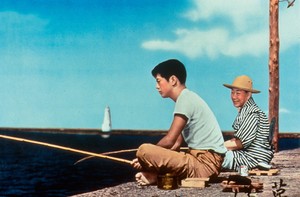
Still from An Autumn Afternoon (1961), directed by Yasujirō Ozu. Photo: courtesy Everett Collection
CVYeah. And Hasumi gets away from all these troublesome, totalizing, boring presumptions of identity or national stability: “This is so Japanese,” “This is so Italian,” “This is so Mexican.” Such clichés have little bearing on the work in front of you. Identity is so porous and unstable. And there are moments in cinema when signs and gestures form their own kind of language beyond language, beyond saying “This is Japanese,” or even “This is cinematic.”
I remember my first encounter with Hasumi beyond this book; it was in a piece by the film critic Jonathan Rosenbaum on Jacques Demy, whom I love.5 And Demy and Ozu are quite linked, as Rosenbaum argues and I’m slowly realizing: in both there’s this emphasis on certain gestures, certain “empty” words and turns of phrase that get reanimated depending on the situation. “Bonjour,” when it’s sung in Demy’s Les Parapluies de Cherbourg (1964), has a different affect than when it’s simply spoken. Same with Ozu—that couple at the train station at the end of Good Morning who refuse to explicitly acknowledge their mutual infatuation with each other, resorting instead to saying “good morning” and “sunny day, isn’t it?”
What Rosenbaum brought up in his piece was a point Hasumi makes in his essay “Sunny Skies”—how the sky in Ozu’s films is less “Japanese,” in the way Schrader and Richie would have it, and more “Southern Californian.”6 It’s always weirdly sunny in his movies, or else constantly hot. And that struck me, because, a) that’s such a brilliant connection, showing how much less in thrall Ozu is to a Western projection of Japan as all haikus and mono no aware and more in debt to Hollywood, Ernst Lubitsch, John Ford. And Hasumi’s vision of LA got me thinking, as a teen, of my own relationship to LA. This may sound perverse, but I don’t associate LA with sunny skies at all. I see rain more vividly in LA, because it’s such a special weather pattern when it cuts through all that, to me, static baby blue. That scene, for instance, in John Cassavetes’s A Woman under the Influence (1974) where it’s raining and gray and Gena Rowlands returns home from the LA asylum—that’s LA to me.
Hasumi isn’t wrong when he sees that sunny skies in Ozu films have a relationship to Southern California. But the lesson I took, even before reading him directly, was that things are so unstable, and that what we must develop is the art and act of looking and noticing, which are such intensely political acts. To look and to perceive deeply requires an attention that many who write about film, I find, simply ignore. They’re thinking of people they already know—writers, philosophers—and they’re thinking of other films, and they’re trying to put these phantom figures around the film in dialogue, instead of focusing on the details of the film in front of them.
Still from Floating Weeds (1959), directed by Yasujirō Ozu. Photo: Photo 12/Alamy Stock Photo
MFI was recently at a screening in Princeton, of [Apichatpong] Weerasethakul’s Tropical Malady (2004). After the screening, the graduate student who had arranged the event said, Weerasethakul is a queer filmmaker and he’s working against the normative, traditional way of filmmaking that directors like Ozu exemplified [laughs]. And you can understand why someone would try to make that argument, right? Especially given some of Ozu’s subjects. But what Hasumi’s book and this translation of it allows you to do is be more ambitious and more careful in thinking about Ozu, to consider whether you’re stabilizing Ozu into something he may not be. Why do both Western and Japanese critics need to think of Ozu as a director with an unchanging style? Why do people say his camera doesn’t move, when one viewing of his silent films proves this untrue? What really is so normative about Ozu, and what do we need to erase from his films to think of him that way? To read Hasumi is to train yourself to frustrate and be frustrated with an idea of a stable style.
I want to talk about what we think the Hasumi-esque is.
CVHaving now read a full-length Hasumi book, his way of looking at cinema strikes me so much in its familiar freshness. I’m not used to looking at film in this way; I’ve been almost trained away from it. Our society, the people around us, are always distancing us from looking at the images—and having us ignore not just the images, but more crucially the rapport between the images.
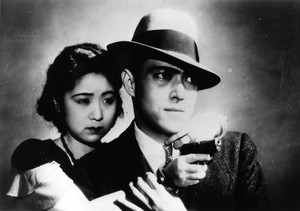
Hasumi rails against people because the things they see in Ozu—the calmness, the tatami shots, the gentility, the imagined Japan of it all, the mu of it all—are elements of what he calls “the Ozu-esque” and have nothing to do with any given Ozu film itself. Hasumi is against a stiff totalization, which generalizes a director or a writer based on how you predict they’re going to act; they thus coagulate into a frozen, recognizable style. But Hasumi refuses coagulation. He doesn’t ossify Ozu by associating him with all the obvious stylistic traits—Ozu is slow, he always does tatami-mat shots, he’s interested in mother/daughter intergenerational relationships, he’s a conservative filmmaker—because he looks at the entirety of the Ozu corpus and reminds us, Yeah, but what about Dragnet Girl (1933)? Where none of those signifiers are at all present. And yet Dragnet Girl has just as much to tell us about Ozu as Tokyo Story, his most famous film, and to not think about Dragnet Girl and think only about the Ozu of one part of his work is to talk, reductively, of the “Ozu-esque.” Hasumi points to how much this inhibits us, and I think the path he opens up for me is precisely the path of freedom for an artist, or an artwork, to be something entirely different in the next frame or the next shot.
MFIf you were to ask me what the “Hasumi-esque” is, I would say it’s exactly what you said, which is, he starts off with a declarative statement. Such as, “Ozu’s sky is always clear.”
CV“John Ford is about throwing.”
MFAlways about throwing. Then he marshals a full run of evidence to convince you that this is true. Then he tells us why that matters. Why is Ozu’s sky always clear? Because by saying “Nice weather,” or “Nice sky,” Ozu’s characters reassure themselves they’re in the worlds of Ozu—Ozu’s cinematic universe, if you will. But then he pushes back against his earlier declarative statement: “Well, this is simply not true in Floating Weeds (1959), where there’s a rainstorm.” I think the crucial move in Hasumi’s essays is always this part where he refuses to dismiss this puzzle piece that doesn’t fit as an exception or a failure. For him, it’s always those moments that tell us how to attend to the works of Ozu—or of Pedro Costa, or Frederick Wiseman, or Jean Renoir, or Chantal Akerman. He consistently comes back to this idea: “It’s not what can be seen, but how we see it.” What’s so beautiful in Hasumi’s writing is that for him, these exceptions—these moments that confound us, that terrorize us—are also moments that inexplicably move us. Because we are moved, as Hasumi would say, we know that these directors were bringing us to the limits of cinema.
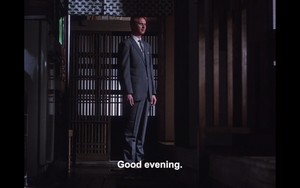
CVWe both chose a shot from an Ozu film to discuss with Hasumi’s criticism on Ozu in mind. I wondered if we could talk now about our respective choices; you chose a film from Ozu’s late period, in color and sound, The End of Summer (1961). This guy in the shot saying “Good evening,” I completely forgot about! I forgot that there’s a white dude named George in The End of Summer who’s dating Ganjirô Nakamura’s mistress’s daughter.
MFI chose this shot because many people associate Ozu with the idea of tradition, a transmission of some kind of Japanese familial lineage, grandmothers and daughters, fathers and sons. And I could imagine someone claiming, “There are no foreigners in an Ozu film,” without much pushback, though as scholars have already noted, you can’t miss his love of Hollywood cinema in his silents, and there are constant references to a foreign world in his late films: a husband flying to Uruguay in The Flavor of Green Tea Over Rice (1952), or Setsuko Hara’s to-be-fiancée looking like Gary Cooper. But this shot isn’t just a casual reference, a nod toward the foreign outside the frame. This is a white man entering the visual sphere for Ozu—even if it’s only for a few seconds. And I wanted to talk about the stakes of it, what it’s doing in The End of Summer, Ozu’s penultimate film.
Let me set up the scene for you. A patriarch of a brewery who is feeling his age has just recently taken up again with his former mistress, and it’s causing a bit of a crisis for his family. The white man appears when he decides to go over his mistress’s house to reminisce about old times, and her daughter comes by. What’s important is that he’s not completely sure if she is his daughter. His daughter comes by and she’s wearing this beautifully pink flouncy modern dress and she’s like—
CVThat’s another thing: to be Ozu-esque, to not see Ozu, is to assume that no loud popping colors, like the daughter’s pink, are allowed in Ozu’s world. And then, boom: pink comes out of nowhere! It really does explode!
MFYes, she’s wearing basically wearing a cupcake. The daughter comes by, and says, “Hi Daddy,” and then she says, immediately, “Oh but what about that mink stole that you said you’ll get me?” Later, she talks to her mother about “all the other men I call Daddy,” and they sweep it casually under the rug. The interesting point about this exchange is that this idea—that his daughter may not be his daughter—is not something that’s existentially threatening to this man, as it had been in his earlier films. In A Story of Floating Weeds, for example, if the man had not sired that daughter, it would’ve been a catastrophe. But something had changed in Ozu’s worlds, which is by that point, the patriarch can take this attitude: “Eh, might be my daughter, might not be my daughter. Whatever. I’ll still buy you that mink stole.” During this conversation, the doorbell rings and a white man appears and he says, “Yuri, hurry up.” And then she leaves.
Halfway through the film, the patriarch dies in his mistress’s house. And so the mistress is left with a burden: to fan his corpse and wait for his real family, his nuclear family to show up to her house. And the mistress and her daughter are waiting for the family to arrive and her mother is so tense while the daughter is sighing, “Should have asked him for that mink stole earlier.” It’s quite a funny scene. But then the doorbell rings and the daughter says, “Someone’s come,” and this is where we find the frame that I’ve chosen. This white man arrives and declaims “Konbanwa,” which is, “Good evening,” and he says it in such an eager weeb-in-training tone, and the mother says, deadpan, “Oh, George is here.” And then the daughter says, “No, it’s not George today, it’s Harry.” Then she leaves.
Still from The End of Summer (1961), directed by Yasujirō Ozu
CVYes!
MFWhat I find so fascinating is that in a film about fathers being substituted for other fathers—this anxiety about the father that is unfelt by the father himself—there’s this strange substitution that’s also happening with the two white men as well. It’s not George today, it’s Harry. The white man in a Kurosawa film or a Mizoguchi film or a Kinuyo Tanaka film is so fraught—the figure of the white man is that of the occupier, threatening Japanese masculinity, “taking our women,” the ruddy, pink embodiment of Japan’s defeat, etc. In their work, the representation of the white man is brutish. But in Ozu’s film, the white guy stands at the threshold of the house, the genkan. And he doesn’t enter. And so if you were going to do a Hasumi-esque reading, it would be not actually to focus on the white man himself but on the fact that he doesn’t enter the house. And in a sense that is true of the patriarch—that he had simply stopped by at all of life’s doors, perhaps too lightly, and he must take stock of that at his close. And it makes you think of all these other moments in Ozu’s films when people arrive to the door but don’t take off their shoes because they know that they’re just stopping by—that in fact, they had not been invited, really, to enter.
It’s played for comedy in Good Morning, where a peddler stops by and is hastened off by an old grandmother telling him to go away, deadpan, holding a butcher’s knife. Or it’s played as tragedy, in Tokyo Twilight for example, when a long-lost mother returns home but knows that she will not be admitted, because her absence was the reason for her daughter’s suicide. It’s a dangerous space for Ozu—so full of overtures of hope and desperation, all that must be played casually.
I think that it may be the only place that a white man can exist in Ozu’s world—where his threat can be addressed, and even made parallel to the concerns of the Japanese patriarch, but they will not be admitted into the house: he’s still contained. And Ozu is wryly anticipating the attachments of weebs, here, too: that white men might like this gentle containment, this “stopping by” at the threshold, that that’s part of the appeal in the fantasy of Japan for them. The katana in the suburban bedroom, the Ozu in their Criterion box set. But a more Hasumi-esque phrasing might be, entering and not entering. And what is the in-between of the two? They close the door behind them and they’re in that little box and what is that box?
CVAnd there’s a whole world contained within this one figure of entering and not entering the house. It’s such an expansive way of entering into a film and delving into all of the different philosophical strands raised by a film, while being firmly anchored in one figure.
MFYes, let’s talk about your shot.
CVIt was such a revelation to me watching this film. Again, in the Ozu-esque, it’s all about family melodramas—until it’s not. All the things that one would assume as the frozen, placid Ozu-esque, all fall apart when you watch Dragnet Girl. There are brutal fistfights. There are women holding guns.
MFIsn’t the only gunshot in all of Ozu in Dragnet Girl?
CVIt might be, honestly.
MFI think so.
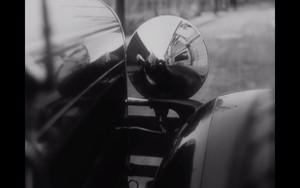
CVI think you’re right. It’s the only time that somebody fires into somebody else. And I chose this shot—of the car speeding away with the lovers, as you see the camera reflected in the rear-view mirror—specifically because it reminded me of the central feature of Ozu’s films, a quintessential Ozu-esque stylistic tic: the eyelines. You see the actors look into the camera in a shot, and in the reverse shot, the other actor is also looking into the camera, but just slightly off, not quite into the camera like the first shot. And here, in Dragnet Girl, we have a moment where there are no people, yet the camera is looking at us in this chase-shot in the mirror. Ozu doesn’t hide the camera. We’re reminded of the presence of the eye that takes in everything very automatically, very mechanically—very, in Hasumi’s words, cruelly.
At the same time, we see buildings and streets warped beyond recognition into the mirror’s vanishing point, like they’re being pulled by a whirlpool. It’s a wild and virtuosic shot that is the opposite of what, in the Ozu-esque, constitutes a typical Ozu shot. It swallows the very materiality of the film whole, in a quite literally visual manner. It presages, I would argue, the optics within the Star Gate sequence in Stanley Kubrick’s 2001: A Space Odyssey (1968), sort of how Hasumi says the shot of the woman with the fedora in Ozu’s That Night’s Girl (1930) presages the moment of Jean Seberg trying on Belmondo’s fedora in Jean-Luc Godard’s Breathless (1960). Here, I feel all the weight of what Ozu wants to say before and after Dragnet Girl seems to collapse into this one shot, of a world that is being dramatically distorted, as the camera lens watches mechanically on. Reality is warped in an intense, yet cool-headed way. It’s a cruel recognition of what cinema does: something is established, and then flipped in the next second.
Still from Dragnet Girl (1933), directed by Yasujirō Ozu
MFIdentifying the Hasumi-esque, I think, is also about identifying who is being “moved” in his criticism. He uses that word a lot.
CVThe “we.”
MFThis “we,” yes.
CVWell, it’s so interesting—there are so many “we’s” in film criticism that I’m allergic to, like Pauline Kael’s “we.”
MFThe Pauline Kael “we.” The infamously hated-by–Renata Adler “we” [laughter].
CVRenata Adler basically says, in her takedown of Kael,7 and I’m paraphrasing: “Who is part of your club, Pauline? I’m not your we. We are not turned on by Robert Altman, by Brian De Palma, because I, Renata Adler, am not.” But Hasumi’s “we” feels more generative. Ryan Cook, in a translator’s note, points to the fact that Hasumi’s writing works through Roland Barthes and Gustave Flaubert, and that his use of “we” recalls the beginning of Madame Bovary (1857), a strange and unsettling first-person-plural narration of people looking at Charles Bovary. Then, after ten pages, it switches to a more “normal” third-person narration. But that “we” still lingers for the rest of the novel: it makes you feel there’s more to this story than just its straightforward narration, a whole unseen community of eyes is also narrating and translating the events. And Hasumi’s “we” doesn’t feel exclusionary. His “we” says: “I’m looking at these films through the particular lens of an ‘I,’ but around me there’s also a host of other subjectivities, whom I will never fully know, and who also inevitably shape what I’m seeing.” In his “we” there’s an unseen group of lookers and feelers, and we’re all thinking it through.
MFIn Japanese, a sentence doesn’t require a subject, so you don’t actually have a stable “we” in Hasumi’s work. Sometimes he uses “wareware” but often he omits it. But I think it’s fair to ask who Hasumi claims is being “moved” by a frame in, say, Early Summer (1951). And I take Aaron Gerow’s point that this is a particular and privileged subject. Gerow asks, “Who is this person who can detect the play of themes, having seen all of Ozu’s films?” For me, when I was reading Hasumi as a twenty-one-year-old, I was imagining a version of myself who could do that. I felt as though Hasumi were addressing some future version of myself, and perhaps of himself—a future reader who could be manifested into being. His “we” was expectant but capacious enough to include her, too, rather than being an exclusionary practice.
Still from Tokyo Story (1953), directed by Yasujirō Ozu. Photo: courtesy Janus Films/The Criterion Collection
CVOh that’s beautiful, that’s brilliant.
MFOne thing I miss in this translation is Hasumi’s use of dots to emphasize or defamiliarize certain words—that’s everywhere in the original but Cook translates it into quotation marks. Each time those dots appeared, you could hear the excited tapping of chalk over a word on a chalkboard, and hear a mind so alive to how language can change. But what I wanted to praise about this translation is that it presents Hasumi as an eminent scholar and critic, certainly, but also someone you could think against, be in conversation with. Cook might examine Hasumi’s statements about Bordwell, for example, and comment in a footnote, “This might not be entirely fair to Bordwell.” The translation makes you think about the text as living, not as the definitive Japanese clapback against Western critics. Hasumi is so eccentric in his writing, so deft and personal, and that really comes across in this translation. The last thing he would want, I think, is to be stultified into a fossil, some national treasure full of wisdom, which is what the West likes to do to aged Asian gentlemen. And which, he points out, has often been done to Ozu.
CVRight. There’s also the deep problem of judging Ozu simply by the billboard-advertisement Ozu of Late Spring or Tokyo Story. There’s also Days of Youth (1929), there’s also his diaries. There are so many other things that are him that we in the United States are not yet privy to because they simply haven’t been available, or focused on, or translated. But A Hen in the Wind (1948) and Tokyo Twilight (1957) serve as anchors of Ozu’s oeuvre. And the same thing for Hasumi’s writings: now I want to read all these other texts that he’s writing about, on Naruse for instance, and, on a parallel track, to watch more Naruse films. The work of opening up the world never ends.
1 Victor Erice, jacket blurb for Shiguéhiko Hasumi, Directed by Yasujirō Ozu, 1983, Eng. trans. Ryan Cook (Oakland: University of California Press, 2024).
3 Pedro Costa, “Three Hours with Professor Hasumi on a Train, in Japan,” Lola no. 7 (November 2016). Available online at www.lolajournal.com/7/hasumi_costa.html (accessed March 24, 2024).
4 Ryusuke Hamaguchi, jacket blurb for Hasumi, Directed by Yasujirō Ozu.
6 Rosenbaum writes, “While Ozu, for instance, is commonly regarded as a ‘realistic’ chronicler of everyday life in Japan, the critic Shigehiko Hasumi has adroitly demonstrated how even the weather in most Ozu films, all of them set in Japan, is the sunny weather of southern California—as perceived by Ozu through his career-long absorption in and fascination with Hollywood films—rather than the rainier weather of Japan.” Rosenbaum cites Hasumi on the same point in a separate essay, “Is Ozu Slow,” 1998, also available on his website, at https://jonathanrosenbaum.net/2022/02/30607/ (accessed March 26, 2024).
7 Renata Adler, “The Perils of Pauline,” The New York Review of Books, August 14, 1980.
Moeko Fujii is an essayist and critic whose work has appeared in The New Yorker, The New York Review of Books, Criterion, Aperture Magazine, and elsewhere. She currently writes a column on film for Orion Magazine.
Carlos Valladares is a writer and critic from Los Angeles. He studied film at Stanford University and began his PhD in History of Art and Film & Media Studies at Yale University in fall 2019. He contributes regularly to Art in America, n+1, and Frieze. He lives in New York. Photo: Jade Sacker