Architect and designer Jayden Ali joins Gagosian associate director Péjú Oshin for a conversation about false notions of failure, four-day workweeks, and the connective power of building together.
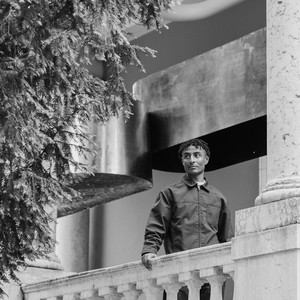
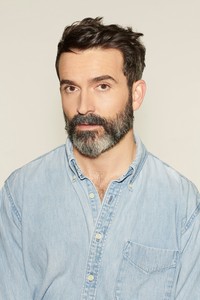
Jayden Ali is an architect, artist, and filmmaker whose interdisciplinary practice JA Projects works internationally on public-facing cultural projects that strengthen communities and actively reflect on society. A trustee of Open City and a design advocate for the Mayor of London, he has been recognized by numerous publications as a key voice shaping the life of cities and is on the prestigious 40 Under 40 list of the Architects’ Journal. Photo: Taran Wilkhu
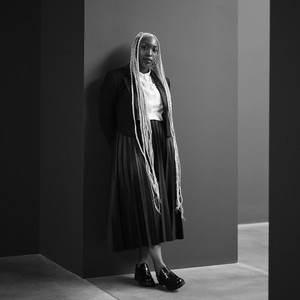
Péjú Oshin is a British-Nigerian curator, writer, and lecturer. As associate director at Gagosian she curated the exhibition Rites of Passage. She has held previous posts including as a curator at Tate, London, and as an associate lecturer at Central Saint Martins-University of the Arts, London. She is the author of Between Words & Space (2021). Photo: Jake Green
PÉJÚ OSHINWe met in Venice in 2022. We were in a tight alleyway with the artist Sonia Boyce, who had the Biennale’s British Pavilion that year, trying to get into a party [laughs]. And we started a conversation. I found out you were an architect and that you were going to be cocurator of the architecture biennale the following year. I remember thinking it was lovely that you had a teaching practice as well, because I feel that’s what I could have used when I was studying architecture: young, fresh, vibrant tutors with a breadth of cultural references. Over the past couple of years, it’s been interesting to see the way your practice has expanded. You’re a curator and an artist also.
JAYDEN ALIIt’s a beautiful moment to be recording a conversation with you, because I saw Sonia and I stopped her and asked her, What would be your advice for an upcoming artist or any artist? She said, To record conversations with your friends. I’m also reminded of the magic of events: when you’re pushed into proximity to others through navigating a city, you’re required to form new connections. It was raining and we had to huddle under umbrellas and the entrance to the party was about as wide as a person. The city gifted us that. And maybe if I can be romantic about that, the pursuit of architecture can also feel like a gift of coming together to produce a collective lived experience—making or shaping or framing your environment—especially when you’re dealing with cities. I think that’s the joy of it.
POI always playfully refer to myself as a failed architect when I meet new people in the field [laughter]. Increasingly, as I’ve been doing that, I’ve been meeting more architects who, like myself, are venturing into art spaces. There are many people like you and me who have backgrounds in architecture, but are dancing between these two different worlds of art and architecture; there’s a critical mass of people establishing a new way of seeing, or maybe rediscovering a way of seeing. So I wanted to know what you think it is about the practice of architecture that inspires this freedom of movement.
JAI’d like to debunk the myth that it’s a new thing for architects to step out beyond the field of building. If you think of OMA and AMO, the architecture practice and design studio, respectively, of Rem Koolhaas, and of his incredible book Delirious New York[: A Retroactive Manifesto for Manhattan, 1978] alongside his continuing scenography for Prada’s fashion shows, you see this interdisciplinary interest. Even if you think of Charles and Ray Eames, for example, they dedicated their studio to making tiny little minicircuses at times. They’re artists in that respect—they’re plugged in and attuned to the world in which we live. It’s a designed output and it exists at the multiple scales of the city.
POYou’re right, there’s always been this multidisciplinary approach. That’s what attracted me to the idea of architecture. I remember a university brochure calling architecture the most public and pervasive of all the arts—that felt exciting, that idea of contributing to the built environment and considering buildings as art. What I may have been noticing is, I think there used to be this idea of architects as being very studious and serious and kind of one-track–minded, and now I think the expanded work of architects is more visible to the public.
JAYou think that the everyday person in the street is open to architecture being more than buildings?
POOkay, maybe it might be too much to say everyone [laughter]. But at least for colleagues and enthusiasts in other creative fields, I think there’s an understanding that architecture can go beyond this, and an appreciation of that possibility. Much in the same way that people have expanded the word “curator” to describe organizing playlists, experiences, food menus, and so on, the increased visibility of key figures has created a shift in language where people are now referred to as star curators and starchitects. That opens up the conversation for people with regard to what the discipline looks like and what it can achieve.
JAI would say the most recent starchitect of our time is Virgil Abloh, and once you consider that, it blows the door wide open as to what architecture is. How can the most famous architect, the one most people in the world would be able to name, be someone who isn’t recognized for building buildings but for taking that as a methodology and applying it to other fields, like art and fashion? Even so, in the more public realm, I think it’s still a battle for us to be defined as more than building buildings. But I’m using the term “battle” quite lightly; I don’t necessarily care about convincing people as to where the term lies, or what’s garnered by the term. It doesn’t really matter to me.
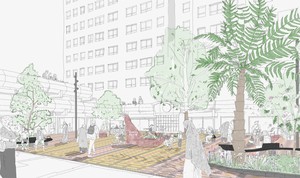
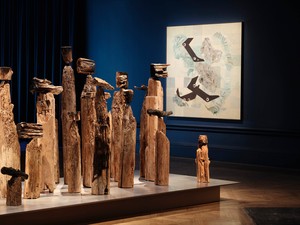
I often look at the description of the studio I founded [JA Projects, London] and what we produce, which includes urban strategy, art, and performance in addition to architecture. It really is a bit undefinable. It’s about the spirit of the thing that we’re producing; the spirit is held together by a commitment to purpose, like having some form of outward-facing social engagement. Even in a fragmentary way; it doesn’t need to be total. You can see it in our Venice project [Dancing Before the Moon, 2023], when we took the budget and distributed it to collaborators so that others could have space. You see it in our project in the National Portrait Gallery [The Time Is Always Now: Artists Reframe the Black Figure, 2024], where we worked with Issi Nanabeyin, a contemporary British artist of mixed heritage, to create a scenographic intervention that celebrated the presence of Black people. You’ll see it in our work in Queens Market[, London] this year, where we’ve designed a whole new public realm; it’s about working collaboratively with traders, local businesses, and communities. It’s a commitment to caring about how things are constructed, what they’re made from, who has the power to make, and how that results in some form of output. There’s something poetic in the output, both in the social meaning and of course from a visual perspective.
The pursuit of architecture can also feel like a gift of coming together to produce a collective lived experience.
Jayden Ali
POIn the past you’ve described your approach as “architecture plus.” Is that a concept you still use?
JAI would commit wholeheartedly to the idea of “architecture plus” in the studio, which is the idea we’ve been discussing of architecture being expansive, interdisciplinary, socially engaged. It’s best illustrated by the fact that everybody in the studio does something else. Architecture is not their sole pursuit; they’re concerned with a range of other creative practices. Today I had an incredible conversation with a member of the team, Brian Yue, who studies East Asian art histories at SOAS [School of Oriental and African Studies, University of London] and is obsessed with ceramics. Isn’t that incredible to have in the studio? How nerdy is it to be obsessed with certain ceramics from a certain dynasty, but how fucking cool? And I’ll tell you what that results in. We designed this exhibition for the Royal Academy [of Arts, London], where the plinths are finished in a timber burr, which is something that forms as a growth on trees as a result of trauma and invasion. There’s a romantic idea behind a burr: it speaks to ideas around resilience and renewal, growth even in the face of trauma. That finish is developed in the studio with my leadership, but it’s developed in tandem with Brian, who is similarly obsessing about the poetics of ceramics—how they’re produced, and the meaning and messaging held in a specific glaze. It’s a transferable lens.
That’s just one example; everybody has some interest outside of the studio. Almost everyone works a four-day week to have time to devote to other pursuits. And I wouldn’t have it any other way, because the input is phenomenal and it’s the thing that keeps me sane. It’s much like the reason I’m interested in teaching again, which is that there’s a whole new generation and a whole new set of concerns they bring to architecture.
POI’ve been thinking a lot about architects like Zaha Hadid and Frank Lloyd Wright, but then also, on the flipside, about artists such as Richard Serra and Do Ho Suh, who employ architectural principles and practices in their work to create these moments of immersion. How do you see or position yourself within this lineage of space-makers?
JAI don’t, which is why it’s so nice to hear you make that comparison. I mean, Serra’s passing really affected me. I grew up in East London and would see his sculpture [Fulcrum, 1987] at the entrance of the Liverpool Street station. It was mind-blowing. Then later, seeing his work at the Guggenheim Bilbao was so arresting for me—that someone could make a practice out of this, creating a whole world of opportunity. It’s an interesting counterexample to the Frank Lloyd Wrights and the Zaha Hadids of the world, which is maybe sculpture masquerading as a building. Or is it a building masquerading as a sculpture? I don’t know the answer.
POThat is a question.
Maybe people don’t trust the future for the same reason they’re suspicious of magic. There’s this promise of change.
Péjú Oshin
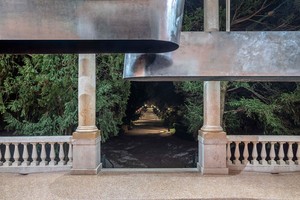
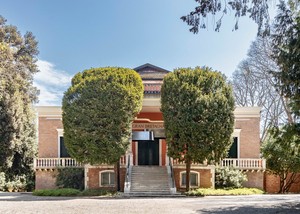
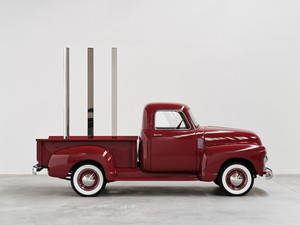
JABut with Serra, I don’t think you could say his work is masquerading as a building in any way. It exists as a form of shelter and it exists on an architectural scale in terms of defining space. It doesn’t exist as a building. There’s a distinction. I don’t think you can see Thunder andŞimşek, my contribution to Venice, disconnected from the influence of Serra. You’re just never going to get two four-meter-long giant steel sculptures with rounded edges that you can stand under and among without Serra as an influence. The criticism of that show is that it’s not “architecture.” But I see it as architectural because it’s deeply concerned with the building [the British Pavilion, Venice Biennale]. It’s deeply concerned with this edifice that sits at the end of a colonial promenade, a neoclassical building with all those columns and all those steps, et cetera. The building required a response, and the response was to exist outside the building. The response was to present a different face and a different first impression to visitors. The response was to soften the power dynamics that were embodied in the building’s colonial aesthetic. So that required something that existed at a scale and a material quality comparable to the building, as much as our means allowed. So you end up with these two large sculptural works, but they’re attached in this elegant way—through architectural detailing—to one of the principal structures of the building, namely the columns. This blurring of the lines begs the same question: Is it architecture masquerading as sculpture or is it sculpture masquerading as architecture? In that context, it’s probably aligned more with Zaha’s work than with Richard’s.
POI loved Thunder andŞimşek, but also the pavilion as a whole; I was there for the opening. To me it was a celebration of various diasporas—really, really beautiful. There was an invitation to be present. The slope for people to sit and watch the film, so you felt like you were outside or on a hill, made it communal. I’m aware that that work references both of your cultural heritages, Trinidadian and Turkish-Cypriot, and your experiences steel pan drumming. I play steel pan too.
JAWe should play together.
POWe should! Are you tenor?
JAI do melody.
POYeah, you do the small pan?
JAYes.
POI play bass. We could do something. The things that keep coming up for me are gathering, collaboration, community, so I wanted to discuss some of your recent projects that you’ve mentioned briefly in our chat so far. I’m particularly interested in the exhibition design for projects like Entangled Pasts[, 1768–Now: Art, Colonialism and Change, 2024], at the Royal Academy [RA], for example. In these instances you’re in dialogue with the curators, designers, artists. It seems in some way there’s a flattening of hierarchies because you’re almost all those things; you’re in a position of decision-making but also in a position to support and facilitate. I’m interested in how you’ve managed such fluid roles and how you switch those different hats?
JAI’ve certainly been lucky to do these projects. They’re all commissions and generally we’re pitching to the organizations. Once we’ve determined that our visions fit together, we work best when we’re in dialogue. I’m not very good at designing in a vacuum, I have to be responding to something. In Venice it was responding to the building. And that’s the joy of dealing with exhibitions, because there are so many different stories embedded in the objects and there are so many different people to interpret them. I’m thankful for you asking the question because I’m really mindful not to step on people’s toes. The dynamic at the RA was that they had a set of in-house curators and a set of external curators who were far more in tune with the lexicon of the Black diaspora and the Black agenda. The in-house curators come from a space of allyship. They want to do well but it’s not their experience. So in that space I didn’t feel so shy about stepping in and giving them confidence about good ideas. In The Time Is Always Now, I didn’t need to do any of that stuff because Ekow [Eshun, curator, writer, and broadcaster] was around [laughter]. And it’s a smaller show. I knew we were singing from the same hymn sheet. So I’m trying to turn it up and dial it down depending on the situation. It’s about active listening. You have to be present. I love the moment of pitching; often I’ll write what we want to do. Some people get it, some people don’t. I was having a conversation the other day about how people don’t trust the future, they want to see what it is. The beautiful thing about writing is, you can convey what it is without pinning it down; it’s like a sketch.
POI love that idea of writing as a sketch. I think people don’t trust the future in part because they don’t trust the present, right?
JAYou’ve hit the nail on the head. But I trust the present.
POYou do?
JAYeah. I think so. I trust people who believe in other people, because they weave magic every single day. They make magical stuff that blows my mind every single day.
POMaybe people don’t trust the future for the same reason they’re suspicious of magic. There’s this promise of change, right? And change is scary for a lot of people, especially as they’re going through it.
JAWhile you were talking about that, I was thinking, Wow, what’s my relationship to change? And I’ve always been comfortable in spaces of relative discomfort. Mainly that’s because I’m historically a poor Black man or boy in a white, increasingly middle-class industry. But that space of discomfort can also be described as a space of instability. If you get comfortable with instability, you get comfortable with change. I want to be in a place that’s dynamic. I don’t want it to feel stagnant.
POIn difficult periods you often find the spaces for innovation; you find a lot of change. Although you love and embrace change, the rest of the world right now is in a relatively stagnant place, it’s slow to change. How can we encourage a sense of comfort in the change, a sense of continually moving forward without forgetting what’s come before us?
JAI can only say how I address it, which is actively seeking out multiple inputs. When you’re growing up, your life is peppered with change—primary school, secondary school, moving house, divorced parents. Stuff’s coming your way all of the time. And you’re learning so much. It’s not all positive but I think that’s really rewarding. My ambition is to stay in the space that’s still giving me that type of stimulus. And the ambition is to provide other people the infrastructure to also receive that stimulus in a very simple way. I think that’s really about generating new ways of being collectively. It’s a practice that’s born from people collectivizing in this megametropolis that we’re in.
Jayden Ali is an architect, artist, and filmmaker whose interdisciplinary practice JA Projects works internationally on public-facing cultural projects that strengthen communities and actively reflect on society. A trustee of Open City and a design advocate for the Mayor of London, he has been recognized by numerous publications as a key voice shaping the life of cities and is on the prestigious 40 Under 40 list of the Architects’ Journal. Photo: Taran Wilkhu
Péjú Oshin is a British-Nigerian curator, writer, and lecturer. As associate director at Gagosian she curated the exhibition Rites of Passage. She has held previous posts including as a curator at Tate, London, and as an associate lecturer at Central Saint Martins-University of the Arts, London. She is the author of Between Words & Space (2021). Photo: Jake Green