This past summer, Jenny Odell, author of How to Do Nothing: Resisting the Attention Economy (2019) and Saving Time: Discovering a Life Beyond the Clock (2023), made a visit to Sarah Crowner’s studio in Red Hook, Brooklyn. Amid a series of new paintings that Crowner is making for an exhibition in Athens this November, the two discussed embodiment, honing attention, and what it means to enter vertical time.
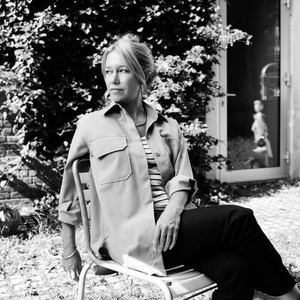
Sarah Crowner lives and works in Brooklyn. Her work points to an expanded field of painting, investigating the relationship between the element and the whole, and how parts build an entirety. In September 2023, the Pulitzer Arts Foundation opened Sarah Crowner: Around Orange, an exhibition of three new site-specific artworks responding to the architecture of the Pulitzer’s Tadao Ando building and Ellsworth Kelly’s monumental wall sculpture Blue Black.
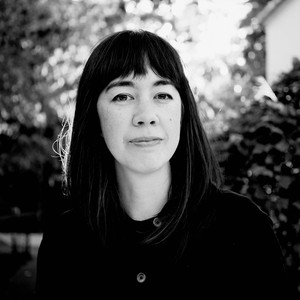
Jenny Odell is the author of the New York Times bestsellers How to Do Nothing: Resisting the Attention Economy and Saving Time: Discovering a Life beyond the Clock, both of which have been translated into numerous languages. Odell has been an artist in residence at Recology SF (otherwise known as the dump), the San Francisco Planning Department, and the Internet Archive.
Jenny OdellIn my conversations with people about their practices, especially in the context of How to Do Nothing, I’m struck by how acts of doing nothing are always embodied. I spoke with someone who really likes to shower in complete darkness at four in the morning. It’s their way of becoming reembodied. I go to the rose garden to remind myself that I’m a body, that I have a body. It’s so easy to forget: we’re working, we’re on our phones, we become just a mind in a way, as if that’s possible. Walking in here, surrounded by your work, I’m reminded of that—how you can feel it in the body as you approach a work of art.
Sarah CrownerYes, the moment of understanding is in the approach. Because I’m not making images, I’m making objects—and this has to be experienced bodily. One way to read my work is through its process: I’m not making an edge by literally painting a line, the hard edges are made by joining cut shapes painted on canvas with a sewing machine. It’s sort of similar to the way a carpenter might join wood; two things are coming together. That’s only really understood through walking up close to the painting, walking back, walking forward. And this is active, necessarily. In the same sense, with my tile installations, specifically the platforms, the bodily feeling of standing on a particular ground is another way to understand the work. Our bodies are rooted to the earth. We could be standing barefoot in the grass, we could be wearing stiletto heels walking on a marble floor, we could be wearing squishy Hoka sneakers on concrete—whatever the case, there’s always embodiment. I think that’s a really interesting way to think about art. Through one’s physical presence, all of the senses are brought into concert.
JOAbsolutely. Part of feeling disembodied is a narrowing of perception to the visual only. There’s a flatness. There’s a part of How to Do Nothing where I wrote about seeing Ellsworth Kelly’s paintings. My first encounter was seeing them on a screen, and they were easy to write off—like, okay, those are panels of flat color. That’s what I thought of them as being. But then I saw them at SFMOMA and they stopped me in my tracks. They weren’t flat at all, they were pulsating.
SCOne hundred percent. That’s why I’m also so glad when people finally make it out to my studio, because they’re going to have a very different experience than if someone emailed them jpegs to view on their phone. Different things in the paintings reveal themselves when you’re physically present. That’s about embodiment, as you say, but also about spending time, thinking about duration, speed.
JOTime and embodiment are very linked. When your sense of embodiment comes back, time also returns—a sense of time that isn’t uniform minutes ticking away. I’ve been thinking a lot about senses of time that aren’t fungible. Not clock time, not measurable work time, but other things like bodily time, ecological time, psychological time. I think it’s no coincidence that art is what does that for a lot of people: you come up to a painting like this and you’re like, Oh, here I am, I’m here in body. You become a more dimensional person; you’re not just this point on a timeline that’s trying to get to the next thing in the day—you have memories and associations and you’re noticing the skylight, and everything floods back in.
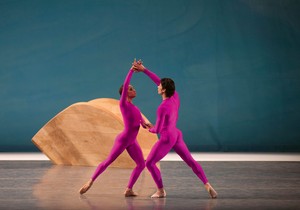
Garden Blue (2018) choreographed by Jessica Lang, costumes and set design by Sarah Crowner; performed by Misty Copeland and Herman Cornejo, American Ballet Theater, New York, 2018. Photo: Rosalie O’Connor, courtesy American Ballet Theater
SCThat was key to my thinking, especially with the performances I’ve worked on, where I’ve designed sets and costumes for dance. In the beginning I started with simple questions like, Can a painting be a backdrop? Could a backdrop be a painting? What’s really the difference? The durational parameters of a performance are interesting to me: the performance could be forty-five minutes long, you arrive at a certain time, you find your seat, you sit down, you don’t look at your phone, you’re not supposed to chitchat, you’re meant to pay close attention to this performance for a set amount of time. Putting a painting in that setting, and seeing what would happen if someone’s attention were directed at the painting for forty-five minutes, felt really potent. It’s very different from museum time or gallery time. What happens to your attention to that object in various settings? And then, How do music and movement alter that experience? Does the music animate the forms in the painting, or do the performers make the painting/backdrop become even more still? Is the painting even a static object anymore?
JOAnd putting a painting in conversation with something else that’s happening, be that performance or music, changes both of them. I did a residency years ago where visual artists and dancers were working together for the Merce Cunningham centennial. I learned about his collaborations with John Cage, where the music and the choreography were conceived of separately but happened together in the same space. “Synergy” is the wrong word, but there’s an interaction between them that’s not going to happen otherwise. The result is its own thing.
SCDefinitely. And with Minimalism or abstraction, for me there’s a real openness to interpretation. More so than with any kind of narrative or figurative picture-making, because in that case there’s probably something anchoring you there. But if you think of a simple green rectangle, a very simple, quiet, almost empty painting—that’s so much more open to possibility.
JOI always find it funny that some people will just completely write a painting like that off, but then there’s another group of people, including me, who might cry in front of that painting [laughs].
SCI know, same. There’s this autonomy to an abstract painting, but then there’s also the agency of you, the viewer. There are these two things that are facing each other and an invisible thread or web connecting those two bodies together.
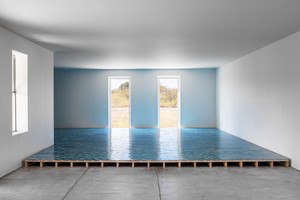
Installation view, Sarah Crowner, Platform (Blue Green Terracotta for JC), Chinati Foundation, Marfa, Texas, 2022. Photo: Alex Marks, courtesy the Chinati Foundation
JOThat’s what I also really love about your idea of walking on a painting. I haven’t had a chance to walk on any of your tile installations, but I can imagine feeling really aware of myself in that space. When I taught, I’d often include Yoko Ono’s Ceiling Painting/Yes Painting (1966) in my lectures. It’s the piece where you climb up on a ladder to find a magnifying glass, and you’re invited to use it to see painted really small on the ceiling the word “Yes.” I would always have to stress to my students that at that time, and still today, the norm when you walk into a gallery or museum space is, Don’t touch the art. Almost like you shouldn’t quite be there.
SCYou don’t feel welcome.
JOAnd you’re not supposed to bump into anything. You’re trying to erase yourself, in a way. I would tell them you have to imagine the experience of climbing up this ladder, which is also precarious, like now you’re in the middle of the space and it’s about you at that point, and then getting this magnifying glass and having the ultimate affirmation from the artist: yes.
SCYes.
JOIt’s so rare. But it’s rewarding and funny to watch people when there are pieces where they are invited—fully, bodily invited—into the experience. There’s always this hesitation followed by glee [laughs].
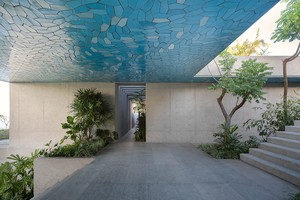
SCFor sure. In your book, you write about bird watching versus bird noticing. That really resonated with me, and in the aims of my practice, “noticing” is really the right word. What I hope my paintings do, or my tile installations do, is make you notice the outside world in a way that’s more considered. I want you not just to look at the painting but to notice what’s around the painting, on the wall, the light bouncing off it, or a window adjacent to it, or the feeling of the floor you’re standing on. Hopefully the painting becomes a tool for training your attention to the outside world. I made a tile installation for a large outdoor ceiling in a building designed by the architect Tatiana Bilbao in Mexico, and there you don’t only just see the pattern of the blue tiles, and the objectness of the tiles, you also see the reflection of the ocean in the ceiling because of the way it’s situated in space. If you pay close attention to that moment for long enough, you might notice things that you might not have before. If we talk about what art’s role is, to me it’s to make you notice the world.
JOI was just asked yesterday what I thought the role of the artist was, and I gave almost the exact same answer. I think I used the word “lens.” An artist helps you see the thing that’s already there.
SCArt trains your attention, like meditation.
JOWhen I gave the original talk that became How to Do Nothing, I was at the Walker Art Center in Minneapolis. I was there for three days for a conference, and they have that James Turrell piece there, Sky Pesher (2005), so I went on three different days. The clouds through his skylight look so different moment to moment because you’re given that lens, because of the size and position of the square. And then to your point, you go back outside and all the clouds look different.
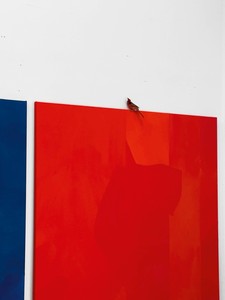
A cardinal perched atop a painting in Sarah Crowner’s studio. Photo: Akiha Yamakami
SCAnd that’s when you start to notice birds [laughter]. I definitely notice things outside my studio window, whether it’s a bird or the shape of a leaf. There was a moment last year when I was making bright red/orange monochrome paintings. They were for a show, Around Orange at the Pulitzer Arts Foundation in Saint Louis (2023), which was, among other things, about color and a response to a 1956 Ellsworth Kelly relief. The studio was filled with red and orange, and at one point we had the windows open and a red cardinal flew in and sat right on one of the red paintings. And I was like, “What! Are the birds responding to the color?”
JOThey do. Some birds see more color than we do, where we can’t even describe the color they see.
SCRight, because the males are more colorful and that’s attractive to the females, right?
JOSo even when birds have a pattern we can see, there’s sometimes more to that pattern that they can see and we can’t.
SCHe came in. He was hopping all around and then he sat right on top of a painting.
JOHe probably liked it.
SCBest compliment.
JOI really love what you were saying about how the ephemerality of the environment that’s showing up in the pieces keeps something alive, as opposed to some inert thing that’s floating through space. There’s a phrase I use in my second book, “unfreezing something in time,” which is when you perceptually take a thing that’s there but goes unnoticed, or doesn’t fully appear, and you work to bring it to the front of your perception. For instance, I think there’s a way of looking at animals where it’s like an automaton: Oh, it’s over there, doing bird things, but it’s not actually having an experience. You can do it with really anything. As an exercise to counteract that, during the pandemic I picked a particular branch of a particular tree in a particular park and I paid attention to that branch every time I walked by. I would take a picture of it. It’s a buckeye tree, and it has a very particular schedule: the branch has a flower stalk, but each flower opens at a different time. So day by day it’s actually different. It’s more complicated than, Oh, there’s the tree.
Those exercises are so important for new realizations. I started trying to keep a list of the first time I’d done something—first time I tried some kind of food, or whatever—but then it became impossible to keep this list because every time you do something it’s the first time that you do it. Everything is new, because things being alive, they’re in time, they’re changing.
I feel like your paintings are so opposed to the popular idea of a painting, which is very much like a thing that exists, that’s closed, and then you, the body, don’t have anything to do with it. It’s not really in time and it’s not really in the world.
SCI was listening to a podcast that discussed a book by the French philosopher Bernard Stiegler, called Taking Care of Youth and the Generations (2008), and in it he describes the concept of attention. He explains that in French, attendre is the verb for “waiting,” which shares etymological roots with our word “attention.” So attention is waiting. And, I would add, patience. To Stiegler, attention is “infinite waiting.”1 That’s interesting to think about when going into an experience with a painting. If you’re open to it and you wait long enough, something comes to you. But you can’t go into it with preconceived notions, or even go into it with the idea of emptying yourself.
JOHave you seen the Ad Reinhardt cartoon where there’s a guy pointing at an abstract painting and he’s like “Ha, ha, what does this represent?” And then the painting gets a face and it points back at him and it’s like, “What do you represent?” And then in the last panel he’s just like dead [laughter].
SCYes! Exactly.
JOI used to show that on the first day of class. Because the key word, as you said, is “open,” you need to be open. And there’s some humility also in that.
SCAnd vulnerability.
JOLike “I don’t know.”
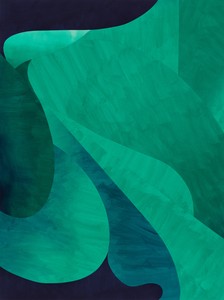
Sarah Crowner, Tropical Nocturnal, 2024, acrylic on canvas, sewn, 96 × 72 inches (243.8 × 182.9 cm). Photo: Maris Hutchinson
SC“I don’t know, I know nothing, but I’m curious.” But that’s not actually true, because, okay, we do know a few things already! And, we do carry all this stuff with us on our backs. Even though I want to say you walk into the painting and you’re completely an open book and just wait, we do have all this history, whether we like it or not—our age, our experience, how our body feels that particular day. All those things do inform.
JOYes, of course. The being open has to be qualified: being open to the interaction. I guess it’s like open to the idea that the painting could have something to say to you that would sound specific to you because of your associations.
Do you feel like there’s a general direction that you’re moving in, maybe even being surprised by, process-wise?
SCWell, the more I try to simplify my work, making it less compositional, less curvy, less complicated, more calm, it seems that I can’t, and I always end up going back to sharp, strong, organized forms. In my mind I’m leaning toward more quiet, more minimal, but then my body wants to gesture [laughs]. So there’s that push and pull. Also, I’m feeling the draw of scale. I want to make more tile installations and create public spaces on a larger scale. I want to do 50,000 square feet [laughter], which is crazy. So if anyone’s listening . . .
JOThat’s exciting. I think it’s really important to have that North Star.
SCThe thing about having a studio, and I’ve had so many studios over my life—everything from 200 square feet in some falling-apart building in Manhattan to bigger spaces—is that my work morphs and changes to fit those dimensions. My work is like smoke, it’ll fill.
JOI love that. Should we talk about screens? Something I was thinking about even before coming here was how that’s one of the conditions of being an artist now: your work is constantly consumed in little tiny jpegs.
SCI think so, and I don’t know what I can do about it or what could be done about it. It’s the way things are moving.
JOThe role of art that we were talking about becomes so much more important. It’s crucial now, because it’s this island of a way of perceiving and being that we all need to learn from and be able to practice. You have to keep coming back, because it’s going to keep getting eroded by the way things are designed now.
SCIt’s very precious. When I grew up, going to a museum was always a special experience; quiet, and meditative. I didn’t have to speak to anyone, and I liked that no one was paying attention to me.
JOIt was contemplative.
SCYour mind could wander and come up with its own associations and you could take your own time.
JOThere’s this book I cited in my own book, Leisure: The Basis of Culture (1948), by Josef Pieper, a German Catholic philosopher. He made a distinction between horizontal time and vertical time. Horizontal time is both work and breaks from work. The breaks from work on that horizontal time are not real leisure to him; leisure for him is instead vertical time, which is something that cuts through that timeline or interrupts it. Vertical time is the time when you suddenly remember this incredible fact of being alive, and your vulnerability in the face of the world. It’s like looking at a sunset for some people. Or for me, when I was working at Stanford, I was usually in horizontal time: I’m late to class, I’m schlepping all these bags because I’ve taken two hours of public transportation to get there, I’m thinking about what I need to do in class, and then, let’s say it’s spring or fall migration, there would be a warbler in a tree and it just completely interrupted everything. At that point I wasn’t only a teacher or an employee or whatever; seeing this bird, I had to think about where it came from, think about weather patterns—and then it would all just collapse back down and I’d have to go to class. But that’s very different from “I had a fifteen-minute break in the break room.”
SCThat’s really beautiful.
JOSo museums are the places to find vertical time.
SCTotally, or seeing the cardinal on a red painting. Magic.
1 Bernard Stiegler says that attention is “waiting on the disclosure of the long webs of connectedness that are in the object, and of course the infinitude of ourselves.” “Your Mind Is Being Fracked,” The Ezra Klein Show, May 31, 2024, 18:09.
Sarah Crowner lives and works in Brooklyn. Her work points to an expanded field of painting, investigating the relationship between the element and the whole, and how parts build an entirety. In September 2023, the Pulitzer Arts Foundation opened Sarah Crowner: Around Orange, an exhibition of three new site-specific artworks responding to the architecture of the Pulitzer’s Tadao Ando building and Ellsworth Kelly’s monumental wall sculpture Blue Black.
Jenny Odell is the author of the New York Times bestsellers How to Do Nothing: Resisting the Attention Economy and Saving Time: Discovering a Life beyond the Clock, both of which have been translated into numerous languages. Odell has been an artist in residence at Recology SF (otherwise known as the dump), the San Francisco Planning Department, and the Internet Archive.