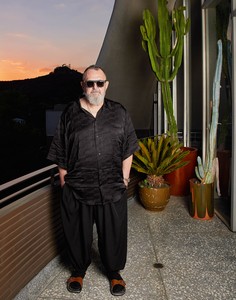
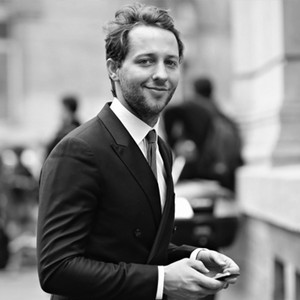
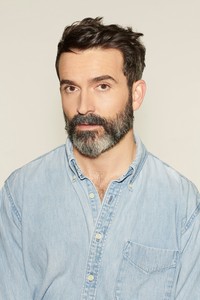
Michel Gaubert, the Paris-based music supervisor behind iconic runway shows across the globe, meets with the Quarterly’s Derek C. Blasberg to discuss his first engagements with music and fashion, his fateful meeting with Karl Lagerfeld, and discovering sounds in unexpected places.
Derek C. Blasberg is a writer, fashion editor, and New York Times best-selling author. He has been with Gagosian since 2014, and is currently the executive editor of Gagosian Quarterly.
Derek C. BlasbergMy first question is about how I should ID you, Michel. I’ve called you a DJ, a sound designer, an audio architect. When you’re filling out your customs forms, how do you identify yourself?
Michel GaubertNowadays it’s “music supervisor.” I know “supervisor” is a bit strong as a word, but I do that because I work for commercials and films, and basically when I choose music for any event I work on, even the fashion shows, I’m really directing where the music should go. I’ve been called many things, but that sounds great to me.
DBIt’s like a conductor except you’re not in front of an orchestra.
MGIf you say “DJ,” it’s limiting because people think it’s me behind two turntables. If you say “sound engineer,” it’s another thing. “Music supervisor” is a more global term, and I can do lots of things.
DBWhere did you grow up?
MGI’m from Bougival, which is near Versailles, west of Paris.
DBTo an American that sounds incredibly exotic: “I grew up near Versailles.”
MGWell, it’s very pretty. My mother still lives in Bougival and it’s beautiful. It’s only twenty minutes from [where I currently live in Paris] and you have the feeling you’re in the countryside, in Normandy or something. It’s very serene.
DBWhen you were growing up, were you an arty kid? What was your childhood like?
MGI was definitely into music. That started very early, maybe when I was five or six. It was something I had in common with my father, who loved Serge Gainsbourg and Billie Holiday. My mom owned bookstores and she was very into fashion. So I made my own little world, where I discovered I loved music, mainly from watching all the music shows on TV. I remember when the big British wave arrived, like the Stones and all that kind of stuff, I was into that right away. I liked the way they dressed. Specifically, I liked the fact that they used their style and their persona to highlight their music. Early on, I realized that they were made to be each other—the image and the sound were to be one thing.
DBThe look and feel of a band were related to the sound?
MGTotally. There was this program in France that had a huge impact on me, Dim Dam Dom. I don’t know if you ever heard of it but if you haven’t you should try and find it, it’s incredible. It was on Sundays during lunchtime, and it was one of the first TV shows that showed music, art, fashion, cinema, all these kinds of things together. And a lot of it was made by artists like William Klein, who was there, Serge Gainsbourg, and there was Brigitte Bardot or Romy Schneider presenting the full collections, and all that kind of stuff. It was filmed in a very modern way, getting away from the old clichés of the ’60s. That really had a big influence on me.
DBDid you have jobs as a kid? When did you discover that music could be a profession?
MGIn the early ’70s, when I was sixteen, I went to America for a year as an exchange student, and when I came back I worked with my mom in the bookstore. That was great for me because I could see all the books I wanted, and the magazines too. I had very easy access to all of this. Eventually I worked in a record shop called Clementine. In those days, specialty music shops in France had to import records, and we would get things that no other people had. At the end of the ’70s, when disco was going out, I went to work at Champs Disques on the Champs-Elysées, which was a milestone in Paris nightlife. It was a shop that was open eighteen hours a day, and it imported all kinds of important music, and basically it was supplying all the clubs of France and abroad. It understood the importance of dance culture and music being discovered as a joyful thing, something to share. And I was in charge! I had a lot of responsibility in that store, and we had a lot of people coming to the store, and that’s the first time I met Karl [Lagerfeld].
DBDid you know who he was?
MGEven then, he was already a collector. We all knew him as one of the biggest clients, in this case of records.
DBI’m excited to talk to you about Karl, since he was the one who introduced us. But when we talk about the end of the ’70s and the early ’80s, I should also ask about designers like Claude Montana and Thierry Mugler, who were huge cultural forces in your early days. I think sometimes that era is glamorized and young people today feel nostalgic for those clothes. As someone who was there, was it that great?
MGI don’t know if I’m nostalgic for those days. I had a good time, but it was very different: there was no Internet, no cell phones, no nothing. The sense of time was different and everything felt less pressured. We had more time to go and have fun, go and do things. There weren’t a hundred shows in fashion week; there might have been thirty. And I feel like people retained a kind of openness because we didn’t have so much information coming at us all day. If we were going to a club or to a movie, we were more receptive, because we didn’t see a bunch of reviews and posts and hear a bunch of other people’s opinions about it.
DBDid you ever go to one of those legendary Mugler shows?
MGMugler liked to be superextravagant and very bold, and there was a sense of humor about what he did, a sense of occasion. I didn’t work for him yet, but I saw one of his shows in 1984, and when I walked out of there, I said, “I want to do that. I want to do music for fashion shows.” It was incredible.
DBThere’s an element of performance art in that type of show. I watch those shows now on YouTube when I can’t sleep, and there are models coming out of the ceiling, models dressed as motorcycles. It was incredible.
MGWith Mugler it would all be sketched—each girl would have a specific light, specific music, specific hair. Every dress would be a whole production. And those shows lasted forever! Some were an hour long. As I told you earlier, attention spans were different back then. Now people at a show start to look for the exit after ten minutes.
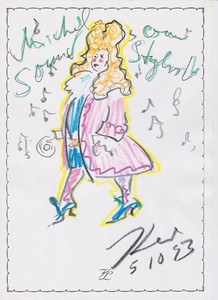
A drawing for Michel Gaubert by Karl Lagerfeld
DBYou worked with Karl for three decades, creating the music for his fashion shows. How would you guys share music tastes? Was it phone calls, text messages, emails?
MGHe was the king of faxing, don’t forget.
DBI still have some of his faxes. I think after he passed away, everyone in fashion finally got rid of their fax machines.
MGAll of it was very complementary. I knew music he didn’t know and he knew music I didn’t know. In the beginning we’d just meet each other. On the first show I did with him he gave me this record by Malcolm McLaren called “House of the Blue Danube” and said “That’s what I want.” He turned me on to a lot of classical music and he was very, very savvy. For me he was a mind-opener, because I realized early on I’d love everything he was showing me. In a way he was my teacher, which was what I liked. But then I was a good pupil, because I was responding to him with other things. My job was to find a way of mixing all this music together and making sense out of it.
DBHe collected so much stuff. He collected art, but also books, furniture, iPads. Do you collect anything?
MGYeah, I collect everything. But with Karl the passion was different. He would have an obsession. Like when he was in Biarritz, he was crazy about Ciboure pottery, and I think he bought everything that was available in the world. Basically there was none left for anybody else. Another time he went through his Memphis [design] era. He would devour, not like a collector but like an ogre.
DBWas this hard to work with?
MGIn the beginning it was more instinctive, but then after maybe four or five years, we knew exactly what to expect from each other. We would share ideas all the time and it was incredible. He would pull out everything from his ideas and his briefs and his resources, and he would share them very, very easily. And then I would answer, “Oh, look at this movie, because it reminds me of this,” and then we brought everything together. I would do little demos of music on movies and show him what I thought it should be like. It could be a mixture of Busby Berkeley and a little Alain Resnais and a video clip from Siouxsie and the Banshees. It was very much a traffic of influence.
DBI like “traffic of influence.” That should be the name of your book, Michel.
MGI like that too. Maybe it will be!
DBI know you’re still working with Chanel, and you often work with Jonathan Anderson at Loewe. Who else are you working with now?
MGEverybody! I work with Sacai, a Japanese brand that I adore; Dior with Maria Grazia [Chiuri], who I like to work with; I also do Nensi Dojaka, a young designer who won the LVMH Prize a few years ago.
DBWhat’s the process when you work with a designer? I imagine it’s different for everyone, but do you look at the collection, or do they send a mood board or something?
MGIt all depends. Everyone is a different thing. When I worked with Nicolas Ghesquière at Balenciaga, it was decided well in advance, maybe three months before the show.
DBThat’s a long time!
MGWhich was good for me. It would give us time to listen to a lot of things, see what we loved, and then funnel it down. Sometimes we would start with ten tracks or ten moods and finish with one. With Karl it was different because, after he started working at the Grand Palais, the decor was very important, as you know, so the music tone was often decided by the mood of the set.
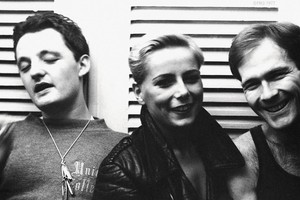
Michel Gaubert, Frederika Levy, and Steven Brinke
DBI’ve been to shows where you’ve created the music and I’ve heard spoken words, the sound of teeth being brushed, traffic. You’ve had what many would call nontraditional sounds. What do you think is the craziest thing you’ve put into a fashion-show soundtrack?
MGI did one show with Raf Simons at Jil Sander and it was all about Lara Croft. She was the muse. Basically the show music was a soundtrack with all kinds of sounds generated from Tomb Raider. There was no music, basically. It was pretty wild. Some people loved it; some people thought, What the hell? That was a weird thing. I love working with Jonathan at Loewe, and we once did a show that was very dark, very cold. So it began with the sound of air conditioning that turned into audio from the film Sunset Boulevard [1950], and then a piece of techno for thirty seconds that turned into something else.
DBI know this is an annoying question but I’ll ask it anyway: Is there a show that was the most memorable for you?
MGI’ve had a long career. So it’s a tough one to—
DBI mean, you did a Fendi show on the Great Wall of China!
MGThe Great Wall of China was amazing, sure. But I have a very good memory of the Chanel show in Cuba, because of the experience there. We worked with local musicians, hiring more than 120 of them to do the soundtrack, the show, and the party. I had to go there twice before the show and cast people, and we had some drum sessions in the backyards of houses to choose the ones we liked, and the people were just fantastic, they were so proud and happy to be part of such an event.
DBIn addition to shows, I know you work on other sound projects. I remember when you created the sounds for the Colette shop in Paris. What else do you work on?
MGI spend time on commercials and campaigns now. And a lot of what I do has become digital. I’m working on a book that should come out in January. I don’t know what it’s called yet but I’m looking for a name. And I’m working on a documentary about Karl.
DBI miss Karl.
MGI miss him too, every day.
DBWhat I miss most is his wit.
MGAlso, Karl was not afraid. He said what he meant and it was always fascinating.
DBMichel, is it annoying when people ask you for music recommendations?
MGYes and no. I like to share with them, but I’m so into my world of music and I don’t listen to music the way a regular person does. So it’s hard when someone asks me, “What are you listening to now?” For the past two days I’ve been working on a specific project, so I’m in a tunnel of music that’s not on everyone’s Spotify.
DBIs it easy for you to go to a party when the music is bad?
MGListen, I’m very open when I go to a party, and if it’s music I don’t like but it works on the crowd, I’m fine with it. But if it’s music I don’t like and I know the party would be better if they did something else, it’s really upsetting. Sometimes I go to restaurants and the music is obnoxious. What’s irritating to me is that people don’t understand the value and power of music and that they could do a better job with it.
DBI would be intimidated to have you over, Michel!
MGI enjoy hearing what other people are listening to because it’s like being a psychoanalyst. Tell me what you listen to and I’ll tell you who you are.
DBWhat’s the most unexpected place you’ve discovered music?
MGOne of the first times I went to Miami I was taking a taxi on a long ride and the cabdriver was playing an audio recording of an autopsy report. It was very strange, but it really struck me. The way the person was speaking was so factual, and I said, “Oh my God, this is something I should do.” Not talking about an autopsy, but the kind of diction, the very methodical way of speaking. I still remember it. Imagine you’re on the freeway in Miami, the sky is blue, it’s warm and everything, and you’re in the air-conditioned taxi, and you hear this kind of thing. It was completely surreal. And I like when things become surreal.
DBIn every interview we ask, Do you think fashion can be art?
MGFashion is an art form. For me, the difference is that most of the time, it’s meant to be sold on a mass level.
DBDo you think music is an art form?
MGYeah, music is an art form. In the same way, music can be made to be sold to millions.
DBWhich of the three is the most pretentious: music, fashion, or art?
MGTo me, music is the least pretentious because everyone can do it very simply. And it’s more spontaneous, and has existed for a long time. Art and fashion are on the same level. It just depends how you market it. You know what I mean? Art can be very pretentious, and so can fashion, as we all know. But it’s easier to give fashion a bad name than art.
DBLast question for you. What song do you listen to to get yourself excited? For me, it’s “Freedom!” by George Michael. When I’m getting ready to go out at night, that’s what I listen to.
MGI have to think about that one. I’ve been in a good mood recently, so I mean, I like a lot of Robyn’s stuff.
DB“Dancing on My Own.” Classic.
MGAlso, an eternal classic for me is “Big Fun” by Inner City.
DBThat sets a good tone.
MGMusically I like the late ’80s. It wasn’t a perfect time, of course, but going out was about having fun. I love that.
Derek C. Blasberg is a writer, fashion editor, and New York Times best-selling author. He has been with Gagosian since 2014, and is currently the executive editor of Gagosian Quarterly.