The fascinating life of Leonardo da Vinci is the subject of a new film by Ken Burns. The legendary filmmaker sat down with the Quarterly’s Alison McDonald to discuss Leonardo’s insatiable curiosity, his passionate enchantment with nature, and his endless search for universal truths.
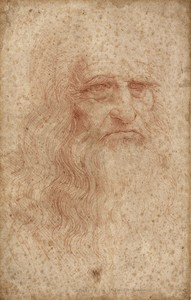
Leonardo da Vinci, Self-portrait (blood on white paper), c. 1515, by permission of MiC-Musei Reali, Biblioteca Reale. Photo: Ernani Orcorte
Leonardo da Vinci, Self-portrait (blood on white paper), c. 1515, by permission of MiC-Musei Reali, Biblioteca Reale. Photo: Ernani Orcorte
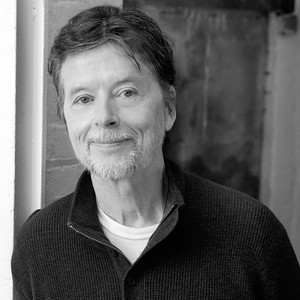
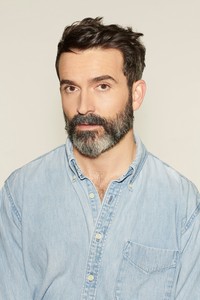
Ken Burns has been making documentary films for almost fifty years. Since making the Academy Award–nominated Brooklyn Bridge of 1981, Burns has directed and produced some of the most acclaimed historical documentaries ever made, including The Civil War, Baseball, Jazz, The War, and, most recently, The American Buffalo. Burns’s films have been honored with dozens of major awards, including seventeen Emmy Awards, two Grammy Awards, and two Oscar nominations.
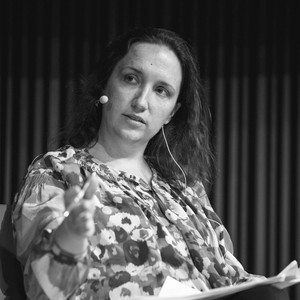
Alison McDonald is the chief creative officer at Gagosian and has overseen marketing and publications at the gallery since 2002. During her tenure she has worked closely with Larry Gagosian to shape every aspect of the gallery’s extensive publishing program.
Alison McDonaldYour films tend to explore America’s greatest stories. What prompted you to make a film about Leonardo da Vinci?
Ken BurnsTo be honest, I didn’t want to do it at first; as you mentioned, I’m an Americanist. But I’ve never been so inspired. My friend Walter Isaacson, who wrote a biography of Leonardo, made the suggestion. I mentioned it to my daughter, Sarah Burns, and her husband, David McMahon—we’ve worked on films together about the Central Park Five, Jackie Robinson, and Muhammad Ali. They were enthusiastic and thought a film on Leonardo would be great. While making this film, Sarah and Dave moved to Italy for a year with my two oldest grandkids.
AMYour films feel effortless for the viewer to engage with, but they are enormously complex puzzles that you layer together. And this must have been a bit of a different experience for you—while there are many notebooks, writings, and sources by and on Leonardo, it must have been a challenge not to have photographic or film sources from the period. How did you put this puzzle together?
KBIt actually wasn’t that different from our other films—process is process. We had different materials to work with under different circumstances, but our approach was the same. As with any project, we arrived at it with preconceptions and quickly become aware of how little we actually knew, which is always a humbling experience. And then we just started building. Sarah and Dave wrote the script, so they were wrestling with the distillation, not just of all the visual material, but also with what we were going to say. To get [the Italian actor] Adriano Giannini to read the script was such a treat.
At some point we realized that, because of Leonardo’s capacious mind, we could keep a similar style—we could explode all the visuals, have split screens, and a single score. There’s one composer for the entire film, Caroline Shaw. And with Leonardo you can show video of rocket ships taking off and solar systems and beautiful images of nature.
AMHow much did what you learned about Leonardo surprise you?
AMThroughout all of Leonardo’s studies—painting, mathematics, physics, engineering—there’s a focus on nature. In the film, he is quoted saying, “The best gift that was given to me by the universe was the chance to question it.” His curiosity about nature was insatiable and he examined it often on both a macro level—water, wind, gravity—and on a human scale: skeletal structures, muscle movements, the way an eye works. Why do you think his fascination with nature plays such a central role in his thinking?
KBLeonardo was seeking a key to the cosmos, a way of better understanding all of human experience and knowledge. He studied the perfection of nature and he saw it as his primary teacher, as essentially the manifestation of God. For Leonardo it was a human responsibility to give nature life in a new way. We see him as a scientist, writer, inventor, theorist, painter, scholar, but he saw no division of labor: for him they were all one thing. He wanted to interrogate the universe. That was his divine duty. He asked the universe to yield up its subjects, to yield up its truth, and he was able to bring back so much to us in all of these various disciplines.
AMHis discoveries are fascinating, especially considering that he was observing with only the human eye. He was way ahead of his time in examining and diagraming how blood pumps through heart valves, for instance.
KBHe was 450 years ahead of his time in so many things. He studied the way heart valves work and his analysis wasn’t verified until we had MRIs, in the 1970s. He had no telescopes and no microscopes. He didn’t have calculus, which would have helped him with a lot of his mathematical stuff. Versing himself in mathematics, he was coming up with stuff about gravity well before Galileo (who didn’t have calculus either), before Isaac Newton (who did), and before Albert Einstein. He was getting to extraordinary places about gravity and fundamental principles of physics. He was an experimental physicist, a surgeon, an anatomist, a botanist. There’s this restless curiosity that’s able to synthesize knowledge and realize that knowledge is not enough. I went to Hampshire College in Massachusetts, and the school’s Latin motto was Non Satis Scire (To know is not enough). It means that you have to take something and put it into motion and practice it and synthesize that knowledge into something bigger that we might call understanding. And what you get when you spend time with Leonardo is just a sense that this may be the most incredible human being, having this gift of revelation in all these different areas.
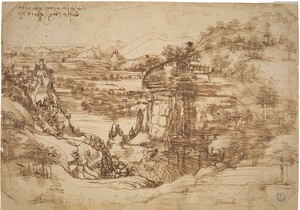
Leonardo da Vinci, Landscape drawing of the Arno Valley, c. 1473, Gallerie degli Uffizi, Florence, Italy
AMIn Florence at this moment, during the Renaissance, the arts were flourishing, there was a rediscovery of classical philosophy and literature, painters and sculptors were celebrated and in high demand. The Christian doctrine that had pervaded European art up to that point had been followed by humanism; it was an era of enlightenment when painting and culture were celebrated as the pinnacle of influence. If Leonardo had lived in a different era, do you think he would have been known as a painter or more celebrated for his scientific pursuits?
KBIt’s such an interesting question. One we can’t answer. But let’s think about how he’s one of the great painters of all time, with only twenty works, half of them unfinished. Still, he made the most famous painting in the world today—a painting of the twenty-four-year-old wife of a well-to-do Florentine silk merchant, a woman who had had five kids by that age. And Leonardo never delivered the portrait. It’s unclear whether he ever considered it finished.
Giorgio Vasari, after describing the face in the Mona Lisa [c. 1503–06], drops down to the neck and says, I can see the blood flowing through her veins. I can see her heart beating. He’s rhapsodizing over the anatomy and the hair and the background and the mist and the texture of the skin and the sfumato technique that just, you cannot believe it when you get up close, what he’s doing with the translation between light and shade and gradations of various colors.
AMIt’s interesting that there are so few paintings, because he made so many drawings and sketches, and articulated so many plans with illustrations.
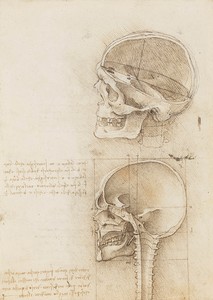
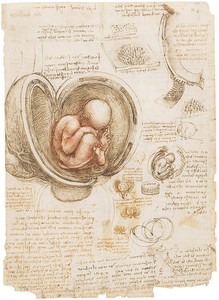
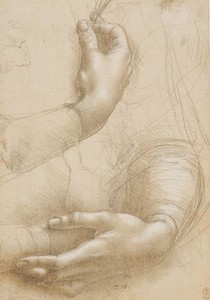
KBThere are thousands of pages of codices and nearly all of them have some sort of illustration, some as simple as a Matisse or a Picasso, with only a couple of gestures. And in that gesture he has captured an emotion. Others are incredibly precise drawings in anticipation of even more complex paintings. And let’s not forget that he abandoned so many things because he’d already moved on from the problem. Still, he created what we believe is the first landscape drawing in Western art. He made the first experimental painting in his abandoned Adoration of the Magi [1481]. And you could also say that the Mona Lisa is a great work of science and that the drawings of embryos and anatomies are great works of art.
AMPatronage then had a completely different type of structure from the patronage we have today. How did shifts in patronage and politics impact Leonardo’s life, his scientific investigations, and the art he created?
KBAs far as patronage, King Francis I of France offered Leonardo the best patronage of all, late in Leonardo’s life, which was by allowing him to study whatever he wanted. To be Aristotle to Francis’s Alexander.
AMLeonardo was born out of wedlock, which at that time meant that he could never attend university. He felt this was a blessing as it meant that his mind was totally open, his perspective wasn’t narrowed. And his notebooks, which he left for future generations to study, clearly connect directly with his thinking and provide insight into what preoccupied his mind.
KBThat’s right. And there’s something organic about this. Adam Gopnik says that Leonardo was trying to crack the code of organic form—that’s where the study of nature came in. But you also have to understand the principles underlying all of this: they could be philosophical, could be spiritual, could be physical, could be architectural, could be all of these things—he felt determined to know everything. He wasn’t a scholar trapped in the ideas they teach at school.
AMWhat do you think sets his paintings apart and makes them stand the test of time?
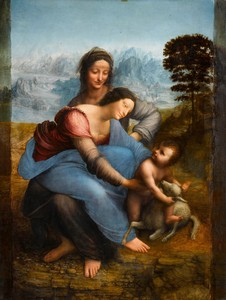
Leonardo da Vinci, The Virgin and Child with Saint Anne, c. 1508–17, Musée du Louvre, Paris. Photo: Art Resource, New York
KBWhen he died, his most famous painting was out of sight in the dining room of a monastery. And to me, he invented film with the Last Supper. He invented cinema, right? It’s not a frozen moment, the way painting is expected to be; there’s dynamic motion, it’s happening and it’s so spectacular. He took these familiar scenes and did them the way no one else ever has. Just look at Virgin of the Rocks [1483–86]: every painter is making their version of the Madonna and Child, but Leonardo’s is filled with the complex tension between a mother’s natural maternal instinct, a very humanist proposition, and the fact that she’s known through all time that she’s to bear the son of God and he’s going to be killed. There are two opposing forces: here’s John the Baptist to tell him of his future Passion, and there’s Jesus as a baby, accepting it. John is a baby and she’s trying to pull John back and trying to reach for her son with her other hand. But there’s an angel in the way. God gets it. God sees this. The fact that Leonardo could make such a complex painting relatively early in his career, and here we are marveling at it 550 years later . . . not just that he pulled it off, but that it’s moving.
AMI was looking at a painting with a scholar and an artist recently, and one of them said that the difference between a good painting and a great painting is that in a great painting, every detail holds time. It’s all there for a reason, and people in the future will continue to look at it and have it hold time, maybe in a different way, from a different perspective, but it will be there and it’ll be active. One of the things that’s so remarkable about your film is that you make the viewer connect to him as a human. He’s not perfect. But also you bring in contemporaries of his who are, by the way, pretty exceptional artists themselves. Early on, Leonardo was an apprentice in the workshop of Andrea del Verrocchio, who had trained many of Florence’s most celebrated artists. Returning to Florence after almost twenty years in Milan, he overlapped with Michelangelo. After that he was invited to join the Vatican court, where he encountered Raphael. These are just a few examples.
KBYeah. I mean Raphael and Michelangelo, please.
AMAnd you explore the dynamics between them, which is compelling.
KBWell, there was some jealousy about Michelangelo’s David. Leonardo realized that David was great, but he wanted to put it behind a wall. And the Signoria, the town government, did not agree, so instead it was placed prominently outside, in front of everything. It was so spectacular. But Leonardo said no, the muscles look like a bag of walnuts, he’s not drawing them right. And Michelangelo himself was not an overly nice guy, whereas Leonardo was apparently very well liked, his jealousy notwithstanding. He had a great sense of humor and a protean intellect.
AMAnd he was so generous with his step-siblings after they behaved selfishly over and over again.
KBYes, his step-siblings cut him out of various wills, but he still left generous sums to them in his will.
AMIt’s rare to find that kindness.
KBIt reminds me of a film I made many years ago about the Shakers. The Shakers discovered that their poorer neighbors were stealing their crops at night. They were master agriculturalists and their crops were blooming when others’ were not, so their poor neighbors were stealing their crops. You know what the Shakers did? They planted more crops. They said, We plant some for the Shakers, some for the thieves, and some for the crows—thieves and crows have to eat too. Magnanimity only makes you bigger and egotism makes you smaller.
AMThat’s a wonderful anecdote. Do you feel closer to Leonardo now that you’ve made the film?
KBI love him. I feel like I know him, but I also feel like he’s unknowable. Last night I saw the film with an audience and I started to cry at scenes that I’ve watched hundreds of times. He gets you every time.
AMDid you expect to feel that sense of closeness when you started the film?
KBWell, I’ve always known that I was an emotional archaeologist. And I’m interested, not in nostalgia or sentimentality, but in higher emotions that may be produced. The difference between the whole and the sum of the parts. There’s a kind of emotional dynamic to all of that. This is a human story. It’s universal to all human beings.
AMHe was such a unique and remarkable person.
KBHe wakes you up and makes you want to be better. I mean, he wrote backwards in a mirror. Every single line of those codices—thousands and thousands of pages—are written backwards. Every time he picked up a pen to scratch, even a grocery list, he wrote backwards. Just think about what that means, the intentionality in every moment. He’s a citizen of the world and he’s virtuous and he’s always pursuing ever more knowledge. He’s like a whirling dervish, spinning on about seven different planes of stuff at once, and he’s writing it all down backwards. I mean, come on. It’s just so great.
Leonardo da Vinci, directed by Ken Burns, Sarah Burns, and David McMahon airs November 18–19 on PBS.
Ken Burns has been making documentary films for almost fifty years. Since making the Academy Award–nominated Brooklyn Bridge of 1981, Burns has directed and produced some of the most acclaimed historical documentaries ever made, including The Civil War, Baseball, Jazz, The War, and, most recently, The American Buffalo. Burns’s films have been honored with dozens of major awards, including seventeen Emmy Awards, two Grammy Awards, and two Oscar nominations.
Alison McDonald is the chief creative officer at Gagosian and has overseen marketing and publications at the gallery since 2002. During her tenure she has worked closely with Larry Gagosian to shape every aspect of the gallery’s extensive publishing program.