October 31, 2024

ink

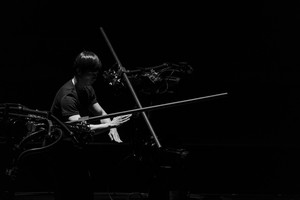
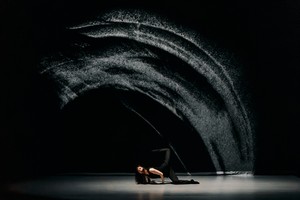
Ahead of the US premiere of Ink at Lincoln Center, New York, the Quarterly’s Gillian Jakab interviews Taiwanese choreographer Huang Yi about the performance’s creation. Huang has garnered acclaim for his work with KUKA, a robot he programmed to carry out his choreography. In collaboration with audiovisual artist Ryoichi Kurokawa, Huang interprets a hundred artworks by calligrapher Tong Yang-Tze in Ink through holographic projections and the movements of both KUKA and human dancers.

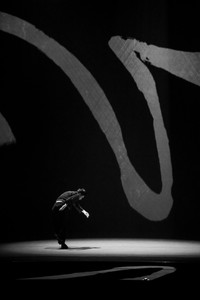
black-and-white photograph of a man dancing in a spotlight with a projection of curving brushstrokes on the stage background

Ink (2023), choreographed by Huang Yi. Pictured: Hu Chien. Photo: Summer Yen

Ink (2023), choreographed by Huang Yi. Pictured: Hu Chien. Photo: Summer Yen

Gillian JakabWhen did you first encounter the artwork of calligrapher Tong Yang-Tze and how did the idea for Ink take hold?

Huang YiCalligrapher Tong Yang-Tze’s works are present in various facets of Taiwanese society—such as posters for movies and performing arts events; logos for magazines, corporations, and arts organizations; and even on the signs of Taipei Main Station and the entry and exit stamps of Taiwan Customs. Throughout my childhood, before I knew Ms. Tong personally, I would inadvertently come across her calligraphy.

I officially met her in 2014 at the Experimental Theater of the National Theater in Taipei, where I presented my first collaboration with Ryoichi Kurokawa—a dance piece constructed in black and white. After seeing the performance, Ms. Tong asked the director of the National Theater to contact me. She expressed her interest in me creating a work incorporating elements of calligraphy—that was the starting point of Ink. However, at that time, I felt I wasn’t artistically mature enough to take on the project. I chose to let the idea simmer in my mind, waiting for the right music to emerge, and didn’t feel I was ready to initiate a production. From that point on, whenever I presented a new work, Ms. Tong would almost always attend and show her support. It wasn’t until she mentioned that she was feeling unwell that I realized I shouldn’t sit on it any longer. After all, no matter how hard I try, I can’t possibly bridge the forty-year gap between us; I could only give it my all and have no regrets.

GJThere’s a mix of both ancient and contemporary influences in the work. Could you say a bit more about that?

HYTo me, the classical embodies a precious spirit and texture. Although technology is central to my creations, the core lies in an accumulation of traditional elements. The key is to find the ideal way of interpreting them to achieve balance.

Ms. Tong’s lines are eternal in my eyes, especially as we’re interpreting her Silent Music series this time—a hundred works of abstract lines. These lines naturally resonate and correspond with the abstract movements in dance. In certain sections of Ink, I interpreted the lines together with the programmed KUKA robot. In other sections, we developed the movements first and then sought matching lines from the Silent Music works.

Gagosian quarterly weekend reads

Get the best of the Quarterly in your inbox twice a month.

By subscribing you agree to our Privacy Policy.

Ink (2023), choreographed by Huang Yi. Pictured: Huang Yi. Photo: Summer Yen

GJWhat was the process like of translating the brushstrokes through the body?

HYI played videos of Ms. Tong’s work while the dancers developed their movements. The dancers then naturally incorporated similar textures and lines into those movements. I also asked some dancers to select lines they were drawn to and then translate them into movements for their bodies. Through different angles and proximities, the entire piece immerses itself in Ms. Tong’s works.

Ms. Tong also requested that I draw some lines with a pencil, which she then interpreted through calligraphy. One particularly memorable instance involved a straight line. In digital art, due to its nature, straight lines are abundant. Yet I couldn’t find a single straight line in her work. So, I attempted to draw various straight lines for her to interpret. I even used a ruler to get them perfectly straight. Ms. Tong chose a wolf-hair brush and drew an exceptionally beautiful straight line, by hand. From start to finish of that line, the stroke felt transparent and delicate, like smoke and dust. I incorporated this into one of the movements for me and the KUKA robotic arms. When the straight line appeared in the air, it slowly disintegrated like a fine drizzle—it was an unforgettable moment.

For a calligrapher, the signature seal is incredibly important; only works that are acknowledged receive this mark. Understanding its significance, when the piece was nearing completion, I asked Ms. Tong if she would allow me to use her signature seal. She happily agreed. Tong Yang-Tze’s signature are the only characters that appear in the entire work. This was my way of expressing respect to Ms. Tong, thanking her for giving me the opportunity ten years ago and for her willingness to wait a decade for the work to emerge. In the future, I will continue collaborating with Ms. Tong, exploring her series of works with Chinese characters.

Ink (2023), choreographed by Huang Yi. Pictured: Tai Yi-Fen. Photo: Lin Chun-Yung

GJAnd what was it like to collaborate with Ryoichi Kurokawa on the audiovisual elements of the work?

HYRyoichi Kurokawa is an audiovisual artist I deeply respect. His self-discipline and meticulous thinking provide me with immense learning and inspiration every time we collaborate.

In performing arts, the audience remains stationary while the work flows before them. In visual arts, it’s the opposite—the audience moves through the exhibition space to experience the entirety of the works. Although I couldn’t have the audience move around, I wanted them to experience the essence of visual arts appreciation. Therefore, we included an independent segment by Kurokawa in the middle of the piece, allowing him to interpret Ms. Tong’s works from a purely audiovisual perspective. The visuals of Ink enable two stunning graphic artists to converse within a single work. Building a bridge between the performing and the visual arts is, in my view, one of the most important concepts of Ink. We didn’t just merge the materials, but also the formats of arts appreciation.

GJWhat do you hope audiences in different parts of the world take away from Ink?

HYI hope they experience the pure and profound beauty of Tong Yang-Tze’s calligraphy; the instantaneous visual tension of Ryoichi Kurokawa’s work; the energy and structure of both Gabriel Prokofiev and Christopher Rouse’s musical compositions; the delicate interpretations of each uniquely talented dancer; and the new developments in humanity, robotics, and technology that all went into this production.

This piece was created during the pandemic. Just as variations in vintage, origin, and climate impart different qualities to wines, so does the environment affect a dance work. I pondered whether I should alter these traces left by Covid, then I recalled Ms. Tong once sharing with me the beauty of creating calligraphy: “When you put brush to paper, each stroke encompasses the day’s temperature, humidity, the state of the paper and brush, and your own condition. Therefore, every stroke is unique and irreplicable.” So, I put down the pen.
Ink, Lincoln Center for the Performing Arts, New York, November 2–3, 2024

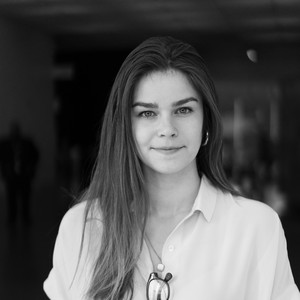
Black-and-white portrait of Gillian Jakab

Gillian Jakab is an editor of Gagosian Quarterly and has served as the dance editor of the Brooklyn Rail since 2016.

See all Articles

Derrick Adams: View Master

Derrick Adams: View Master

On April 16, the Institute of Contemporary Art, Boston, opened the first midcareer survey of Derrick Adams’s multidisciplinary practice. Covering over twenty years of work, the exhibition, titled View Master, brings together the artist’s painting, sculpture, collage, performance, and video, as well as a vibrant new commission created for the museum’s façade. Ahead of the opening, Adams met with Tessa Bachi Haas, cocurator of the survey, to discuss his formative experiences with television, the impact of his work in arts education on his practice, and the importance of taking a more complex, more joyful, and more expansive approach to Black American life and culture.

Engaging with the Past: An Interview with Jenny Saville

Engaging with the Past: An Interview with Jenny Saville

On March 28, a major exhibition of Jenny Saville’s work opened at Ca’ Pesaro–Galleria Internazionale d’Arte Moderna in Venice, bringing together nearly thirty paintings from the 1990s to the present. The exhibition is curated by Elisabetta Barisoni, head of the museums division at Venice’s Ca’ Pesaro, Museo Fortuny, and head of MUVE in Mestre. Saville’s monumental canvases are set in dialogue with the great Venetian artists of the past, creating a unique encounter between contemporary painting and the city’s artistic heritage. Here, the artist speaks with Stefania Ventra, professor with Ca’ Foscari University of Venice, about her early trips to Venice, the radicality of Titian’s painting, and depicting emotional truth.

A Tremendous Generosity: Jeff Koons on Marcel Duchamp

A Tremendous Generosity: Jeff Koons on Marcel Duchamp

Jeff Koons tells Alison McDonald about his appreciation for the pioneering artist and thinker Marcel Duchamp.

On Walter De Maria: Donna De Salvo and Lucy Raven

On Walter De Maria: Donna De Salvo and Lucy Raven

The Singular Experience at Gagosian’s Le Bourget gallery is the largest exhibition of Walter De Maria’s work in France in several decades. Organized by Donna De Salvo, senior adjunct curator at Dia Art Foundation, the exhibition marks the first time De Maria’s final sculpture, Truck Trilogy (2011–17), is being shown outside of the United States. Here, De Salvo speaks with artist Lucy Raven about her evolving kinship with De Maria and more.

Peter Hujar & Paul Thek

The Art of Biography
Peter Hujar & Paul Thek

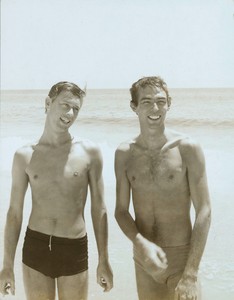
Andrew Durbin’s dual biography, The Wonderful World That Almost Was: A Life of Peter Hujar and Paul Thek, published by Farrar, Straus and Giroux, tracks the convergences and divergences in the lives of the two artists, from their first meeting in Coral Cables, Florida, in 1956 through their generative romantic and creative partnership in New York, Italy, Fire Island, and beyond. Ahead of the release, Durbin met with the Quarterly’s Wyatt Allgeier to speak about the development of the project, the sublime noncompliance of these two artists, and the motifs of love, death, and rebirth that weave through the telling of their story.

Fashion and Art: Daniel Roseberry

Fashion and Art: Daniel Roseberry

Daniel Roseberry, the creative director of Schiaparelli, met with the Quarterly’s Derek C. Blasberg at the maison’s historic headquarters at 21 place Vendôme, Paris, following the Schiaparelli Fall/Winter 2026–27 ready-to-wear show. Since taking the helm in 2019, Roseberry has been credited with advancing the heritage of the house through unpredictable sculptural designs that carry Elsa Schiaparelli’s Surrealist spirit into a new century. The pair discuss the much-anticipated exhibition Schiaparelli: Fashion Becomes Art, now on view at the Victoria & Albert Museum, London, as well as Roseberry’s early exposures to art, his continued dedication to drawing, and the enduring legacy of Elsa Schiaparelli’s daring vision.

Helter Skelter: Arthur Jafa and Richard Prince

Helter Skelter: Arthur Jafa and Richard Prince

Helter Skelter—an exhibition at Fondazione Prada’s Venetian venue, Ca’ Corner della Regina—marks the first creative dialogue between two visionaries of American art, Arthur Jafa and Richard Prince. The show explores the grit, grift, violence, and ingenuity of American culture through more than fifty works, including photography, video, and large-scale installations that interrogate themes of race, gender, media, and politics. In the interview below, Nancy Spector, the exhibition’s curator, speaks about the shared motifs—from apocalyptic sunsets to a fascination with “monstrosity”—that led her to pair these artists for the first time.

Theaster Gates: Dave, All My Relations

Theaster Gates: Dave, All My Relations

A conversation between Theaster Gates and Jessica Bell Brown, with an introduction by Sydney Stutterheim.

An Eye on the Market: Trading Beauty

An Eye on the Market: Trading Beauty

Valentina Castellani speaks with the Quarterly’s Alison McDonald about her new book, Trading Beauty: Art Market Histories from the Altar to the Gallery. The illustrated survey traces the evolution of the Western art market from the medieval era to the present day.

Art Work: Sally Mann and Amor Towles

Art Work: Sally Mann and Amor Towles

Sally Mann joined novelist Amor Towles in a conversation about her widely celebrated new book, Art Work: On the Creative Life (2025), at an event hosted by the New School and the Strand in New York. Published by Abrams, Art Work is about the challenges and pleasures of the creative process. Its mix of illuminating stories, practical advice, and life lessons, illustrated throughout with photographs, letters, and journal entries, offers insights into Mann’s own experience of making art. Here, Mann and Towles speak about the writing process, historical ghosts, and fortunate mistakes.

Mary Weatherford and Mark Lee: Persephone

In Conversation
Mary Weatherford and Mark Lee: Persephone

Ahead of Persephone, an exhibition of new paintings by Mary Weatherford inside Hong Kong’s historic Pedder Building, the Quarterly’s Wyatt Allgeier met with Weatherford and the architect Mark Lee to talk about their collaboration. Here, they discuss how custom architectural interventions—from mirrored columns to strategic light play—transform the gallery, evoking Persephone’s mythic journey through the underworld and back into the light of spring.

The Future of the Past

The Future of the Past

Ashley Overbeek tells the story behind the Art and Antiquities Blockchain Consortium (AABC), cofounded by Susan de Menil. The story begins with a famous pair of Byzantine frescoes once hosted by the Menil Foundation in Houston, passes through the repatriation of a group of Bura funerary objects to Niger, and explores how new technologies are helping to resolve the world’s oldest cultural disputes.