Alison McDonaldThis is an important year for you—the twentieth anniversary of Masa, your highly acclaimed restaurant in Columbus Circle, and the tenth anniversary of Kappo Masa, your restaurant on the Upper East side that is a collaboration with Larry Gagosian. Do these anniversaries prompt you to reflect on how you started?
Masa TakayamaVery much, but it’s also been very busy, so it doesn’t feel as though twenty years have passed, or even ten years for Kappo already. It all feels like it happened yesterday, although I have certainly learned a lot. At this point we’ve served generations. In the beginning, we had seven-year-old kids coming in with their parents, and now they are twenty-seven years old and still coming.
AMHow have you and your restaurants evolved over time?
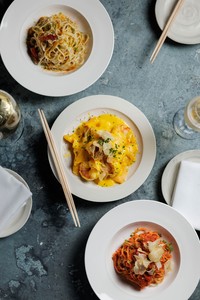
MTIn this business, you notice people’s tastes changing every year, and you need to adapt to those trends on some level. That challenges us to innovate with the menu. Lately, people tend to eat lighter—fewer carbohydrates, less gluten, more protein, those are the trends—so for one of our menu items, for instance, I created fish pasta.
AMYes, I love that dish! Noodles made entirely from fish, no wheat. It’s unique.
MTNobody else makes that kind of stuff.
AMYou travel quite a bit. You must learn a lot about regional cuisines during your travels.
MTYes, definitely. One time, in Thailand, I noticed that of course there were a lot of spicy dishes, but sometimes they just threw some fresh herbs onto the plate, which makes a nice aroma, flavor, and texture. After that trip I started using cilantro. Japanese food never uses it, but now it’s part of one of our most popular dishes—cilantro and a little spicy chili, scallops, octopus, and asparagus. It’s very popular; it will not be changing. [laughter]
AMHow did you first meet Larry Gagosian? You started Kappo Masa together ten years after you opened Masa.
MTI first met Larry many years ago in Los Angeles, when I had a very small restaurant—it only seated a few people for dinner at a time—and [the Canadian musician] Robbie Robertson brought him in for dinner. As for opening Kappo Masa together, I’m always interested in new projects, and Larry has such a good business sense, not only for art, but also for food and restaurants. Although when we first started talking about it, he took me to see two floors at 976 Madison Avenue: the ground floor and the basement level. He asked which I preferred, and I replied the basement. Larry said no. [laughter] He did not think a basement-level restaurant would be successful. But I insisted.
AMAnd today that’s part of what makes it so appealing. You almost feel transported to a different place, away from the bustle of Madison Avenue.
MTExactly, it’s more of a neighborhood club. We used to say that celebrities go to other spaces to be seen, but they come to Kappo Masa to just be themselves. When I designed the staircase and the lounge area, I put big flat walls in, so as to create more of an impression of hiddenness.
AMWhat about the Japanese stone on the walls? It has a beautiful texture, and you use it in both Masa and Kappo Masa. Does that reduce the noise levels?
MTThe stone is like a sponge for sound—and for smell. Like a filter. At the very beginning I did not realize that; I just put it on both sides of the bar because it’s my country’s stone. Normally, when you step into a Japanese restaurant, you can smell the soy sauce right away.
AMYou have long been interested in designing objects. In fact, you create many of the dishes and platters used to serve the food in your restaurants. You consider that part of the holistic experience.
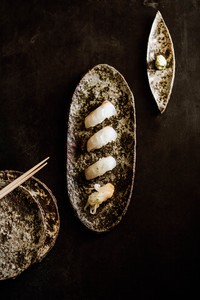
MTThe dishes and platters serve as frames for the food, which really is the main event. As when you frame a painting—it should look more beautiful in the frame. Likewise the way you serve food should complement and contribute to the experience.
AMOften the design objects serve a function as well. For instance they might retain cold or heat.
MTYes, absolutely. That has to be planned. When I first opened Masa in 2004, I had an idea that we could make sake cups out of wood. But I wanted them to be one-time use. In Japan, we have a proverb, ichi-go ichi-e, “once in a lifetime, never happen again.” It means this moment right now, this moment that comes once in a lifetime. I designed paper-thin wood sake cups. The first one was of cedar. When you have a very thin slice of cedar, you can see the light pass softly through it. And when you poured the sake in, it slowly absorbed through the wood. And a nice sugi—we call it sugi, the cedar—will add flavor to the sake. It is so good. But in the end you cannot keep the cup; you have to throw it away.
AMThat’s delightful! Do you still use those in your restaurants?
MTWe don’t, but after that we used hinoki wood, which is Japanese cypress. My counter is also made of hinoki.
AMWere you likewise able to taste the hinoki flavor when using that cup?
MTMore. Totally different flavor—hinoki flavor is stronger. Those cups were still very thin, but after that I made thicker cups, easier for people to drink from. Then in wintertime I started making bamboo cups, we call it madake. Bamboo naturally grows as an empty cylinder. In Japan the winters can get very cold, so I got the idea to freeze the bamboo cups until just before pouring the sake in. Plus, bamboo has a beautiful color.
AMWhat prompted you to make the design objects available for purchase?
MTGuests started asking if they could buy things off the table.
AMHa! I thought you were going to say that you caught guests stealing items.
MTThat too! At this point, a majority of the menu is served on Masa Designs objects.
AMThis article will publish during Art Basel Miami Beach, so I want to ask you a couple of questions about tropical climates. You know a lot about how ingredients come to be, because I would imagine the origin of the ingredient—the salinity of the environment where something is grown, the specific temperature of the water, those kinds of details—must make a big difference in terms of what makes something taste a certain way or have a certain texture.
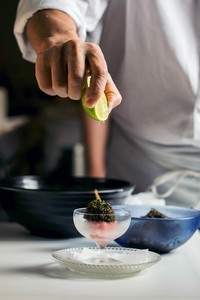
MTTypically, I prefer to work with fresh local ingredients. In Miami they have stone crabs, but it is a short season. In Turks and Caicos, which has almost the same climate as Miami, they have a shellfish called conch, which I’ve used to make ceviche. Very sweet, simple ingredients—lime juice and salt. People loved it.
AMAnd those climates are obviously also good for citrus fruits.
MTOne time I served guests in Punta Mita, Mexico—we were supposed to bring all the ingredients there, but we did not bring anything. Instead, we went to the fish market when we arrived and bought local lobsters and clams. I made ceviche with sliced serrano pepper—very finely sliced—then added lime juice and orange juice squeezed together with a little olive oil. It was very good. I love to create something new and different with local food.
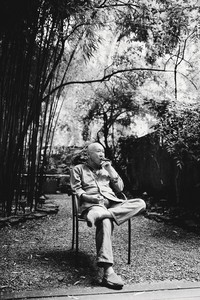
AMThere is a large Cuban population in Miami, which must inspire very interesting food. And I know you appreciate cigars.
MTNot everybody likes cigars.
AMWhen do you usually smoke a cigar? After a meal? At the end of the day?
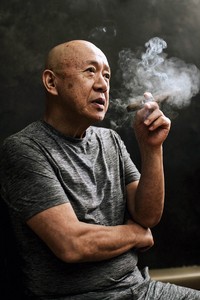
MTIn the morning.
AMReally! With a cup of coffee?
MTCoffee, chocolate-chip cookie, cigar. Every morning.
AMDo you have a favorite region or type of cigar?
MTI like a lot of different ones. My favorite is Cuban, but it has to be the real Cuban—today there are a lot of fakes. Nicaraguan cigars are very good too. They are harvesting the tobacco leaves over there and the leaf is getting better; they age it better.
AMWhat makes a cigar special?
MTOf course the flavor, the taste. Fake ones often have no taste, like paper, but the real stuff tastes good. The aroma and taste is like a soil, the flavor is like a mulch.
AMHave you gone to Cuba?
MTNo, not yet.
AMHave you ever traveled to study tobacco leaves in Nicaragua?
MTI have been there a few times when they are making cigars.
AMDo you have a collection?
MTI buy them all the time.
AMThey don’t stay around long enough to be collected?
MTNo. Some people collect cigars, for aging. One of my friends who lives in Switzerland collects tons of cigars. Each time he visits, he gives me boxes that are aged, vintage.
AMSo, what’s next?
MTWe’ve been working on many exciting projects. I’m proud to share that one of my most popular dishes will be available soon at home; my goal is for families across the world to be able to enjoy my food in their own kitchens.
AMWow, have you done anything like that before?
MTNo.
AMThat must be challenging, especially transitioning from intimate and singular dining experiences to maintaining consistent quality across a wide audience who will prepare the food themselves. It must be a totally different, more scientific way of thinking about food.
MTYes, it is completely different. We’ve been planning it for a long time, and we want to get it right.
AMSo I will be able to cook dishes from the Masa menu at home. That’s amazing. That feels like the future.