Thomas Schütte’s monumental sculptures were the subject of a recent exhibition at Gagosian, New York. Here, Amber Collins looks into the history of the artist’s Frauen series, eighteen works made between 1998 and 2006, and considers his radical explorations of the human body.
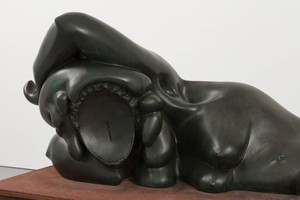
Thomas Schütte, Bronzefrau Nr. 1 (Bronze Woman No. 1), 1998–2000 (detail), patinated bronze on steel table, 63 × 101 × 49 ¼ inches (160 × 256.5 × 125.1 cm). Photo: Fredrik Nilsen Studio
Thomas Schütte, Bronzefrau Nr. 1 (Bronze Woman No. 1), 1998–2000 (detail), patinated bronze on steel table, 63 × 101 × 49 ¼ inches (160 × 256.5 × 125.1 cm). Photo: Fredrik Nilsen Studio
Amber Collins is the associate director of research at Gagosian Art Advisory. An art history graduate of the University of Chicago, she will contribute essays to the forthcoming publications Thomas Schütte: Major Sculptures (winter 2025) and Amorelle Jacox: Color Keeping (spring 2025).
There is a quickness and a looseness to the fluidity of Schütte’s sculptures, but like the geology of a mountain, beach, or ocean, it couldn’t be any other way.
How does Thomas Schütte manage to simultaneously embrace and reject modernism in a single work? Tradition is invited, but only to a point. Suspended between distant pictorial realities, his sculptures can be fluid and elastic, strong and confined, buoyant and heavy, melting and coiled, playful and graceful, abstracted and whole. Schütte’s work, which spans sculpture, painting, drawing, printmaking, and architecture, is persistently contrarian and multidirectional—a place where past, present, and future are nonchronological, and where three left turns somehow never equal a right.
The Frauen sculptures, Schütte’s most ambitious and complex body of work to date, constitute a radical aesthetic statement on the figure in contemporary sculpture. The series, made between 1998 and 2006, is a sequence of eighteen works based on the female nude, each cast in bronze, steel, and aluminum. In them, the artist engages in a dialogue with the figurative tradition of the female nude, a subject that stretches back to antiquity. The works also build on the revolutionary iterations realized by such early modernist masters as Henri Matisse, Pablo Picasso, and Henry Moore, casting their transformation of the figure and liberation of form into the contemporary landscape. Emphasizing both figuration and abstraction, the Frauen, with their vast range of poses and styles, propose a vision of sculpture tethered not to representation, but to the fundamental possibilities of form.
The Frauen originated from brick-size blocks of clay rapidly formed by hand, then glazed and fired. Between 1997 and 1999, in the renowned ceramics workshop of Niels Dietrich in Cologne, Schütte created an astounding one hundred and twenty Ceramic Sketches. Describing the process, he said, “I was handed a small board with clay and given an hour to model it into a figure. It was sheer ambition: I made five, six, seven pieces a day.”2 The artist selected and scaled up eighteen of the one hundred and twenty Ceramic Sketches to make the Frauen. Thus each Ceramic Sketch, whether ultimately cast or not, belongs to a continuum within the series, as each assumed a new form in the passage from one to the next. In other words, the Ceramic Sketches are embedded in the DNA of every Frau.
Often shown on shelves alongside the Frauen, the Ceramic Sketches are important in our consideration of the large-scale works. In 1999, Frauen (Nrs. 1–4) were first exhibited at Dia Center for the Arts in New York alongside seventy-five Ceramic Sketches. And the Frauen have been connected to their ceramic origins from that debut presentation onward—“every mistake in this quest for form, each blind alley, was just left there,” Schütte later said of the installation.3 Exhibiting the Ceramic Sketches with the Frauen invokes the sculptural thinking of Medardo Rosso, an Italian contemporary of Auguste Rodin. Rosso broke from the sculptural gravitas of late nineteenth-century Europe by elevating the bozzetto, or rough sketch, to the stature of a finished artwork.4
Rosso’s sculpture and Schütte’s Ceramic Sketches both manifest strong evidence of the artist’s hand. Rosso preserved the wax shell from the bronze casting process—a wax barrier is typically used to create a mold, then melted out and replaced by molten bronze—and reinforced it with plaster to create works such as Ecce Puer (Behold the Child, 1906, cast c. 1958–59). He worked up the wax by hand, leaving traces of his fingerprints and deliberately manipulating his surfaces to capture the fleeting and ephemeral qualities of light. In the last twenty years of his life, Rosso did not choose any new subjects, but continued to make new casts of existing models, reworking these in constantly different ways and ultimately producing roughly two hundred sculptural versions of just thirty-five different subjects. Though his work is aesthetically quite different from the Frauen, Rosso’s singular focus and transformation of each cast into a unique object parallels Schütte’s process.
To create the large-format Frauen, Schütte worked with the Kayser art foundry in Düsseldorf to enlarge the ceramic figures into polystyrene blocks prior to being cast. After sawing out each shape, he coated the Styrofoam dummy in plaster of Paris and jute, and over the course of six to nine months, hammered, sanded, and polished the model that would be used to make the casting mold.5 Over the next two months, the Frauen were created in parts using the sand casting method, then welded together. Each work was cast five times: twice in steel, twice in bronze, and once in aluminum. The patinated bronze and roughened steel surfaces were achieved with acid and heat, and the reflective aluminum surfaces with polishing. The finished forms were positioned on bases consisting of welded steel beams, mirroring the worktables in the foundry where they were created as well as the bases of the Ceramic Sketches.
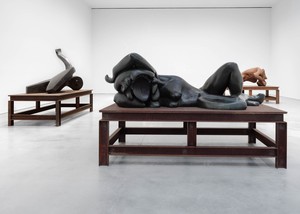
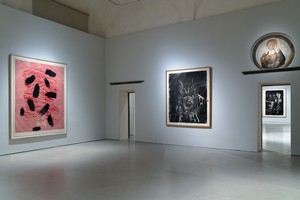
Installation view, Thomas Schütte: Major Sculptures, Gagosian, West 21st Street, New York, January 22–February 22, 2025. Photo: Maris Hutchinson
Schütte’s choice of steel for the first Frauen exhibited in 1999 explicitly acknowledged the history of this material across the twentieth century. I am thinking in particular of David Smith, whose economical use of welded steel in the Depression-era United States made it a dominant practice for the sculptors who followed. In 1930, Smith saw reproductions of Picasso’s welded metal sculptures published in Cahiers d’Art and “learned that art could be made with steel, the material . . . that had previously meant only labor and earning power.”7 Smith’s turn to industrial materials in works that merged abstraction and figuration prefigured the Minimalists, for instance Richard Serra, who would leave figuration entirely and decisively behind. Over the past century, figurative cast steel forms have been increasingly rare, and steel has itself become rarer in contemporary art. And so, in 1999, when Schütte cast his first four Frauen in steel, the artist connected his contemporary practice with the cast steel figure lost to abstraction.8
For turn-of-the-twentieth-century artists, the female nude figure was so ingrained as a subject that it begged for departures from conventional modes of representation. In appearances from Aphrodite in ancient Greece to Venus in the Renaissance, she had been staunchly upheld as a symbol of divine love, fertility, desire, and sensuality. Think of the Venus de Milo (130–100 BC), Sandro Botticelli’s Nascita di Venere (Birth of Venus, c. 1485), or Titian’s Venere di Urbino (Venus of Urbino, 1538). By the twentieth century, this stalwart subject was no longer firmly wedded to these ideals. In discussing Schütte’s reclining sculpture, Penelope Curtis has said, “The fragmented figure is a central part of the modern figurative tradition, taking us back to the age of the great excavations and then on to its effect on sculptors from the late nineteenth century onwards: Schütte is hardly alone in removing parts of the body. This is another tactic for converting the figure into sculpture and it is one employed by Rodin, Maillol, and many others (and even by Moore, in terms of his massive reduction of the head). Removing the head, it might be argued, is not to objectivize the female body as simply a body, but rather to convert it into a piece of sculpture.”9
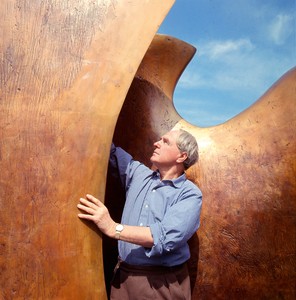
Henry Moore, arguably the foremost British sculptor of the twentieth century, presented sculptural variations of the reclining figure from the mid-1920s until his death in 1986. Moore was a disciple of the French sculptor Aristide Maillol, who worked almost exclusively with the female nude (as in La Montagne [The Mountain], 1937). Following Maillol’s example, Moore viewed the reclining nude as an ideal starting point for experimentation: “The vital thing for an artist is to have a subject that allows [him] to try out all kinds of formal ideas, things that he doesn’t yet know about for certain but wants to experiment with, as Cezanne did in his Bathers series. . . . In my case the reclining figure provides chances of that sort. The subject-matter is given. It’s settled for you, and you know it and like it, so that within it, within the subject that you’ve done a dozen times before, you are free to invent a completely new form.”10 Moore’s manifold reinventions of the reclining figure included works like his first life-size example from 1951, in which buoyant, biomorphic limbs oscillate between naturalism and abstraction. Echoing Moore, Schütte stated in an interview in 2004, “I am merely trying to find form. How else can one still find a form? Picasso, Matisse, automatically spring to mind . . . their works are crucial in this regard.”11
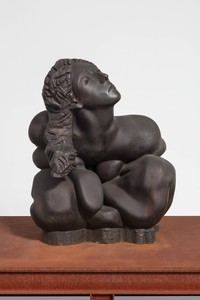
Thomas Schütte, Bronzefrau Nr. 13 (Bronze Woman No. 13), 2003 (detail), bronze on steel table, 70 ¾ × 98 ⅜ × 49 ⅛ inches (179.7 × 249.9 × 124.8 cm). Photo: Fredrik Nilsen Studio
Picasso, after completing what is considered one of the most climactic images of his career, Les femmes d’Alger (Version “O”) (Women of Algiers [Version “O”], 1955), famously remarked to his biographer Roland Penrose, “When Matisse died, he left his odalisques to me as a legacy.”12 Before Matisse, they likely belonged to Eugène Delacroix, and before him, to Jean-Auguste-Dominique Ingres. Evidenced by this inheritance, the odalisque forged a long-standing dialogue across artistic generations, capable of expressing homage, emphasis, denial, rebuttal, or, in the case of Picasso and Matisse, elegy. Speaking of this lineage, Schütte noted that his very first cast Frau, Stahlfrau Nr. 1 (Steel Woman No. 1, 1998), “had several faces, a Picasso face, Walt Disney arms, a Matisse body, and a picture-book breast.”13 The hurtling Stahlfrau Nr. 6 (Steel Woman No. 6, 2003), with her protruding, accented spine, also immediately invokes Ingres, who added three extra lumbar vertebrae to his La Grande Odalisque (Large Odalisque, 1814) to enhance her sexuality.
Schütte’s Stahlfrau Nr. 4 (Steel Woman No. 4, 1999), a dense, pancaked figure in pseudo-bas-relief, nods to Matisse’s Les Nus de dos (The Backs, 1909–31), an imposing quartet of bas-relief nudes depicted from the back, often on view in the sculpture garden of New York’s Museum of Modern Art.14 About The Backs, Schütte has said, “Sometimes I have the need to look at history, I am very interested in looking again at . . . these brutal sculptures of Matisse, they are really brutal, and there is a lot to learn from them.”15 In the Frauen, Schütte seemingly inverts Matisse’s approach by rotating the vertical plane of The Backs onto steel tables. Characteristic of Schütte, however, attempts to trace a direct lineage to a modernist predecessor prove slippery. Aluminiumfrau Nr. 8 (Aluminum Woman No. 8, 2001), when viewed from one angle, replicates the elongated silhouette and curvaceous form of Ingres’s La Grande Odalisque, and when viewed from another, appears downcast, dejected, anything but La Grande Odalisque.
Still, Picasso’s statement begs the tantalizing question: When he died in 1973, to whom did he leave the odalisque? In 2003, Schütte said of his use of the female nude: “If it were convention I would be delighted. Except no one is doing it. Because it is not a convention. I’m doing it and no one else is.”16 His Frauen do relate, in their many iterations, to the late period of Picasso’s career, when he returned to and reinvented the female nude in endless iterations.17 The Frauen can also easily be read as a brilliant synthesis of Cubism, a much earlier moment for Picasso. In their sharp planes, angular contours, and shattered perspectives, the works readily conjure Picasso’s Tête de femme(Fernande) (Head of a Woman [Fernande], 1909), historically considered the first Cubist sculpture. Rose-period Picasso might also come to mind in our experience of Stahlfrau Nr. 6, whose weathered surface and taut waist recall Picasso’s coral-clouded vision of Fernande Olivier, Nu sur fond rouge (Nude on Red Background, 1906). The Surrealist angle Picasso took in the 1930s, dominated by sensual visions of his then-muse Marie-Thérèse Walter, is also reflected in Schütte’s ever-present curves. Yet Schütte’s use of reflective surfaces, especially in aluminum, has no connection to the modernist master whatsoever.
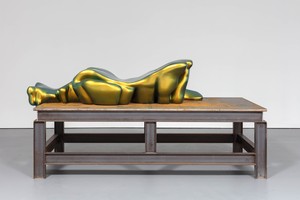
Thomas Schütte, Aluminiumfrau Nr. 8 (Aluminum Woman No. 8), 2001, lacquered aluminum on steel table, 50 × 105 ⅛ × 49 ⅛ inches (127 × 267 × 124.8 cm). Photo: Fredrik Nilsen Studio
Not long before beginning work on the Frauen, Schütte initiated his enigmatic Große Geister (Large Spirits), a series of seventeen colossal aluminum figures made between 1995 and 2004. These alluring, seemingly extraterrestrial figures coil up toward the heavens, and when installed in groups, they seem to know the choreography of Matisse’s Dance (I) (1909).18 Like the Frauen, the Große Geister derive from preparatory works. Schütte made approximately one hundred miniature Kleine Geister (Little Spirits) by twisting wax cords together into spirals and then immersing the resulting forms in liquid wax. The related work Torso (2005) is a cross-section of a Große Geist that emphasizes the progression of the bulging Geister folds into the expressive Frauen furls, perhaps most evident in Aluminiumfrau Nr. 8. These pieces riff on Constantin Brâncuşi’s poised Torso de jeune homme (Torso of a Young Man, 1924), with its eloquent and balanced juxtaposition of brass, limestone, and wood. A historically minded glance at Aluminiumfrau Nr. 8 and its undeterred leak of aluminum beyond the base also recalls Umberto Boccioni’s triumphant Forme uniche della continuità nello spazio (Unique Forms of Continuity in Space, 1913, cast 1931 or 1934). Epitomizing Futurism and the machine age, Boccioni’s polished figure bleeds into space as if confessing to gravity, air, or light. In the Frauen, powered too by energy and motion, we can make out Boccioni’s spirited call: “Let us fling open the figure and let it incorporate within itself whatever may surround it.”19
The Frauen became increasingly abstract over the course of the series. One of the most abstract iterations, Bronzefrau Nr. 14 (Bronze Woman No. 14, 2003), is a lackadaisical figure in repose with cartoonish eyes (as if sharpied in) and one raised arm. The hole in her heart cues Picasso once more—in this case, his groundbreaking Guitare (Guitar, 1914). Another hole, this one an ovoid piercing the figure’s head, evades a reading of violence and rather is legible as an ode to modernist British sculptor Barbara Hepworth and works like Figure (Nyanga) (1959–60). (Hepworth first introduced the pierced form in her work in 1931, predating Henry Moore’s similar use of holes by two years.)
Larger than life size, the Frauen do not return our gaze. They seem to look through us, back and ahead. If we were to imagine a contemporary response to these works, Pierre Huyghe’s bee-swarming reclining female nude, decapitated and crowned with a hive, could be it. Like Schütte, Huyghe draws on the figurative tradition of the female nude as a framework for metamorphosis. However, it is not Schütte’s mere use of the female nude, but rather his collapse of a multitude of figurative traditions within the genre and invention of form therein, that position his Frauen in the history of sculpture. Schütte’s subject is distorted, bent, twisted, fragmented, compressed, exaggerated, built, demolished, rebuilt, and then abstracted all over again in a search for pure form. Seemingly pried from the margins of imagination, the forms found are distinctly Schütte: strangely exquisite and beautifully absurd.
In 1898, Auguste Rodin’s Le Monument à Balzac (Monument to Balzac, 1898) proposed a form so inconceivable that it took more than four decades to cast in bronze and permanently home. This homage to the French novelist Honoré de Balzac was finally erected in 1939, long after Rodin’s death in 1917, at the crossing of Boulevard Montparnasse and Boulevard Raspail in Paris. When initially presented in plaster at the Salon of 1898, the work was described as “a block of salt caught in a shower,” and “a snowman in a bathrobe whose empty sleeve suggests a strait jacket.”20 Similar descriptors have been leveled at Schütte’s work. In the New York Times, the Frauen have been described as “women put through the spin cycle” with “featureless faces like pie plates.”21 Comments like these indicate the discomfort and insecurity that arise when we are confronted with radical, truly new forms. “Art is beautiful but requires considerable effort,” Schütte has said.22 The artist asks us to sit with this difficulty—it is part of the work.
1 Charles Ray, “How Do You Tie a Bronze Knot,” in Thomas Schütte (New York: Museum of Modern Art, 2024), p. 23.
2Thomas Schütte: Ernst Franz Vogelmann-Preis 2014 (Munich: Hirmer, 2014), p. 97.
3 Dorothea Zwirner, ed., Thomas Schütte (Berlin: Friedrich Christian Flick Collection; Cologne: DuMont Literatur und Kunst Verlag, 2004), p. 162. Quotes from this monograph come from an interview between Ulrich Loock and the artist.
4 Rosalind Krauss, Passages in Modern Sculpture (Cambridge, MA: MIT Press, 1981), p. 32. Krauss further explains, “He saw his own roughened surfaces, eloquent with the imprint of his fingers as he worked them and his own presentation of gesture through fragmentation of the body, as furthering that claim” (p. 32).
5 Linda Walther, SCHWEBEZUSTÄNDE: Frauen von Thomas Schütte (Berlin and Boston: Walter de Gruyter GmbH, 2020), pp. 19–20. All details pertaining to the production of the Frauen, including Schütte’s use of the sand casting process and achievement of desired surfaces, come from Walther’s research.
6 The works are not considered part of an edition. As Schütte has explained, “It wasn’t an edition, they are all quite different. Either the bronze is patinated differently or the tables are different . . . sometimes they are sitting squarely on it, other times angled.” Zwirner, Thomas Schütte, p. 173.
7 Smith quoted in Jane Harrison Cone, David Smith, 1906–1965: A Retrospective Exhibition (Cambridge, MA: Thomas Todd, 1966), p. 6.
14 Schütte was the subject of a 2024–25 retrospective at the Museum of Modern Art, New York, also home to Henri Matisse’s Backs. The exhibition included four Frauen(Nrs. 1, 6, 16, 17), which provided an opportunity for viewers to perceive similarities across the works. It does not seem a coincidence that the museum installed a work by Picasso (Night Fishing at Antibes, 1939) on the wall adjacent to the escalators leading up to Schütte’s exhibition.
15 “James Lingwood in conversation with Thomas Schütte,” in Thomas Schütte (London: Phaidon, 1998), p. 24.
17 From 1960 until his death in 1973, Picasso painted more than three hundred depictions of the female nude, including his Le peintre et son modèle series and works after Rembrandt and Édouard Manet.
18 This work is in the collection of the Museum of Modern Art, New York.
19 Jon Wood, David Hulks, and Alex Potts, eds., Modern Sculpture Reader (Leeds, England: Henry Moore Institute, 2007), p. 38.
22 This quote comes from the press release for Schütte’s 2024–25 retrospective at the Museum of Modern Art, New York. The exhibition’s curator, Paulina Pobocha, explains, “This quote reveals so much about Thomas’s approach to art-making. Even the simplest gesture arises from a concentrated study of form and content, reflections on history, and how art—whether sculpture, drawing, or architecture—relates to the world beyond itself. More than this, he implicitly asks his audience to meet him halfway, to take time with the work. This too requires effort, but the most rewarding kind.”
Amber Collins is the associate director of research at Gagosian Art Advisory. An art history graduate of the University of Chicago, she will contribute essays to the forthcoming publications Thomas Schütte: Major Sculptures (winter 2025) and Amorelle Jacox: Color Keeping (spring 2025).