The Shrouds, a new film by David Cronenberg, coproduced by Prospero Pictures, Saint Laurent Productions, and SBS Productions, made its debut at last year’s Cannes Film Festival. Following the US premiere at the New York Film Festival in the fall, film writer and programmer Miriam Bale met with the auteur to discuss grieving, documentation, and the film’s cast.
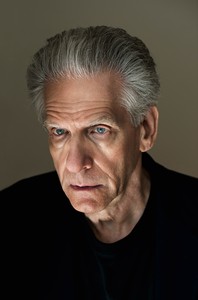
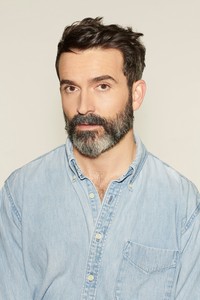
David Cronenberg, 2024. Photo: Caitlin Cronenberg
David Cronenberg, 2024. Photo: Caitlin Cronenberg
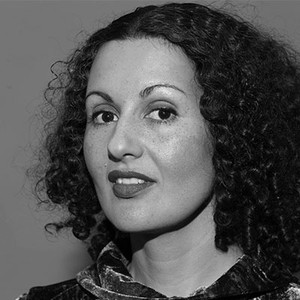
Miriam Bale is a writer and film programmer based in California.
David Cronenberg has established his reputation as an auteur through his uniquely personal work as both film director and writer. Beginning his career in underground filmmaking, he has developed a dramatic oeuvre of outstanding depth and breadth and has been lauded as one of the world’s most influential filmmakers. Recognitions of his contributions to art and culture have included the Order of Canada and France’s Légion d’Honneur. Photo: Caitlin Cronenberg
The newest David Cronenberg film might be his most personal. Made in response to the death of his wife of forty-three years, it investigates and envisions mourning. In the film, Karsh (Vincent Cassel) is an entrepreneur who invents a new technology that allows its users to watch the body of a loved one decompose. This enterprise is Karsh’s reaction to the loss of his wife, Becca (Diane Kruger), whom he discusses with Becca’s dog-groomer sister, Terry (also Kruger), and with Terry’s exhusband, Maury (Guy Pearce). Terry and Maury then entangle Karsh in various conspiracies involving his company, GraveTech, seemingly as a way to deal with the shock and anger of loss.
After Karsh’s dentist tells him that grief is rotting his teeth, he goes on several dates, eventually starting a relationship with a beautiful woman (Sandrine Holt), the wife (and soon the widow) of a potential Hungarian client. Karsh also hops into bed with his own sister-in-law, perhaps as another way for both to fill the void left by Becca. Despite these heavy and sexy themes, The Shrouds is a comedy, like most of Cronenberg’s films. The audience at the New York Film Festival premiere laughed throughout, rhythmically, almost as music to accompany the mournful score by Howard Shore. The day after that NYFF screening, I had the pleasure of talking about the film with Cronenberg.
miriam baleI don’t know if you sat through the screening, but the audience was laughing throughout. It was very different from the Cannes audiences, where I think they were hesitant to laugh because of the subject matter.
david cronenbergPeople just didn’t get it [in Cannes]. It’s language and culture and who knows what else. I think it’s also, as you said, with the topic, people don’t want to laugh at something so tender.
mbAbsolutely, they feel it would be disrespectful.
dcThey didn’t get it. But of course in Toronto they got it. If they weren’t going to get it in Toronto, then they weren’t going to get it anywhere. And then I was quite certain that they would get it here [in New York] too.
mbSo the last time I interviewed you was for A Dangerous Method [2011]. That’s a very Jewish film, with themes of the body versus the soul, and here we are again with The Shrouds, which is very Jewish—it has matzo ball soup, and this very Jewish approach to the afterlife. And again it has the body versus the soul, with the body obviously the winner. I wonder if you find it a very Jewish film?
dcOh yes. I mean, I’ve never denied my Jewishness, but it was never the subject; it’s not like Philip Roth or Saul Bellow. I grew up in a very secular household, very Jewish but very secular, and full of art and music. My father was a writer, my mother was a musician. So, classic assimilated, secular Jewish. But because of the subject matter, once you get into burial, you’re immediately trespassing on religious territory: burial practices, questions of the soul and the body, and all that. So you can’t really avoid it and it becomes a discussion.
mbThere’s that wonderful line about how the soul loves this body and has only seen through the eyes of this body, and so is kind of holding on.
dcIt’s a beautiful metaphorical thing, which is part of the Jewish religion and not something people talk about much, but when I did my research, I found that and thought, “Well, I really like that.” And I saw that soul as I created it in the first scene. It looks a little bit like a cicada, I think, like an insect, floating around her body.
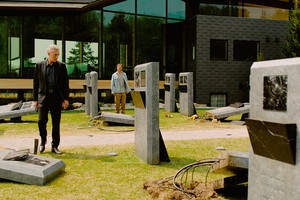
Still from The Shrouds (2024), directed by David Cronenberg
mbOh, that’s amazing. I wanted to talk to you about that illustration in the beginning.
dcYes, well, that’s in Karsh’s dream. He’s seeing that soul fluttering around her body and being reluctant to leave it. And it’s in the shape of some kind of insect, a winged insect that’s kind of glowing.
mbThere have been a lot of discussions about how Karsh, as portrayed by Vincent Cassel, is very similar to you physically.
dcYes, but I didn’t cast him for his hair, it’s really happenstance. I mean, certainly because Karsh is the bereaved widower, he’s playing me to a certain extent, or that character is me to that very limited extent. But Vincent wasn’t the only one we thought of casting. I knew that if Vincent was doing the role, he would still have a bit of an accent. So there are a lot of considerations. I’d worked with him twice before, and I just love the actor. I really don’t think he looks like me, actually. But the hair is slightly similar.
He did decide that he was modeling himself on me. So one of the things he did was, the way he moves in the film is not the way Vincent normally moves. It’s a subtle thing. Also the way he speaks—accent aside—is much more relaxed than he normally is, he’s normally very quick, very staccato, very French-tough-guy, and we both knew that wasn’t the right rhythm for this character. I did say, Model your accent on me. I said that to Guy Pearce and to Diane Kruger as well. Because this is a very Toronto movie as well as a very Jewish one.
mbThe character of Karsh: he’s an entrepreneur, but he has a background as an industrial film producer, so he’s also a filmmaker. I don’t know if I’ve seen that in your movies before.
dcNo, usually I don’t directly address the whole filmmaking thing, I leave that to others who want to do it. [Federico] Fellini did it very well in 8 ½ [1963], and others have done it, but I haven’t really addressed it directly. Obviously, in some ways, the Shrouds are cinema. They’re creating the cinema of the cemetery.
mbExactly. I mean, Karsh talks about the high-res zoom. I’d love to talk more about the ShroudCam as this new kind of cinema.
dcWell, that’s exactly it. For him, it’s more shooting documentary than fiction or drama, but it’s a legitimate extension of his work as a documentarian. This is something that most people have never wanted to document, which is the decomposition of the human body in a grave. So it fits that it’s part of his work as a filmmaker.
mbI watched the film a couple of times and there are so many routes you can focus on—creating a new cinema, detective-plot mechanisms—but I feel like on some level this is simply a film about a widower learning to date again while he’s still fused with his past, with his wife.
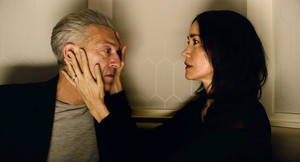
Still from The Shrouds (2024), directed by David Cronenberg
I want to continue to have a relationship with this body, and for it to be a real relationship, it has to go into the future. If it’s just the past, it’s not a relationship, it’s just a remembrance.
David Cronenberg
dcYes, that’s true. I mean that’s the last scene in the movie. Basically he’s understanding that he’s never going to be able to make love to a woman without his wife being involved somehow, and that his experience of her for so many years will color any experience he has with another woman, primarily erotically but also every other way. And in my experience that’s true. So I made it physical, the fusion of his new girlfriend and his dead wife. But metaphorically I think it’s quite accurate.
mbYeah, and it’s emotionally deep and resonant to see it as well as to feel it in the film. You talked about Karsh’s new girlfriend, but I’m especially interested in Terry, too, because Terry is in some ways also a fusion. She has, let’s say, Karsh’s most negative qualities, these grief roads he could go down, such as giving up on life. She’s given up surgery to focus on the surfaces of animals, she’s going into these conspiracy theories, but she has the body of his wife, so in some way she’s a fusion. Is that a correct read?
dcYeah, it’s absolutely correct. The difference is that unlike the Hungarian’s wife, Terry knows this. She knows that part of her attraction to Karsh is that she’s like his wife, like her sister. And yet, in another way, she’s in competition with that sister for Karsh’s affection and attention. And she questions it, and there’s that long sex scene, which to me is actually a dialogue scene, where they’re talking about that, talking about Maury, her ex, and all of that, and she’s saying, “How do I feel compared to Becca, how do you feel?” But she’s really saying, “Do you think you could love me the way you love Becca, or is that impossible? Is it impossible because I’m her sister and I’m too close to her, and that’s going to be too frustrating? Or does it make me more attractive and more likely to be loved by you?”
I also didn’t wanna do the sort of classic grief-movie flashback, you know, lots of scenes of the happy times they had together on the beach, that time they went to Cuba together, or whatever. I wanted his love for Becca to be delivered by him, primarily verbally, and then in those scenes that aren’t happy scenes at all, the horrible times when she’s being dismantled surgically. He’s having dreams of that.
mbWhy was that? You didn’t want it to be nostalgic?
dcBecause I think it’s so easy. Why pinpoint those happy moments? Because when I think of my past, it’s not always the happy moments I’m thinking about, and sometimes it’s not even any significant moments: it’s sometimes the totally insignificant moments that are so very painful, just some words that were spoken, and that only you two have ever spoken to each other. Things like that.
I also wanted to be forward-looking, with him saying, “I want to be with her body in the future, as it decomposes.” I’m not thinking about looking at Polaroids of sex we had, or something like that; I want to continue to have a relationship with this body, and for it to be a real relationship, it has to go into the future. If it’s just the past, it’s not a relationship, it’s just a remembrance. So he’s willing to go that far. It’s basically, How dark do you want to go? He’s willing to go all the way to that darkness, that particular darkness.
mbSo the fusion is temporal as well as physical? That’s beautiful.
Last night at the screening, when you were talking about your wife, you were interrupted by a walkie-talkie.
dcI wondered what that was. I thought it was somebody making a comment.
mbIt was such an eerie moment, though, and it made me want to ask if you’d ever do a ghost movie. I feel like the answer might be no.
dcAbsolutely no.
mbTell me why.
dcBecause a ghost movie is a religious movie, and it completely subverts the reality that we are going to disappear as if we never existed. And that’s the existential problem, you know? It’s very difficult for a living creature, especially a human, to imagine that and to accept that it’s actually going to happen. Kids are pretty shocked when they discover that not only are they going to die, but their mommies and daddies are going to die. This is a difficult moment for any kid to get over. You don’t read about it much but every kid has to come to that awareness. And to me the cop-out is to say, No, but we’ll be in heaven, we’ll be somewhere really nice together. I think Christopher Hitchens said that religion is made by death. Religion is created by death. And I think it’s true. I think every religion is a way of avoiding the reality of death. So a ghost story is just another religion—you’ll still be alive, you’ll be a ghost but you’ll still be hanging around and still interfering in human affairs.
mbAnd you’re not interested in that fantasy when the reality is so interesting in itself?
dcWell, it doesn’t mean that a ghost story like Hamlet can’t have great resonance and metaphorical significance, and be powerful and beautiful, but to me it would feel like a cop-out. It’s just not part of what I want to do in my art.
mbYou mentioned earlier that you considered that long sex scene between Karsh and Terry to be more of a dialogue scene than a sex scene. Could you tell me more about what that means in how you framed it and shot it?
dcI just meant that they talk all the way through the scene, and what they say is more important than the kind of sex they’re having. So, not a traditional kind of sex scene. I framed it very simply so that you can see both of them speaking at all times to emphasize this, so no cutaways to close-ups of body parts and so on.
mbI want to ask one more question about Maury, such a wonderful character, and such a wonderful performance by Guy Pearce. There’s that line “brothers in sorrow” about Maury and Karsh. I feel like Maury contrasts the divorce separation from the widowed separation. Could you talk a little bit about that relationship between Karsh and Maury?
dcWell, they’re similar: they’re both men who have been married to sisters and can’t let go of them, even when the sisters are gone in one way or another—in one case because she’s had it with him, and in the other case because she’s dead. So there is that parallel. And that’s part of why Maury is so adept at conspiracy, because that’s his way of somehow still connecting with Terry. But as she said, she got rid of Maury because he’s a schmuck, and that was the end for her with Maury. But yeah, they’re parallel relationships.
mbUltimately they’re similar. But Karsh is just not a schmuck.
dcNo, he’s not. Thank you.
mb[wide-eyed puzzlement]
dcI took that personally.
mbYou should.
The Shrouds opens in select US theaters on April 18, 2025.
Miriam Bale is a writer and film programmer based in California.
David Cronenberg has established his reputation as an auteur through his uniquely personal work as both film director and writer. Beginning his career in underground filmmaking, he has developed a dramatic oeuvre of outstanding depth and breadth and has been lauded as one of the world’s most influential filmmakers. Recognitions of his contributions to art and culture have included the Order of Canada and France’s Légion d’Honneur. Photo: Caitlin Cronenberg