On April 3, an exhibition of new paintings by Julie Curtiss opened at Gagosian, Paris. Ahead of the show’s debut, the artist met with author Lauren Elkin to discuss the work’s relationship to the Florida suburbs, the power of juxtaposition, and what it means to leave a painting open for the viewer.
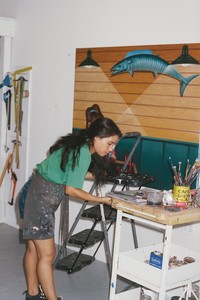
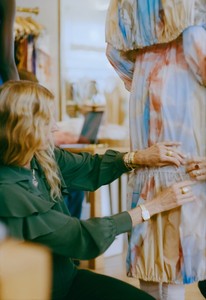
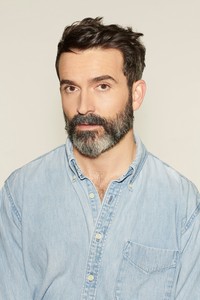
Julie Curtiss in her studio, New York, 2024. Photo: Dan MacMahon
Julie Curtiss in her studio, New York, 2024. Photo: Dan MacMahon
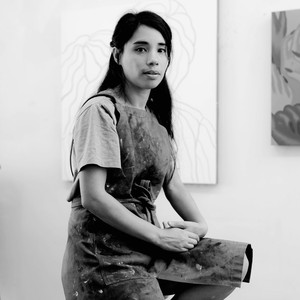
Julie Curtiss was born in 1982 in Paris and lives and works in New York. Associating humor with darkness and the mundane with the uncanny, Curtiss employs a visual language of vivid colors and forms that are at once seductive and grotesque, exploring the puzzle of identity and extending an invitation to reflect on the idea of an unfixed, ever-changing self. Photo: Dan MacMahon
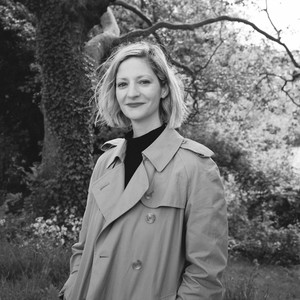
Lauren Elkin’s most recent books are Scaffolding: A Novel (2024) and Art Monsters: Unruly Bodies in Feminist Art (2023). Other books of hers include No. 91/92: Notes on a Parisian Commute (2021) and Flâneuse: Women Walk the City, which was a New York Times Notable Book of 2017 and a finalist for the PEN/Diamonstein-Spielvogel award for the art of the essay. She lives in London.
Lauren ElkinDo you think of the work in this upcoming show in Paris as a departure for you, or as a natural development of your work over the last few years?
Julie CurtissWell, the paintings in this show revolve around a specific point in my life. I made these works just after giving birth. We were spending most of our time in Florida then; we have a small house there, in Tampa Bay, and we figured we’d be more comfortable there. We would have my husband’s mother around to help out during the few first months. Not only having a child but also spending more time in a suburban environment—it was a huge life change.
There are references from this time in the works, which are almost snapshots, and more autobiographical than earlier paintings. I was walking around my neighborhood during this important life event and taking photos of things that struck me. So it’s a collection of those photographs that evolved in my head and became compositions and narratives. The paintings are a bit like novels.
LEThat’s interesting. In what way are they novelistic?
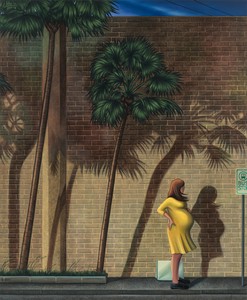
JCThe way they’re built out. If you look at Last Stop [2025], for instance, I began with the setting and the mood—those very gloomy, shadowy palm trees. Very tropical but also something dark about them. And then I added the character, waiting at the bus stop in this in-between state. That’s a characteristic of many of the figures, waiting between states, neither here nor there. They’re in a mode of thoughtfulness or dreaming.
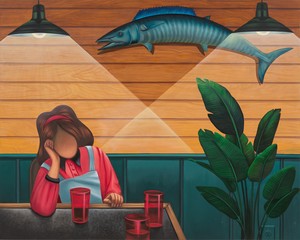
Julie Curtiss, Fish Camp, 2024, oil and acrylic on canvas, 48 × 60 inches (121.9 × 152.4 cm). Photo: Maris Hutchinson
LEI see that in Fish Camp [2024]. The lone woman at the bar.
JCThat was inspired by two different things. First, the Fish Camp, which is a restaurant in Saint Petersburg, not far from where we live. There are beautiful fish trophies floating above your head while you’re eating. It’s so surreal and bizarre, but also such a typical diner—the red cups, the wood paneling. I knew I wanted to paint these things and eventually I thought about one of my favorite paintings at the Metropolitan Museum [of Art, New York], Vermeer’s Maid Asleep [c. 1656–57]. Half of the painting is shadow, and you see the maid on the left dozing off.
LEHow about your painting of the two women with their strollers?
JCThat was the first painting I made after I gave birth. Stroller moms. To be honest, I just don’t love the American suburban landscape, even if my area is actually quite gorgeous, with beautiful oak trees. The manicured lawns, the vast space between people, waving from cars to your neighbors. Amidst all of this are lots of young mothers—like me—and all these young children everywhere. It’s sunny, everyone is really fit, it feels so integrated—and I always say I’ve been grafted onto this scene, this New York transplant. I had really bad postpartum depression, on top of this more general feeling, and the bouncing-back moms, in their gym gear, were a subject of fascination, so seemingly different from my reality. I didn’t relate to it at all.
LEIn the suburbs everyone’s so atomized, they’re in their own houses, they’re in their own cars. They’re only outside for a walk, for exercise. Your women with the strollers are going to just hop back into shape from having a baby and it’s going to be all spandex, very fake, like in your painting—their bodies are molded into these weird bulbous forms. And it’s like their entire life is an extension of their manicured lawns. Everything is just manicured, manicured, manicured, and you don’t leave your bubble.
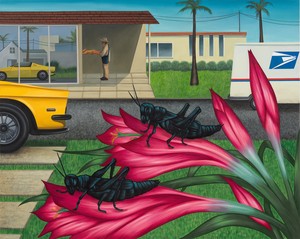
Julie Curtiss, Delivery, 2025, oil and acrylic on canvas, 48 × 60 inches (121.9 × 152.4 cm). Photo: Maris Hutchinson
JCThe Floridian suburb is distinctly fascinating because the state is one of the wildest places in America in terms of flora, fauna, natural occurrences, but it’s full of suburbs where people are constantly trying to control the environment. It’s a constant battle. Our neighbors across the street removed all of their beautiful lawn. They completely peeled it off, installed concrete everywhere in front of their house, and then put down AstroTurf. That’s the new trend!
LEWow. That’s such a perfect encapsulation of that suburban mentality: we’re going to control our environment as much as we can, even the grass will be fake. How did you come to be in America to begin with, and do you find it a nourishing place to live and work, or do you miss Europe?
JCOh no. I find it way more nourishing than working in Paris. I’m from Paris, from Montreuil, the suburbs of Paris, and I studied at the Art Institute of Chicago for a semester. I somehow got into an exchange program and it was such a revelation for me. I found the subculture so alive. The contemporary art environment is better for me in America because there’s a more intense push for action than in Europe. It never worked very well for me to think too much ahead of what I was making. Europe in general and France in particular—we’re too cerebral; but in America you do whatever the moment asks. You make first, and then you think about it. And that was a much better process for me. The visual language was so new and refreshing and bold and nonhierarchical, no taboos, no dos and don’ts—it was quite liberating for me.
I also discovered the work of the Chicago Imagists at this time, and then in 2010 I moved to New York and started to work for Kaws. He’s an avid collector and I had access to a lot of really interesting subcultural art. All of this gave me the confidence to do what I actually enjoyed. For a long time I’d been flirting with illustration, with graphic novels, but I’d been afraid to bring that into my art.
LEYou’ve spoken in the past about the distinction between illustration and the figurative work that you do. You said something like, In illustration you have to give people all the information they need to see what you’re drawing, but in your work you suggest and step back, letting viewers fill it in or understand it as they will.
JCYeah, even though I have this attraction to illustration, what I do is very different. I don’t need to explain what I’m doing, I don’t illustrate an idea, I don’t work toward literal representation; I give a lot of details, a lot of information for the eye to see, lots of figurative elements, but at the same time I keep the meaning of my works very open. It’s important to allow for inner contradictions and strange juxtapositions.
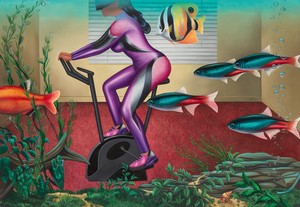
Julie Curtiss, In the Flow, 2025, oil and acrylic on canvas, 55 × 80 inches (139.7 × 203.2 cm). Photo: Maris Hutchinson
LECould we talk a bit more about juxtaposition in your work, specifically in terms of the kind of productive ambiguity it creates? People throw the term “surrealist” around a lot, but there’s something in that history that’s perhaps useful in approaching your work. Your painting In the Flow [2025], for instance, of the woman on the exercise bike behind the fish tank, is an amazing expression of that surrealist idea of Lautréamont’s about the “chance encounter of a sewing machine and an umbrella on an operating table.” These disparate elements come together and create a marvelous shock. Who would ever think to paint a woman on an exercise bike as viewed through a tank of fish except for you?
JCThank you [laughter]! Well, the work is often about a shift or shifts of perspective. I was just listening to the audiobook of your recent book Art Monsters [2023]; I feel like it’s an exposé about my work. You have this whole theory around the slash in writing.
LEYes, a device for suturing together these different ideas without explaining the links between them.
JCExactly—something can be one thing and its opposite, and somehow it still works. Art is really the perfect place where this can happen and somehow still make sense. Often what prompts a painting is an inner conflict between two things suddenly forced into dialogue. When they meet in the same space, there’s a shift of perspective, an ambiguity with the gaze. Where is the action taking place? In that specific painting there’s the woman on a bicycle, and bicycles are supposed to go somewhere, but she’s going nowhere. It’s stationary, she’s pedaling just for the act of it. And yet she’s somewhere else—she’s wearing a VR set. Is she visualizing another space? She’s here physically but she isn’t here mentally. And then she’s placed behind this fish tank, which is displacing her one more time. We were already talking about the rift between human and nature in the suburbs, and the neutralized space that humans have created for themselves in the chaos of nature; the aquarium is another attempt at control, a miniature natural environment that’s completely artificial.
LEAnd there’s an amazing visual resonance between how shiny the fish are and how shiny her Lycra outfit is. She’s like an artificial fish.
JCYeah, exactly. I want her to look as beautiful and tropical as the little fish.
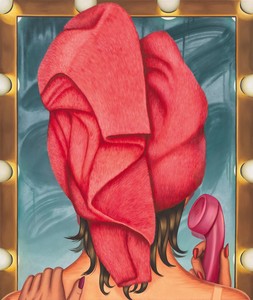
Julie Curtiss, Téléphone Rose, 2025, oil and acrylic on canvas, 40 × 34 inches (101.6 × 86.4 cm). Photo: Maris Hutchinson
LEYour subjects are also often faceless. As I write in Art Monsters, there’s a major feminist history of faceless portraits by female painters. In several portraits Vanessa Bell made of her sister, Virginia Woolf, in 1912, for instance, she doesn’t give her a delineated face. I was thinking about that as the answer to the problem of identity, the problem of the female artist representing herself on the canvas and escaping the male gaze, as well as the more general problem of knowing another person. How could Vanessa Bell ever do her sister’s face justice on a canvas? She can’t. So she just has to leave it blank.
JCExactly. It’s not one single answer. The fragmented self, the puzzle of the female body, the Medusa turning others into stone with her gaze, it’s all part of that decision making. But on a very basic level, for me, there’s something very satisfying and magnetic about a face in a portrait. That’s where your eyes want to go first. There’s probably some form of primal psychology in that, making sure you can read the other person’s mood and behavior. In a sort of passive-aggressive reaction to that impulse, I need to erase the face, eject it from the frame, which forces the viewer to look at the rest of the image and complete the image in a more total way. Additionally, I’m interested in voyeurism: the fact that you can look as much as you want at the painting without it looking back at you is appealing.
LEThis is a growing approach in contemporary literature as well. It’s become more common not to name your main character in a novel. Elif Batuman wrote an essay a number of years ago in which she talks about a Chekhov short story, “The Lady with the Dog,” and she’s like, It takes a writer of great power not to name the dog. The dog is just a dog, it’s not Buffy or Fluffy or Fido. Batuman wrote approvingly about writers who have the restraint to keep from pinning down a person with a name. I think of that when I look at the women with no faces in your paintings; it would be a disservice to stoop to the level of giving them faces.
Julie Curtiss, Last Stop, 2025, oil and acrylic on canvas, 102 × 84 inches (259.1 × 213.4 cm). Photo: Maris Hutchinson
JCRight. I’m not painting anybody in particular—they’re templates anybody, archetypically, can inhabit and project on.
LEI know that this work isn’t in the exhibition, but I encountered a painting you did of a woman with a breast pump on the Internet somewhere, and I loved it so much. There’s a fascinating surge right now among women our age who are thinking about motherhood and artistic or literary creation in a way that hasn’t been done before—what it actually feels like, from the inside. And I wonder how you think about painting now that you’re a mother, to return to that subject. How has that shaped your practice? Some artists I’ve spoken to don’t want to talk about it. It’s like, “I’m just an artist. I don’t want to talk about motherhood. I leave that at the studio door.” But you’re painting a woman with her breast pump, which is a very specific experience—
JCWhen I was pregnant, people would ask, Do you think it’s going to change your work? I was like, I have no idea. Maybe not. My practice is intuitive, and while it isn’t intentionally or clearly autobiographical, of course my life slips in.
LEOf course—you’re always drawing from your own experience of what it is to be a human being.
JCAnd then you extrapolate and you develop an empathetic approach to your characters. I create all these characters who are sides of my own self, more or less developed, more or less alien. I have a lot of animals in my work, and even with the creatures that are the most alien to us—a horseshoe crab or a lobster, more prehistoric or less familiar animals—even with those creatures you can feel a sense of empathy.
LEYou’re constantly widening the frame of what art can approach, and I’d wager that becoming a mother can only push that expansiveness further. Watching your child can be making art; you’re still working, even if you’re mothering.
JCBut it’s interesting that you bring up the breast pump painting. Living in this culture, you have all these images of motherhood in your head—iconography of Mary, the child and the breast, the ideal image of motherhood. But that wasn’t my or many people’s experiences of motherhood. My painting is this lonely Mary pumping her breast in the middle of the night. It was inspired by Georges de La Tour’s painting of a nocturnal Mary Magdalene bathed in the very warm hue of candle- light, but now it’s modern times and it’s the blue glow of the machine and it’s cool, hazy, and slightly sad. I guess you could say I was turning my grief into something positive. A big theme in my work is modernity and the associated sense of disconnect. That’s why there are so many animals—searching for that lost connection with the primal self, or with something more instinctual. My characters sometimes seem lost in the urban landscape. But there’s humor in the face of all this, there are question marks.
Julie Curtiss was born in 1982 in Paris and lives and works in New York. Associating humor with darkness and the mundane with the uncanny, Curtiss employs a visual language of vivid colors and forms that are at once seductive and grotesque, exploring the puzzle of identity and extending an invitation to reflect on the idea of an unfixed, ever-changing self. Photo: Dan MacMahon
Lauren Elkin’s most recent books are Scaffolding: A Novel (2024) and Art Monsters: Unruly Bodies in Feminist Art (2023). Other books of hers include No. 91/92: Notes on a Parisian Commute (2021) and Flâneuse: Women Walk the City, which was a New York Times Notable Book of 2017 and a finalist for the PEN/Diamonstein-Spielvogel award for the art of the essay. She lives in London.