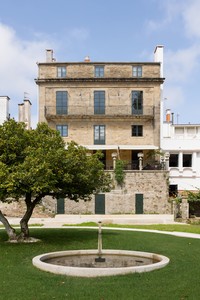
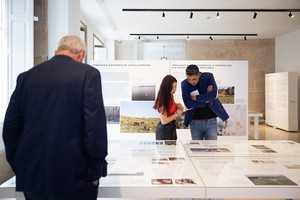
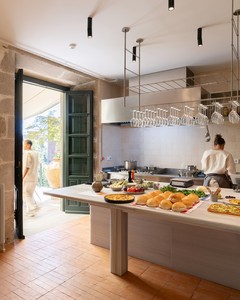
In 2017, the architect David Chipperfield launched the nonprofit think tank and agency Fundación RIA in the autonomous community of Galicia, in northwest Spain. The organization has worked closely with local communities, government, industry, and academic institutions in pursuit of an interdisciplinary understanding of built and natural environments in Galicia. As Chipperfield discusses with his close friend the Galician artist Álvaro Negro, the region is rich in lessons both philosophical and architectural. The two spoke on the occasion of the 2024 opening of Casa RIA, the Fundación’s new headquarters for public programming, research residencies, and exhibitions—as well as a new cantina run by chef Iago Pazos—in Santiago de Compostela.
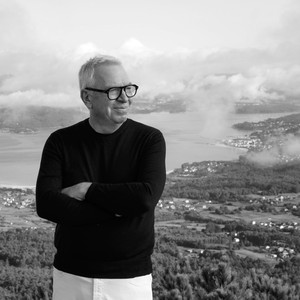
David Chipperfield is an architect whose work includes celebrated cultural, residential, educational, retail, workplace, and civic projects. Among the major completed works of his practice are the rebuilding of the Neues Museum, Berlin, an extension for the Kunsthaus Zurich, Turner Contemporary in Margate, England, the Amorepacific headquarters in Seoul, and the Bryant in New York. Photo: Adrián Capelo
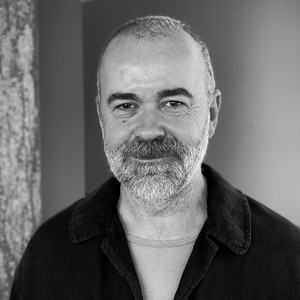
Álvaro Negro’s painting feeds on both the Spanish and the Italian pictorial tradition, tending toward abstraction but making more or less explicit references to reality, and assuming the experiential as a foundation from which to reach the cognitive. Photo: Thomas Struth
Álvaro NegroDavid, could you tell us about how your life experience in Galicia has influenced your architecture and, by extension, your decision to create a foundation that conceives its projects with a clear multidisciplinary vocation?
David ChipperfieldAs an architect, you’re always designing physical things. You’re designing houses or libraries or museums. You’re dealing with the inanimate, the fixed, the substantial. But of course these things don’t make any sense without occupation. They must be built around something, otherwise they’re just empty vessels. As an architect you find yourself celebrating not only the static and the physical but also the relationship between the physical and the fluid, the software, the people. A room is for people, after all. And what rewards you most in architecture is the dynamic between those two things: that the physical object has a relationship with or can be related to by the variables. Simply put, the way people come in and enjoy themselves (or not) in the spaces you’ve designed is what concerns me the most. In that sense, I’ve always felt that architecture is more of a background, or a stage, and hopefully it’s a high-quality one that quietly insinuates its qualities on you. You should enjoy simply being there, the way you do in nature. But the awareness of the architecture should come after that feeling more than before. I’ve always felt the danger of architecture is that it loses this ambition. If you’re not careful, you become more interested in the object than in the purpose or, eventually, the humanity. The mantra of modernism was “form follows function,” but what is function when it comes to people and their daily lives? Is there a strict single function for a bathroom, for example? It’s not just a place for washing, it’s also a place to be and to enjoy the idea of water. Our work here in Galicia is informed by this attitude. Fundación RIA is really a space to think through the specificities of this place, of the experience of people’s lives, and to engage with architecture in a less rigid and more ecological manner.
ÁNAs you were speaking, I started to think about when I tried to take this chair: we don’t simply sit, we make a shape that we need in order to be seated, as we are now. But a child can approach a chair in an incredible array of ways. It’s like another thing, it’s a toy. That kind of imagination, of playing with an object, I feel it within certain buildings. And maybe the architect feels this in one way, but the community, the people, use it in their own way.
DCThere’s an interesting difference, because I think as an artist, you’re at liberty to make a provocation. You have that license with an audience. You put something on the wall and we’re expected to look at it, and therefore when we look at it, we expect to find something. You’re invested with the chance to say something, and by saying something you can make us think or challenge our expectations. It’s a provocative position, even if it’s affirmative of certain things.
In architecture there are certain moments when provocation is interesting: at the beginning of the twentieth century, and following the First World War, architecture was part of the provocation in asking how society changes. The early buildings of the modern movement made us think about how we built, how we lived. Society wanted or needed that provocation and an idea of change, of progress. But in general terms, architecture is not a very comfortable medium for provocation, or for commenting or making a joke or asking a question, because the purpose of architecture is affirmative. It confirms your feelings of comfort, of security, of protection. You don’t want to go into a building and say, “Well, it’s really fascinating because it made me feel so uncomfortable.” Whereas with a painting you might say, “I have to say it’s really interesting because it disturbs me in some way,” you know? Architecture is not meant to disturb you. We have a much more conciliatory relationship with society, which is to quietly elevate and persuade and contribute. We’re therefore much less independent of the relationship to the individual, to the audience. We need the community, we need permission, we need a client, we need a budget, we need a timetable, we need contractors. Before we begin any creative aspiration, we have to fulfill all of the technical ones. So then the question is, if we fulfill the technical requirements, what are the creative aspirations that might be available or relevant? Having the cantina with Casa RIA, for instance, is not provocative in any way, but there is definitely scope there to consider more than just the physical specifications.
ÁNIn Corrubedo, Galicia, where your family have had a home for over twenty years, five years ago you reopened a village bar, Bar do Porto. This is not just a place for leisure; it is conceived as a democratic space where people from all walks of life share experiences and celebrate them as rituals that value the everyday as transcendental. In this way, residents build and maintain a sense of belonging to the community.
DCThat’s an essential component of the thinking around Fundación RIA and Casa RIA, because as architects we’re designing the hardware and, in a way, the software too; we’re directly involved in the program and activities that occupy the building and how people use it. You might say that we’re creating the play and the theater at the same moment. Part of the reason is that we want to reconfirm the cantina, or the bar, in its social importance.
ÁNThe first thing that you see, entering into the kitchen in Casa RIA, is there isn’t a limit between the inside and the outside. It’s like the produce that ends up on my plate came directly through the window. That tells a lot about your passion for food, about a kitchen, about the space in a personal way. It also connects to the way food is thought about in Galicia: here we value the quality and source of the product more than anything else. That is, what comes from the food comes from an activity.
DCAbsolutely, and I think these are questions about how we see the future and how we deal with our past. From an autobiographical point of view, I completed my studies as an architect in the late 1970s, when the dream of the modern movement was collapsing. Nonetheless we were taught about the work of great modernist heroes, and I still can’t be free of them—Corbusier, Mies van der Rohe, Alvar Aalto, many more. We were—and are—captivated by their ideological and missionary attitude to design. But by the 1970s and ’80s, the dream of modernism and technology, and the idea of progress, had really started to crumble. Around us we were seeing the results of bad planning decisions and the impact on the quality of our built environment and quality of life, particularly in social housing.
ÁNIt was like the first crisis of the idea of progress.
DCIt was the first crisis of progress, and now we’re going through another and more profound one. It was a very interesting time to be a student at that moment, when everybody started to rethink the recent past for what seemed like the first time; we started to look at architects of the nineteenth century instead of architects of the twentieth century, and reevaluated the concept of progress. Within my own context and the people around me, we were very influenced by architects from Europe, architects like Álvaro Siza, Rafael Moneo, Portuguese and Spanish architects who were looking for a more convincing relationship between modern ideas and traditional restraints of historical and physical context because the architecture of modernism had become international and independent of place. My generation tried to refind this idea of place, in our projects and as a profession.
Having spent my early professional years in Japan, I had a very heightened awareness of the idea of place, especially being an outsider. For architects and designers, it is incredibly inspiring and humbling to work in Japan, and in a culture where there is an impetus to celebrate daily rituals and the seasons, to invest things with meaning or importance. There is a profound connection to the place, the past, and the present moment. I’ve found a similar environment in Galicia. When we first came here as a family thirty years ago, there was something very refreshing about it. Perhaps this was a result of our own projections, especially coming from London, where everything can feel invented, artificial, speculative. But for five weeks a year, here in Galicia we immersed ourselves in everything that’s not artificial, everything that’s real, that connects you to your surroundings, to the people and nature around you, and that locates you. Admittedly we were without the disadvantages that you might feel if you lived here the whole year; I fully recognize that we had an extremely privileged relationship during those weeks, but it was deeply formative. It gave me a new idea of what quality of life should feel like, and a new idea of “progress.” I owe so much to Galicia.
ÁNYou have many close friends who are artists, like Thomas Struth and Tracey Emin. Every individual has a different idea or a different approach, of course, but do you see something common between your activities and theirs?
DCNot so much. I mean, obviously we swim in the same water and we get excited about common things. We’re all visual people and we look for ideas in similar places. But I think my fortune of having artists as friends helped me confirm the notion that the architect is not an artist. There are too many architects who think they are artists, but I’ve never been a frustrated artist because I don’t think I’m that creative. Maybe by having artist friends I could just relax. I suppose if you had friends who were priests, you could just relax about being too religious [laughs]. Your soul is protected by them.
Another lucky thing about knowing artists is you can trust their opinions, which are usually free of agenda or a priori principles. When I’m in Galicia and I talk to you, I know the things you say have cultural authority and independence. When I first started working in Germany, knowing artists like Thomas Struth, Thomas Demand, and Wim Wenders gave me an amazing reassurance and support. I accept—and always assumed—a certain level of ignorance and naivete about places outside my own country. I’ve learned that the first rule of being somewhere that’s not yours is to never confuse your ignorance with some sort of superficial understanding.
ÁNThen again, when you’re so close to something, because it’s your country or it’s your family, it’s more difficult sometimes to take a distance and analyze things properly. A balance is needed for any clarity.
DCCertainly. My privilege has been to enjoy the meaningfulness of places that aren’t mine, and maybe to exaggerate that meaningfulness because I don’t know the bad bits of it. At a conference here, someone from the region said something like, “Come on, David, you’re just exaggerating. This place isn’t so wonderful as you keep telling us it is. We’re not as good as you keep telling people. Our food isn’t so good. It’s an exaggeration.” And I say “Of course,” I recognize that sometimes I may have exaggerated things. But if you don’t make exaggerations, elevate things, celebrate things, then so much of life can be too easily dismissed. It’s a responsibility for all of us, it’s what artists do, and that’s an aspect of architecture that I love, the exaggeration. Perhaps I might think too much about the details of a door handle—it’s just a door handle—but if we dismiss all these small things, what’s left? To make life meaningful you have to exaggerate a little.
David Chipperfield is an architect whose work includes celebrated cultural, residential, educational, retail, workplace, and civic projects. Among the major completed works of his practice are the rebuilding of the Neues Museum, Berlin, an extension for the Kunsthaus Zurich, Turner Contemporary in Margate, England, the Amorepacific headquarters in Seoul, and the Bryant in New York. Photo: Adrián Capelo
Álvaro Negro’s painting feeds on both the Spanish and the Italian pictorial tradition, tending toward abstraction but making more or less explicit references to reality, and assuming the experiential as a foundation from which to reach the cognitive. Photo: Thomas Struth