Jenn Nkiru’s capacious career spans from directing music videos for Beyoncé to participating in the Whitney Biennial. Here, Péjú Oshin interviews Nkiru about her latest film, THE GREAT NORTH, an exploration of the Black history and architecture of Manchester, England. The two discuss the film’s formal and historical considerations and its place in Nkiru’s artistic practice.
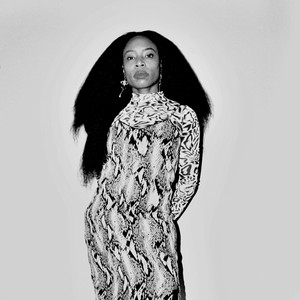
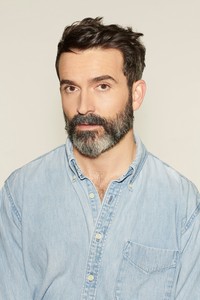
Jenn Nkiru is a London-born artist and director whose practice spans film, music, and contemporary art, exploring time, rhythm, and the poetics of Blackness. Last year she launched her imprint MOTHERSHIP alongside the international premiere of THE GREAT NORTH, her feature documentary debut, continuing her inquiry into form, process, and the radical possibilities of the moving image. Photo: Rosaline Shahnavaz/AUGUST
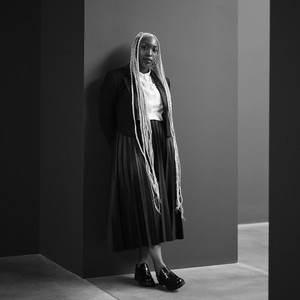
Péjú Oshin is a British-Nigerian curator, writer, and lecturer. As associate director at Gagosian she curated the exhibition Rites of Passage. She has held previous posts including as a curator at Tate, London, and as an associate lecturer at Central Saint Martins-University of the Arts, London. She is the author of Between Words & Space (2021). Photo: Jake Green
Péjú OshinI was so excited to see your new film, THE GREAT NORTH. Thank you so much for the invitation.
Jenn NkiruThank you for coming. The film is still so fresh for me—I finished editing just days before the first screenings. From commission to completion, I had it in production for five years. Factory International commissioned it toward the end of 2019, but then covid happened and we didn’t begin shooting until January 2023. I was deliberate about waiting until I could give it my full attention. For me, creating requires a concentrated, unrestricted mode of working, and I’m glad I held out for that.
This film became the first project produced under my new imprint, MOTHERSHIP, and it’s completely and independently produced by me. Seeing it on-screen feels like the culmination of so many dreams I’ve had around art, ownership, and practice. It lives up my intentions. This is what happens when you have the freedom to work unbridled.
I’m deeply thankful to Factory International in Manchester for their trust. They didn’t know exactly how the eventual film was going to unfold, but they had such great belief in my vision and the project and they part-funded it. Originally the commission was for a five-to-eight-minute piece, but it quickly became clear that this story couldn’t fit into that framework. It had to grow into what it is, a near-one-hour odyssey.
PODuring the screening, you spoke about spending a lot of your time in the archives while making this film. And archives, generally, are interesting because they can be a space where things either go to die, they’re hidden to never be seen again, or where they’re allowed to keep breathing. You seem to have the latter view: the archive as a living organism.
JNPeople often assume that an archive represents a fixed moment in time, something rooted in the past. But for me it’s essential to make archives active, alive, and in continuous dialogue with the present. There’s a saying: people don’t truly die when they pass away, they die when people stop saying their name. That idea resonates deeply. History is a teacher and there’s so much to learn from those who came before us. By nature I’m a bit of a nerd—I love immersing myself in reading, exploring, and letting my mind wander through ideas and connections. For me it’s in that process of exploration that the past transforms into a living force, constantly reframing the present and taking on expanded possibilities for the now and next.
POYou present the credits at the end of the film as a kind of bibliography. I’d love to hear more about that choice.
JNI don’t make films because I’m a cinephile. For me, film is simply the most expansive container for the ideas and forms I’m drawn to. My work often borrows from a range of disciplines, so it always feels essential to credit and share those sources. What’s the sense in knowledge if it’s not shared, you know? My work is a sharing. The bibliography becomes an invitation, a launchpad for onward exploration. If the film resonates, you can follow the threads and engage with the ideas further, discovering more in your own way.
POWhat are some of your favorite disciplines that you’ve been able to weave into this new world that you’ve built?
JNTwo critical themes in my work are sound and movement. A friend recently joked—because I sound-designed this piece as well—“You’re really a musician moonlighting as a filmmaker” [laughter]. But I don’t see those kinds of distinctions. For me, sound and image are inseparable. When I see images, I hear sound—it’s always been that way, and I thought it was perfectly normal. Sound and music are my first loves, and while the image technically comes first in filmmaking, for me the sound often leads. I’ll hear something and then think about the image that needs to meet it. Sound is omnipresent in my work, a force that magnifies and deepens the visual.
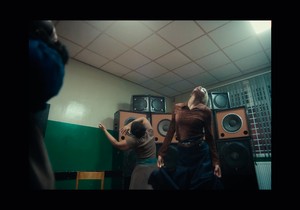
Movement, too, is a language I deeply enjoy. When words fall short, movement has the ability to tap into another depth—it becomes a kind of spiritual interpretation of the body, a way the body translates sound and emotion. Movement bypasses intellectual barriers and goes straight to feeling, cutting directly to the emotional core.
In this most recent piece, architecture—specifically shape—also plays a significant role. I’m not just thinking about architecture in a physical or environmental sense, I’m thinking about the architecture of the mind, somatic architecture, and how we internalize and externalize space. My work often meditates on the externalization of interiority. To borrow Tina Campt’s framing, it’s about visually interpreting the Black interior. These ideas—sound, movement, and the interplay between interior and exterior spaces—are the key elements driving my work.
POI can definitely see those three disciplines influencing, or in relationship to, your work. You mentioned music or sound as being your first love—I think I remember you talking about that being an introduction from your dad?
JNI grew up surrounded by so much sound. My godfather played a huge role in shaping my sonic palette—we spent so much time together, and he introduced me to an entire world of music and culture. My parents were just as influential. They had this amazing combined record collection and Saturday mornings were my time to explore it. I’d pull out every record, scatter them all over the living room, and just listen. There’s even a photo of me putting a record on the player while still in Pampers [laughs]—I was tiny but already completely immersed in sound. Music was my first doorway into art and culture, and it’s shaped so much of who I am.
This year has been especially exciting in that journey. I did the sound design for a piece I created with Kamasi Washington and George Clinton called GET LIT—an incredible experience that’s deepened my connection to sound. I’ve been diving into the craft of sound design: working with stems, playing with time by stretching, compressing, reversing, and slipping sounds. I’m constantly thinking, How can sound act as a motif? How can it carry the weight of a visual? How does it propel the story forward? And what happens when sound and image truly meet—what new emotional or imaginative spaces can we unlock? It’s so fun to play.
I wouldn’t call myself a musician, I don’t play any instruments, though I did tinker with drums, percussion, and piano as a child. But sound and music have always been a natural part of my life. They feel like an old friend—ever present, guiding me, inspiring me, and encouraging me to think expansively about how stories can be told.
POI love that. It feels like there are these cycles for you; there’s a constant return to different influences. With movement, I think about [the choreographer] Ivan Blackstock as a longtime collaborator for you. He worked with you on the movement for THE GREAT NORTH, right?
JNYes. Ivan Blackstock, an incredible choreographer, movement director, and dancer, has been a key collaborator of mine since 2017, which somehow feels like a lifetime with the way the world is moving. He has such a deep fluency in the language of movement, in ways that I don’t. My connection to movement is very instinctual, while his is steeped in the technical and formal aspects. He’s brilliant. That balance makes working with him so rewarding. Film is such a team sport, and I’m endlessly grateful for the collaborators I work with. To be transparent, their patience with me is something I deeply appreciate. I’m very particular in my thinking, and often they’re pushed to work in ways that stretch beyond what they’re used to. But that’s where the magic happens.
I love watching people discover themselves within the process. It’s beautiful. That was especially true with the editor I worked with on THE GREAT NORTH. It was our first time working together and I told him, “This is going to be trial by fire.” I’d say, “For this scene, we’re going to play some jazz—does this piece work? Are you ready?” And he was not only willing but he started offering ideas of his own. Watching someone lean into the work, grow with it, and make it their own—it’s such a brilliant, energizing thing.
POYes, and the third thing you mentioned, architecture, made me really excited, because I’m very interested in the built environment. There’s so much that the built environment does, particularly in creating and storing and holding memories. What happens when the physical body’s no longer there, but there are still these remnants of the people and the culture that existed in those spaces? Thinking about the role of architecture in the film, you collaborated with [the design collective] Resolve, whom I love.
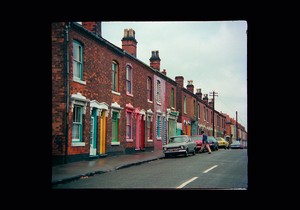
JNMe too! Shout out to Akil Scafe-Smith and the Resolve Collective—brilliant people. Architecturally I had this self-generated thesis about the use of red clay or red earth in Sudano-Sahelian architecture and how its construction relates to the abundance of red brick we see in British architecture. I began by looking at the Great Mosque of Djenné in Mali, which is made entirely of mud clay. What’s fascinating about it is the permanent scaffolding built into the structure, both inside and out, and the annual communal ritual where the entire community comes together to replenish and rebuild it, literally keeping it standing.
In the UK, so many iconic red-brick buildings were constructed by working-class people who often never got to enjoy the interiors of those spaces. At first, the connection between Manchester and Mali felt random, even to me. Why was I trying to tie these two places together? Looking back, it was pure curiosity and artistic indulgence. Had there been an exec beyond me, I’m sure I might have been told to cut it out. But I find that once you start putting seemingly disparate ideas together, the connections that emerge can be profound. I’ve been rereading Sam Selvon’s novel The Lonely Londoners [1956], and there’s this moment where the redness of the earth in the West Indies is described and one of the characters relates it back to England. I thought, “Wow! You see?” No idea ever exists in isolation—no thought is ever the first time a thing has been thought about. These connections are always there, waiting to be uncovered.
JNYes, always. When I think about African history, so much of it is oral rather than written. Including it in film makes it feel real in a different way—it transforms what might otherwise feel like hearsay or fleeting into something material and tangible. The question of how something becomes “real” is such an interesting exercise to me because it’s deeply tied to power, agency, and repetition.
For example, in the film there’s this story I’ve heard repeatedly: that Marcus Garvey, when visiting England, would distribute copies of his paper The Negro World to navy men in places like Liverpool and Cardiff. This isn’t something I’ve seen documented anywhere—I’ve searched high and low—but it exists on this communal level, passed down through elders who say, “Yeah, Garvey used to do that.” And it’s been repeated so often, it feels undeniable. But then the question for me that always arises is, How do we write these oral histories into the larger narrative of history? How do we ensure they’re not lost?
Admittedly, working with limited resources has also shaped my creative approach. I often find myself pulling together whatever fragments I can find and trying to create a sense of order that will resonate with my audience. The Pan-African Congress of 1945, for instance, which took place in Manchester, is a pivotal moment, but there are no moving images of it, only still photographs. I asked myself, How do I imbue a static photograph with feeling? I ended up using a piece of jazz music plus some sound design I made to breathe life into those shots, to give them renewed rhythm and energy.
For me the challenge is always, How do we materialize these histories in a way that makes them real, that makes them alive again? Film allows me to do that—I get to bridge the ephemeral and the material, turning memory into something tangible and felt.
PORight, the documentation itself isn’t what makes something valid or real.
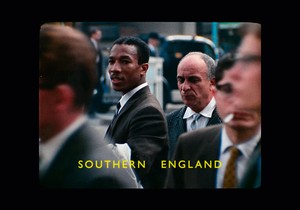
I want to go back to something you said earlier: how your environment can shape the lens through which you’re viewing the world. We’re both from South London, and I suppose there are a couple of things I’m thinking of right now: in the film you draw these parallels of north and south, and I was thinking about how here in the UK we have a different north/south divide from in the US, and from the concepts of the Global North and the Global South. The South here in the UK is seen as being more affluent than the North of England, yet in America the South is seen as less affluent than the North, just as the Global South is seen as less affluent. But you also expose within the film that at one moment Manchester was the richest city in the world. I’m interested in how you’ve navigated showing these comparisons of north and south, especially with you being from South London, a city in the South of England.
JNIt’s funny, isn’t it? Being from the south of the south [laughter]. When you think of the north in the United States, it’s places like New York and the East Coast states, and when you think of the South—Deep South—you think of Mississippi, Louisiana, Texas. But the UK flips that entirely. It’s one of the only examples I know of where the north is less affluent and the south is wealthier. That inversion fascinated me while making the film. How do you tell the story of an anomaly?
I was also struck by how divided the country feels—not just geographically but culturally, linguistically, socially. The North and South of England have distinct identities, and that’s something I’d always noticed but never had the right forum to explore. This film became the space for that inquiry.
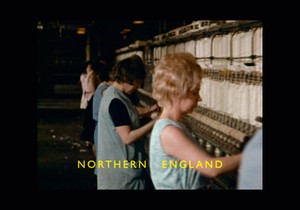
One of my entry points was the influence of cotton. During the Industrial Revolution, Manchester was the richest city in the world, a powerhouse of production—but it wasn’t near the capital and it didn’t grow cotton. That was one of the first things I thought: Wait a minute, how was Manchester producing one-third of the world’s cotton when the plant doesn’t grow there?
When we screened the film in Manchester, I collaborated with David Olusoga, who’s been exploring these same historical questions. We both agreed: once you start looking into it, the conversation inevitably leads back to empire and imperialism. The Global South was powering this northern industrial boom, with cotton being grown in current and former colonies under exploitative systems. The wealth of Manchester—and the wealth of Britain—was built on the labor and resources of other parts of the world. This link between the Global South and the industrial north, mediated by empire, became a central thread in the film. It’s impossible to talk about Manchester’s history without acknowledging that truth.
POMost definitely. You spoke about taking into account expressions of Blackness and Black culture and its histories—about there being so many different ways to exist in Blackness. How do you approach weaving together all of these elements while maintaining this sense of universality?
JNI’ve realized that I’m constantly making the work. I’m so curious as a person, and always have been—I’m always listening, observing, and bookmarking experiences. It’s like I’m gathering ingredients for this ever-evolving cake I’m going to bake. My process then becomes about reconciling all of these fragments, asking, Okay, what belongs here? What’s going to shape this story?
In doing this, I often confront the gaps in mainstream culture’s understanding of Blackness and personhood. There’s such a narrow and, frankly, reductive lens through which it’s often seen. For me, Blackness is not solely a fixed identity category, it’s a container space for our imaginaries—expansive, fluid, without edges. It’s like water, adapting, moving, and holding infinite possibilities. My work is always seeking to explore Blackness through the lens of possibility and acceleration—this idea that Blackness holds the potential to propel us into uncharted territories, to imagine futures we haven’t even begun to consider.
Black media, particularly music, have been doing this for decades. Take techno and jazz, for example: both genres gave us a language that transcends the finite constraints of the spoken word. It charts emotions, experiences, and ideas in ways that other forms simply can’t. That’s the energy I aim to bring into my work: pushing beyond what’s known, creating something that speaks to both where we’ve been and where we want to go.
POI think the film does the important job of giving people space to dream and reimagine—going back to the archives, going back to the history books. As I’m saying this, the still images from the film are coming to mind. And even though those images are still, what you do is create a kind of emotion and a movement around them, so they’re not just stuck there in that moment. The viewer can time travel a little bit.
JNThat makes me so happy. At the core of so much of my work is a desire to remind the audience that imagination is always available to them. My hope is that the work functions as an invitation—especially from a Black perspective—to hold onto and honor the spiritual insights that are deeply embedded in our experiences.
It’s also about rejecting, in many ways, the Western, linear, Enlightenment-era mindset that insists that something must be written down or factually proven to hold value. There’s so much richness and validity in oral and visual traditions, in intuition, and in forms of knowledge that transcend the confines of the written word. A key invitation in my work is to engage with that spiritual wealth—to be exploratory, to listen deeply, to sympathize, and to interpret. It’s about stepping into a space where the unseen and the intuitive are given their full weight and where imagination becomes a powerful generative force.
POI love the idea of continued exploration. I see the connections from this project back to your previous ones, like your films BLACK TO TECHNO [2019] and REBIRTH IS NECESSARY [2017], as well as to your commercial work with Kamasi and Beyoncé. It’s beautiful to see this continuation, this expansion, this growth. You’re able to traverse from the top end of art making into everyday, accessible forms like the music video, which comes into everyone’s home on a TV screen or laptop or iPad. You’re keeping a broader group in mind and helping people build a visual vocabulary that they might not ordinarily have access to. Through the multilayering of references that you put into the work, you’ve expanded your public’s literacy to express what they see and know to be true.
JNThat’s what I’ve always wanted to do—and what an executive once told me I could never do. “You can’t have a career like that,” they said. My response? “Watch me.” I’ve never been bound to any single medium or genre; my commitment is always first to the idea. Sometimes the best vessel for that idea is a piece of art, sometimes it’s a music video, sometimes it’s a commercial, and at other times, a film.
On a personal level, it’s so important for me to be able to speak to multiple people from multiple backgrounds in my work. While I’m often speaking first to a Black audience, my audience is far-reaching, spanning different cultures, ages, and interests. My aim is always to balance universality with specificity, to craft work that is deeply personal yet universally resonant. To me, no audience is too small or too big, too niche or too mainstream. Everyone deserves to engage with ideas that expand their world, and I’ll embrace whatever medium allows me to make that connection with my audience.
Jenn Nkiru is a London-born artist and director whose practice spans film, music, and contemporary art, exploring time, rhythm, and the poetics of Blackness. Last year she launched her imprint MOTHERSHIP alongside the international premiere of THE GREAT NORTH, her feature documentary debut, continuing her inquiry into form, process, and the radical possibilities of the moving image. Photo: Rosaline Shahnavaz/AUGUST
Péjú Oshin is a British-Nigerian curator, writer, and lecturer. As associate director at Gagosian she curated the exhibition Rites of Passage. She has held previous posts including as a curator at Tate, London, and as an associate lecturer at Central Saint Martins-University of the Arts, London. She is the author of Between Words & Space (2021). Photo: Jake Green