Maximiliane Leuschner is an art historian and writer with bylines in Artforum, the Brooklyn Rail, Burlington Contemporary, C Magazine, ESPACE art actuel, frieze, L’Essenziale Studio, Monopol, STIR, and Texte zur Kunst. Photo: Sophie Davidson
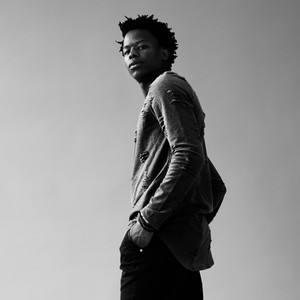
From dancing kwaito on the streets of Zolani in South Africa to performing a duet with Cira Robinson during British Grime artist Stormzy’s performance at the Glastonbury Festival in 2019, Mthuthuzeli November steps out of line. This Capetonian choreographer pushes well beyond the classical repertoire with his dynamic fusions of Western and African dance, intertwining elements from classical ballet, contemporary dance, and other movement forms. With recent credits with Cassa Pancho’s Ballet Black, the Royal Ballet’s Festival of New Choreography, Ballett Zürich, the Cape Town City Ballet, and Charlotte Ballet, November, now based in London, continues to bedazzle audiences across continental Europe. This autumn his Rhapsodies—an arrangement for two pianos and four fingers that riffs on George Gershwin’s Rhapsody in Blue (1924)—and an adaptation of a previous piece for Ballett Zürich will feature in Racines/Roots, a triple bill in the 2025–26 season of the Paris Opéra, the accompanying pieces being by George Balanchine and Christopher Wheeldon.
For the Quarterly, November spoke with Maximiliane Leuschner about making work for such renowned institutions as the Paris Opéra and Ballett Zürich, and about adapting one of the best-known compositions of the Jazz Age for the proscenium.
Maximiliane LeuschnerTell us about Rhapsodies.
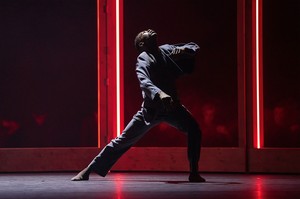
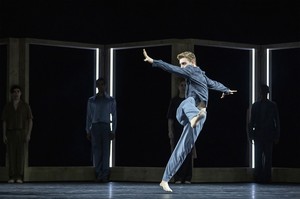
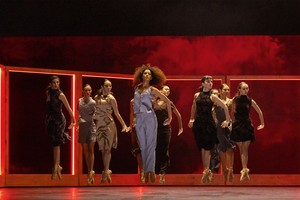
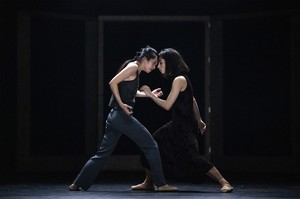
Mthuthuzeli NovemberRhapsodies is an existing work, a remounting of a work that I first made for Ballett Zürich. It premiered in January 2024, and its title riffs on George Gershwin’s iconic Rhapsody in Blue. I liked the idea that music envelops the dance like a collage of ideas. I wanted to explore intimate moments in people’s lives that aren’t always visible, but I also wanted to isolate each section as something that exists within a frame of its own. So, on stage, I’ve mounted these wooden frames. Sometimes they shape the space: you can see through them, but there are also lights surrounding them. And they also frame the dancers. At its core, Rhapsodies is a piece exploring love, people, and identity in a very abstract way. There isn’t a narrative per se, although you can find one if you really look for one. The piece is eighteen to twenty minutes long, depending on how fast the orchestra plays.
MLHow did you find making the work?
MNIt was interesting because I found it hard to see myself in the Rhapsody in Blue melody. Perhaps because I often create my own music when I choreograph?
Halfway through the piece, there’s a moment when I abandon the score altogether to explore my own self-identity. It delves into the roots of my being African. Once the score comes back again, it continues to the end. When I was making the piece, I was capturing moments with the dancers, really just living in the moment and making sure that each section is tailored to a specific person, group, or duet. But I also wanted to be part of that process, so I put myself in there, exploring my identity within the music and the structure, and within, I guess, the organization. Ballett Zürich is a big organization, and Paris Opéra even more so. So the piece is quite close to my heart. I’ve done it for really huge houses and Rhapsody in Blue is a huge work; everyone recognizes it. To create with something like that is quite a daunting task.
MLHow do you achieve this motionwise? Do you break up the middle sequence? How do you find your own identity within the movements and music?
MNThe middle sequence is prerecorded: the orchestra stops playing completely while the piece dives into a completely different world. It lasts no more than two minutes, but it’s a moment when it feels like you’ve entered a completely different space. It’s quite abrupt, in the sense that there’s a flow within the Gershwin score; once you disrupt that and start adding African drums and chanting, the movement vocabulary completely changes.
Maybe there’s something a little bit uncomfortable about that, at first, but it also speaks to what I am, who I stand for and what I stand for, and the place I have in the ballet world as a Black choreographer. Maybe it could feel disruptive to the ecosystem that people build when I enter art, so there’s that feeling in the piece that maybe is uncomfortable for some people. Maybe it’s not, maybe it’s a beautiful thing, but maybe it’s not, you know? I don’t know!
I often have this conversation about being one of the only Black South African choreographers making work for big ballet companies. What will it feel like for me to enter the Paris Opéra? I don’t know what that feeling is like, but I can only try. Those are the ideas I try to approach in my work, being myself as much as possible without trying to be anything else.
MLHow will you approach this at Paris Opéra?
MNThis is what I’m looking forward to. I don’t often restage my works, so when I do, I usually change the whole thing. Perhaps because I don’t like copying and pasting something that was made for someone else. And I think each dancer deserves their own unique take and approach to something. They deserve to feel like they have something being made on them. I’m excited to remake the entire work, to reimagine the entire idea.
MLHow do you find working with classically trained ballet dancers? How do you approach the challenge of teaching them new steps outside their movement vocabulary?
MNI’m always intrigued and interested in working with classically trained ballet dancers. Luckily, dancers are intelligent in the way they move their bodies. My movement is quite grounded, heavy, and very much inspired by South African and African dance. Really the biggest challenge sometimes is not so much that they can’t do the movement, but the time required to get them to the point where they don’t feel silly. Sometimes trying to differentiate between it looking good and feeling silly—it’s hard to get the dancers to believe that they look like they belong in the world that we created. So my approach is to try to remind them to have fun and a good time with it, so that they feel like they belong in a space, that they can try new things. We can all fail, and we can all succeed, but as long as we’re having a good time, that’s okay. I find that people pick up information much better when they’re happier, obviously. So I try my best to create a safe environment where people can look at me demonstrating a movement they’ve never done before and feel safe enough to try and dive deep into that world.
MLFun and play are such great ways to create safe spaces, break up movements, and find new ways of interaction that don’t seem contrived. Do you give your dancers instructions?
MNI try not to spoon-feed them too much information. Again, dancers are really smart. Overdoing the information takes away the magic of them finding out what they’re capable of. And as with audiences, sometimes you don’t want to give them too much information about things. You have to let them feel it, even if it doesn’t always happen on the spot. I’ve had moments when I’ve worked with dancers and months later, after performing the work, they’ll approach me: “Oh, I get it now!” And there’s something beautiful about that. Of course, if there’s an important piece of information that somebody needs to know, I’ll give it to them, but it’s all about discovery. The piece always grows a little in dialogue with everyone. By the time people do the last show, the growth is always a beautiful thing to see.
MLI get you. As a critic, I often see a performance several times, not just once, to see how the piece develops and unfolds on stage during the course of the run; but also for myself, as an audience member, to find my way into the narrative and performance. Speaking about the narrative, when you write the score, do you write your own music? How do you approach this in general?
MNIt depends on what I’m trying to do. Sometimes, if the focus is purely on real instruments, I tend to work with collaborators who can play the instruments and have them in the studio. I’ll describe the feeling and they’ll improvise, or I’ll sing it out loud myself. I can’t actually write music myself, but I like percussion. I play a lot of drums, and there’s a lot of chanting and song, which I do by myself. I just record myself at home. But for a big orchestra, for example, I would work with a friend of mine and we’d develop it together. Then it will be orchestrated by somebody else. That’s my usual approach to music: following a feeling that I have. I try my best to gauge if it’s going in the right direction based on how I would like it to make me feel.
MNI just close myself off and allow myself to be in the moment as much as I can. I go for walks a lot. Sometimes I’ll make a short sequence and then put my headphones on to listen to it for an hour or so on repeat. If that sparks new ideas, I’ll come back to it and continue. In most cases I’m creating the music as I’m making the dance, so I’ll go into the studio and try a section, come back home and continue to work on it, and then add the new thing, which I’ll take to the studio and see if it works. If it doesn’t work, I’ll scrape it out and try another version. I like this way of working because it lets me be in that world all the time. But the problem with big orchestras is that they usually need the music about six months in advance, and it has happened that I don’t feel the music anymore by the time I have to choreograph it, so there can be a bit of an imbalance.
MLHow do you deal with this imbalance?
MNUsually I work on something else in between before I return to something that was submitted a long time ago. When that happens, I take a moment and turn inward: “What was I thinking about? How do I respond to my initial idea?” Sometimes things shift, other times they don’t. But I try my best to stay true to myself and the original idea.
Some ideas come from an emotional response to something, especially in my work, and all my works are personal. I respond in an emotional, personal way, and I usually give out my ideas to people by saying “This is what I’m thinking about now,” which may make it easy for me to go back to that moment, because it’s something that’s still very much in me, you know. But yeah, it can be difficult to plan things in advance.
MLTell us about your movements.
MNI just stand up and do it. It’s difficult for dancers sometimes because I don’t come up with preplanned movements. I usually make a disclaimer in the beginning: “When you see it the first time, that’s when it’s happening in my head!” This can be hard because I can keep going for hours, so it’s quite a lot for dancers to constantly try to keep up.
MLBut then it’s always nice when you work with people who are still practicing themselves. You can tell that they know what they’re doing.
MNI’m grateful that I can still show movement and give that to the dancers. Otherwise I would have to describe movement, and I’m not that good with words.
Maximiliane Leuschner is an art historian and writer with bylines in Artforum, the Brooklyn Rail, Burlington Contemporary, C Magazine, ESPACE art actuel, frieze, L’Essenziale Studio, Monopol, STIR, and Texte zur Kunst. Photo: Sophie Davidson