Harris Dickinson was launched into the public eye as a phenomenal actor in films like Beach Rats, Triangle of Sadness, and Babygirl, but he was always a director at heart. This fall sees the release of his debut feature film, Urchin, about an unhoused young man named Mike who cycles in and out of jobs and a system ostensibly there to help him. Dickinson talked to Miriam Bale just after the film screened at the Telluride Film Festival, revealing that biographically, politically, and imaginatively, the movie is intensely personal. Funny, warm, and unusual, Urchin marks the birth of a new auteur’s vision.
Miriam BaleThe end credits say “Filmed in East London,” and you’re from East London, is that correct?
Harris DickinsonYeah.
MBWas that important personally or was it just part of the funding?
HDIt was an area I just knew very well. I visualized a lot of the film there over the years, so it felt like the closest to the version of the story in my head. I could have filmed it in a different part of London, but there’s a weird sort of tribalism in London, if you’re from East, or West London, or South, which is silly. But yeah, the necessity to film in that area was more just about my desire.
MBBut it’s changed a lot in your lifetime.
HDYeah, it has. It’s interesting. There’s a classic route that people do: My mum’s mum and my granddad were all born in the heart of East London—by the Bow bells, like they say. And then people want to get out of it, so they move out to the suburbs and the edge of East London and toward an area called Chingford and then out toward Essex. And so, slowly, slowly, everyone’s kind of done that in my family. And I’ve gone back to where we grew up. But it’s changed a lot. I mean, in my area in particular, there’s a lot of gentrification happening.
MBYou’ve been better known as an actor so far, but you started as a director, didn’t you?
HDWell, director . . .
MBOn YouTube?
HDOn YouTube, albeit. Yeah, I was making these short weekly sketch-show episodes on YouTube. And then I was also making skateboard videos. I was the go-to guy who would shoot the videos locally. And then as I started to get a bit older—I say “older,” I was still only twelve, thirteen, fourteen—I started to make more dramatic stuff. And I was like [jokingly serious voice], “Yeah, I’m actually really interested in drama now. I’m not messing around with this silly stuff anymore. I’m going to be a grown-up and do some real serious shit.”
As a fourteen-year-old I would make these short films that I would write. I would use my family and I would use my mom’s clients. My mom was and still is a hairdresser, so I would rope in people that she worked with. And yeah, I started like that and then I wanted to go to film school, but I had a really unlucky film teacher. We didn’t get along. And then, I dunno, I got discouraged by the educational element of it and I decided to go and focus on acting. I was doing some theater locally. So yeah, it’s weird, I lost my confidence with it a bit because of that. And then I was still writing on the side while I was trying to act, but I think acting took off a little bit before, and a bit more successfully. So I just kept my writing going, some plays and some shorts. And then when I got to a certain point I was like, Well, hang on a minute, what about that thing I love very much.
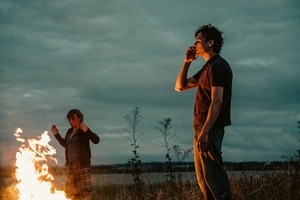
Still from Urchin (2025), directed by Harris Dickinson. Photo: courtesy 1-2 Special
MBHow did the teacher discourage you?
HDI think he was ultimately someone who didn’t want to be teaching seventeen-year-olds. I mean, it got so bad that people in the class would be like, Why is he treating you like that? The thing is, I know for a fact that if I were a teacher and I had a kid in my class who was showing real interest in a subject, like genuine extracurricular vibes, spending all his pocket money on shit, I would give them everything you possibly can think of to make them feel safe, supported, inspired. And he did everything but that. It was the opposite. He blocked me, he put me down, and it made me angry. And ultimately I left college because of it. I didn’t finish the course.
MBI’m sorry.
HDI mean, it was a good excuse anyway to get out. But my mum, she tried to say to me at the time, You can’t just leave. And then it got so bad that she noticed that it was getting to me. But I was also doing running work at the same time while I was at college.
MBLike on sets?
HDOn sets. I was doing some running stuff and some second-assistant camera stuff and assistant stuff. And I was doing some music videos. I was doing some documentary stuff. There was an older guy who would just call me up and be like, Yo, we got a job.
MBBut when you were younger, you were spending your pocket money on cameras and props?
HDYeah.
MBThat’s crazy. You were really dedicated.
HDYeah, I had a job. I’d do the paper round and I worked in a café on the weekends, so I’d just save up. Yeah man, I bought a mic, a little tripod. I just loved it. It was my main thing.
MBI’m glad you came back to it. Okay, so speaking of jobs, you also worked in a hotel kind of like we see in Urchin? Is that right?
HDIt’s the exact hotel we see in Urchin. I was doing night work and morning shifts and auditioning at the same time.
MBSo what led you to want to make this film in particular? Was it capturing the atmosphere that you were around? Was it politics, film influences? Or all of that?
HDI think it was a mix of things. I’d had people close to me who’d been dealing with addiction and I was fascinated by it. Not on a traumatic level, more on a fascination of how advanced we are as people yet ultimately we’re really rudimentary in our design. We fall back into things very, very easily. And then I was working at this place in East London. At the start of the lockdown I didn’t have anything to do and I felt useless.
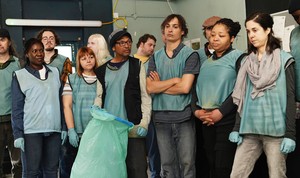
Similarly with a lot of politics—I was engaged politically but I didn’t really know how to make a change. I thought, Okay, perhaps “localized” is a good place to start. And then there was a great organization called Project Parker, run by volunteers. It focused on outreach work with people sleeping rough in London. And then, I dunno, I became quite saddened and energized to want to try and capture that journey a little bit. I tried to pepper in elements that were closer to me, i.e., the hotel and the litter-picking work that I’d done. And it was worlds that were kind of transient. So yeah, it became an interest in trying to capture a story centered around someone who was my age battling against themselves.
Still from Urchin (2025), directed by Harris Dickinson. Photo: courtesy 1-2 Special
MBYou talked about your own experience in those jobs. And something that I’m seeing in some of the reviews is, people don’t understand why these characters keep talking about the meaning of life and those sorts of things. But I wonder if those people have never had dead-end jobs like that, where you just need to fill the time.
HDYeah, yeah. Well, the thing about litter picking is that there’s not a whole lot of nuance to it. You have a task: You have rubbish to collect, and you have to empty the bins. Once your bins are overflowing you have to empty them, refill them, and there’s a simplicity to it. So yeah, I had some amazing conversations when I was doing that kind of work. It opens the mind up to it. Same in a boring hotel, in a boring bar, when nobody is coming in yet.
MBAbout the addiction thing, I’m interested in the part where Mike’s going back to jail and there’s that really abstract scene where we go down the drain; we don’t see his time in jail but we quickly get his isolation and the sort of biological changes of getting clean. It’s such an interesting choice. It made me think of Uncut Gems [2019] and the bullet shot in Performance [1970], these macro scenes. So why that transition?
HDWell, originally there was a section in the script that went into prison and then I got fatigued by it. I was never really interested in that side of it. I think we’ve seen a lot of prison-drama crime-y things in the UK that aren’t necessarily interesting to me. Also, I didn’t know it. Though I went into prisons as part of my research, I haven’t been in prison. So I thought, How do we move through this. There’s an amazing sequence in The Panic in Needle Park [1971] where Al Pacino’s character goes into prison and we just see him shower and then he comes out again, and it implies prison duration and it implies some sense of transformation, but it doesn’t really give the full story. So I was interested to see how far we could push that without it being basic. But I think the supernatural side of it, and—actually, I dunno if it’s supernatural, it’s more like natural matter, right? On a scientific level.
MBYou’re right. It’s not fantasy, it’s not supernatural, it’s super macro, natural. There are lots of beautiful abstract scenes. I know you’re putting together a series of some of the influences on your film at the Roxy Cinema in New York, and one is [Lino Brocka’s] Manila in the Claws of Light [1975]. I could see a lot of similarities—obviously the struggle just to get by in a city, but also the beauty, the sunsets, again the abstract and the beauty of his experience of the city. What was so inspiring about Manila in the Claws of Light?
HDWell, it’s a sprawling urban odyssey, isn’t it. And I really wanted to try to find a way to traverse different worlds with Mike—to meet him, to find our way into his world on the very pragmatic level of the street, very unromantic, very harsh, very uncomplicated in terms of how we see it. And then slowly we get introduced to different characters. And it’s almost like people coming into his world in a fable manner that tests his will, in a way. But Lino Brocka always manages to—in Insiang [1976], in Bona [1980] as well, there are heightened moments but we never really escape from the reality of the story, which I appreciate. And same with an amazing Leos Carax film called The Lovers on the Bridge [1991]. There’s utter magic in it, and it’s still a very severe circumstance for the characters. But that was always part of the conversation: How do we allow levity and beauty into it as well?
MBYou mentioned with the prison stuff, there were things you wanted to stay away from in British cinema. It feels like you’re pushing against some of what we consider British cinema, whether it’s the kitchen-sink realism or the Richard Curtis comedy, but also being in conversation with, say, Ken Loach or Mike Leigh.
HDSure. I mean . . .
MBNo?
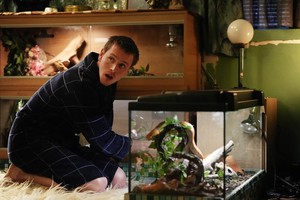
Still from Urchin (2025), directed by Harris Dickinson. Photo: courtesy 1-2 Special
HDYeah, no, for sure. I mean, I have great admiration for Loach specifically, and Mike Leigh too. Mike Leigh’s different because there’s more comedy, it feels like there’s more of an embrace of the absurd in his films. And then even Shane Meadows—there’s a real severity and a harshness to those films that I think is really important for social films and political films. But I mean, I love a lot of American filmmakers as well, and a lot of European filmmakers who are concerned with the truth but they’re not bogged down by it. In Vagabond [1985] Agnès Varda manages to make something with real beauty, too. I don’t think you have to make a film that has weighty or important values or messaging but is heavy-handed with it. I just think we’re kind of past that a bit. We’re in an information-overload time. If you want to get things across, there are ways to do it that can be enjoyable, too, that can come back and almost cut themselves.
But it’s just me. I dunno. It also comes to my sensibility. I can’t define what it is. Of course there’s always a thing when a new filmmaker makes a film and everyone goes, Oh, it’s like this, or it’s like the Safdies [Josh and Benny Safdie]. And it’s like, okay, well, the Safdies didn’t invent long-lens cinematography. The Safdies didn’t invent synth soundscapes; that comes all the way from [John] Carpenter and [John] Cassavetes.
MBYeah.
HDFor me, it goes deeper and is more expansive than that. It’s also about who I’ve been exposed to in my life, the characters and people who have come in and out of my life. I think it’s a result of that, so I always feel reluctant to compare.
MBFair! But you mentioned Cassavetes, who was also an actor. I think I heard that you originally didn’t even want to be in a supporting role in Urchin, is that right?
HDYeah, we had an actor lined up to play Nathan, and then he dropped out around five days before. So it was tricky. We auditioned a few people, then I ultimately just decided to do it because it felt too much to ask of someone to try and understand the world so quickly. I dunno if I’d do it again, but it made sense at the time.
MBWell, you’re so good. I mean, of course, you know the character because you were so deep in it. Would you ever do a Cassavetes? Write, direct, and act?
HDStar in the lead role?
MBYeah, do all three.
HDI don’t think so. No, no, no, I don’t think I could do that. I’ve not got the brain for it. You have to be so switched on. You can’t—you have to have your eye in the back of your head. Even when I was in those small scenes, shit was going bad. I just didn’t have it in me. We had a big fight scene in the square where we’re rolling around on the floor. We had a lot of background supporting artists, and I look back at the footage now and there’s a guy and he’s overacting with his dog or something, and I’m like, fuck, I missed it because I was on the floor. So no, I need to be focused on the monitor with my little tent-hood thing on. So all I can see is the screen.
Miriam Bale is a writer and film programmer based in California.