A Decade of Daring Elegance: Hélène Poulit-Duquesne at Boucheron
As CEO of Boucheron, Hélène Poulit-Duquesne has spent the past ten years revitalizing one of Place Vendôme’s most storied jewelers. With a bold vision rooted in heritage yet unafraid to challenge convention, she has redefined luxury for a new generation, blending physical and digital worlds and placing art and crafts at the heart of the brand. In this conversation she reflects on her journey; the evolving nature of retail; and why emotion, innovation, and human connection remain Boucheron’s greatest jewels.
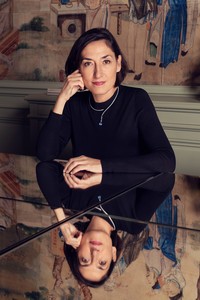
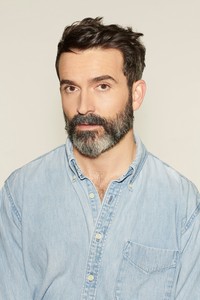
Hélène Poulit-Duquesne, Boucheron CEO
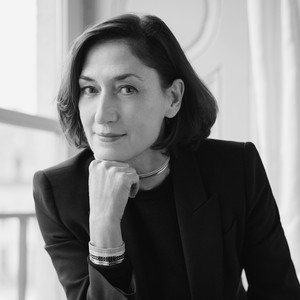
Hélène Poulit-Duquesne, Boucheron CEO
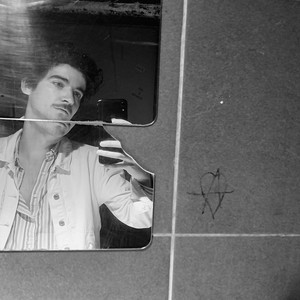
Wyatt Allgeier is a writer and an editor for Gagosian Quarterly. He lives and works in New York City.
Hélène Poulit-Duquesne joined Boucheron as CEO in October 2015, bringing to the role her significant expertise in international development along with an in-depth understanding of the jewelry and watchmaking industries. After graduating from the French business school ESSEC, she began her career at LVMH. In 1998 she moved to Cartier International (Richmond Group), where she was appointed to the executive committee in 2010 as international marketing director.
Wyatt AllgeierIt’s been almost a decade since you began at Boucheron.
Hélène Poulit-DuquesneYes, next month.
WANext month! I’m curious to hear you talk about when you began and what’s changed over the past ten years, whether in your goals or in the industry at large.
HPDWhat’s changed at Boucheron: pretty much everything except the history of the brand, the DNA of the brand. When I joined, many people used to call Boucheron the sleeping beauty of Place Vendôme, meaning that it was totally undamaged in terms of its high-end reputation from the end of the nineteenth century and beginning of the twentieth. So regarding its craft, history, and patrimoine or heritage, it was excellent, but it hadn’t had any investment in the last, I would say, twenty to forty years, when Cartier, Van Cleef, and others were integrated in a group and became big brands. That wasn’t the case at Boucheron. So I had to rethink a lot.
The first thing I did was jump into the archives to understand the heritage of the brand in terms of style. And I was obsessed with stating the differences we found when comparing Boucheron to the competition, because my theory is that if you’re trying to do with the same recipe, the same storytelling, what the big brands have been doing for forty years before you, you’re just running after a dream, you’re never catching up. In terms of heritage, one of the main differences is that we’re a lot more about nature than artifice, at least in terms of what we’ve been showing in recent years. Reading books and newspapers of the time, we also found that Frédéric Boucheron was incredibly innovative—stylistically, technically, and in the way he was doing business.
All of this incredible history was in place, and of course Claire Choisne, our creative director, joined Boucheron before I did and I’d been watching what she was doing with admiration.
WAHer vision is completely singular, brilliant.
HPDWe’re both obsessed with progress, with pushing the boundaries, because the brand already has such a strong history. We’re here for a short time, whereas the brand has been here for more than 160 years. So during our time we just want to have the brand moving as Frédéric Boucheron would have done. We’re following in his footsteps. At the same time, we’re trying our best to shake the industry a little, because it’s very traditional.
WAI saw the High Jewelry collection “Impermanence” in Paris; it’s outstanding, unbelievably sculptural and unorthodox.
Composition n°5 from Boucheron’s “Impermanence” High Jewelry collection
HPDYes, I thought that collection really captured the essence of what we’re doing, because it’s super emotional, a way of telling a story about society.
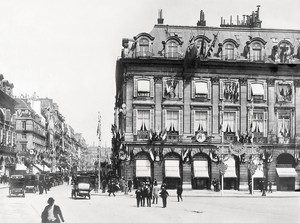
The façade of Boucheron, Hôtel de Nocé, Place Vendôme, Paris, c. 1914
WACould we talk about real estate and retail? Frédéric Boucheron reinvented what a jewelry store looked like, how it could function, isn’t that right?
HPDHe opened in the Place Vendôme in 1893. He first started displaying jewelry vertically in his boutique at the Palais Royal and continued doing so in Vendôme. So what we did was renovate the High Jewelry boutique in Place Vendôme. In fact we renovated the full building: we have the creation studio, then just above we have the atelier, and then we have the boutique. We created a floor of 200 square meters, an apartment where we can launch our collections and even accommodate our guests. It’s a real apartment where people can sleep at night and stay for the full experience inside the room. We did all this at the same time that we created a new international concept for the other stores everywhere in the world. For instance, we’re opening a big flagship in Shanghai by the end of November this year. We have the design frame, and in each boutique you can recognize items that are typical of our concept, but then each one is also different.
WACould you tell me about the High Jewelry clients? What’s their approach to engaging with jewelry and with the space? Have you seen that change?
HPDTwenty years ago, I think jewelry was about buying a product, and today it’s not just about buying, it’s about fitting with the brand and being connected to a full world. That’s why, when e-commerce came, all the journalists were asking, Do you still need the boutiques? I remember saying at the time that the physical space was more important than ever: The more digital a brand becomes, the more physical it has to be. And the physical part has to be a lot more than just a place where you can buy. If you want to buy online in two clicks, you can get whatever you want; by contrast, I want people to feel at home, part of a family, when they enter the world of Boucheron. I decided to mix new furniture and antiques in our boutiques because I truly believe that objects bring their souls. Integrating old pieces with new ones is part of what we’re doing in our home.
WAIt’s how people live. Exactly.
HPDYou have your grandmother’s commode and then you have the new sofa you’re buying. At home, people often have a feeling of mixing generations.
WAThat’s an interesting idea about e-commerce actually making us appreciate being in a space together in person.
HPDAnd even more after COVID. Going to events and meeting people, having a coffee, having a chat, being in the boutique, being in the universe of the brand—it’s becoming crucial.
WAAnd the magic of the physicality of stones, you can’t see it online. You can’t see it in a picture. You can’t feel it in either the literal or the figurative sense.
HPDYou have to feel it! I’m a big stone lover. You have energy in stone. When you buy a colored stone, for example, you need to see it at night, you need to see it in sunlight, you need to see it in northern light—because these different appearances don’t tell the same stories, they don’t have the same color or energy. Physicality is super important for a big stone. Of course you have the certificate, where it comes from, the carat, but the reality is that it has to be—
WALove. An affair of the heart—
HPDLove at first sight, yes.
WAWhat do you see as the most exciting challenges in the years ahead?
HPDSuccess in the United States.
WAWhen did your New York boutique open?
HPDA year ago exactly. It’s our first retail footprint in the US, so it’s a big adventure. When I joined the company I had to make tough choices. The most important one was, I said, We run for Asia first because I know that the return on investment can be quicker there. We did a very good job repositioning the brand in Japan; we entered Korea and have twelve boutiques there; and of course China—we now have seventeen boutiques there. So in the US we’re a little late, but now we have to stick, be consistent, and invest over the next twenty years. It’s going to be a long journey.
WAI noticed in the “Impermanence” collection that pieces were being modeled by men as well as women, and I was curious about High Jewelry for men—I haven’t seen other brands do that. I didn’t know if that was a response to the customer, if there was already a demand, or if it’s about creating that demand?
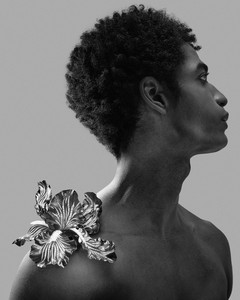
Composition n°3 from Boucheron’s “Impermanence” High Jewelry collection
HPDIn fact we had to stake out this position. It came from Claire. She asked me in 2020, Can I put High Jewelry on men? And I said, Of course. I’d actually been fighting for the last twenty years or so for men to wear jewelry again, which was somewhat the case in Asia. Now it’s more common, but it hadn’t been the case at all in Europe in recent history because of the French Revolution, where we decided to kill the kings. Before the French Revolution you had kings and male nobility wearing diamonds and pearls in many countries—much more so than their wives, in fact. And then because of the revolution all these status symbols disappeared, and men started to only wear a wedding ring and a watch.
WAEveryone wanted to be understated.
HPDExactly. You wouldn’t show that you had money and power as a man anymore. I didn’t understand why, because diamonds and pearls are so beautiful on men. I remember in the company I worked for previously, I was trying to put jewelry on men and even on the top management, and they were reluctant. So when Claire came to me, I said, Of course, yes. When the team came to me asking, Are we going to create collections for men?, though, surprisingly I said, No, not at all. Because at Boucheron it’s not about being a man or a woman, I don’t care; it’s about individuals. We want to help people reveal their personalities, who they are. At Boucheron we say, Never impose, always propose. And that comes from Frédéric. People select pieces to express who they are.
WASince we’re an art title, I’m interested in the role art plays in your life.
HPDI would have loved to be an artist, but my parents thought it wasn’t a career. When I was young I loved to sketch dresses and collect copies of Vogue; I said to myself, I’m going to work in the luxury industry. At that time it wasn’t fashionable at all. I did my business-school degree because my parents wanted me to have a nice diploma. And I said to myself, I’ll work in luxury because at least one part of my passions, which is creativity, will be fueled.
I began at LVMH because I wanted to be close to artists, to brands, to beauty. And when I joined Boucheron I decided we needed to have a link with art. When we were opening in China I said, We can’t enter China with just a selling perspective, because Chinese culture is so deep. We need to create a link through something that’s more about society. So we decided to do a partnership with Yishu 8, an artist residency in China—we created a prize to award young artists from France a residency in Beijing for some months.
WAA dialogue between the cultures.
HPDExactly. Then we selected an art fair for art from the Middle East—the Menart Fair, which takes place in Paris every year—and we’re supporting that fair. Last year it was about women artists in the Middle East, really interesting. Then quite recently we decided to create a prize with Marie Claire magazine and Art Paris, a contemporary art fair in Paris for women artists at an international level.
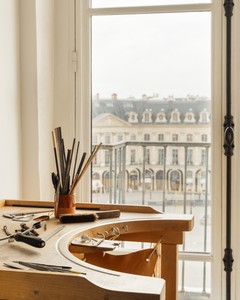
View from the Boucheron workshop, Place Vendôme, Paris
WACould we talk about the role of craftspeople, of artisans? How important is it that everything is still made by hands?
HPDAt Place Vendôme, the studio takes up one floor. So the artisans are working together pretty much every day. I think it’s super important. In the last twenty years, new technologies have been coming to our industry—
WALike rendering software?
HPDYeah, exactly. The artisans were upset at first by the fact that we were using this new technology, as well as 3D printing, which helps us make mock-ups very easily. I remember discussions with the craftspeople, explaining that the more you use technology for low-level tasks, the more you use the hands of the craftspeople for high-value tasks. I think that’s exactly what’s happening today more than ever. It’s like I was saying about digital and physical commerce: The more you use digital, the more the physical is important. The more you use technology, the more human hands and eyes are important. And I think it’s the same for the artificial intelligence coming to our industry: You need the brain of the human to master the beast of the machine.
In terms of innovation, the reason artisans come to Boucheron is generally because they know they’re going to have fun, they’re going to invent new techniques. There’s an increasing scarcity of artisans, so for the last ten years we’ve been supporting a school in Paris, the Haute École de Joaillerie, because you really need to invest in what we call in France filière, meaning the raising of young talented people in an industry. It’s been hard to attract young people, but now the salary is increasing. So we go to see students to explain that if you want to enter this technical field you can have a great life and be nicely paid. Sometimes it’s considered outdated or not intellectual, which couldn’t be less true.
Hélène Poulit-Duquesne joined Boucheron as CEO in October 2015, bringing to the role her significant expertise in international development along with an in-depth understanding of the jewelry and watchmaking industries. After graduating from the French business school ESSEC, she began her career at LVMH. In 1998 she moved to Cartier International (Richmond Group), where she was appointed to the executive committee in 2010 as international marketing director.