The Quarterly’s Derek C. Blasberg talks with scholar and curator Mari Carmen Ramírez about her book and the corresponding exhibition, Frida: The Making of an Icon.
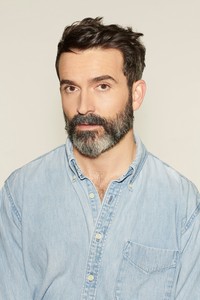
Derek C. Blasberg is a writer, fashion editor, and New York Times best-selling author. He has been with Gagosian since 2014, and is currently the executive editor of Gagosian Quarterly.
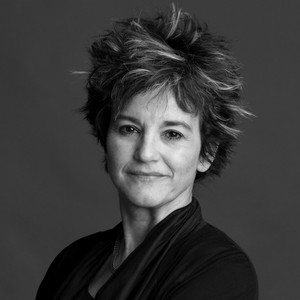
Mari Carmen Ramírez is the Wortham Curator of Latin American Art and founding director of the International Center for the Arts of the Americas (ICAA) at the Museum of Fine Arts, Houston. A globally renowned authority on modern and contemporary Latin American art, Ramírez has published extensively and curated numerous exhibitions, including the award-winning Inverted Utopias: Avant-Garde Art in Latin America (2004, with Héctor Olea); Beatriz González: A Retrospective (with Tobias Ostrander, 2019); Hélio Oiticica: The Body of Color (2006); Contingent Beauty: Contemporary Art from Latin America (2015); and HOME, So Different, So Appealing (with Chon Noriega and Pilar Tompkins, 2017). She has also conceptualized and implemented the ICAA Documents of Latin American and Latino Art Project, a major digital archive and book series focused on primary sources. Photo: Timothy Greenfield-Sanders
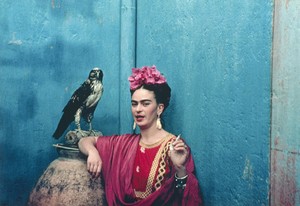
Frida Kahlo wasn’t always Frida Kahlo™—makeup tutorials, merch, Beyoncé’s Halloween costume, the eyebrow industrial complex, dorm-room posters that scream “art history major and a minor in feminist studies.”
When she died in 1954, she had staged remarkably few solo exhibitions—one in New York in 1938 and another in Mexico City in 1953—and was best known as the wife of Diego Rivera.
How did we get from a relatively obscure Mexican artist to an internationally recognized pop-cultural deity?
That’s what scholar and curator Mari Carmen Ramírez set out to answer with her major exhibition Frida: The Making of an Icon, now on view at the Museum of Fine Arts, Houston, through May 17. (From there, it travels to the Tate Modern in London this June.)
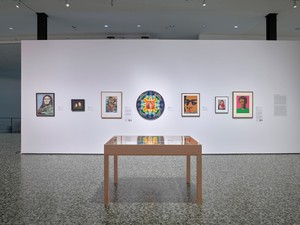
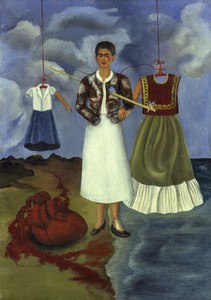
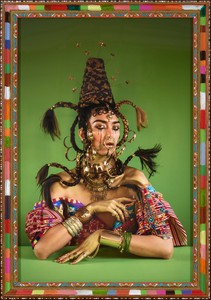
The show features 35 works by Kahlo alongside pieces by artists who have borrowed from, responded to, and sometimes outright appropriated her image—charting the transformation from artist to phenomenon.
Ramírez’s exhibition corresponds with her eponymous book, which approaches Kahlo not just as a painter, but as a cultural construct shaped by politics, feminism, identity, and decades of reinterpretation. It’s the first major scholarly study to tackle Frida as a global icon—and why she still matters now, in our era of personal branding and perfectly curated chaos.
I sat down with Ramírez to talk about separating the artist from the myth, what surprised her most in her research, and why Frida’s relevance has only intensified over the last 70 years.
Derek C. BlasbergIn November 2025, Kahlo’s 1940 painting El sueño (La cama) sold for $54.7 million at Sotheby’s, making it the most expensive artwork by a woman ever auctioned. Do these market milestones help when someone like you is working on a museum show?
Mari Carmen RamírezI wasn’t surprised it went for that much, given all the hype around Frida. But, for me, in terms of the scholarship and the type of issues that I’m interested in with Frida, it’s more of a distraction than anything else.
DCBBecause it puts the work in a more financial than an artistic context?
MCRYes, but also because people tend to focus on that rather than on other aspects that are even more important.
DCBThe argument is that Frida means more than just an auction record.
MCRYes, she’s a phenomenon, much more than just an artist. This is what the exhibition aims to bring to light: what I call the “Fridaphenomenon,” a combination of iconicity, myth, and consumer culture.
DCBIs it accurate to say that your show is the first to approach Frida Kahlo explicitly as a global icon?
MCRThere was an exhibition in 1992 in Mexico City called Pasión por Frida (Passion for Frida) that attempted to do that, but it was too early. Frida became a global icon in the late ’90s and 2000s. That exhibition laid the foundation, but was still too early in the process to assess how global she had become.
DCBWell. What took so long?
MCRFrida is a curious phenomenon because she was not an icon at all during her lifetime. She did not consider herself a professional artist for most of her life, and was always in the shadow of her famous muralist husband, Diego Rivera. She sold only a handful of works. When she died in 1954, she was known primarily to intellectual circles in the United States and in Mexico. It’s not until 1976 and ’77 that the first biographies of Frida Kahlo appear in Mexico, and then, in 1983, Hayden Herrera’s book becomes a smash hit and is translated into many languages. This is when she becomes an icon—a posthumous one. And not just a regular icon; she’s a plural icon, because it coincides with the post-1968 student movement and a new generation of Mexican artists and activists who discovered her in the 1980s and 90s.
DCBThen she goes global?
MCRYes, this happens worldwide. Her prices rise, she gains market presence. But the most important part is how she’s embraced by many social, political, and artistic movements in the 1980s and ’90s. That’s what makes her a global icon.
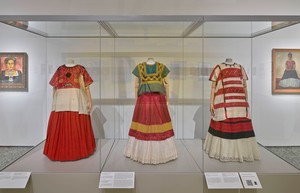
Installation view, Frida: The Making of an Icon, the Museum of Fine Arts, Houston, January 19–May 17, 2026
DCBWas there a specific moment that launched her into this status, and that made her posthumous presence as an icon undeniable?
MCRThe process began in the late ’70s. The amazing thing is that it’s the Chicana/Chicano movement here in the United States that projects her outside of Mexico for the first time. Simultaneously, you have a feminist movement claiming Frida, and you have the LGBTQ movement latching on, too. The Splendors of Mexico exhibition, which took place at the Metropolitan Museum of Art in New York in 1990, is part of a citywide festival that featured nearly 200 exhibitions. The Mexican government and business interests sponsored it—they papered New York City with Frida posters. Frida was on buses. Frida was on billboards. There’s a whole marketing campaign that brings her to people’s households in New York City in 1990. And then around 1992 or ’93, Madonna emerges on the scene with a passion for Frida, and she purchases two famous paintings. Madonna’s contribution is making Frida available to her circle of celebrities, movie stars, and VIPs, and that has real impact.
DCBPeople are sometimes surprised to hear Madonna is well known in the art world for collecting incredibly important works by female artists.
MCRYes, which also contributed to market activity—Frida’s prices continue to rise. All together, these three things—the Met show, Madonna, the art market—start creating a commercialization of Frida. People start wearing T-shirts and bags, and they try to embody Frida. Again, this is what I mean by the “Fridaphenomenon.”
DCBIs this unique to Frida?
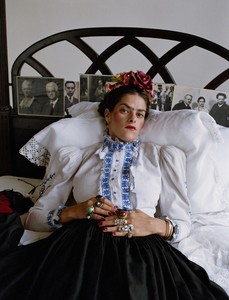
MCRMany artists have had a mass appeal. Think about Picasso, think about Van Gogh, think about Andy Warhol. But none of these artists have sparked what Frida does, in the sense of people wanting to embody Frida, be Frida, dress like Frida. You have Frida look-alike contests—now, seven decades after she died! There’s an emotional connection between Frida and her fans, which you don’t find with other artists. The Frida cult extends to everything. Not just her art, it extends to her persona—her attire, her dress, her accessories, everything.
DCBOne of your book’s central arguments is that Frida participates in constructing her own image. Do you think she was consciously shaping a public persona, or did this icon truly emerge after her death?
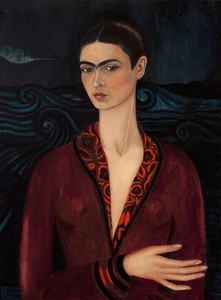
MCRShe was consciously shaping a persona. That’s the argument that [historian Gannit Ankori] sets forth [in her acclaimed biography about Kahlo’s life and legacy] and that I use as a foundation for the exhibition. Part of her appeal, and the way that this plural icon functions, is that she’s able to fashion a multifaceted persona within her lifetime. She was deliberate about how she projected herself—she learned that from her father, who was a photographer, and for whom she would pose. We see Frida the artist, Frida the young woman, Frida the devoted wife. We have Frida the mestiza, Frida the revolutionary, the bisexual woman, the transgressor. She built all of these personalities, and that’s what allows other groups of artists to appropriate her. In many ways, she creates what [Mexican artist] Mónica Meyer considers to be “a template for people to inhabit.”
DCBYou’re drawing a distinction between Frida the historical artist and Frida the phenomenon. What do we misunderstand about her art when these two figures collapse into one?
MCRThe mainstream interpretation is that her paintings illustrate her biography, that everything she painted had to do with something that happened in her life—some tragic event or accident. Or it’s all about Diego. We have to separate that and see her as an artist in her own right. She was a sophisticated painter. She knew a lot about art history and painting. She was not a victim. She was a very resilient woman. That’s what all of these groups of artists captured from her in the 1980s and ’90s.
DCBIs there a version of Frida that feels most faithful to the historical legacy?
MCRIt’s impossible to pin her down to a single identity, which she rejected. That’s one of the ways icons operate in our society. Icons are mediated by the time in which they operate and the communities to which they’re responding and that are responding to them. Frida is whatever we want Frida to be.
DCBYou have clothing, photographs, and ephemera in the exhibition. Tell me a little bit about the items that are included in the show.
MCRWe have dresses from the Museo Kahlo. We have jewelry, photographs, and some personal objects. These things all reveal aspects of her personality. People want to see these objects, relate to them, and imagine Frida wearing them.
Installation view, Frida: The Making of an Icon, the Museum of Fine Arts, Houston, January 19–May 17, 2026
DCBI remember I once saw one of her artificial legs at her museum in Mexico City.
MCRYes, we have one of her artificial legs. We have shoes and corsets. We’re very grateful to the Museo Dolores Olmedo[, Mexico City], which has lent us about fourteen works from its collection, one of the most important collections of Frida Kahlo in the world. They made it possible for the core group of very important paintings, such as My Nurse and I [1937], to be in the show.
DCBDuring your research, did you uncover anything that genuinely shocked you?
MCRWhen I started this process four years ago, I thought I was going to be doing a historical exhibition focused on 1970–2000, thinking Frida was a phenomenon frozen in time. I was shocked to see how relevant and topical Frida continued to be, and the number of artists after 2000 who had taken off her legacy, including disabled artists. That was a genuine surprise.
DCBFrida famously rejected the label “Surrealist,” insisting that she painted her own reality. Does your work reframe her place within art movements?
MCRIn the exhibition, there’s a section called “Surreal Affinities” that seeks to reframe her contentious relationship with André Breton and the Surrealists. People have tried to peg her as a surrealist, but as you said, she rejected that classification. At one point, she claims that she didn’t know anything about surrealism, but that’s not true either. So, we tried to reframe her. Frida is one case where it’s very difficult to classify her within any of the existing movements. She was basically self-taught and drew from many different sources, including the Renaissance and Baroque periods. It’s a futile exercise to try to determine whether she’s a surrealist, a realist, a folk artist, or whatever the classification is. She’s a phenomenon unto herself.
DCBHer physical suffering is central to her mythology. How have you attended to her relationship with pain or physical suffering in her mythology?
MCRWe have a section in the show that features the accident as a preamble to some of the disabled artists we showcase. We deal with it in terms of her resilience to pain, but we don’t delve very much into it. We’re trying to get away from that whole mythic aspect of her, and this notion that Frida was a victim. I’m more comfortable highlighting her political profile, which is often ignored in favor of her pain. She’s seen as a victim when in reality she was a left-leaning, politically involved individual. She was a Stalinist at the end of her life!
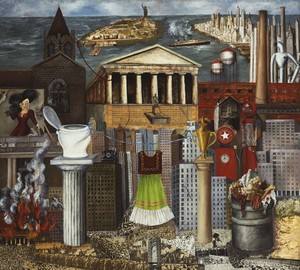
MCRShe was committed to the notion of revolution. She had affairs with Leon Trotsky. She was friends with André Breton, who put art at the service of the revolution. She was married to Rivera, who was a founding member of the Mexican Communist Party. She was a political animal! And she was very critical of the United States for its capitalist tendencies—that’s all in her paintings. But people don’t talk about those aspects of her.
DCBIt’s amusing to think about her as a communist, as her auction records and her paintings are acquired by people who are winners of a game of capitalism.
MCRYes. Well, it’s a great irony of her myth.
DCBPeople often talk about her bisexuality. How do you think those qualities of hers have been minimized, misunderstood, or even sensationalized over time?
MCRThat’s what these groups, like the gay movement, have picked up. They identify with her bisexuality and her transgressive attitude toward sex and gender. They’ve recovered that aspect of her, rather than the victim. They don’t want to hear about the victim. They want to hear about the woman who was defying all sexual and moral codes.
DCBShe’s often cited as an inspirational figure. Do you think Frida would have considered herself an inspirational figure?
MCRI think so. She wanted to do good by people, and she would have enjoyed being a role model for them.
DCBIn the history of art and popular culture, Frida has emerged as a figure of far greater significance than Rivera. However, in their lives, Rivera had bigger commissions and exhibitions in the US, and Frida didn’t. What do you think she’d make of that?
MCRShe probably wouldn’t believe it. She was in absolute awe of him all her life. She was devoted to him, even though they fought, divorced, then made up and fought again. And she was very dependent on him for emotional support.
DCBWhat do you consider the best tribute to the legacy of Frida Kahlo?
MCRCasa Azul, [literally “The Blue House,” Kahlo’s former home in Coyoacán, Mexico City, and today it’s one of the most visited artist museums in the world]. That’s the best way to get to know Frida. Seeing her bed, her library, her kitchen, everything that was hers. Her library is very fascinating, and her collection of folk art and dolls. It gives you a real sense of who she was.
Frida is whatever we want frida to be.
Mari Carmen Ramírez
DCBYou worked on this for four years. How do you feel now, at the other end of this project?
MCRWhen I started this project, I thought people would be fed up with Frida, and nobody would want to know anything more about her. It’s just the opposite.
DCBYou weren’t always a fan of the Fridaphenomenon, were you?
MCRI have a particular history with this because I was in Mexico City as a doctoral student in 1983 when Hayden Herrera’s biography of Frida came out. I was part of that first wave of a new generation rediscovering Frida. And obviously, I was very enthusiastic about it. I had my poster, my biographies. I was a complete Frida fan, trying to indoctrinate other people about Frida. But then, when I came back to the States and started my career as a curator of Latin American art, I realized what a drawback Frida was, because by then she had become a stereotype. Promoted by the market, she had become a cliché for the entire continent. I would take people around what is now the Blanton Museum in Austin to see the collection of mostly South American art, and they would tell me, “Oh, this is not Latin American art.” I would say, “What authority do you have to tell me that?” And they would say, “Because it’s not Frida.” Frida is the exception, and not the rule! In 1990, I wrote “Beyond the Fantastic,” an essay that has been published many times and is still used as a text in many art history classes. I was denouncing the Frida stereotype, which made me the ipso facto president of the Anti-Frida Kahlo Club. For many years, people associated me with anti-Frida Kahlo positions because we had to take those positions to advance the agenda of Latin American art in the United States—we could not do it with Frida representing all of Latin America! But that doesn’t mean I didn’t appreciate her art and what she stood for. This exhibition and book have given me a broader, more in-depth understanding of her real impact and legacy.
DCBYou loved her, you hated her, you loved her—it was a complicated experience for you! I think Frida would appreciate that.
MCRBut it’s an advantageous position because it gives me a critical edge. I can see this more objectively than most Frida scholars.
DCBI want to think she would be happy to know that someone is both a fan and also annoyed by her legacy.
MCRBut I’m not annoyed by her legacy. Her legacy is fantastic. I’m annoyed by what she’s become because of the market and all these other non-artistic interests. I’m annoyed at what she has become in terms of being a commodity.
DCBIt’s a sort of shadow of her legacy?
MCRYes, a shadow. But, what’s interesting is that we did an informal survey amongst the 50 living artists in the exhibition where we asked them, point-blank, if they were still interested in Frida after all the commodification, and how they felt about what she had become. Ninety percent of them said that Frida was Frida despite any commodification. What she stands for in terms of resilience, hybridity, syncretism, forward views, progressive views, gender identity—it all continues beyond her commodification. People can make that distinction.
DCBEveryone knows Frida Kahlo.
MCROne thing I have been struck by is how emotional the relationship remains. Whether it’s my hairstylist, the guard at the museum, or the woman who sells the tickets, they all have an emotional response when you mention Frida. Some people cry! There’s a real emotional connection to that, which you cannot overestimate. Intellectuals and progressives have a way of looking down upon that kind of phenomenon as being kind of populist, or the fact that you have to disengage the intellectual part from the commercial. In Frida, it goes together. You can’t separate them.
Derek C. Blasberg is a writer, fashion editor, and New York Times best-selling author. He has been with Gagosian since 2014, and is currently the executive editor of Gagosian Quarterly.
Mari Carmen Ramírez is the Wortham Curator of Latin American Art and founding director of the International Center for the Arts of the Americas (ICAA) at the Museum of Fine Arts, Houston. A globally renowned authority on modern and contemporary Latin American art, Ramírez has published extensively and curated numerous exhibitions, including the award-winning Inverted Utopias: Avant-Garde Art in Latin America (2004, with Héctor Olea); Beatriz González: A Retrospective (with Tobias Ostrander, 2019); Hélio Oiticica: The Body of Color (2006); Contingent Beauty: Contemporary Art from Latin America (2015); and HOME, So Different, So Appealing (with Chon Noriega and Pilar Tompkins, 2017). She has also conceptualized and implemented the ICAA Documents of Latin American and Latino Art Project, a major digital archive and book series focused on primary sources. Photo: Timothy Greenfield-Sanders