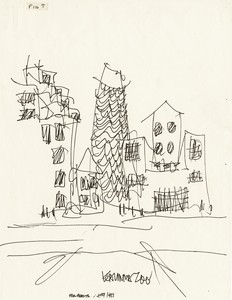
Frank Gehry: Fish Lamps
Paul Goldberger traces the history of the fish form throughout Frank Gehry’s career.
Spring 2026 Issue
Deborah McLeod, senior director at Gagosian, Beverly Hills, reflects on the generous and innovative vision of Frank Gehry. Having worked with the architect and artist for more than a decade, McLeod addresses his outsize impact on the city of Los Angeles and the world beyond.
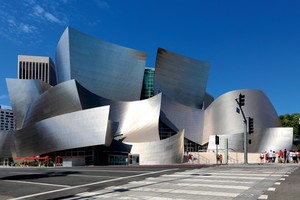
The Walt Disney Concert Hall, Los Angeles, 2017. Architect: Gehry Partners, LLP, and Frank O. Gehry. Photo: Raymond Boyd/Getty Images
The Walt Disney Concert Hall, Los Angeles, 2017. Architect: Gehry Partners, LLP, and Frank O. Gehry. Photo: Raymond Boyd/Getty Images
Frank Gehry was beating the clock and he wanted more time. He had so much to do, and his vision for the future of his adopted hometown Los Angeles—and of the world—was vibrant. This is how his optimism in these dark times prevailed; he was on a mission to transcend the known and to create architecture that was art, alive not inert, capable of inspiring joy and uniting us in awe. His calendar was packed: the opening of the Guggenheim Abu Dhabi next year, the 2028 Olympics in LA, and the realization of his ambitious LA River Master Plan, which is to bring art centers, public parks, and civic amenities to our underserved communities, transforming our city. Frank was so much a part of the fabric of LA, and for so long, that his loss seems to have knocked out our center of gravity. We are wobbling now, without our generous and daring visionary, our international icon, our teacher, our irrepressible agent of change for the good. He was the best of us and our vital GPS beacon.
As one of the most inventive and radical architects of the ages, Frank was consumed with his practice. His close family and deep friendships brought balance and joy. So did his extracurriculars: Frank played in a men’s hockey league until he was in his late seventies, he was an avid sailor, and he was deeply passionate about music. A teacher throughout his life, in 2014 he and Malissa Shriver cofounded Turnaround Arts California to bring art to low-performing elementary and middle school children in the state. He was a prince.
Among Frank’s happiest and most rewarding pursuits outside of architecture was his sculpture practice. He thought like an artist, his friends were nearly all artists and musicians, and he was in heaven creating art for art’s sake, with only himself to serve and satisfy. I had the supreme privilege of working with Frank in this regard at Gagosian for thirteen years.
Frank meant so much to our gallery, especially in Los Angeles, and he remains a pillar of our formidable artist roster. He was a giant, a radical deconstructor and inventor, like Pablo Picasso. Larry and Frank had a robust forty-year friendship and Larry tracked Frank’s practice closely, including his design work. Frank began to make furniture in the late 1960s and Fish and Snake Lamps in the early 1980s, when he participated in a Formica Corporation contest to show off its new laminate. Frank worked with Tomas Osinski, an artist, trusted craftsman, and friend, to help realize the lamps. In 1983 this resulted in the first Frank Gehry Fish Lamps, and they were exhibited at Gagosian in Los Angeles the following year.
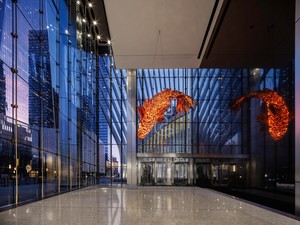
Frank Gehry, Untitled (Fish on Fire, Greenwich Street), 2024, copper and steel wire, 84 × 86 ¼ × 243 inches (213.4 × 219.1 × 617.2 cm), installation view, 3 World Trade Center, New York © Frank O. Gehry. Photo: Lasky Films, courtesy Silverstein Properties
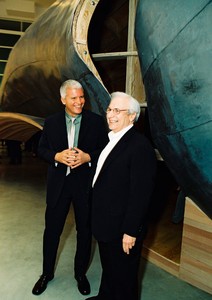
Larry Gagosian and Frank Gehry at the opening of Frank Gehry: A Study, Gagosian, Beverly Hills, March 18–May 1, 1999. Photo: Bei/Shutterstock
The lamps were a watershed for Frank, who had been fascinated by the elegance and dynamism of the fish form for decades but now saw it as an architectural blueprint. He said he recognized “a complete vocabulary that I can draw from” and he never looked back. That first group of Fish Lamps—approximately two dozen—were acquired by luminaries including Agnes Gund, Jasper Johns, Philip Johnson, Victoria Newhouse, and Marcia Weisman. Frank kept good company.
In 2012, the magnificent Frank Gehry–designed Fondation Louis Vuitton was under construction in Paris, and Larry had the good idea of making an exhibition of Frank’s beloved vintage Fish Lamp sculptures in our Paris gallery, which had opened just a year prior. “Paris loves Frank,” Larry had said. I made the call to Frank, he agreed to the show, and I set about locating the lamps we hoped to borrow. The next time I spoke to Frank, I took a flyer and asked if he would consider making a small edition of new Fish Lamps so that we would have something to sell in this exhibition of loaned works. Frank said he would think about it. The next day he said, “I have an idea.” You are very lucky if Frank Gehry has ever said this to you.
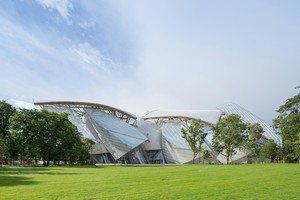
Fondation Louis Vuitton, Paris. Architect: Gehry Partners, LLP, and Frank O. Gehry. Photo: Iwan Baan, 2014
Frank’s architectural language was the same language he spoke every day. One of love, joy, and compassion. Frank’s emotional and symphonic architecture captured and radiated all of that. Each of his buildings is a self-portrait.
Frank had started to conceive of an entirely new body of Fish Lamp sculptures for Paris. The forms were more dynamic, some hanging from the ceiling, some diving, tails up, as big as men. Frank was so exhilarated that the show doubled and we presented this new work in both Paris and Los Angeles in concurrent shows in 2013. I was thrilled: Not only were we getting two shows of new work, but Frank Gehry was about to execute an architectural intervention in our Beverly Hills gallery. Dear Diary! Larry was thrilled too. Frank’s design was an amazement, with intimate darkened rooms to give the magical glowing lamps maximum effect. Immersive installations are common now but Frank was ahead of the curve, and we had lines around the block.
Frank’s art and architecture make you feel your humanity, and this was his intention. Fifty years ago, he wept when he stood in front of the classical Greek bronze Charioteer of Delphi: He had the charged realization that inert material sculpted by an unknown artist in the fifth century BCE could touch him with profound emotional impact across millennia. This became Frank’s North Star principle for his architecture.
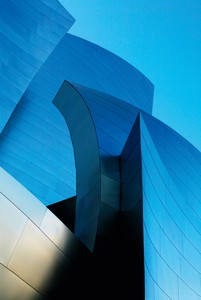
The Walt Disney Concert Hall, Los Angeles, 2003. Architect: Gehry Partners, LLP, and Frank O. Gehry. Photo: Ted Soqui/Corbis via Getty Images
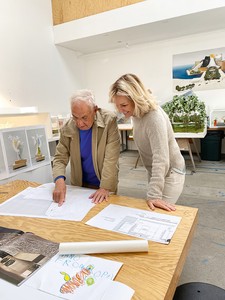
Frank Gehry and Deborah McLeod
Frank was this way in person too. He was warm and put people at ease by telling stories that were funny and usually self-effacing. His mind sparkled and his thinking was fresh. Frank said, “If I knew where I was going, I wouldn’t take the project.”
Frank’s architectural language was the same language he spoke every day. One of love, joy, and compassion. Frank’s emotional and symphonic architecture captured and radiated all of that. Each of his buildings is a self-portrait. The world will miss Frank Gehry terribly, and in LA it will be a sharper pain. Frank said he wanted his buildings to provide comfort. We shall look for it there.
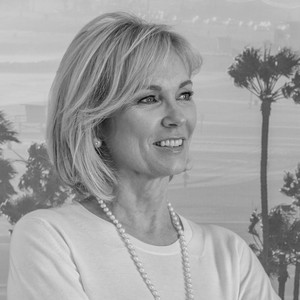
Deborah McLeod is a senior director at Gagosian, having joined the gallery as director of the Beverly Hills outpost in December 2005. In 2009 she oversaw the Richard Meier–designed expansion of the Beverly Hills gallery, doubling the footprint and adding an outdoor exhibition space. With an emphasis on both primary- and secondary-market sales, she oversees gallery operations, the exhibition program, and client service. She works closely with gallery artists Theaster Gates, the Frank Gehry Estate, and the Chris Burden Estate.
Paul Goldberger traces the history of the fish form throughout Frank Gehry’s career.
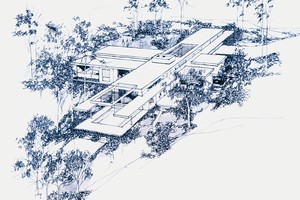
Frank Gehry speaks to Jean-Louis Cohen about the early years of his practice, including his work with LA artists, and the role of sketching in his design process. The first volume of the catalogue raisonné of the architect’s drawings, edited by Cohen, was published by Cahiers d’Art earlier this year.
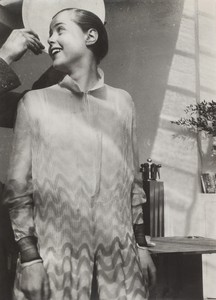
Inspired by a visit to the Fondation Louis Vuitton’s exhibition Charlotte Perriand: Inventing a New World, William Middleton explores the life of this modernist pioneer and her impact on the worlds of design, art, and architecture.
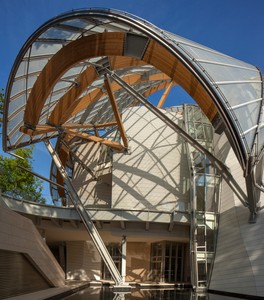
Frank Gehry discusses the Fondation Louis Vuitton with Derek Blasberg.
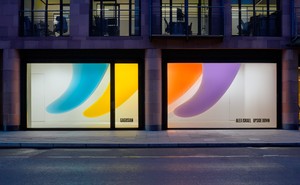
Ahead of Alex Israel’s exhibition of four new Fin sculptures at Gagosian, London, the artist spoke with Susan Casey, author of The Wave: In Pursuit of the Rogues, Freaks, and Giants of the Ocean (2010), about the ocean, surfing, and Los Angeles.
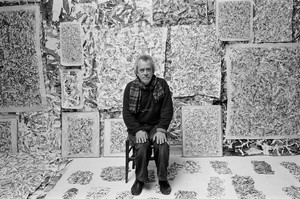
On July 9, Simon Hantaï: the last studio opens at Gagosian, Gstaad. Curated by Anne Baldassari, the show comprises sixteen of the artist’s dernier atelier (last studio) paintings of 1982–85. The exhibition is accompanied by an illustrated catalogue, copublished by Gagosian and Skira, which features an essay by Baldassari and an extensive portfolio of previously unpublished photographs by Édouard Boubat. Here, we share the introductory chapter from the publication.

Adam D. Weinberg has been working with Giuseppe Penone on an exhibition of the artist’s new sculptures, The Reflection of Bronze, that opens at Gagosian, New York, on April 22. The works explore the character and possibilities of bronze. Here, Weinberg considers Penone’s enduring engagement with the alloy and addresses the conceptual underpinnings of the exhibition’s three-room structure.
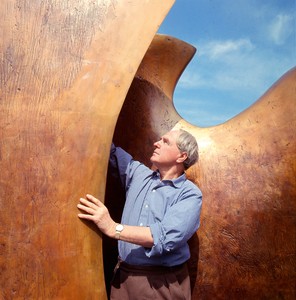
Laura Bruni writes about a major exhibition celebrating the work of the British sculptor Henry Moore at the Royal Botanic Gardens, Kew, London.
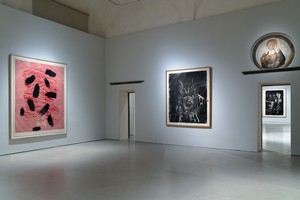
On the occasion of Baselitz: AVANTI! at the Museo Novecento in Florence, Italy, Holly EJ Black considers the roots and reverberations of Georg Baselitz’s printmaking.
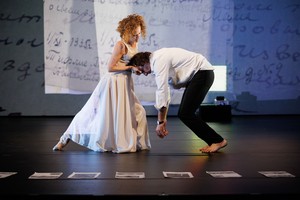
Mark Franko considers how Emily Coates resurrects the spirit of George Balanchine’s American beginnings through archival research, spoken dialogue, and movement in her performance Tell Me Where It Comes From.

Carlos Valladares wades through the discourse around the musician and actress Charli XCX’s mockumentary, guiding us through its myriad references, from the Spice Girls to Andy Warhol.
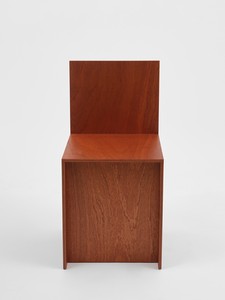
From the perspectives of their respective fields, three international cultural figures—artist and designer Ronan Bouroullec, fashion visionary Michèle Lamy, and chef and restaurateur Enrique Olvera—reflect on Donald Judd’s work in furniture, the subject of recent exhibitions in South Korea and Japan.