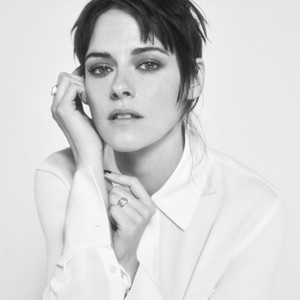
Kristen Stewart is an actress who was nominated for an Academy Award for her portrayal of Princess Diana in Pablo Larraín’s film Spencer (2021). In 2015 she became the first American actress to be awarded a César Award in the Best Supporting Actress category for her role in Olivier Assayas’s Clouds of Sils Maria, in which she starred alongside Juliette Binoche. Stewart recently starred in Rose Glass’s film Love Lies Bleeding, which premiered at the 2024 Sundance Film Festival and was released widely in March 2024. The first film she directed, the experimental short Come Swim, premiered at the 2017 Sundance Film Festival.
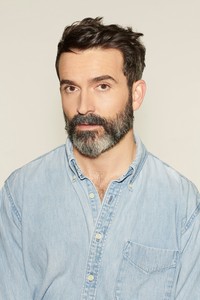
Mike Stinavage is a writer and waste specialist from Michigan. During his political science masters program at CUNY Graduate Center he was awarded Fulbright and Martin Kriesberg fellowships to research the politics of waste in northern Spain. He currently lives in France.
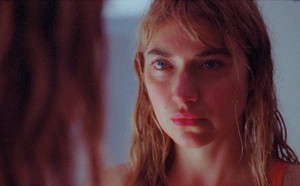
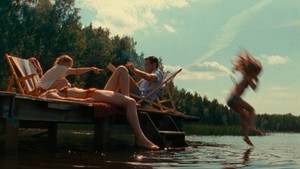
In September, the town of Deauville, a coastal enclave of Normandy, France, goes from blue, white, and red to red, white, and blue for the Deauville American Film Festival. Among this year’s special guests was Kristen Stewart, whose directorial debut, The Chronology of Water, won the Revelation Prize, having premiered in the spring at Cannes. Some weeks later, Stewart and I caught up to talk about the film, which she adapted from Lidia Yuknavitch’s 2011 memoir of the same name. In it, Lidia, played masterfully by Imogen Poots, flails and flounders and appeals poetically to the human condition.
Mike StinavageOkay, let’s see how much ground we can cover in the time we have.
Kristen StewartReady, set, go! Let’s cover all the fucking ground.
MSLet’s do this. I was really taken by The Chronology of Water, which I saw at the Deauville Film Festival. It was a highlight for me. I’d be curious to hear you talk a little bit about the festival: Were the American flags everywhere as jarring to you as they were to me?
KSYou know how your phone gives you memories? I recently saw a picture that I don’t necessarily remember taking, being like [sticks up middle finger] right under the flags. I was taken fully aback, though not by their presence, because that’s obvious, it’s an American film festival that takes place in France. But my reaction to the scale of that image wasn’t a positive one. It was irksome.
MSFor me, too—the quantity of flags hanging from every surface at the festival site and in the town.
KSIt’s just too associated now with people who are like [yells] beating their fucking chests.
MSDuring the festival Q&A, you mentioned there were a lot of people who doubted the movie, which as I understand took a long time—maybe a decade—to make. Could you talk a little bit about the doubts you heard about, and which of those doubts were most unsettling for you?
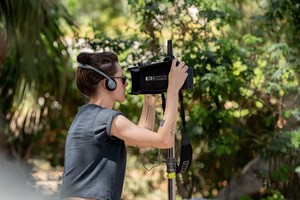
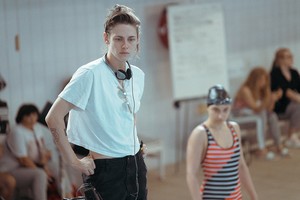
Kristen Stewart on the set of The Chronology of Water, Malta, 2024. Photo: Mark Cassar
KSSuperloaded question because there are so many ways to answer this. The reason I really wanted this to be my first film is because it’s about expression itself, and despite it being hyperspecific [to Lidia Yuknavitch], considering it’s a memoir, it’s the whole notion that you can rewrite your life, and that is kind of everyone. The book is so inviting that Lidia almost goes away as a character and you sort of fill in atmospheric blanks, despite being dragged through the hyperspecifics of this one woman’s life. When you reduce it to a synopsis, it sounds a lot like stories we’ve heard before. It sounds like hell. It sounds so much smaller than what the book gives you.
As a filmmaker, I can’t imagine ever wanting to examine anything from the outside. I really am interested in interior life and how people see things versus what they see. I knew that if I had Imogen, and if I followed my instincts and meandered through intuition, there was no way I’d be wrong. You can’t fail if you’re coming from a very pure place.
The film took eight years because I had to figure out the grammar. I think I was able to make something specific while not reducing it to terms inherently designed to belittle the female experience. The words that are given to us to define ourselves are bullshit, so we have to break the back of them and make them ours. That’s what the movie’s about. It’s not about the fact that Lidia got abused by her father and turned to drugs and swimming and then finally had a baby. That frames the plot and her life, but really the book is about this atmosphere of trespass and repossessing the body through words and art and pain. This breaks through to a place of joy in an undulating and frustrating and unexpectedly shaped way, which leaves people on the edge of their seats and sometimes falling through completely. It’s like a train that slows down and speeds up when you don’t expect it.
MSThe deep conviction really came through, that’s for sure.
KSI just answered probably three of your questions in one because I’ve just been ticker taping.
MSNot a worry—the most interesting thing is to hear you speak freely about the film. I will say that I can imagine the elevator pitch for this film being difficult because of the nuance, the tone, and the cuts to different images where we see Poots’s character go through all the different kinds of waves. To your last point, you very successfully take us not only to the edge of but over the guardrails of typical filmmaking and typical narrative. Did you ever have vertigo about going over those guardrails, and tackling such commendable but very difficult topics of the human condition?
KSI’ve been watching some really tough material lately. On the set, we kind of looked away from the most abhorrent human tendencies in the movie and renarrativized them. And there’s something miraculous-feeling about it, like something holy and cool. There’s very little hyperrealism. It’s all a rendering. The film feels like it’s from her perspective, so you’ll encounter striking images and you don’t always know what happens before or after an experience; often she’ll be talking to you about it as you’re watching it, or it will be in montage. It’s sort of like how you remember life. I’ve said this before, but I wanted it to feel like a DMT trip that you suddenly woke up from and wrote one final sentence.
When I was on set, I wasn’t afraid of going over. I just wanted to make sure we stayed in a place where I wasn’t thinking about how people were watching it from the outside. It really needed to feel like it had its own little body that had eyes. And you can’t look everywhere at once; that makes you so fucking focused on the touch of something, the color of something, how hot something feels. The tone of her voice in any given moment is so much more important than knowing where she is in her life. You just feel that her mother is a ghost in the film. This kind of recollection feels so much truer to being a human than “And then this happened and then this happened and then this happened.” Also, if we showed you all the shit that happens to Lidia in an objective way, no one would be able to watch this movie.
The movie’s fun to watch even though on paper, yes, it’s hard. I also think it’s like a Rorschach inkblot test: People come out of the screenings sometimes and are like, “Oh wow, that was like really tough for me.” And then some chick will come out and be like, [sigh], “God that felt so good.”
MSWhen tackling these concepts of grief and addiction, especially with someone as talented as Imogen Poots as the protagonist, it’s easy to think of grief and addiction as somehow romantic, as something beautiful. Yet in reality we know that it’s not. The lived experience is brutal. Do you think there’s a danger there, in the representation of grief and addiction onscreen as romanticized?
Kristen Stewart on the set of The Chronology of Water. Photo: courtesy The Forge
KSWhen morality is taken into art, it creates a scenario where you’re looking at yourself from the outside, which is really the antithesis of everything that I think is pure in art. And there are sensory representations and sort of slippery slopes that have undeniable momentum and exhilaration and a lot of euphoria baked into their release. When I was younger, that was what I fixated on. I definitely didn’t think about the shitty repercussions. I’m thinking of Sophie Gilbert’s book Girl on Girl: How Pop Culture Turned a Generation of Women Against Themselves [2025]. And there could be an entire other meditation on how we’ve been turned into addicts, too—I was raised on [the Cheech and Chong film] Up in Smoke [1978] and on every fucking bong-pulling and red-cup party, all of those. But I think we show hell in our representation of drugs and alcohol in the movie. You turn to them because of the voids in yourself and you try to fill them, but you just gouge them out even deeper, and then filling them back up again becomes almost impossible. I mean, it’s like a death drive—Lidia’s on such an unbelievable death drive. And you can see it from the beginning. But at the same time, it would be so silly to deny that it’s also fun as fuck.
MSIt gives a certain color and vivaciousness to life, the ups and downs. It’s easy to internalize, almost unknowingly, a life-is-a-wonderful-shitstorm mentality from the things we watch.
On a different note, I wanted to ask you about your future directorial plans. As I understand it, you’re thinking about both directing and acting in the film. What are the risks and rewards associated with having both roles?
KSPeople have, I think, defined what those roles are, and what the public expects of and projects onto actors—their sort of servitude because of the rarefied and incredible positions that they’re in, because everyone wants to be in the movies and make a lot of money and have attention. And directors are these sort of visionary, mysterious Wizards of Oz who fill a position of power resembling teachers, church leaders, fathers. It’s like this authoritarian role that is revered. But my actors have everything to do with the storytelling and with the realization of every dream. It’s not a big deal to get in front of the camera and do a couple of scenes. I’m an actor; I’ve been doing it since I was nine years old. I just think we need to blow the smoke away from having the roles of both actor and director. It’s not a huge deal. I have one foot in it and one foot out at all times. As an actor, I don’t need to be blind to the process, don’t need to lose all sense of self in order to be a conduit for someone else’s perspective, to be filled with the spirit of the director’s notions, the mouthpiece for someone else’s ideas. Are you fucking kidding me? We’re doing this together. We are literally mirrors of each other and if we’re lucky we share space and have overlapping ideas that find their way into the movie.
MSIt’s admirable to hear about your filmmaking process and imagine such collaboration taking place both in front of and behind the camera, without a Queen of Sheba on high directing everyone into place. What future directing projects are you taking on?
KSI’m writing three movies right now and I have a feeling that one of them, which is the most buoyant one, and the one I’ve been thinking about for the least amount of time, is going to be my next one. I want to shoot it in LA. Have you seen [Mona Fastvold’s film] The Testament of Ann Lee [2025]?
MSNo, not yet. Should I?
KSIt’s incredible. I was talking to Mona about structure. A huge aspect of what my movie ultimately wants to be about—even though it’s currently still in gestation—is breaking down barriers and acknowledging them and finding new bodies and shapes. Every movie has its own body and its own kind of process. I’d like to make a movie about that. I’m meditating on how to create a bespoke process, and not having that be something you say just in interviews but actually thinking every day how to get closer to people and further away from imposed, controlling, fucking dead narratives. It’s like—I wish I could tell you more, but I actually shouldn’t [laughs].
Kristen Stewart is an actress who was nominated for an Academy Award for her portrayal of Princess Diana in Pablo Larraín’s film Spencer (2021). In 2015 she became the first American actress to be awarded a César Award in the Best Supporting Actress category for her role in Olivier Assayas’s Clouds of Sils Maria, in which she starred alongside Juliette Binoche. Stewart recently starred in Rose Glass’s film Love Lies Bleeding, which premiered at the 2024 Sundance Film Festival and was released widely in March 2024. The first film she directed, the experimental short Come Swim, premiered at the 2017 Sundance Film Festival.
Mike Stinavage is a writer and waste specialist from Michigan. During his political science masters program at CUNY Graduate Center he was awarded Fulbright and Martin Kriesberg fellowships to research the politics of waste in northern Spain. He currently lives in France.