On the occasion of Andrea Fraser’s exhibition at the Fondazione Antonio Dalle Nogare in Bolzano, Italy, Mike Stinavage speaks with the feminist performance artist about institutions and their discontents.
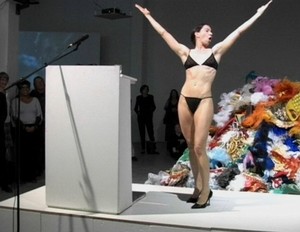
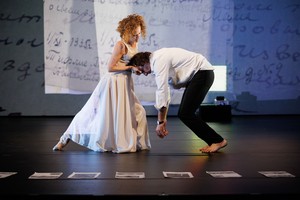
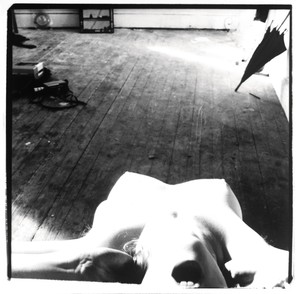
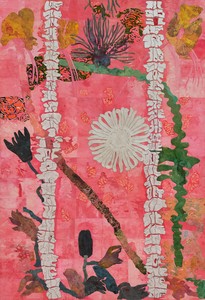
Andrea Fraser, Official Welcome, 2001–03, Collection M HKA/Flemish Community. Photo: M HKA/clinckx
Andrea Fraser, Official Welcome, 2001–03, Collection M HKA/Flemish Community. Photo: M HKA/clinckx
Mike Stinavage is a writer and waste specialist from Michigan. During his political science masters program at CUNY Graduate Center he was awarded Fulbright and Martin Kriesberg fellowships to research the politics of waste in northern Spain. He currently lives in France.
A quivering, shaky voice is interrupted by upbraiding speech, bellows, schmoozy art world lingo, and stripping: pieces like Andrea Fraser’s Official Welcome (2001) are not for the faint of heart. And yet, her performance resonates—the battle of controlling and contorting one’s acute discomfort is memorable due to its familiarity. Hence I can easily recall my first encounter with Fraser’s work, at her retrospective at the Museu d’Art Contemporani de Barcelona (MACBA) in 2016.
Since the late 1980s, Fraser has created pieces that provoke and probe the art establishment. We met recently over video call, ahead of a new survey of her work related to collectors, collecting, collections, and the art market, to discuss the perennial topic of arts institutions and their pervasive influence. The exhibition, «I just don’t like eggs!». Andrea Fraser on collectors, collecting, collections, opened in April at the Fondazione Antonio Dalle Nogare in Bolzano, Italy.
In the second half of the twentieth century, institutional critique began with a group of conceptual artists who explored the internal biases of the art world. The artists in those early days—among them Michael Asher, Marcel Broodthaers, Daniel Buren, and Hans Haacke—called attention to the controversies and the ethical implications of museums and gallery spaces. Hans Haacke’s MoMA Poll (1970), for example, asks the audience to weigh in on politician and magnate Nelson Rockefeller’s position on the MoMA board.
Fraser, a leading artist in the second wave of institutional critique, notes the influence of those earlier artists: “I’ve identified as a post-studio artist for a long time. I associate post-studio artists with Michael Asher, who taught a class at Cal-Arts for years called Post Studio.”
For Fraser, the artist’s studio—like discourse, finances, organizations, and events such as galas and openings—is a relational site worthy of interrogation. Institutions, she argues, are internalized by the people participating in the field of art, influencing the ways that we interact with the world. Throughout her career, Fraser has embodied or investigated various roles, including museum visitor, gallerist, docent, artist, art commodity, art collector, art historian, and donor—sometimes a dozen or more at once. In Official Welcome (2001), for example, Fraser performed as sixteen different art-world personas in a speech delivered to members of the MICA Foundation.
For more than a decade, Fraser has also taught as a tenured professor at University of California, Los Angeles (UCLA).
“You know,” she says, “I’m an art professor. So that’s why I’m so wordy.” As is evident, her work has struck a chord in both arts and academic institutions.
In many ways, then, Fraser is the art world. The tension therein is how an institutional critic has evolved and continues to evolve while wrapped in an institutional embrace.
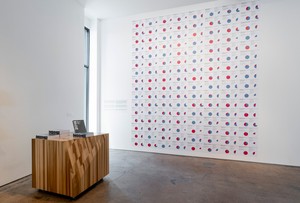
Andrea Fraser, 2016 in Museums, Money and Politics, 2018, vinyl; installation view, SITElines.2018: Casa tomada, Santa Fe, New Mexico, 2018. Photo: Eric Swanson
One particular line of interest for Fraser is how participants in the field of art are seduced by the authority of its institutions and led to reproduce its value structure and ideals. Years after performing as the museum docent Jane Castleton in Museum Highlights: A Gallery Talk (1989), Fraser entered the Guggenheim Bilbao as a rogue museum visitor for the video Little Frank and His Carp (2001). Holding an audio guide to her ear, the museum visitor is wooed by its smart and sensual descriptions of the building: “These curving surfaces have a direct appeal, which has nothing to do with age or class or education. It gives the building its warmth, its welcoming feel. And in this way, the atrium tries to make you feel at home and prepares you for the purpose of the building: the art it contains.”
Incidentally, Fraser had not traveled to Bilbao to create this performance specifically, but rather to approach arts institutions from a different vantage point: she and her collaborators were developing a Basque television sitcom set in a museum and based on the Guggenheim Bilbao.
Between laughs, she described the sitcom:
The key characters were a museum guide, of course, a young woman who gave tours of the museum; a man who was an art handler and also an artist, [who] was making sort of subversive interventions in the museum; and then someone who worked in the restaurant.
In one of the episodes, there was a work of the Virgin Mary. Something about the artwork was seen as blasphemous and offended the Catholic community, who then were demonstrating at the museum. But then a miracle was attributed to the sculpture. It went from being an object of protest . . . to being an object of pilgrimage. And then they stole the sculpture.
In the end, without suitable writers, the sitcom did not take off. “The characters I created just immediately got reduced to stereotypes, ridiculous sort of offensive stereotypes.”
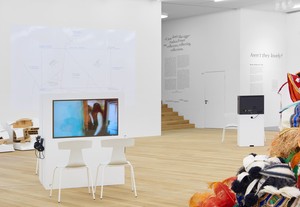
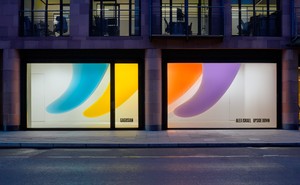
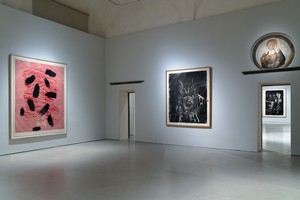
Installation view, «I just don’t like eggs!». Andrea Fraser on collectors, collecting, collections, Fondazione Antonio Dalle Nogare, Bolzano, Italy, April 13, 2024–February 22, 2025. Photo: Jürgen Eheim
Humor and absurdity result naturally from rupturing the self-seriousness of the art world, as seen recently in the pranks and parodies embedded in Ruben Östlund’s film The Square (2017) and in “Waiting for the Artist,” an episode from the television series Documentary Now (2019). In Fraser’s work, the humor is not the contemptuous, snarky kind, however, but something far more nuanced:
Regarding pranks: that gets into what I sometimes call the “Jackass school of performance art.” I think of pranks as an adolescent form of critique that have limited value.
Parodies were an influential idea for me in the ’80s, but I’ve spent a good part of the past thirty years trying to distance myself from interpretations of my work as parody. Parody is an emotionally facile form of critique that distances and simplifies what is usually a much more complex relationship to the object. The way that Museum Highlights gets written about is a case in point. It is often written about as a parody of volunteer docents and the silly or crazy things they say about art. There are often pretty misogynist undertones to that interpretation. In fact, the script is quoted from museum publications and public reports, invariably in those days written by men. I never considered it parody. To consider it parody is a way of distancing or disowning our own implication in those discourses and practices.
Though parodies have been left in the past, Fraser’s ongoing focus on institutional critique spans to the present day.
I sometimes say that if it doesn’t make me acutely anxious it’s not worth doing. And that it is rooted in a kind of psychoanalytic idea. The point where you need to make an interpretation or an intervention is the point of acute anxiety.
Just as artists must undergo a complicit or explicit agreement with the institution of art to gain entrance, we all, as Sigmund Freud explains in Civilization and Its Discontents (1930), must abide by a similar contract to enjoy the protections of civilization. To live among others in a shared environment, conventions govern our everyday actions. Obeying these social norms is key, and taming our uncouth aspirations and curbing our undesirable or aggressive tendencies is part of the process. Freud writes: “Each one of us behaves in some one respect like a paranoic, corrects some aspect of the world which is unbearable to him by the construction of a wish and introduces this delusion into reality.”1
“Actually, that’s not one of the texts by Freud that I’ve read recently, or that I think about so much,” Fraser said when we spoke. She turned the camera to show her bookshelves. “But you know, it’s on my list of something that I have to go back to. Wait, where is it?”
For a moment she searched the shelves in vain, then finally held the book in front of the camera. “Wow, I inherited this from my sister, and she read it in October 1981. I probably got it from her not long after that, actually.”
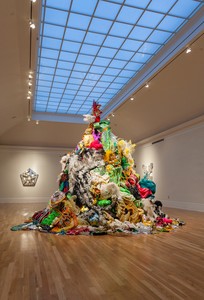
Installation view, Andrea Fraser, Um Monumento às Fantasias Descartadas (A Monument to Discarded Fantasies), 2003, mixed media (Brazilian carnival costumes), New Orleans International Art Festival, Prospect.3, New Orleans, 2014–2015. Photo: courtesy the artist and Galerie Nagel Draxler Berlin–Cologne–Munich
When we, consciously or not, embody an institution, a brand, a rigid identity, an agenda, we inevitably reject, trash, repress, or suppress other parts of the self. Just as rules of civilization may feel constraining, does Fraser feel restricted by the role or labels attributed to her by the art world?
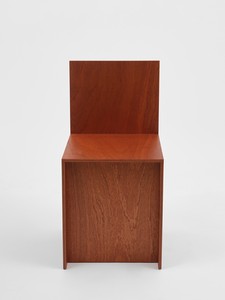
I think those are my own constraints that I’ve placed on myself. Sometimes I regret that I used to really like to paint and draw, and I stopped, you know, thirty years ago. . . . I do really like to make things. I make furniture for myself. I actually got back into a ceramic studio recently after I don’t know how long.
Outside of institutional critique, she has a reputation, too, for dance. Samba, to be specific.
I’ve spent a lot of time in Brazil. That started in 1998, when I was in the Bienal in São Paulo. I sort of fell in love with samba. So that is something that I do when I go to Brazil. I will go out and samba, not every night, but three or four times a week. I know where all the samba schools rehearse for Carnival.
One of Fraser’s only sculptures, a centerpiece in the MACBA retrospective soon to be on view in Bolzano, is a pile of Carnival costumes with the Portuguese title Um Monumento às Fantasias Descartadas (A Monument to Discarded Fantasies) (2003). The word fantasia, Fraser tells me, has a double meaning, both “costume” and “fantasy.”
In the MACBA exhibition brochure, Fraser wrote, “At the end of the festivities, many of these glamorous costume items, once animated by individuals, become disposable identities that litter the streets.”
Toward the end of our conversation, Fraser noted her interest in rereading Civilization and Its Discontents. “One of the things that I’m starting to look at now, which I think probably will be my next project, is the psychology of authoritarianism and authoritarian impulses.”
1 Freud , S. 1930. “Civilization and Its Discontents”. The Standard Edition. W.W. Norton & Company, Inc.
Mike Stinavage is a writer and waste specialist from Michigan. During his political science masters program at CUNY Graduate Center he was awarded Fulbright and Martin Kriesberg fellowships to research the politics of waste in northern Spain. He currently lives in France.