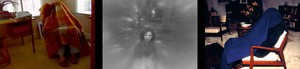
Michael Cary explores the history behind, and power within, Nan Goldin’s video triptych Sisters, Saints, Sibyls. The work will be on view at the former Welsh chapel at 83 Charing Cross Road, London, as part of Gagosian Open, from May 30 to June 23, 2024.
Michael Cary organizes exhibitions for Gagosian, including thirteen Picasso exhibitions in collaboration with John Richardson and members of the Picasso family. He joined Gagosian in 2008 after six years working with the late Kynaston McShine, then chief curator at large at the Museum of Modern Art, New York. Photo: Clive Smith
When Nan Goldin’s older sister Barbara was a teenager, she would go to the movies to make out with boys. Most teenagers do that at some point, a rite of passage for young Americans, skirting parental surveillance, testing maturity, flirting with dirty, exciting feelings in the dark. In that darkened space beneath projected images, we surrender something. Cinema is subversive: it can touch us in ways that feel almost indecent. And filmmakers are tricksters, lulling us and seducing us with images, sound, and narrative so we don’t see their sucker punch of subtext approaching.
Goldin begins her film Sisters, Saints, Sibyls (2004–22) with a religious myth, the story of Saint Barbara. This does two things: it teaches us how to read what we are about to watch and indicates that unbelief may be a part of the equation. The film is presented as a three-channel projection—a triptych, the classical narrative form of religious painting. In this opening gambit, Goldin invites us to interpret and infer narrative from the still images of paintings, like the slides in an art history lecture, time-traveling from the Byzantine through the Renaissance, as the saint’s story is told in voice-over. Saint Barbara was locked away by her father to preserve her virginity, she secretly converted to Christianity in defiance of her pagan parent’s beliefs and was tortured and executed because of it. The story is meant to serve as a lesson to believers—the lesson of an exemplary life which you should strive to emulate, knowing full well that you will be unable to, ensuring guilt and shame. This is not simply an introductory analogy to the real subject of Goldin’s film, but instruction on how to read the visual narrative Goldin sets forth.
America at mid-century: pious, prosperous, patriotic, proper. It’s a common trope in the United States to hark back to a simpler, better time, a time of conservative moral character and father knows best. Nostalgia is fantasy, of course; the 1950s weren’t a better time for Black folks, or for women. It wasn’t a better time for anyone who stepped out of line, for lefties, free spirits, homosexuals. In fact, looking back from the twenty-first century, it wasn’t the deviants who were the dark side of the ’50s, it was the perception and persecution of deviancy that in hindsight cast a shameful shadow across that era. The flip side of all that conformity was a straining at the reins that gave rise to the full flowering of psychoanalysis in America. It became de rigueur and the rage to turn to the headshrinkers to explain society’s ills. We put everyone from veterans to criminals to Marilyn Monroe on the couch, and we were awash in bennies and Valium to get us through.
Barbara Holly Goldin reached the age of twelve in 1958. That was when the “trouble” between mother and daughter really began. Mother sent Barbara to a psychiatric detention center to fix her, to solve her. Barbara was in and out of facilities for the next six years, and Goldin presents us with the receipts: “Acting out, open defiance, sexually provocative behavior, association with undesirable friends, loud and coarse in speech”—all things a good girl shouldn’t be. Barbara went on dates with an older Black man. One psychiatric report states that she appeared to be confused about her sexual identity and that she described being attracted to other girls. Barbara appeared awkward and ungainly and refused to shave her legs. She stirred up a perfect storm of middle-class, mid-century fears: race, deviant sexuality, failed femininity.
At about the time Barbara ran away and escaped her first confinement, Joseph L. Mankiewicz’s film of Tennessee Williams’s play Suddenly, Last Summer (1959) was released: Kate Hepburn, Monty Clift, and Liz Taylor, with a screenplay by Williams and Gore Vidal—another perfect storm. In the film, a family matriarch (Hepburn) implores a doctor (Clift) to have her niece (Taylor) institutionalized—to have her lobotomized, cutting out of her brain a vicious story that she won’t stop repeating. The offending story tells of an event “last summer” that exposed evidence of the homosexuality of the matriarch’s late son. The film dramatizes the panic surrounding behavior deemed unacceptable, unthinkable, and a mother’s hysterical inability to live with the ordinary, ungovernable truth.
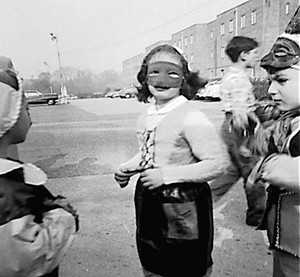
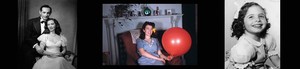
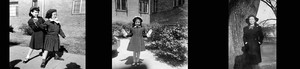
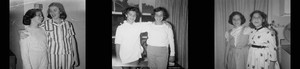
The truth is important to Goldin and she finds it by riding the waves of subtext, expertly calibrating the tension between what we see and what we hear: happy snapshots from a family album accompanying voice-overs reading the psychologists’ sober reports on Barbara’s condition; girls’ rooms in psychiatric wards, with happy, colorful bedspreads and a scrapbook titled “Joyful Memories,” accompanied by a soundtrack of a patient sobbing and negotiating with a caregiver; exterior shots of a lovely suburban home accompanied by Barbara’s “mother” screaming insults like slut and whore.
It was in that home that Barbara and Nan grew up, in “the banality and deadening grip of suburbia.” Barbara was the elder sister by seven years, and Nan idolized her. Nan had a front-row seat to the “trouble” in that home: distant father, hysterical mother, the physical and psychic abuse that Barbara suffered, the effort to keep up appearances, hiding from the neighbors what was really going on. Goldin reads in voice-over from another doctor’s report: “There is much evidence that it is not Miss Goldin who should be in the hospital, it’s Mrs. Goldin.”
The sibyls were prophetesses in ancient Greece, oracles of fate. They were the voices that revealed the subtext of a life. Barbara tells Nan that if Nan stays in that home, the psychiatrists say she will end up like her sister.
Barbara died by suicide in 1965, at the age of eighteen. Goldin revisits the scene of her death, framing the footage from Barbara’s perspective: on train tracks, a speeding Amtrak fast approaching, then roaring by. We hear a contemporaneous report of the suicide read aloud, but the images we see were shot recently. We imagine the historical event with the voice-over as our guide, but we also imagine Goldin’s presence at that site, what it must feel like for her. We see a shot of a figure walking through trees, presumably near the train tracks. Is that Nan? She is there, but not necessarily behind the camera; she is not there alone. She’s there with us. We witness her witnessing.
Barbara’s suicide was a defining event in Nan’s life and prompted her to escape that home. The remainder of Sisters, Saints, Sibyls describes her trajectory in the aftermath—how the events in that suburban crucible affected her life. Nan rebelled, ran away, and found her own tribe of fellow rebels; “I wanna be evil, I wanna spit tacks.” We see familiar characters we know from Nan’s life: David, Brian, Cookie. She shows us the banality and deadening grip of addiction and her own journey of confinement in rehab. From the outside, Nan’s hospital looks like privilege, like a stately English manor, a stark contrast to the bleak bureaucratic facilities where Barbara was treated. But on the inside we see Nan’s self-inflicted wounds and the bars on the windows, an interior reality that the neighbors don’t see.
So much of Goldin’s work is a kind of archaeology, reconstructing a historical milieu for us. We both see and imagine her in those spaces, at that time, not as documentarian but as participant. As a filmmaker, this is doubly so—not only is she a participant in historical events but we see her in the film examining those places in the present, in “reel” time, with us. Seeing Nan change and age through the film emphasizes what Barbara missed out on; she didn’t get the chance to mature, to grow older and wiser, to realize a life for herself. Nan did, and Barbara missed that too. But with living comes not only maturity, joy, ecstasy, and change but loss, pain, addiction. Trouble. It reminds us that living is brave, no matter how it turns out.
For the Gagosian Open presentation of Sisters, Saints, Sibyls, Goldin chose the site of the former Welsh chapel, a deconsecrated church in the center of Soho, London. A triptych in a church: a natural home. Goldin’s first presentation of the film was in 2004, in the chapel of the Hôpital de la Salpêtrière, Paris, during the Festival d’automne. Salpêtrière was founded in 1656 as an asylum for poor women struggling with mental illness. In his book Madness and Civilization, Michel Foucault describes the seventeenth-century origins of the “philanthropic” confining of “madness” to hospitals such as this one: “From the very start, one thing is clear: the Hôpital General is not a medical establishment. It is, rather, a sort of semijudicial structure, an administrative entity which, along with the already constituted powers, and outside of the courts, decides, judges, and executes. . . . A quasi-absolute sovereignty, jurisdiction without appeal, a writ of execution against which nothing can prevail.” The hôpital was an institution designed not to treat and care for women but to confine, discipline, and punish them. Salpêtrière is also, of course, where Foucault himself died young, in 1984, from complications of aids, the disease so intimately entwined with the love that dare not speak its name. A disease surrounded by the silence of shame. Goldin’s life work has always been about addressing shame, diffusing it, renouncing it, refusing it. Attacking the powers that try to shame. Showing that shaming itself is shameful.
Goldin says that as a teen she suffered from crippling shyness: “My sister’s suicide silenced me.” Photography was the outlet that allowed her to “walk through fear—taking a picture was kind-of protective.” It was through photographing her friends that she connected with them, and it’s through her photographs that she connects with us.
Sisters, Saints, Sibyls reminds us how lucky we are to be alive in the time of Nan Goldin. She is an archivist, constantly updating and revising her works, adding to them, altering them, and with each new work we feel we’ve been with her for decades. “Nan” is an artist whose work is so raw and honest that we feel we know her like a friend. Goldin is the journeyman, the maker of the experiences that allow us to know Nan. We imagine how Nan feels because we read it on her face, and we can read it on her face because Goldin has so skillfully arranged for us to do so. It’s an oeuvre of extraordinary generosity and empathy, though neither Nan nor Goldin wears her heart on her sleeve. Sisters, Saints, Sibyls is a film as intimate as a diary, as deep as an archive, as hopeful as a prayer.
How do you make a life-affirming film about suicide, abuse, addiction, and constraint?
You look at the truth. Life ain’t pretty, but it is beautiful.
Michael Cary organizes exhibitions for Gagosian, including thirteen Picasso exhibitions in collaboration with John Richardson and members of the Picasso family. He joined Gagosian in 2008 after six years working with the late Kynaston McShine, then chief curator at large at the Museum of Modern Art, New York. Photo: Clive Smith