Christian House reports on Paris’s American Library, a storied collection of English-language books in the French capital, tracking its evolution and enduring role in a cosmopolitan literary milieu from World War I to the present day.
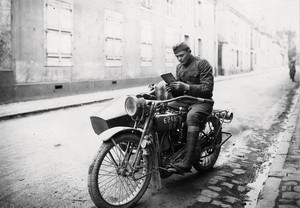
Soldier reading a book in Le Mans, France, 1919. Photo: American Library Association
Soldier reading a book in Le Mans, France, 1919. Photo: American Library Association
Christian House worked as a proposals writer at Sotheby’s for a decade before a period as an obituarist for the Telegraph. He now writes on visual arts, literature, and history for publications such as the Financial Times, Canvas, and CNN Style.
The invitation to the ceremony for the American Library in Paris Book Award arrives with a footwear warning. The event is held in the Hôtel de Talleyrand, an opulent eighteenth-century residence, overlooking the place de la Concorde, that was once the nerve center of the postwar Marshall Plan. The problem is its exquisite parquet flooring: Wear flats. There have been slip-ups. The warning is fitting: The American Library in Paris has been creating safe spaces for readers for more than a century.
This private lending library opened in 1920 and is today situated just over the Seine from the Hôtel de Talleyrand at 10 rue du Général Camou, an oddly quiet side street near the Eiffel Tower. This unassuming building is a citadel of free speech and a refuge for bibliophiles of all nationalities: It is the largest English-language lending library in continental Europe, with a print collection of over 100,000 volumes and some 5,000 members. Yet it remains unknown to most visitors to the city and indeed to many Parisians.
I’m in Paris to attend the award presentation and discover more about an establishment brimming with knowledge but somewhat shrouded in mystery. What I discover is an unlikely tale of pioneering librarianship, experimental literature, wartime resistance, and shadowy spies. It is also a story of community.
During its fledgling days in the 1920s and ’30s, the American Library was the haunt of diplomats, professors, and journalists, as well as local children sitting down to story hour. And then there were the avant-garde cultural figures: Gertrude Stein and Ernest Hemingway perused the library’s stacks and wrote for its literary journal, Ex-Libris.
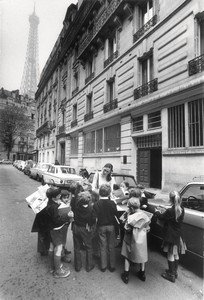
The American Library in Paris, 10 rue du Général Camou, Paris, 1975
The Hôtel de Talleyrand reception hails this year’s award winner while also marking the departure of Audrey Chapuis, the library’s director for the past seven years. On the eve of her return to the United States to become president of the Tampa Bay History Center, in Tampa, Florida, she considers the library’s unique place in Parisian culture—and in her own life. “When I was seventeen, I wanted to come and find writers and thinkers and artists who wanted to sit around and talk about the meaning of life. And that actually exists here, it’s a true thing. And it’s vital, vibrant, and continuously relevant,” says Chapuis, talking to me in her office deep in the library’s lower ground floor. As with so many Americans, Chapuis’s romantic idea of literary Paris was informed by the current incarnation of Shakespeare & Company, the Left Bank bookshop that is a popular tourist haunt. “And then I discovered the American Library when I moved here. I said: ‘Oh, no, this is the real deal.’”
The members assembled for the award are a debonair lot. I talk to a number of lawyers. The men’s tailoring is discreet while the women are a riot of scarves. One senses the presence of Patek Philippes. The award is to be presented to the British biographer Sue Prideaux for her Wild Thing: A Life of Paul Gauguin (W. W. Norton), which debunks many of the tawdry myths surrounding the French painter. Prideaux has a talent for unpicking the tangled psychology of complicated characters—her previous subjects have included Edvard Munch, Friedrich Nietzsche, and August Strindberg.
Prideaux’s study of Gauguin has already won Britain’s Duff Cooper Prize, but the library award, which celebrates works of literature that draw on France for their inspiration, is particularly welcome: “Libraries have meant so much to me all my life, from when I was a little girl sitting on a library floor reading Beatrix Potter fairy tales,” notes Prideaux. “It’s like being given a present from all the books. The wonderful thing about a library like this one is that you can just wander about—it’s like the best sweet shop in the world, you never know what you’re going to pull off a shelf.”
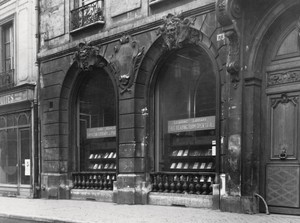
The former Left Bank branch, located only a few blocks from the Sorbonne at 173 boulevard Saint-Germain, Paris, 1948
The library was born of war. Its motto is “Atrum post bellum, ex libris lux”—“After the darkness of war, the light of books”—and its bookplate features a book lying open on top of a rifle and sword, with the dawn sun breaking in the background. When the United States entered World War I in 1917, the US Library War Service sent out a nationwide call for books to send to soldiers heading overseas. “The slogan of the Library War Service was ‘one book for every soldier.’ Two and a half million books were eventually shipped to Europe in just over a year,” notes Mayanne Wright, a Paris-based American writer of textbooks who sidelines as the library’s docent archivist, providing history talks to visitors and scouring Paris flea markets for ephemera relating to the period when the institution was founded.
Talking me through the library’s history, Wright explains that its seed was sown at the end of World War I, when some of the books sent to France became its nascent collection. Meanwhile, an information revolution was underway in France. “The first literary agency [the William A. Bradley Literary Agency] was founded in Paris in the 1920s. They published everybody who’s anybody in the Lost Generation of the avant-garde—people who couldn’t get published, like James Joyce, Henry Miller, later on James Baldwin. And the man who founded that agency was involved with the library. He was on our fundraising team.”
The library had several homes, including its original spot overlooking the gardens of the Élysée Palace, before it settled into its current premises in 1964. Free to all (although a borrowing card cost ten francs), it was innovative from the beginning. There were readings by French literary luminaries such as André Gide and Colette. The children’s reading room—which today includes a dedicated mezzanine for teenagers—was particularly pioneering: “American influence basically brought children’s librarianship to France,” says Wright. “We were the first one to open a dedicated children’s department. That was in 1920. We’ve never had anyone call into question a book that a kid would read.”
But there have been dramas. Amazingly, the library remained open during World War II. Some staff fled the German Occupation, others were interned. One was shot by the Gestapo for not raising his hands fast enough during a surprise inspection. Another librarian, Freddie Hawkins, had a French mother and a British father (Eric Hawkins, managing editor of the Paris Herald). “Being bicultural and bilingual, Freddie was approached by the British spy services,” says Wright. “We have the reports from the British government. He was a really bad spy. He only went on three missions because he wrote poor reports and had a hot temper.”
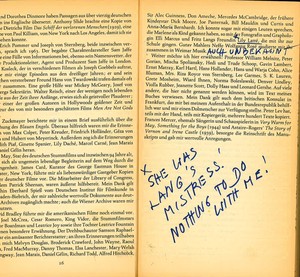
Annotated volume from the personal library of Marlene Dietrich, now owned by the American Library in Paris
Rumors of spies in the library swirl through its corridors. Dorothy Reeder, its director in the early 1940s, was said to be a spook. “The 1950s census has her back in Washington, DC, and she’s listed as an analyst in Intelligence,” says Wright.
In the postwar years the library continued to be used by celebrated writers, including Mary McCarthy, Art Buchwald, and Samuel Beckett. And over the subsequent decades it built a marvelous collection. It doesn’t have a first folio by Shakespeare or a dazzling medieval book of hours; there’s no priceless copy of John James Audubon’s Birds of America. What it does have, notes Wright, is a unique group of early Paris phone books; books owned by screen actress Olivia de Havilland, who served on the library’s board; part of Sylvia Beach’s collection from the original Shakespeare and Co.; and volumes from the library of Marlene Dietrich, some of them annotated. “She was quite the scoffer,” says Wright. “Many of the notes are written in red.”
In the twenty-first century the library has become much more than a depository of books. “We are a kind of free port for intellectuals,” says Rachel Donadio, its curator of cultural programs. “The library exists outside the logic of the market, outside the French cultural establishment, outside the United States, and this gives us real freedom.”
The library’s current “Ways of Seeing” program showcases links between literature and visual art. Speakers have included the author Michael Pollan, on psychedelics; Sarah Burns and David McMahon, on their and Ken Burns’s documentary about Leonardo da Vinci; and curators Lynn Gumpert and Sophie Eloy, who discussed their exhibition at the Orangerie on the spirited fin-de-siècle Paris art dealer Berthe Weill. And there have been recent talks by novelists such as Jhumpa Lahiri and Rachel Cusk. “Writers understand the soul of the library,” says Chapuis, adding that the institution has a duty to platform all voices: “I assume that something might come down the pipe that would give us pause, but it hasn’t yet.” What would the library’s stance be on a controversial figure such as Jordan Peterson, the psychologist and bestselling author of 12 Rules for Life (2018)? “If we had Jordan Peterson, we would put him in conversation with someone who would ask the right questions,” says Chapuis. “We want to have a library with books on the shelves, which means that there will be books with opinions we don’t agree with.”
The library expands its mission through the de Groot Visiting Fellowship, which supports writers, scholars, and other thinkers who advance cross-cultural dialogue, and a Cultural Fellowship that allows authors space and time to work on a project. The current Cultural Fellow is Molly Ringwald, the American actress and author of both fiction and nonfiction. “Having a dedicated place where I go for an extended period of time was truly transformative for my process,” says Ringwald, who is working on a memoir of her time living in Paris during the 1990s. “I think that libraries are useful for everyone—actors, writers, students—or anyone who could use a break from the endless media cycle of catastrophe online. Looking to the past for instruction, inspiration, and solace is just some of what libraries have offered me.”
For its members, the library also offers a hub that is lively yet familiar. “While as expats we are all in search of the exotic international experience, there’s comfort too in finding a bolt-hole filled with like-minded individuals whose values feel comfortable and require no translation. Such is the feeling you get as an American upon entering the American Library in Paris,” says Laura Wenke, an American marketing executive who has lived in the city for many years. “The intellectual horsepower I find here is the icing on the cake.”
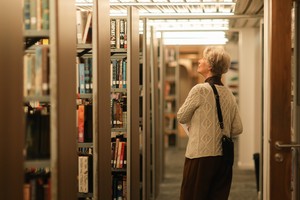
Inside the American Library in Paris
Spending time with the librarians and friends of the library, one gets the sense that they see the institution as a retreat from febrile politics, siloed thinking, and the speed and jarring nature of modern life. Few view the library as a sanctuary quite as much as Maisie Fieschi, its chief of staff. Fieschi was raised as a reader: Her mother is the celebrated Australian children’s author Ursula Dubosarsky. Within a year of arriving in Paris in 2012, Fieschi, then an editor in her twenties, had met her future husband, Simon, a French social media manager. In an essay written for an anthology, The Gifts of Reading for the Next Generation (2025), Fieschi recalled how tragedy struck several years later: “Our Parisian life unfolded like every clichéd Audrey Hepburn film—until 7 January 2015. Simon was the second person shot during the attack on the Charlie Hebdo offices. The satirical cartoon magazine was targeted by Al-Qaeda militants who wanted to silence its writers and deny readers their freedom of choice.” Nearly a decade of intensive medical care and rehabilitation, legal fights, and media attention followed. In 2024, Simon Fieschi died as a result of his injuries.
By then, Maisie had discovered the American Library. She was a reader, then a volunteer, before joining its permanent team. “It was a choice: I wanted and needed to be among books,” she writes. “Joining the Library, the world opened up to me again, just as it had in my childhood, wandering through my mother’s book collection. Once a week, I would retreat to its shelves, indulging in solitary afternoons among the stacks, surrounded by books curated by generations of librarians I would never meet. In those moments, I was simply myself—free of political labels, free of the burdens of victimhood, free of Charlie Hebdo. The American Library was my personal refuge, and it revitalized me.”
The morning after the book award I meet Sue Prideaux for breakfast in a café near the place Vendôme. She is keen to celebrate the institution that has celebrated her.
“The library has an incredibly dedicated and united team that is driven by its belief in the scholarship that drives the institution,” Prideaux tells me. “Their feeling of the importance of their cog in the Enlightenment wheel, which gives meaning to their lives, reminds me of my dear Nietzsche: ‘If you have a why, you will always find a how.’ From the conversations I had, it was strikingly evident they had their why.”
Photos: courtesy American Library in Paris, unless otherwise noted
Christian House worked as a proposals writer at Sotheby’s for a decade before a period as an obituarist for the Telegraph. He now writes on visual arts, literature, and history for publications such as the Financial Times, Canvas, and CNN Style.