For the fortieth anniversary of Nan Goldin’s genre-defining photobook The Ballad of Sexual Dependency (Aperture, 1986), Gagosian, London, will be exhibiting all of its 126 photographs, the first time the entire body of work will be shown in the United Kingdom. To celebrate the occasion, David Velasco looks back to the series’ creation and evolution, considering the radical exploration of seeing and love at the core of The Ballad.
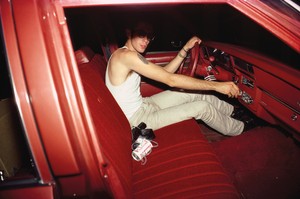
Nan Goldin, Mark in the red car, Lexington, Mass., 1979
Nan Goldin, Mark in the red car, Lexington, Mass., 1979
David Velasco is a writer based in New York. From 2005 to 2023 he was an editor at Artforum and was editor in chief for the final six of those years. He is the recipient of a Literary Award from the Lannan Foundation (2024) and of fellowships from MacDowell (2025) and Denniston Hill (2025).
I watch The Ballad of Sexual Dependency because I need to see how she sees the world. Nan Goldin has, for many decades now, submitted her seeing and so our seeing to a continuous evolution. She does this, I think, by trying to see with the eyes of others, by pairing her sight with that of those often effaced or mangled by the common world of images. Another word for this is empathy, though this is a small word, a word too often contained to individual feelings to properly describe such a vast and transformative adventure of the spirit.
The world moves through her vision. She sees, then we see, then things change. Nan has said that she makes no distinction between her art and her activism. This is not because she makes “activist art,” an invention of the market that manages to be at once cynical and naive; it is because her art and her activism are extensions of the same attitude toward the world. They are ways of learning where to stand, what to look for in the given atmospheric conditions (lighting, mood, character), when to show up and when to withdraw, when to light a cigarette, when to take your shot. It is this deep desire to be close to certain people, to dignify them by showing them at the quicksilver intersection of who they really are and how they want to be seen, that has made Nan such a uniquely consistent innovator of style, genre, form, and action.
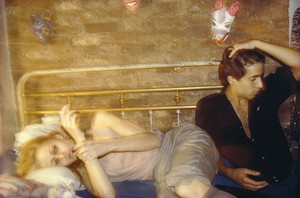
Nan Goldin, Greer and Robert on the bed, New York City, 1982
Generations of artists have tried to copy Nan’s aesthetic without understanding that to make pictures like that you have to move through the world differently. It is no accident that the same person who lugged slides of her friends to nightclubs and made new combinations of songs and images to make them happy—who in doing so invented new ways of looking and telling stories with pictures—would be the same person to join and often lead righteous struggles around AIDS, the opioid epidemic, the genocide of the Palestinian people. It is all about attitude—how and why you look. Attitudes become form, as Harald Szeemann put it. Really getting to the attitude demands a deeper understanding of aesthetics and its assassin, beauty.
It is early morning and this young girl is leaving the club. She has red or bleached curls and she’s cranked all the way up. She had known she was famous before anyone else caught on, and this keeps her safe. She is carrying these images—some of the most extraordinary images ever created, so special they belong to history, really—in a plastic bag. She just dumps the trays from the projector, nearly a thousand fragile slides, into this bag and moves on. Before the next showing, wherever that might be, she sits down in a loft with Rene Ricard or Suzanne Fletcher or her agent Marvin Heiferman and she does a massive amount of coke and puts them back together, in whatever order then feels right.
This is howThe Ballad of Sexual Dependencygot made, over years, contingently, one night to the next. Nan got used to showing her pictures as slides in the 1970s, when she was in school at Boston’s Museum of Fine Arts and living in a lesbian-separatist commune in Provincetown. She had no access to a darkroom so she used slides to show her pictures to her teachers. Like most innovations, it was at first just the solution to a problem.
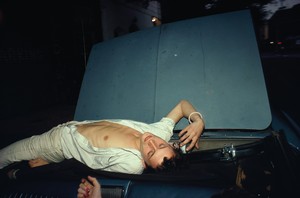
Nan Goldin, French Chris on the convertible, New York City, 1979
It came together at night, in spaces for dancing or film or music. Unlike the pictures in an art gallery, The Ballad brought its own light. Probably the earliest iteration was at Frank Zappa’s birthday party at the Mudd Club in 1979, but the work wasn’t yet a work and wouldn’t even be called The Ballad for a few more years. Most of her friends couldn’t get in and probably no one even noticed what was happening.
The soundtrack started coming together in 1980, when Nan screened slides at the Times Square Show and her DJ boyfriend played music. Everything evolved through the doing—at other clubs and gatherings; at Edit deAk’s Dubbed in Glamour event at the Kitchen in 1980; at the Arsenal theater in Berlin; during the Whitney Biennial in 1985; at the Saint, a massive club on Second Avenue, in May 1986; many many times at O-P Screening Room, an avant-garde venue on Broadway near East 12th run by a Palestinian-Egyptian man named Rafic Azzouny. In the early days the audience and the subjects were the same. The people would scream at the screen when they saw their photo; some would protest a picture and Nan would take it out. Sometimes the show was twenty minutes and sometimes an hour and a half. (The canonical iteration is around forty-five minutes.) In 1986, the curator François Hébel suggested Nan carve out the pictures of drag queens, and so those pictures got assembled into another of her masterpieces, The Other Side.
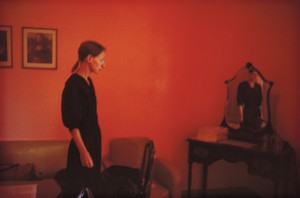
Nan Goldin, Suzanne with Mona Lisa, Mexico City, 1981
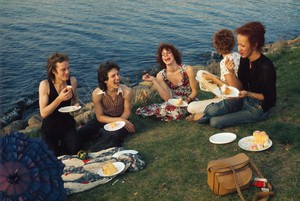
Nan Goldin, Picnic on the esplanade, Boston, 1973
Nan says that anyone who took as many photos as she did could stand where she does, that the genius is all in the edit. I know that’s not true. We live in an endless current of images and I’ve looked at millions of pictures and when I see one of Nan’s it still stops me wherever I am. She has an instinct for photos. I don’t know why or how, but she does. From the ages of fifteen to eighteen she watched all the great movies—Antonioni, Jack Smith, Warhol, Bertolucci, Bergman, John Waters, Morrissey, Fellini. She saw what the camera could do. And she knows what thing goes next to or across from another. She gets everything and just enough in the frame.
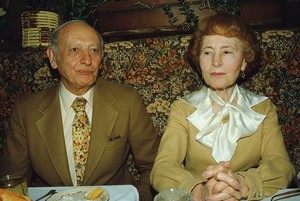
Nan Goldin, The Parents at a French restaurant, Cambridge, Mass., 1985
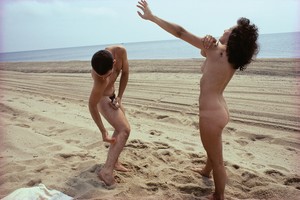
Nan has rhythm. Clash is important: one wrong thing next to one right thing, ornamental patterns—sparring wallpapers and bedspreads. In the book you get it right off the bat in The Parents at a French restaurant, Cambridge, Mass. (1985), her father’s crowded floral tie antagonizing the chintzy banquette, the tie and the seating as alike and estranged as the parents are to each other. Then the clash between images: Immediately after the claustrophobic picture of the parents is Susan and Max sunbathing on the beach, Provincetown, Mass. (1976), two young people naked and angular and free. Then suddenly the contrast of colors—the teal wall of Self-portrait in blue bathroom, London (1980) across from the bleary red of Suzanne with Mona Lisa, Mexico City (1981), the spread beginning and ending with a mirror.
Nan Goldin, Susan and Max sunbathing on the beach, Provincetown, Mass., 1976
The Ballad’s rhymes and discords are so funny. In the slideshow, where music is the motor, it is funny to hear the Velvet Underground and Nico’s “I’ll Be Your Mirror” over the section of people looking at their reflections. It is funny to put—again, in the slideshow—a picture of the Aperture book of the Ballad covered in lines of coke. It is funny to introduce a section featuring a gunslinging Brian, Nan’s abusive boyfriend, with Ennio Morricone’s title song for Sergio Leone’s Western The Good, the Bad, and the Ugly (1966). There is humor and violence and beauty that smacks the eye awake. French Chris on the convertible, New York City (1979) is a modern pietà. Nothing has caught the essential distance of intimacy like that dreamy smear of Greer and Robert on the bed, New York City (1982). And few images radiate the emotional and compositional complexity of Picnic on the esplanade, Boston (1973)—Nan’s Déjeuner sur l’herbe, taken when she was twenty.
“These photos come out of relationships, not observation,” Nan writes in the first foreword to the book version of The Ballad, published now forty years ago. As always, Nan sees what she’s doing better than anyone. She sees everything, sometimes too much. Some people talk about The Ballad as though it’s an artwork like other artworks, something you can own or put in a museum. But it’s actually an act of devotion, scripture, a manual for how to be with others. What this cascade of pictures does is teach us how to see, which is just another word for love.
David Velasco is a writer based in New York. From 2005 to 2023 he was an editor at Artforum and was editor in chief for the final six of those years. He is the recipient of a Literary Award from the Lannan Foundation (2024) and of fellowships from MacDowell (2025) and Denniston Hill (2025).