On the heels of finishing a new novel, Scaffolding, that revolves around a Lacanian analyst, Lauren Elkin traveled to Metz, France, to take in Lacan, the exhibition. When art meets psychoanalysis at the Centre Pompidou satellite in that city. Here she reckons with the scale and intellectual rigor of the exhibition, teasing out the connections between the art on view and the philosophy of Jacques Lacan.
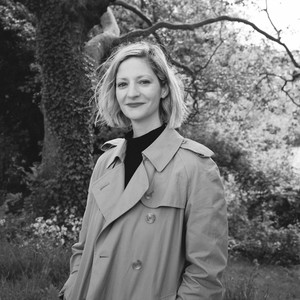
Lauren Elkin’s most recent books are Scaffolding: A Novel (2024) and Art Monsters: Unruly Bodies in Feminist Art (2023). Other books of hers include No. 91/92: Notes on a Parisian Commute (2021) and Flâneuse: Women Walk the City, which was a New York Times Notable Book of 2017 and a finalist for the PEN/Diamonstein-Spielvogel award for the art of the essay. She lives in London.
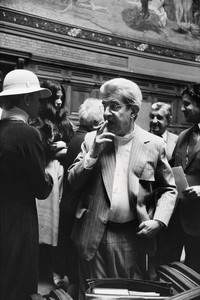
At the entry to the Jacques Lacan exhibition at the Centre Pompidou–Metz is a video of the great psychoanalyst himself, holding forth, cigar in hand. His noncigar hand gesticulates like he’s conducting an orchestra; sweat beads on his upper lip. I catch bits of what he is saying but he swallows his words and the volume is low. Catching every other phrase, or every other other phrase—it’s like a metaphor for my encounters with Lacan’s own work.
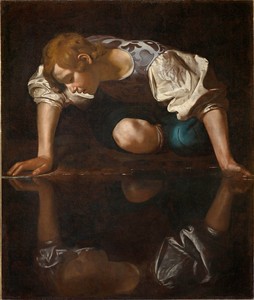
Nearly twenty years ago, I was assigned Lacan’s Four Fundamental Concepts of Psychoanalysis (1973) in a postgraduate seminar. We read about the developmental stage when a baby can recognize itself in a mirror and understand itself as a human being separate from its mother. Lacan called this the mirror stage, the moment when we enter into subjectivity and autonomy, but in that fundamental moment of separation there is also loss—the loss of the mother, and therefore of something previously taken to be a part of the self. And at the same time, through this visualization of itself in the mirror, the infant has to accept the limitations of its own body—which it had previously considered multiple, oceanic, a pleasurable assortment of discrete body-parts. To see ourselves as whole is paradoxically to accept ourselves as incomplete. We enter what Lacan called the Symbolic order (the world of language and culture) through this experience of loss, which will always stay with us: we will always feel we are lacking something without ever knowing what it is.
I found this notion incredibly powerful, and immediately set about exploring it my own academic and creative writing. This finally culminated in a novel called Scaffolding, to be published this June in the United Kingdom (Chatto & Windus) and in the United States in September (Farrar, Straus and Giroux). When the novel begins, the main character, a Lacanian psychoanalyst, has lost a pregnancy in her second trimester, and shortly thereafter has reencountered an old boyfriend. Lacan’s ideas provided a way to write about trauma, loss, love, desire, and the way memory works, allowing the past to live in the present. Lacan is, I believe, a great philosopher of love and longing.
But the problem with writing a Lacanian novel is that Lacan is so hard to understand. Everything is loaded up with wordplay, self-referentiality, chains of association. He did not publish often, preferring to give yearly themed seminars in which he orally worked out his thoughts. The students, psychoanalysts, writers, even actors who attended them in Paris from 1952 to 1980 often brought Dictaphones with them so they could relisten at their own pace at home. Several decades later, with the lectures published and in my lap, I nevertheless made very little headway with them.
In the end it took me sixteen years to feel I’d gleaned enough to write Scaffolding. At a certain point during that process I realized that even if I trained as a psychotherapist, I’d still have an imperfect mastery of his work. I spoke to a friend, an actual Lacanian analyst, about this and asked him what he thought. I may be misremembering, but I believe he was the one who gave me permission to just work with whatever version of Lacan I could grasp from my reading. It’s like jazz improvisation, I seem to recall him saying: you take some of it, riff on it, and it becomes its own thing.
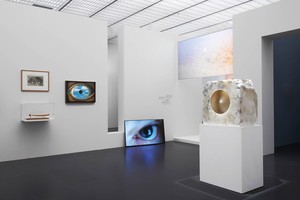
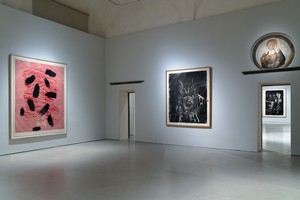
The same principle animates the Lacan show in Metz. Cocurated by the art historians Bernard Marcadé and Marie-Laure Bernadac with the psychoanalysts Gérard Wajcman and Paz Corona, the show does not attempt to illustrate Lacan’s theories with corresponding works of art, or to psychoanalyze the artists or the works, but rather to use art along with Lacan’s ideas as an invitation to visitors to do their own intellectual freestyling.
The curators argue that a Lacanian approach to art is not simply an interpretive tool, or a means of speculating about the psychology of the artist; rather, it invites the viewer into the relationship—as Marcel Duchamp said, the work of art is completed by the viewer.1 What does a painting do to the viewer, how do we look at it, how does it allow us to think about subjectivity, representation, the gaze, desire, lack, identity, sexuality—that is to say, life itself?
The curators, two art historians and two psychoanalysts, have divided the show into two parts. The first is an archival presentation of Lacan’s life, with placards guiding us through the main developments and vitrines presenting letters, photographs, notes, books, magazines, and other paraphernalia. These are a treasure trove, from Roland Barthes’s notes from his sessions with Lacan during the writing of A Lover’s Discourse (1977) to the copy of Histoire de l’oeil (Story of the Eye, 1928) that Georges Bataille signed to Lacan and his second wife, Sylvia, to whom Bataille had previously been married.
The second, dominant part of the show is the art. Some of the works here, by Salvador Dalí, Hans Bellmer, and André Masson (Sylvia Lacan’s brother-in-law) were actually made in direct conversation with Lacan. Others have been selected by the curators for their resonance with Lacan’s ideas. You might even say that art was a cornerstone of Lacan’s thought. In The Four Fundamental Concepts of Psychoanalysis, several sessions are devoted to questions of vision and the gaze. And he habitually referred to art and cinema during his lectures.
When Lacan looked at a work of art, he was not interested in its mimetic properties, writes Marcadé in his catalogue essay, but rather in the way it allows the viewer to be “led astray.”2 “Of course works of art imitate the objects they represent, but this is not exactly their aim. In giving an imitation of an object, they make that object into something else. And so they only pretend to imitate. . . . The more the object is presented as an imitation, the more it opens up a dimension where illusion breaks down and turns into something else.”3
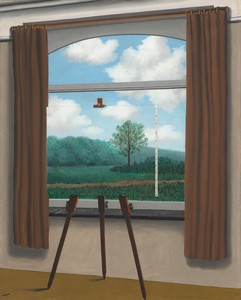
In the case of figurative work, Lacan argued that the object portrayed is both present and absent. It’s clear from these lines why René Magritte, for instance, held such fascination for Lacan. In his thirteenth seminar Lacan refers to Magritte’s painting La Condition humaine (The Human Condition, 1933), which depicts an easel with a canvas on it, placed in front of a window; the painting on the canvas precisely replicates the landscape outside the window, obscuring and replacing it.
This painting, though not in the show (instead they have Le Faux Miroir [The False Mirror, 1929]), brilliantly illustrates the point the curators are trying to make about the relationship between Lacan and art. It’s not that Magritte’s piece “proves” Lacan’s theory, it’s that the work of art and the work of theory together help us to think about the very act of looking at art. Apparently Magritte was often asked what was behind the painting in La Condition humaine, to which he would reply: nothing. “Visible things always hide other visible things. But a visible image isn’t hiding anything.”4 This reminds me of Susan Sontag’s 1964 essay “Against Interpretation,” in which she expresses her impatience with critics who persist in “interpreting” works of art, as if art had to be decoded, its “hidden” meaning finally revealed by the detective critic. Instead of a hermeneutics, she calls for an “erotics” of art.
I don’t know if Sontag was thinking of Duchamp (perhaps unconsciously?), but he’s here, of course, as his alter ego Rrose Sélavy—famously a pun for the slogan “Éros, c’est la vie.” The two men were friendly; Duchamp attended Lacan’s seminar, and on at least one occasion had lunch at his home, where he saw Gustave Courbet’s infamous portrait of a lady’s bits, The Origin of the World (1866), which Lacan owned for a time. Masson painted a sliding door to be used to hide it (one imagines it was not the sort of thing you could casually have hanging on your wall in 1950s France—or today, for that matter). This staging of the painting would have a major impact on Duchamp, leading him to create his own version of Courbet’s painting, Étant donnés (1966).
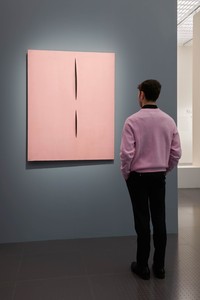
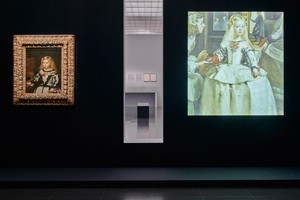
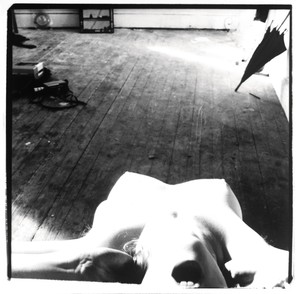
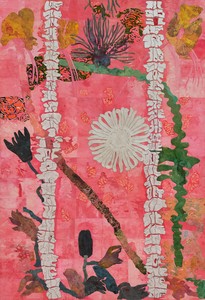
The Origin of the World is present in the show, though unobscured by Masson’s painted panel, which appears beside it. It is accompanied by a variety of works by feminist artists: Mira Schor’s gorgeous, six-foot-tall painting Sexuality Surfboard II (or Sexuality Stele), of 1994, pale pink, slit in the very middle to reveal a semicolon; a photograph from Deborah De Robertis’s 2014 performance Miroir de l’Origine (Mirror of the origin), in which she posed in front of Courbet’s painting at the Musée d’Orsay with legs splayed to reveal her own vagina; Betty Tompkins’s Fuck Painting #59 (2017); and Agnès Thurnauer’s Origine World #3 (2014), which presents a copy of Courbet’s painting overlaid with the names of famous male artists whose names Thurnauer conjugates in the feminine: Jacqueline Pollock, Jeanne Dubuffet, Katia Malevich, Marcelle Duchamp. There is also Lucio Fontana’s Concetto spaziale (Spatial concept, 1958), with its double pink vinyl laceration, and Velázquez’s portrait of the Infanta Margarita Theresa from 1654.
Wajcman, the psychoanalyst who is one of the cocurators, has called Lacan a “split collector”—a collector of what Freud called Spaltung, the splitting of the subject.5 Lacan’s son-in-law Jacques-Alain Miller, a psychoanalyst in his own right who has overseen the publication of most of Lacan’s seminars, writes that in Lacan’s work “the hole, as opposed to the lack, implies the disappearance of the order of space. . . . it is not a lack in the Other, but rather, in the place of the Other there is a hole. It is in relationship to the hole that there is ex-sistence.”6 Lacan, reading into what he called in French the fente (which to me echoes the English word fount, or source), or looking at images of slits or splits, found a way to rebut Freud’s idea of a woman as a castrated man, for a split is not nothing, a hole is not no-thing. The surface of a painting can be slit and split, whether literally or figuratively, but it does not reveal anything beneath, only the circumstances of its materiality.
In his thirteenth seminar (published as The Object of Psychoanalysis 1965–66), Lacan refers multiple times to Las Meninas (1656), Velázquez’s canonical portrait of the Infanta and her entourage. If you look closely, Lacan says, you can see that Velázquez has painted a vulva into the folds of the Infanta’s skirt. (It takes some effort on my part to follow Lacan down this path of thought, given that when the image was painted, the Infanta was a five-year-old girl.) As a “representation of representation,” much like Magritte’s La Condition humaine, Lacan argues that the painting is not inviting us to figure out what it is depicting but rather inviting us into the space of the picture—through its “open window”—to consider the real object of the painting as the Infanta herself, the “central object, the split, the little girl, the girl = phallus, which is what, moreover, I earlier identified for you as the slit.”7
The show, which is immense, calls for a great deal of mental agility; I am grappling with Lacan’s complicated ideas while also trying to remain open to the many pieces included, meeting them on their own terms. But from the Infanta onward, I am tangling with one of Lacan’s central concepts, the objet a, which despite my past struggles has always eluded me.
As it turns out, that’s exactly what the objeta does.
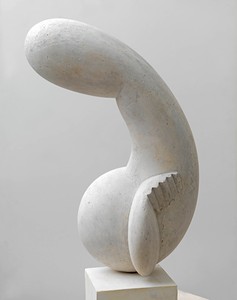
The objet petita is lack: what we are forever chasing and can never find. Lacan says that the Infanta, with her invisible/visible slit, is the objet a par excellence. A variety of gazes converge on her: her own parents’, reflected in the mirror in the background; Velázquez’s, who is both the author of the painting and a figure within it, supposedly painting the Infanta and the others as reflected in a mirror situated where we are standing; and, of course, our own gaze, the viewer’s gaze. Lacan uses these multiple gazes to dramatize the split in subjectivity that the painting enacts, “distinguish[ing],” writes Marcadé, “between what can be seen and perceived in terms of the way the visible escapes from visibility.” It is precisely this “escape” (écart) from visibility that characterizes the objeta, a “cause of desire,” that which escapes, which flees, which falls.8 In Lacan’s iconography these include breasts, shit, the voice, the gaze, the phallus. And art is, obviously, chock full of objets a. The curators have included familiar pieces by Carol Rama, Louise Bourgeois, and Constantin Brancusi, as well as a giant theater curtain painted to resemble a sky and broken on one side: La Dépossession (The dispossession), by Latifa Echakhch (2014).
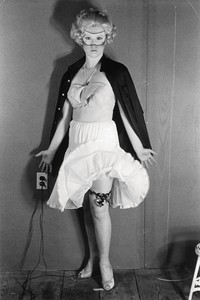
By the time I’ve seen the last room, my phone has run out of battery from being called on to take so many pictures and notes, and I am starving; the show is too big for the three hours I’d planned for it. Too immense, even, to write about in one essay—I’m leaving out Sarah Lucas, Claude Cahun, Tracey Emin, Cindy Sherman, Annette Messager, the docent who was so tired by the end of his tour that he said he needed a lie-down, the toddler who watched the Lacan footage beside me, the people I overheard imitating Lacan’s declarative inflections (Comment! c’était! que!), a scene from Jean-Luc Godard’s Masculin féminin (1966), Ghada Amer’s Disney/Cocteau remake And the Beast (2004), Andy Warhol’s Blow Job (1964), the mirror scene from Martin Scorsese’s Taxi Driver (1976—Are you talkin’ to me?), Pierre Huyghe’s neon sculpture of the Real, the Symbolic, and the Imaginary glowing at us from the ceiling. They are the objets petita of this essay.
For Lacan, the pleasure principle “lead[s] the subject from signifier to signifier, by generating as many signifiers as are required to maintain at as low a level as possible the tension that regulates the whole functioning of the psychic apparatus.”9 This is as good a description as any of what it’s like to move through an art exhibition—and very much like the work of the writer. After the show I sat in the café, stringing idea after idea onto the strand of thought that is this essay. Like a spider (a Bourgeois work not in the show), I secrete it from the series of impressions I had at the show, from my reading before and afterward, from my history of thinking about and with and through Lacan. The free play of ideas, laying hold of some while accepting that others will slip away, understanding and accepting that those may well be the most powerful: What else is the therapeutic encounter, or our creative practice?
1 “The artist produces nothing until the onlooker has said, ‘You have produced something marvelous.’ The onlooker has the last word on it.” Marcel Duchamp, quoted in Calvin Tomkins, Duchamp: A Biography (New York: Owl Books, 1996), p. 396.
2 Marie-Laure Bernadac, Bernard Marcadé, et al., Lacan: l’exposition, exh. cat. (Paris: Gallimard, 2024, for Centre Pompidou-Metz), p. 10. All translations mine.
3 Jacques Lacan, L’Éthique de la psychanalyse (Paris: Éditions du Seuil, 1986), pp. 169–70.
4 René Magritte, quoted in Marcadé, Lacan: l’exposition, p. 160.
5 Gérard Wacjman, “The Split Collector.” La Cause Freudienne, no. 79 (2011/3): p. 79.
6 Jacques-Alain Miller, “Lacan’s Later Teaching: Cut and Continuity,” trans. Barbara P. Fulks, Lacanian Ink 21 (October 2003): n.p.
The UK edition of Scaffolding is available for preorder through Penguin Random House UK (Chatto & Windus; June 13, 2024)
The US edition of Scaffolding is available for preorder through Macmillan Publishers (Farrar, Straus and Giroux; September 17, 2024)
Lauren Elkin’s most recent books are Scaffolding: A Novel (2024) and Art Monsters: Unruly Bodies in Feminist Art (2023). Other books of hers include No. 91/92: Notes on a Parisian Commute (2021) and Flâneuse: Women Walk the City, which was a New York Times Notable Book of 2017 and a finalist for the PEN/Diamonstein-Spielvogel award for the art of the essay. She lives in London.