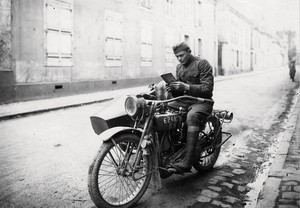
Christian House tracks the history of novelists’ engagements with photography and speaks with three contemporary writers—William Boyd, Teju Cole, and Orhan Pamuk—about their own approaches to the medium.
Christian House worked as a proposals writer at Sotheby’s for a decade before a period as an obituarist for the Telegraph. He now writes on visual arts, literature, and history for publications such as the Financial Times, Canvas, and CNN Style.
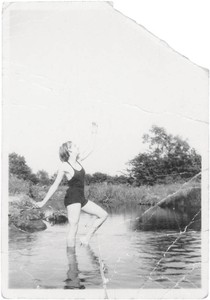
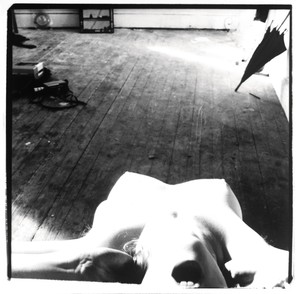
It all began when I picked up a woman at a bus stop in South London. She was lying on the sidewalk, immortalized in a scuffed-up early-twentieth-century photograph. Glamorous, in a down-at-heel kind of way.
I swept up the tiny print, no more than three inches by two, one corner torn off, and looked more closely. She was in her twenties, wearing a knitted swimsuit, striking a classical pose up to her shins in water in the middle of a lake. Here she was forever fixed—looking deliriously happy—in the ripples of a moment from the 1930s. I slipped her into my pocket.
A while later I showed the print to the British novelist William Boyd, who I knew collects found photographs. In 2015, Boyd featured the image in his novel Sweet Caress. The book, which charts the audacious life of a fictional photographer named Amory Clay, includes seventy-seven anonymous photographs that Boyd used for narrative purposes. On the frontispiece, and on the jacket of the Spanish edition, the unknown lady in the lake has become Amory.
And so my interest in the curious tangle of photography and literary fiction was tripped. Of course, the prurient tendencies of the camera have been a constant theme in storytelling. (Alfred Hitchcock adapted Rear Window [1954] from a short story by Cornell Woolrich, who had himself lifted the premise from H. G. Wells.) But some writers have picked up their Leica—or less-esteemed model—and focused in a more practical fashion. Which conjures up a paradox: writers sit in rooms imagining, photographers are out and about beholding.
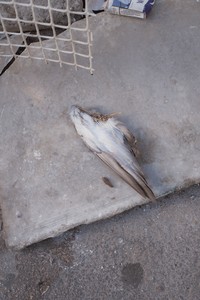
In fact, writers have been drawn to the dark(room) arts since the nineteenth century. Those with a scientific bent approached it in the same spirit that authors now ponder the thrills—and perils—of AI. During the cold winter nights of 1893, the Danish playwright, novelist, poet, and painter August Strindberg spread out a series of photosensitive plates on the ground in the Austrian village of Dornach, near Basel. The results—which he called “celestographs”—were a series of works created without a camera, images dappled and stained like pieces of rusty metal or mildewed newspaper. The abstracted compositions might illustrate constellations of stars; more likely they capture the marks of dust and grime. Today they lie in drawers in the Royal Library in Stockholm. They would continue developing if exposed to sunlight. They are unfinished stories.
Photograph found by the author
Not long after Strindberg scanned the night sky, Arthur Conan Doyle, the creator of Sherlock Holmes and an ardent amateur photographer, was duped by spirit photography, the notion that ghosts of loved ones could be caught by the camera shutter like a moth under a glass. Even authors can be hoodwinked by the lens.
With the arrival of the portable pocket camera and 35mm film in the twentieth century, novelists began using negatives like a notepad. In the early 1930s, Georges Simenon, the creator of Inspector Maigret, recorded the seedier corners of Mittel Europa and Africa while on reporting assignments. And the British travel writer and novelist Bruce Chatwin was a constant shutterbug, photographing Javanese caves, Peruvian geoglyphics, and assorted frescoes and prayer flags. Chatwin, who began his career as one of Sotheby’s first experts on Impressionism, filled his fiction with arcane details the way a collector fills a cabinet of curiosities. Similarly, his photographs were exhibits for personal contemplation. While Chatwin was using the camera as a journal, the postwar German novelist W. G. Sebald treated his contact sheets like a mood board, inserting his black-and-white captionless compositions—guileless snapshots of objects and locations—into his autofiction in a manner that is suggestive rather than illustrative. And considering the fact that Sebald famously included a nine-page sentence in his masterful swansong Austerlitz (2001), they also provided a breather for the reader.
The abutting of jotting and snapping continues today. Boyd, the author of bestsellers such as A Good Man in Africa (1981) and Any Human Heart (2002), is now planning a volume of his own shots. He is not unique. At Harvard, the Nigerian-American author Teju Cole oscillates between creating photobooks—meditative series on Swiss vistas and his kitchen counter—and novels that explore the experiences of the Nigerian diaspora. Meanwhile, in Istanbul, the Turkish Nobel laureate Orhan Pamuk has already produced two volumes of photographs, each focusing on a different aspect of his beloved city. His pictures can be seen this summer and fall at the Lenbachhaus Munich alongside objects from his fabled Museum of Innocence.
Discussing their double lives with me, this trio talk about how photographs provide verisimilitude, a sense of place, the comfort of nostalgia, and, conversely, a discomforting sense of loss. For Boyd, Cole, and Pamuk, photography has become a separate creative channel, providing gambits that are often, but not always, complementary to their fiction.
Photographers make perfect protagonists: they’re on the scene, they bear witness to the action. In turn, a photograph can be a convenient plot device. These flexible items—flexible physically and contextually—provide evidence, accurate or misleading, and can become coveted or reviled objects. “My last produced TV series, Spy City, hinges around a photograph that was taken in Beirut in 1961. It’s the MacGuffin, if you like,” Boyd tells me in the study of his London home. “There’s a search for this photograph which is revelatory and shows a conspiracy between Russians and other spies.”
Photography began to creep into Boyd’s work with Nat Tate, a 1998 novella in the guise of a monograph on a forgotten, in fact fictional, Abstract Expressionist painter. Boyd inserted anonymous photographs of people and places that were in fact of entirely different people and places, prints he sourced from flea markets and eBay. In Sweet Caress, which expanded on the found-photograph strategy, Amory Clay acts as a kind of guide through the various subsections of the professional practice—portraiture, reportage, art photography—as she snaps and struggles her way through some of the more piquant periods of the twentieth century (in Berlin she dabbles in some Weimar-era pornography).
Are there parallels between a story and a photograph? “It depends on the photograph,” Boyd says. “The New Yorker writer Janet Malcolm said that if you scratch a photograph, you’ll find a painting. But there are also types of photographs, such as those by Cindy Sherman, in which there is a short story lurking behind them.” But, he continues, the viewer is complicit in the storytelling. “You think, how did this decisive moment come to be?”
For two centuries, the viewer has seen a photograph and assumed it to be true. “It has the imprimatur of something that’s real and snatched,” agrees Boyd, adding that this, of course, is catnip for a novelist: “I try to make fiction seem so real that you forget it’s fiction.” Yet, of course, a photograph is a construct, edited by choices of time, place, angle, and the all-important crop. And recently photographs have become shifty. David Hockney, who created vast collages of Polaroids in the 1980s—what he called “joiners”—said that the medium lost its claim to authenticity once it became digitized.
Boyd has been taking photographs for years, shooting with a digital Leica. His snaps pick up on inscrutable aspects caught on the fly: broken tarmac, graffiti, the tiles of a swimming pool. “Even the most banal things can make an arresting image if you frame them correctly. It’s that sense of ‘What am I looking at?’ Oh, it’s just a bench with oblique sunlight.”
The allure of the floating detail, unfreighted by context, has its literary echo in the way a novelist creates drama or comedy from an event observed by someone missing the bigger picture. Boyd, who might take ten pictures in a week or just one in an entire season, is selecting 100 of his mercurial photographs for a new book, Abstractions (slated for 2025).
In his introduction to Robert Flynn Johnson’s book Anonymous: Enigmatic Images from Unknown Photographers (2004), Boyd pinned down thirteen ways of looking at a photograph, from aide-mémoire to advertisement—categories, he notes, that can overlap in a single frame. Pursuing his thesis further, he suggests that all great shots correspond to fine-art laws of composition. “The photographs that haunt you are all beautifully composed in a way that someone in the eighteenth century would understand,” he says, adding with a smile: “I wait to be disproved.”
Cole’s photography ticks several of Boyd’s boxes: street pictures, still life, conceptual. The polymath has placed his photographs in his novels and his stories in his photobooks. In his practice, the mediums act like two hands on a piano.
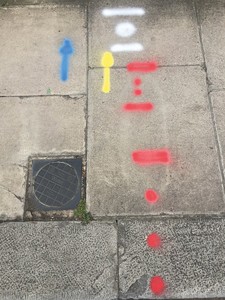
Photograph by Teju Cole, from Pharmakon (MACK, 2024), courtesy the artist and MACK
Cole explains that his signature blend took shape when he was in his early thirties. “I had one of the first generation of small digital cameras; they weren’t on the phone at that time. But they were small. It had three megapixels. Sometimes our life is quite affected by offhand comments. Somebody said, ‘That’s interesting what you’re doing with such a small camera. I wonder what you would be able to do with a real camera.’ It’s flattery, it’s praise, it’s a bug at the back of your head. You feel, Maybe I have a talent. Maybe I have an eye. You know what they used to say about Bruce Chatwin, that he just had an eye. You could see from the man’s prose that he had a kind of extreme alertness and attention to the fine surfaces of things.”
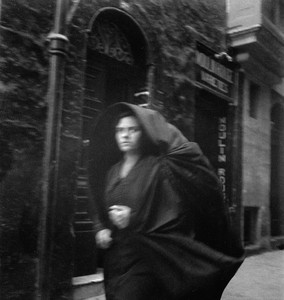
For his debut novel, Every Day Is for the Thief, published in English in 2014, Cole slotted in his own studies of surfaces. Woozy black and white compositions taken in Lagos—cracked windows, hazy highways, dusty yards, smeared windshields—marry up, but not didactically, to his tale of a young émigré discombobulated on a short trip home. “There’s a blur in them. There’s a kind of unsettledness,” he says. “For me these are photos taken by that character, that narrator.”
Cole believes that the days of mysterious unidentified photographs, like my sidewalk discovery, are numbered. “Not only will we be able to figure out who’s in the photo because of the power of the algorithms—so anonymity’s gone—but also the likelihood of finding a photo in the street has plummeted precipitously.” How many people still carry a physical photograph in their wallet?
Yet Cole’s books revel in unknowability. In Pharmakon (2024) he presents fleetingly short stories interspersed with photographs of cracked masonry, flaking paint, boulders, and the fuzzy edges of buildings and woodland. “It’s about borders, it’s about stone. It’s about the detritus of modern life that claims to be one thing but is actually something else,” he says. “I think photos refuse to have a conclusion.”
In Cole’s 2023 novel Tremor, we are introduced to a photography professor from Nigeria living on the east coast of America. In the opening passage he is upbraided by a homeowner for taking pictures in his neighborhood. “He has pressed the shutter twice when an aggressive voice calls out from the house on the right,” Cole writes. “You can’t do that here, the voice says.” Photography, we are reminded, can chafe, can provoke.
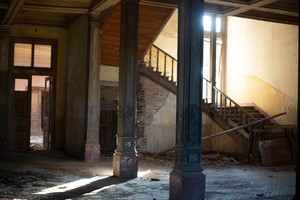
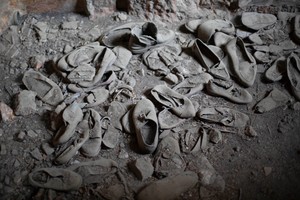
Pamuk happily admits that his camera led him astray—to rewarding ends. In his new series of pictures, the author of My Name Is Red (1998) and, most recently, Nights of Plague (2021) captures the forlorn state of the abandoned Prinkipo Greek Orthodox Orphanage on the island of Büyükada in the Sea of Marmara. “One of the biggest old buildings in the world was decaying and falling apart two miles away from my summer house. It took a lot of effort to sneak inside, because it was dangerous and no one was allowed,” he confesses. “I entered it three times in 2020 and 2021.”
Pamuk’s illicit photographs of the dilapidated site tell an architectural ghost story. In the half-light of the empty rooms and corridors, wooden panels and slats dangle from the ceiling. A pile of girls’ sneakers and ballet shoes is shrouded in dust. “In the last three years, the orphanage collapsed more. Now no one can enter. In Istanbul, there are many old buildings in terrible shape. I have a self-imposed project of making a photobook of ‘modern ruins’ around Istanbul.”
Central to both Pamuk’s writing and his photography is the concept of “hüzün”—what he describes as “Turkish melancholy.” His memoir Istanbul: Memories and the City (2003) illustrates this “almost philosophical and partly mystical feeling of going inward” through the mid-century photographs of Ara Güler—Turkey’s equivalent to Henri Cartier-Bresson—and his own pictures taken as a teenager in the 1970s.
Pamuk once declared, “I write because I can only partake in real life by changing it.” Are his photobooks, on the distinctive orange lighting of Istanbul’s alleyways and the panoramic views of the Bosporus seen from his balcony, spurred by the same instinct? “It’s not the same. In photography, I’m a voyeur, a gazer, a passive eye whose mind is busy with his camera rather than representing a group, a problem,” Pamuk explains. “As a novelist I am not a simple voyeur, rather I’m self-consciously political. In art and photography my motivation is rarely political.”
For two decades, Pamuk has used his camera as a means of immersion. “My novel A Strangeness in My Mind [2014] is about lower-class life in the shanty towns of today’s Istanbul and their development into high-rises. In the six years that I wrote the book, I took tens of thousands of photos of Istanbul. I used them to write the novel,” he says. “I don’t have artistic pretensions when I photograph, though it is impossible to resist the temptation of making series, groups, and by them books that will look beautiful.”
Boyd, Cole, and Pamuk all speak of the fluidity of photographs. Which brings me back to my image of the woman in the water, that curbside debris turned cover girl. Before its reframing, that photograph was something else entirely—possibly a forgotten fragment of a forgotten romance? Were the shutter and the pose flip sides of a wonderful affair? What did the subject and the snapper do after that decisive moment? Was there lunch? Was there lovemaking? But that, of course, is another story.
Christian House worked as a proposals writer at Sotheby’s for a decade before a period as an obituarist for the Telegraph. He now writes on visual arts, literature, and history for publications such as the Financial Times, Canvas, and CNN Style.