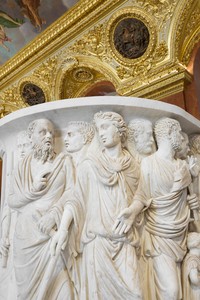
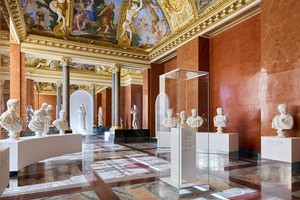
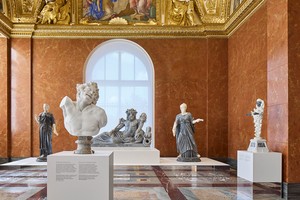
The exhibition at the Louvre Museum is based on a single concept: excellence. At its origin is the gesture of the sculptor, who brings matter to life and—in the case of each work in the Torlonia collection—creates works of extraordinary quality. These are gathered today in a collection that would not have come into being without the passion for art of several generations of the Torlonia family. The imposing figure of Hestia Giustiniani, an extraordinary series of sarcophagi, imperial busts, and more will unfold all their evocative charm. At the heart of the Louvre, precisely where the museum’s archaeological collections have been displayed since 1798, the Torlonia marbles will re-create a significant fragment of history. No place is more appropriate to highlight the connections and parallels between these two “sister collections”: the Torlonia collection and the Louvre’s.
A precise and scholarly narration by curators Cécile Giroire, Martin Szewczyk, Salvatore Settis, and Carlo Gasparri intertwines with the grandeur of the imperial apartments featuring a selection of more than seventy exceptional works. At the core of the exhibition are sixty-two highly representative works from the most important private collection of ancient Roman sculptures in the world, meticulously restored in the Laboratori Torlonia after a scrupulous study, thanks to the support of maison Bulgari. The exhibition will focus on the most emblematic genres of Roman sculpture, with its rich and varied artistic styles. Portraits, copies of famous Greek originals, works inspired by classical or archaic Greek art, thiasos (groups or processions of worshippers), satyrs and maenads, and allegories make up the repertoire of images and forms that give Roman art its potency.
The Torlonia princely family followed in the aristocratic traditions of papal Rome, developing a passion for ancient sculpture that led to the assembly of this magnificent collection. The Museo Torlonia, which opened in the 1870s, was designed with the great public institutions of the time in mind—the Vatican, the Capitoline museums, the Louvre. Alessandro Torlonia’s museum closed in the mid-twentieth century in the wake of World War II, but the Torlonia marbles remained famous. Since 2020, these masterpieces have been on public display once more thanks to a series of special exhibition events. The ones held in Rome and Milan, curated by Salvatore Settis of the Scuola Normale Superiore in Pisa and Carlo Gasparri of Università degli Studi di Napoli Federico II in Naples, took visitors on a journey through the history of the collection. In Paris, thanks to close and collegial cooperation with the Italian ministry of culture, the Torlonia marbles are being revealed to a foreign audience for the first time.
Over the course of the nineteenth century, the Torlonia princes acquired the busts and reliefs, statues and sarcophagi, thanks to a series of acquisitions from other important Roman collections as well as from excavations carried out on lands belonging to the family. This makes the Torlonia collection more than an accumulation of ancient sculptures of exceptional quality; it is also a collection of historic collections. In the words of Settis, it epitomizes “a sociocultural practice that began in Italy and particularly in Rome, triggering a vast process that was to lead to the founding of grandiose sovereign collections such as those of the popes and the kings of France, and, later on, to the creation of a new institution, that of the public museum, which first saw the light in Rome when, in 1734, Clement XII founded the world’s first public museum at the Campidoglio.”
The first set of ancient Roman works to enter the Torlonia collection at the start of the nineteenth century previously belonged to the famed sculptor and restorer Bartolomeo Cavaceppi (1716–1799); other early acquisitions included the collection of the prestigious Galleria of Marquis Vincenzo Giustiniani, amassed in the seventeenth century, including masterpieces such as the renowned Hestia Giustiniani. Works subsequently acquired by the Torlonia princes included archaeological discoveries uncovered from the grounds of the family estate, which had some overlap with ancient residences from the Imperial age, for instance the Fanciulla Torlonia (Young Torlonia Girl) and the Rilievo con scena di porto (Relief Depicting a Port Scene), during the restoration of which unexpected traces of color emerged. Other archaeological finds were unearthed in the fifteenth or sixteenth century and made their way into the Torlonia holdings in the centuries that followed. An exceptional piece that was already quite famous in the seventeenth century is Il Caprone (The Resting Goat), restored by Gian Lorenzo Bernini himself.
At the end of the nineteenth century, the collection now encompassing an extraordinary number of ancient marbles, a project emerged, promoted by Prince Alessandro Torlonia (1800–1886), to establish the Museo Torlonia, reusing some old granary spaces along Via della Lungara in which to display the works before small groups of visitors. It opened in 1875, and an exceptional testimony of this work is the 1884–85 catalogue curated by C. L. Visconti. An avant-garde volume for its time in both concept and typographic technique, it reproduced the entire collection in a truly modern manner, delineating its contours and establishing its place in history. Alessandro Torlonia’s inspiration to take an innovative step by creating a museum where the category of artworks known as antiquities could be shown to the public was influenced by his passion for collecting and aristocratic taste, but also reflected a new historical moment: the birth of archaeology as a field of study in its own right.
The Paris exhibition, as envisioned by the curators, presents the history of the collection and illustrates how it was shaped by the circumstances under which it was assembled. The distinctive Torlonia collection—at once the last princely collection in Rome and a museum focused on the future—was founded on the principles of critical selection and scholarly presentation. At the Louvre, visitors will encounter a reunification of two works that were once displayed together in the Villa Albani, home to the Torlonia collection: the magnificent Prisoner King, sculpted from very rare Egyptian marble and now in the collection of the Louvre, purchased by Cardinal Albani from the Villa Medici in the eighteenth century, and a large vase, also sculpted from rare Egyptian marble, from the Torlonia collection.
The heritage of the Museum Torlonia, a pioneering idea that has passed down an exceptional legacy to future generations, has been furthered over a century later by the family foundation established at the behest of Prince Alessandro Torlonia (1925–2017). The Fondazione Torlonia promotes the study and conservation of the Torlonia collection and the Villa Albani Torlonia, one of the highest expressions of eighteenth-century taste, of which the Torlonia family became owners in 1866. The classicist dream of Cardinal Alessandro Albani (1692–1779), who promoted the burgeoning neoclassical movement through the Villa Albani, involved talents such as Giovanni Battista Nolli (1701–1756), Giovanni Battista Piranesi (1720–1778), and Johann Joachim Winckelmann (1717–1768). The Villa Albani organizes the antiquities collections according to a harmonious plan, nestled among the various buildings and gardens. Rising like a vast architectural complex, these elements provide a choral understanding of environments, landscapes,
and works of art that “live” here, as if eternally waiting to be rediscovered.
The Torlonia collection and Villa Albani Torlonia are two extraordinary artistic heritages whose destinies have intertwined, preserved under the aegis of the same family. Together, they reflect key moments in the histories of collecting, archaeology, restoration, and Western civilization; indeed, they are part of the family’s cultural heritage for humanity, to be passed on to future generations. The Fondazione Torlonia has devoted significant attention to a fundamental conservation effort, thanks to the support of its partners, employing the most advanced technologies to fulfill its mission. It also aims to promote and widely disseminate its work through publications and by exhibiting the works to encourage further studies, research, and initiatives. In doing so, it continues the academic and educational ambitions of Prince Alessandro Torlonia in the cosmopolitan spirit that has always characterized the collection of antiquities.