Photographer, artist, and curator Paul Clemence reports on the recently developed Clichy-Batignolles eco-district, an expansive project that looks to set the model for sustainable urban development.
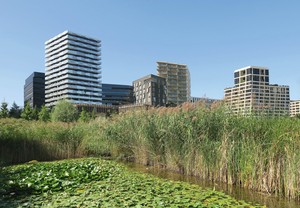
Martin Luther King Park, Clichy-Batignolles, Paris. Design: François Grether, Jacqueline Osty, and Omnium General d’Ingénierie
Martin Luther King Park, Clichy-Batignolles, Paris. Design: François Grether, Jacqueline Osty, and Omnium General d’Ingénierie
Paul Clemence is a visual artist, curator, and author focused on the cross sections of art, design, and architecture. An architect by training, he has photographed iconic structures all over the world by the likes of Zaha Hadid, Renzo Piano, Bjarke Ingels, Lina Bo Bardi, Oscar Niemeyer, Ruy Ohtake, Herzog & de Meuron, and SANAA.
There certainly exists a Parisian dream that is still alive and is constantly renewed, a mirage that reverberates among the books and in the collective imaginary.
—Federico Castigliano in Flâneur: The Art of Wandering the Streets of Paris
The thought of Paris will forever hold in our mind’s eye romantic images of the Eiffel Tower, the Seine River, its historic bridges, the Louvre, and, of course, the Haussmann boulevards with their elegant, distinctive architectural style. But cities are living organisms, and if they are to thrive, inspire, and remain relevant (escaping the Venetian destiny of becoming a “city museum”), they must then evolve, keep up with the changing needs of the times. In the 17th arrondissement, a cutting-edge urban development project is showing that the City of Light is doing just that, investing thought and resources in creating a new paradigm for sustainable urban living.
A couple metro stops from the Gare Saint-Lazare, in the northwest part of the city, the recently developed Clichy-Batignolles eco-district is bringing Paris to the heart of the contemporary urban and architecture conversation, injecting the city with fresh approaches to urban planning and buildings and landscape design. A joint public and private partnership covering an area of 54 hectares (133 acres) on what was formerly a freight yard for France’s national railway company (and the site of the proposed Olympic Village for the Paris 2012 bid), the project is one of the largest amid the new urban mixed-use developments in Paris. Divided into nine lots, it features a comprehensive program that includes housing, office spaces, retail, childcare, and sports, recreational, and cultural facilities.
Planning for the eco-district started in 2002, and since the very beginning the standards and goals of the climate and biodiversity plans put forth by the city of Paris were the guiding factor: energy efficiency, reduction of greenhouse gases, water management, and social diversity and inclusion. It was a unique opportunity to combine forward-thinking energy strategies with urban planning at the root of the project.
“We are changing how we organize the public and green space, and the density, to try to answer the environmental question,” says Catherine Centlivre, urban planner and operations manager at Paris & Métropole Aménagement, the agency responsible for developing and managing the project.
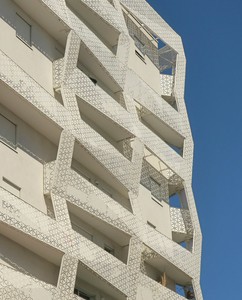
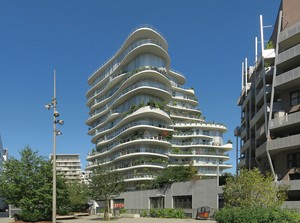
Plot o3, Clichy-Batignolles, Paris. Architects: Gaëtan Le Penhuel & Associés + Saison Menu + Sud Architectes; developers: BPD Marignan + Groupe Financière Duval
To ensure a healthy variety of conceptual proposals, the city set up an international call for submissions and decided to award each lot to not one but a pair of architecture offices (one established and one emerging), fostering a rich exchange of ideas and concepts. Taking the conversation further, workshops were organized to bring together all the participants involved: the designers, city officials, the developers, service providers, and community members. Together they discussed the potential for shared resources, individual design subtleties, and the contextual impact of each project and the interrelationships between them, making sure that each piece of architecture would fit seamlessly with the district’s bigger picture.
“Each workshop was organized around a theme, such as volume, silhouette, streetscape, uses and environment, formal language and materiality, and landscape,” explains Nicholas Gilliland, architect and founding partner at Tolila + Gilliland Atelier d’Architecture, one of the firms involved in the project.
The negative space between buildings that is so essential in defining the urban experience—sidewalks, open spaces, squares, recesses—was given as much thought (and discussion) as the buildings themselves.
One of the main features of the district’s ambitious master plan—developed by architect and urban planner François Grether, landscape architect Jacqueline Osty, and the architecture and planning firm Omnium General d’Ingénierie—was an area of 10 hectares (25 acres), to be allocated for a green park. This would be the structural axis for the district, both geographically and symbolically, pointing to the leading role played by green areas in the integration of the district with the surrounding neighborhoods. The landscape design was a starting point, as intrinsically relevant as the overall infrastructure, rather than just a late-stage cosmetic beautification of the grounds. Thus, the park’s alleys and walkways were thought of as sensible extensions to the existing street grid leading to the area instead of interruptions on that grid.
“The landscape of the park continues the urban framework,” Osty explains. “The framework of the paths extends that of the streets and reinforces the perspectives from one to the other; it crosses Paris toward the suburbs and from middle-class neighborhoods to more working-class neighborhoods.”
Completed before any of the adjacent buildings were finished, what is now known as Martin Luther King Park features 600 plant species, carefully selected for their ecological benefits as much as for their seasonal character and blooming timeline.
“The park is near the Square des Batignolles, which was the first Parisian public garden created under Baron Haussmann,” Osty explains. “That square accommodates many uses in a romantic landscape setting: rock garden, grotto, waterfall, stream, pond, lawn, grove of trees.” The challenge she took up for herself was to represent these natural elements in the city “in a contemporary way,” she says.
A pivotal moment for the project was the decision to relocate the Tribunal de Paris (Paris Courthouse) just north of the district. Given the narrow lot, the building would have to go vertical. And so a new, 160-meter tower, designed by Renzo Piano Building Workshop (RPBW), was added to the master plan, bringing with it a new energy to the development.
“In the beginning the ambition was to create a new eco-district integrated into the density of the arrondissement, with new, decarbonized mixed housing and office buildings and facilities around a huge green park,” says Centlivre. “Then, with the addition of the Renzo Piano Tribunal de Paris, it suddenly gave the project a new, metropolitan scale, a new dimension with the Métro Line 14, and a modernity with the design of the high tower.”
Speaking of the tower design, Bernard Plattner, the RPBW partner in charge of the project, talks about the relevance of creating “an emblem, a signal, within the Parisian cityscape of today.” In an area otherwise devoid of significant urban references, the tower becomes a landmark. “It becomes a symbol for the renewal of urban activities in Paris, signaling somehow a new openness, a new era of potential urban development,” Plattner continues. Beyond the building being a physical reference, he draws attention to the activity that happens inside it, in the 90 courts nestled within, stimulating the district’s organic growth.
Altogether, the district features 3,400 residential units (50 percent subsidized housing, 30 percent privately owned, and 20 percent rent-controlled units) and 140,000 square meters of office space. Among the residential projects, Lot o8 sums up much of the district’s ambitions and DNA.
Located centrally, adjacent to the northern part of the park, the triangular Lot o8 was given to Paris-based architectural firms TVK and the aforementioned Tolila + Gilliland to develop jointly. The plan, distributed across three separate buildings, was to combine all three different housing categories required by the city, retail shops, an entertainment center, a concert hall, and a seven-screen cinema.
Gilliland explains how that collaborative experience unfolded: “Each project was developed by a team of the two offices. For example, the ‘cultural hub’ on the north end of Martin Luther King Park was a codesign by our office and TVK team. We combined our teams in one shared space, all the way from sketch phase to permit, assuring that this very complex hybrid block was coherent in its whole.” Highlighting the virtues of such teamwork, Gilliland continues: “It was an incredibly rich experience, and the project certainly benefited from the debates and diverse points of view. It makes a lot of sense in complex projects such as this.”
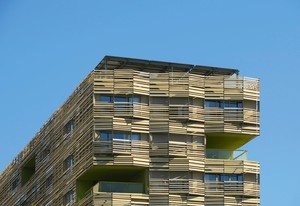
Plot e4, Clichy-Batignolles, Paris. Architect: Philéas K Architecte; developer: RIVP
Beyond the usual elements found in carbon-neutral structures—renewable energy efficiency, broad use of photovoltaic panels, rainwater management and reuse—the district also features two firsts for Paris: the city’s first smart grid and its first pneumatic waste collection. (Garbage bags are tossed in receptacles in each building that are then vacuumed via subterranean pipes to a nearby treatment center, eliminating in this way the noisy and cumbersome traffic of waste collection trucks.) Attesting to the project’s success, the eco-district has won several prestigious design and environmental awards. “The eco-district introduced the notion of major urban developments such as this being able to take on environmental and social challenges at a scale that goes far beyond standard—and often already-ambitious—city and state regulations,” Gilliland says.
Paris has had its share of urban redevelopment plans. There was the grandiose renovation of the 1800s, put forth by Haussmann under the direction of Emperor Napoleon III, that gave us the celebrated, postcard-perfect Paris we all know. Then there was Le Corbusier’s radical Plan Voisin, which although unrealized would go on to be a source of inspiration for modernist urban utopias all over the world; some say it even inspired another of Paris’s large-scale urban projects, the controversial business district of La Défense. But what distinguishes the mostly completed eco-district, beyond the obvious environmental sensibilities, is that it was a vision developed with the participation of all stakeholders, not from the top down, conceived collaboratively rather than coming from an individual’s egocentric vision. The result is a rich urban setting of varied scales, spatial experiences, materials, shapes, and textures that feels like an organic city rather than a planned development.
“I am all for this way of doing things and believe it expresses something that was already important some time ago, that is, a culture of diversification,” says Grether, the architect responsible for the project’s master plan. “Diversity of thoughts, tastes, colors, subjectivities. This pluralism is a singularity of the times. I feel it is perfectly legitimate for the urban form to reflect this contemporary spirit.”
Yes, like Bogart famously said, “We’ll always have Paris.” Just not necessarily the Paris of yesterday.
Photos: Paul Clemence
Paul Clemence is a visual artist, curator, and author focused on the cross sections of art, design, and architecture. An architect by training, he has photographed iconic structures all over the world by the likes of Zaha Hadid, Renzo Piano, Bjarke Ingels, Lina Bo Bardi, Oscar Niemeyer, Ruy Ohtake, Herzog & de Meuron, and SANAA.