Gagosian Quarterly film writer Carlos Valladares lived in Paris last year while researching his dissertation on French auteur Jacques Demy. Here, he maps out five cinemas that brought him endless joy during this time, sharing a bit about the history and current repertory of each.
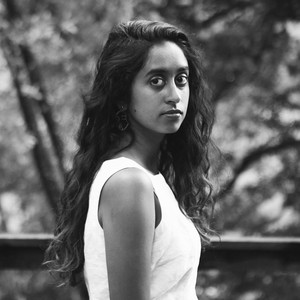
Teresa Mathew is the Associate Research Director at the New Yorker magazine and a writer and illustrator based in Brooklyn.
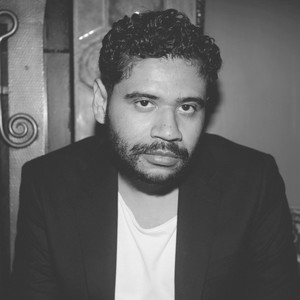
Carlos Valladares is a writer and critic from Los Angeles. He studied film at Stanford University and began his PhD in History of Art and Film & Media Studies at Yale University in fall 2019. He contributes regularly to Art in America, n+1, and Frieze. He lives in New York. Photo: Jade Sacker
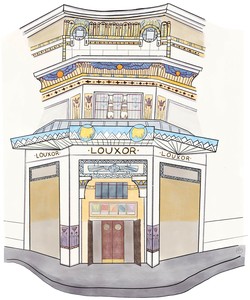
My go-to cinema, at 170 boulevard de Magenta. Built between 1919 and 1921 as an opulent silent-movie palace to entertain the working-class community in Barbès in the 18th arrondissement, the theater is ten minutes down the street from where I used to live, on boulevard Barbès. The architect, Henri Zipcy, wanted to cash in on the Egyptian vogue inspired by the now-lost 1917 feature Cleopatra starring Theda Bara, so the auditorium is decked out in eagles and zigzagging serpents. For a good while in the twentieth century, Le Louxor made its profit by showing Bollywood movies, North African melodramas, and midnight pornos. In the Mitterrand ’80s, it was, briefly, a gay nightclub: Megatown, “la plus grand boîte gay de France.” That era lasted only, tragically, a single calendar year, 1987 to 1988, but it was just long enough for Megatown to be preserved on film in the club scenes of the Jesús Franco slasher Les Prédateurs de la nuit, or Faceless (1988), in which mad doctor Frank Flamand (played by Helmut Berger, Luchino Visconti’s muse) and his sexy assistant (Brigitte Lahaie, star of such classic pornos as Je suis une belle salope [1977] and Couple cherche esclave sexuel [1979]) kidnap and murder party girls with nice skin in order to restore the face of the doctor’s disfigured sister. The theater was closed for many years, and then restored to its former glory in 2013. When I went to the ex-Megatown, there were no crazy doctors or club rats. Nor, as Le Louxor Redux, did they screen Faceless. Hélas! Missed opportunity. But they did show Charlie Chaplin comedies, to the delight of innocent eight-year-olds, Aki Kaurismäki’s gorgeous Fallen Leaves (2023), and, for three months, Jacques Demy musicals on Sunday mornings. Every Sunday at 10, no matter how late I’d stayed out the night before, I’d roll out of bed in pajamas, text whomever was around, and berate them to join me in my ten-minute trudge, in the perpetual rain, down the boulevard Barbès to rewatch the glowing Catherine Deneuve and Françoise Dorléac in my favorite film, Les Demoiselles de Rochefort (1967). Those Sundays were reserved for romance, and pining, and good skin.
24 boulevard Poissonnière, 9th arrondissement
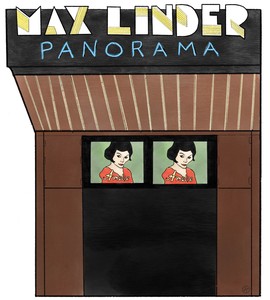
Max Linder Panorama
Another sumptuous movie palace in the vein of Le Louxor but located within the 9th arrondissement at 24 boulevard Poissonnière. One of its earliest owners was the titular Linder, the French Charlie Chaplin, who exclusively screened his popular two-reel comedies at the cinema. A group of ardent cinephiles restored the palace in 1987, preserving its Art Deco grandeur. The orchestra pit contains 264 seats, the second-floor mezzanine holds 185, and the third-floor balcony (my vantage point of choice) seats 108. I came often during their Martin Scorsese retrospective leading up to Killers of the Flower Moon (2023). The balcony was the perfect cavernous whirlpool of silence in which to get lost and experience on the big screen, and for my first time, Hugo (2011), Shutter Island (2010), and The Wolf of Wall Street (2013). And the opportunity to immerse myself within Scorsese’s 225-minute history of Hollywood—A Personal Journey with Martin Scorsese through American Movies (1995)—within a decadent work of art that, in the States, would surely have been ruthlessly transformed into a Ticketmaster-approved concert venue, is nothing to be sneezed at.
4 rue Christine, 5th arrondissement
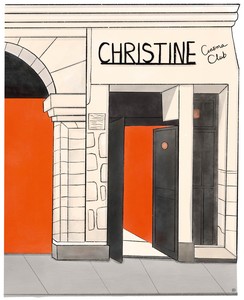
Christine / Écoles Cinema Club
Some of the most adventurous, and fun, repertory film programming happens at the Paris Cinéma Club, something of a French Film Forum, a Gallic New Beverly. It is divided into two cinemas, about a fifteen-minute walk from each other in the 5th arrondissement: the Christine at 4 rue Christine (right across the street from No. 5, where Gertrude Stein and Alice B. Toklas lived in Stein’s final days), and the Écoles Cinéma Club at 23 rue des Écoles. The theaters are owned by Ronald Chammah, producer, director, and longtime partner of Isabelle Huppert, and are programmed by Huppert’s and Chammah’s son Lorenzo. Great restoration runs of forgotten masterpieces have screened at the Christine, including Lindsey Vickers’s uncanny British thriller The Appointment (1981), Michael Roemer’s Vengeance Is Mine (1984), and the films of Ida Lupino. Huppert herself appears regularly at Écoles to talk about her own films, such as Malina (1991) and The Flood (1993). The series ideas are, as I say, fun. One summer, the Christine mounted a thirty-film festival called “Women.” Not “Women Directors.” No. Even better, and more deranged: films whose title is the name of a woman: Angel (1937), Sandra (1965), Wanda (1970), Fedora (1978). The program was a hit, and was revived the following summer. At Écoles, I’ll never forget the experience of watching Coup de foudre à Notting Hill, or Notting Hill (1999), for the first time among a sea of French millennials; it was clear they knew every line of the script because they’d squeal in anticipation of some, even reciting them out loud. Relatedly, I can’t forget a sold-out Tuesday 2pm screening, whose audience consisted solely of elder and infirm French folk, of Fritz Lang’s Moonfleet (1955), which is apparently a cult classic here. And it was at the Christine where I was properly hazed into French cinema culture: watching John Cassavetes’s New Yawk–loud Gloria (1980) in the “Women” series, I took out a pen to record a beautiful line in my journal. I was then violently shushed by a pencil-necked thirty-something for having the audacity to . . . write. When I didn’t stop writing the line, he groaned loudly—louder than even my pen, if you can believe it—and provoked everyone to turn and look at him as he clambered, Jerry Lewis–style, out of the cinema in a drama-queen huff. He did not return. Here was the line I wrote: “You’re my mother, you’re my father, you’re my mother, you’re my whole family. You’re even my friend, Gloria. You’re my girlfriend too.”
51 rue des Écoles, 5th arrondissement
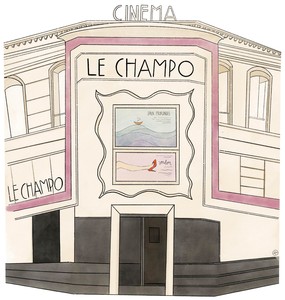
Rue Champollion Cinema
Unofficially Cinema Row, rue Champollion in the 5th arrondissement is dotted with three theaters—including the oldest repertory cinema in the city, Le Champo Espace Jacques Tati, as well as La Filmothèque du Quartier Latin and the Reflet Médicis. A cheap and good bistro, Café le Reflet, sits between them, if you want to get a bite before or after the movie. Two filmmakers seem to constantly be showing on rue Champollion: Yasujirō Ozu and John Cassavetes. All big-city cinemas should have Ozu and Cassavetes playing around the clock. Ozu matinees were a treasured part of my time in Paris; The Only Son (1936), Tokyo Story (1953), Good Morning (or Bonjour, 1959), and An Autumn Afternoon (1962) were reliable standbys to be shown at noon on weekends. They came and went as regularly as the weather in Ozu’s films: always sunny, always clear, whether the season is early spring or late summer. Shadows (1959) and A Woman under the Influence (1974) were perpetually showing, and La Filmothèque mounted a spectacular run last year of a restored Husbands (1970). Again, the film was greeted with stone faces among the French youth in the audience—this, for a self-billed “comedy about life, death, and freedom,” perhaps Cassavetes’s funniest—and most brutal—picture.
13 rue Victor Cousin, 5th arrondissement
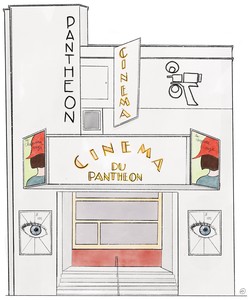
Cinéma du Panthéon
The oldest continuously running cinema in the city is Cinéma du Panthéon, at 13 rue Victor Cousin in the student-oriented 5th arrondissement. Formerly a gymnasium, it was converted into a silent cinema in 1907. Jean-Paul Sartre watched movies there as a child. For most of the twentieth century it was owned by Pierre Braunberger, who pioneered the screening of foreign films in their original languages (this was before subtitles had been invented) and who produced films by François Truffaut (Shoot the Piano Player, 1960) and Jean-Luc Godard (Vivre sa vie, 1962). Agnès Varda showed her first film, La Pointe Courte, there in 1955. I remember seeing Ken Loach’s last film The Old Oak (2023) at the Panthéon and being grateful they had a balcony, so that no one could watch me ugly cry at Loach’s social-realist melodramatics for the umpteenth time. But arguably a bigger draw is Le Salon on the top floor, designed by Christian Sapet and none other than Catherine Deneuve herself, with its wide space, comfortable seating, tart pear crumble, a vast and bilingual film reference library, good light, and its bizarro decoration: an Op-art photograph of Deneuve where she appears cross-eyed from every angle, a terrifying poster of Nastassja Kinski in Paris, Texas (1984) who looks as if she were trapped inside a milky, blurry Paris Instagram filter. There’s also a marvelous bookstore next door, where I bought the screenplay to Truffaut’s Two English Girls (1971) and the autobiography of Bulle Ogier. Ethan Hawke’s rare 1996 novel The Hottest State remains waiting for a lucky reader to snatch up.
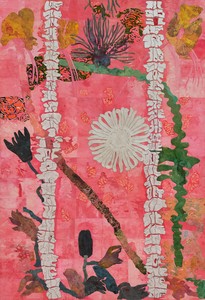
Illustrations by Teresa Mathew
Teresa Mathew is the Associate Research Director at the New Yorker magazine and a writer and illustrator based in Brooklyn.
Carlos Valladares is a writer and critic from Los Angeles. He studied film at Stanford University and began his PhD in History of Art and Film & Media Studies at Yale University in fall 2019. He contributes regularly to Art in America, n+1, and Frieze. He lives in New York. Photo: Jade Sacker