Paul Clemence is a visual artist, curator, and author focused on the cross sections of art, design, and architecture. An architect by training, he has photographed iconic structures all over the world by the likes of Zaha Hadid, Renzo Piano, Bjarke Ingels, Lina Bo Bardi, Oscar Niemeyer, Ruy Ohtake, Herzog & de Meuron, and SANAA.
“If you create the stage setting and it is grand, everyone who enters will play their part.”
—Morris Lapidus
Ever since its early days, Miami Beach has been known as a place to get away, a place where people could forget their troubles and for a few hours or a weekend or a cold winter season soak up the sunshine and relax. From the pioneer day-trippers of the 1900s, coming from Miami by ferry for an “Ocean Beach” outing, to today’s cosmopolitan travelers, Miami Beach has long appealed to our desire to escape somewhere else, somewhere foreign, its turquoise waters and tropical setting suggesting a certain irresistible exoticism that invites us to let loose.
It is no surprise that the architecture there would aim to reflect that mood, reinterpreting whatever the going design style was of the time to suit that escapist, indulgent desire. It began with the choice of the Mediterranean Revival style to give the first estates and resorts a European flair, branding this new, developing destination with a familiar and established sense of Old World sophistication. Then, in the 1930s, modernity landed in Miami Beach with the arrival of the Art Deco period and its Streamline Moderne and Nautical Moderne variations. Blending inspirations from early modern architecture (think Bauhaus), machine technology, and the sleek designs of ocean liners, the style was a perfect segue in the development of the exotic vacationland. The unique aesthetic, and Miami Beach’s version of it, with its portholes and window eyebrows, would become an intrinsic part of the city’s identity.
A couple decades later, as modernism gave way to the less uptight midcentury modern, Miami and Miami Beach would fully embrace the movement and give it their own interpretation of it, what would become known as Miami Modern, or MiMo. Taking cues from modern trends happening then in Europe (particularly Scandinavia) and Brazil, the MiMo style favored glass walls opening interiors to the outdoors, free-flowing spaces, open floor plans, biomorphic and irregular geometric shapes, and angled roofs. Given the tropical weather, protection against the year-round intense sunlight was a must and provided architects with another creative opportunity (beyond the obvious use of brise-soleil): the so-called “breeze blocks,” or concrete screen blocks that let air and wind through while also offering privacy and shaded areas. Designed in an infinite array of patterns, they perfectly combine function and aesthetics and are an easily recognizable staple of most MiMo buildings. Windows were also an important design element, carefully placed, often boxed (protruding slightly off the façade) or in a continuous horizontal ribbonlike layout.
But the biggest distinction this Miami version of modernism would bring to the movement was a whimsical sense of architectural freedom, adding a degree of playfulness to the mostly functional and serious modern tenets. And no architect would understand that so fully as Morris Lapidus. There were other prominent and very talented architects working in Miami Beach in that period who made noteworthy contributions to the city, like Norman Giller, Melvin Grossman, and Igor B. Polevitzky, but it was Lapidus who would see (and seize) the full potential of this liberated version of modernism and proceed to take it to the next level. “Lapidus is MiMo, but he is quite different,” says Jean-François Lejeune, a University of Miami architecture professor. “He was working on another scale—it’s another idea. He created, to some extent, what can be considered the MiMo monuments.”
Breeze blocks at Belle Plaza condominium, Miami Beach. Architects: T. Trip Russell and Associates
As it happened, his first big commission there in Miami Beach would be to design the largest hotel the city had ever seen, a building that would further establish it as a glamorous, world-class destination: the Fontainebleau Hotel.
Born in the Ukrainian city of Odesa but raised in New York City, Lapidus initially pursued acting and worked in theatrical set design. He eventually chose to study architecture, but the theater-staging experience would stay with him and become an important element of his design philosophy. After graduating he worked for several years for a firm that specialized in designing stores. It was an opportunity for the young designer to begin to understand and experiment with how space and design can orchestrate human behavior. It was then, also, that he began his personal journey with modernism, his designs distilling certain modernist ideas into a retail setting. A lifelong dialogue would ensue between his own architectural concepts and the modernism dogmas of the architectural establishment. Having already had some experience in hotel design in Miami Beach, he was tapped in 1952 by real estate developer Ben Novack to design a massive new luxury hotel that was meant to be not simply a place of lodging but a full-fledged entertainment complex, what today’s hospitality marketers would call a “guest experience.” The project was a chance for Lapidus to bring together his observations of how people interact with space, his theatrical sensibilities, and his personal interpretations of modernism, all in a single project, one that would push the limits of what was then accepted as architecture.
Lapidus threw in together Neo-Baroque, French and Italian Renaissance, and of course, MidCentury Modern.
Paul Clemence
It was a major commission, but it also presented quite a challenge: Novack’s inspiration was the original Chatêau de Fontainebleau outside Paris, and he wanted his new property to replicate the chatêau’s grandeur. If on the one hand the desired grandiose scale was a great opportunity for Lapidus to flex his creative muscles, the historical reference point posed a real threat to the execution of his unique architectural vision, and the balance he wound up striking between the two aspects would forever mark his legacy, in ways both positive and negative.
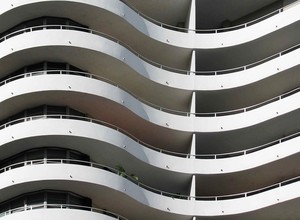
He approached the commission wanting both to adhere to modernism but also to reshape it, give it more sway, more drama, if you will, to foster a deeper and more emotional connection with the visitor. He was an avowed fan of the work of Brazilian architect Oscar Niemeyer and its sensual, organic shapes, and when it came time to develop the architectural parti for the new hotel, Lapidus bent the usually monolithic volume of the modern buildings into a sweeping curve, 440 feet long, creating a dynamic structure unlike anything seen at the time. It was a radical gesture that sent a strong message about both the building and the place: This is not your typical hotel; fasten your seatbelts, we are taking off into a whole new modern world! It was an optimistic message about the future and its possibilities of freedom and fun (after all, it was a resort). Belying the building’s unusual external appearance, the functional program itself was addressed in a rather pragmatic and efficient way, while still not losing sight of Lapidus’s interest in what Le Corbusier called the promenade architecturale, the experience of the body moving through space. A master of spatial layering, Lapidus would orchestrate an engaging flow between the multiple dining areas, the ballroom, the lobby, the swimming pool, the cabanas—everywhere was seen an opportunity to wow the guests. But some of his choices to impress them, namely the interior design, would prove to be quite controversial and deeply affect his reputation. A believer in “our primitive emotional craving for enrichment and adornment,” Lapidus went all out in staging the interiors for maximum effect. Attempting both to please Novack’s chatêau fetish and to add some pizzazz to his design, Lapidus threw together Neo-Baroque, French and Italian Renaissance, and of course midcentury modern. Historic-looking statues and classic artifacts with modern materials and furniture, Italian mural recreations with a geometric black-and-white marble inlay floor inspired by his own bowtie: The mix-and-match undoubtedly added to his dreamscape concept, but it also gave the hotel a kitsch quality that, depending on the different epoch’s thinking and depending on whom you ask, either detracted from or elevated the architecture. “People often talk about that kitsch element and forget how good he was at designing space,” Lejeune says. “The spatiality of these hotel lobbies, for example, are quite spectacular, how they flow and the sightlines.”
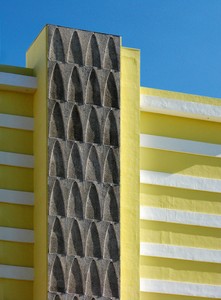
Bas-relief at 5600 Condominium, Miami Beach. Architect: Morris Lapidus
That eclectic mixing of styles in his interiors was a part of his work mostly found in his hotel projects (maybe as much a marketing as a design choice), and whether one likes it or not, it certainly created a distraction in how his designs were perceived, the gaudy candelabra taking away from how well the space and programmatic requirements were resolved. In his other projects, addressing less commercial typologies (residential, religious, and civic buildings), we can still find his flamboyant aesthetic, his inventiveness and creative freedom, but none of the attention-grabbing excesses of the hotels.
Miami-based multidisciplinary artist and architecture aficionado Carlos Betancourt found inspiration very early on in both aspects of Lapidus’s oeuvre, in his playfulness and his serious side. He speaks of becoming obsessed with Lapidus ever since he first saw, as a kid, what was then the Fontainebleau Hilton. Betancourt was on a family trip to Disney World when his father decided to make a stop to check out the famed hotel he had read about in Reader’s Digest. “I remember being completely in awe—the sweeping curve, the expansive spaces,” he says. “There was an exciting energy to the place, as if every wall, furniture, or object was alive and breathing a feeling of joy.”
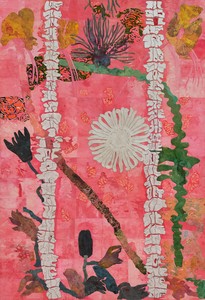
Later, upon moving to Miami, Betancourt established a connection with the city’s genius loci through Lapidus’s work. “The shapes and forms that Morris was using is what helped define a Miami aesthetic for me when I moved here. I couldn’t find much that defined this place besides the palm trees, the ocean, and the Everglades, something that was endemic to Miami or that was created by an artist, so his work became my muse,” Betancourt explains. “He had helped give form and shape to this place where few were trying, and that became an important point of departure for me and my work. Lapidus continues to be a muse for me.” He speaks of being inspired by Lapidus’s bold gestures, like the plastic flowers in an antique vase, but he also draws attention to how the architect would execute his visions: “He knew the importance of different planes, of layering information—what’s in the foreround all the way to what’s in the background. He was a master at giving us information, I would say, in my artist’s mind, in a collage way. And that stayed with me. Layering and collage continue to influence my artwork.” Later Betancourt would celebrate the architect with the series Lapidus Infinitus.
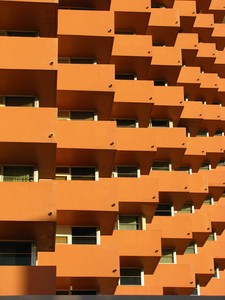
Curving balconies at Oceanside Plaza condominium, Miami Beach. Architect: Morris Lapidus
Morris Lapidus would go on to design other hotels, like the neighboring Eden Roc and the now-demolished Americana, and many residential and office buildings. But no project would reach the level of recognition of the Fontainebleau, still one of the world’s most famous hotels.
Reaction to Lapidus’s work by the architectural establishment was mostly negative in the beginning, his work not taken seriously, like Miami itself back then. But slowly, as ideas and thinking about taste broadened, people began to reevaluate and appreciate what he brought to architecture.
“Morris gave Miami a visual language, a reference,” Betancourt says. “When you think about Miami, you think of many things, but you also think of Morris Lapidus. To be part of a city’s visual identity, capturing its essence, is no easy task. His influence continues everywhere to this day.”
Indeed, as with the Eiffel Tower, the Chrysler Building, or the Colosseum, one glance at the Fontainebleau’s curving swoosh and we immediately know where that is: Miami Beach’s forever-sunny dreamscape!
Photos: Paul Clemence
Paul Clemence is a visual artist, curator, and author focused on the cross sections of art, design, and architecture. An architect by training, he has photographed iconic structures all over the world by the likes of Zaha Hadid, Renzo Piano, Bjarke Ingels, Lina Bo Bardi, Oscar Niemeyer, Ruy Ohtake, Herzog & de Meuron, and SANAA.