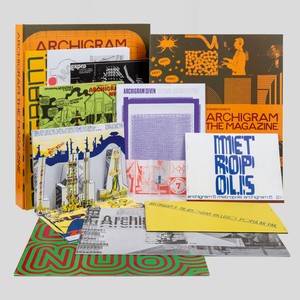
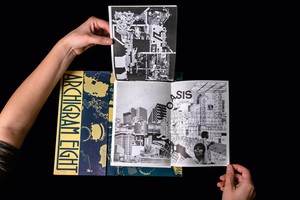
D.A.P. and Designers & Books have published the first authorized facsimile of the highly influential and heterodox magazine Archigram, produced by the architectural collective of the same name between 1961 and 1974. This new edition faithfully duplicates the original nine and a half issues, complete with pop-ups, electric resistors, gatefolds, and all, and accompanies them with a collection of essays by key figures from the world of architecture. Here, Dan Fox considers the legacy of this innovative, irreverent, and prophetic magazine.
Archigram: The Magazine (D.A.P. and Designers & Books, 2025)
Archigram: The Magazine (D.A.P. and Designers & Books, 2025)
Dan Fox is a writer, musician, and filmmaker. He is the author of the books Limbo and Pretentiousness: Why It Matters, and codirector of the BBC documentary Other, Like Me: The Oral History of COUM Transmissions and Throbbing Gristle. He is a consulting editor for The Yale Review and lives in New York. Photo: Matthew Porter
“Keep the drearies on the run!” they liked to say. “This’ll upset them!” “They” were Archigram, a loose coalition of architects formed in London in 1961: Warren Chalk, Peter Cook, Dennis Crompton, David Greene, Ron Herron, and Mike Webb. “Them,” the drearies, were dour modernists, preachy architect academics, jobs-worth town planners, and ideology cops of both the left and the right. Archigram were anti-puritans and tech-optimists. They were Information, Pop, and Space Age rolled together. Believing that people deserved more than to spend their lives living in drab boxes, Archigram imagined a new paradigm for architecture: expendable, flexible, mobile, high tech, cheerful. Buildings should be as dynamic as aircraft and home appliances. Archigram wouldn’t be the ones to build this world; the group’s major work was the magazine that gave them their name, a paper monument in 9 1/2 issues, constructed from collage and Letraset, poetry and polemic, and ornamented with a sci-fi lexicon of clip-ons, cushicles, gloops, infogonks, paks, and suitaloons.
The Archigram six taught at architecture schools and worked for commercial practices. They did civic jobs for the Architects Department of the London County Council (LCC). In the pages of their magazine they shared wild dreams of inflatable homes and networked “Informaisons.” Cook, for instance, proposed modular Plug-In Cities with units that could be swapped in and out according to need, and Instant Cities resembling nomadic music festivals. Crompton prophesied a smart Computor [sic] City constantly responsive to its inhabitants’ needs. Herron imagined colossal Walking Cities, like cruise ships on mechanical legs—perhaps Archigram’s most indelible image. “What is a room?” they asked, “what does it do?” The group questioned the nature of a home, a road, a town, the media, and wondered if all of them could be the same thing. “The existence of the pocket tape recorder has the same meaning for us as the tower crane,” they declared.
Archigram dissolved in the mid-1970s. Much has been said about their legacy. Renzo Piano’s and Richard Rogers’s Centre Pompidou in Paris, with its colored service ducts and flexible interior spaces, is frequently cited as an example of the group’s influence. (In Denis Postle’s 1980 documentary Beaubourg: Four Films, the original Archigrammers are captured outside the Pompidou sniffily noting how static and undynamic it appears to them.) Archigram inspired the High-Tech movement of the 1970s, and later the work of marquee names including Tadao Ando, Diller and Scofidio, Zaha Hadid, Bjarke Ingels, and Bernard Tschumi. They provoked counterreactions too, accused of being fantasists, of not being political enough, and, in the glare of hindsight, for advocating ideas that immiserated twenty-first-century life. The authors of Learning from Las Vegas (1972), Denise Scott Brown, Robert Venturi, and Steven Izenour, dismissed them as Jules Verne “with an appliqué of Pop-aerospace terminology.”
The reputation of Archigram magazine outstripped its availability. For years original editions were hard to find outside specialist research libraries. Copies exchanged hands among private collectors for eye-watering sums. If you were lucky you might see one trapped in a vitrine in an exhibition about “lost modernist futures,” or whatever the urgent topic was in curator-world that season. Archigram’s most eye-catching images—the Plug-In City, the Walking City—circulated online, in architectural history books, and blown up on the walls of museums. Here they emerged cropped, rescaled, amputated from their original contexts, and in full color (most issues of Archigram magazine were monochrome). Arguably it didn’t matter: The ideas were the important thing. But something was missing. The authorized set of facsimile editions recently published by Designers & Books and D.A.P. restores what has been unavailable to general readers for years: a sense of Archigram as more handmade zine than magazine, fizzing with the energy of work done on stolen time with paper and glue raided from the office stationery cupboard.
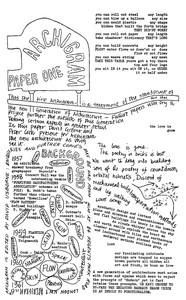
The first issue appeared in May 1961. It was made by Cook, Greene, and Webb, then fresh out of architecture school, and edited by designer David Usborne. Cook would later describe it as “a weird little thing”; he wasn’t wrong. Archigram Paper One cost sixpence and comprised two sheets of paper, one folded around the other. On one page were splodged images of architectural models. Idea fragments in neat lettering snaked between the pictures: “The inner space pushes through the skin.” “Roads—Walls—Spaces can exist as one.” On the other sheet, scribbled keywords in little balloons bumped against islands of typed text. The language was terse and cryptic, like field reports from architectural secret agents: “FREEDOM, FLOW, PLASTICS . . . D. Greene’s mosque, Cook—Sainsbury Piccadilly. ‘FURNITURE MANUFACTURERS ASSOCIATION’ schemes at poly: M. Webb’s taken further than others termed bowellism.” What was bowellism? Was it contagious? Who were these people? Whoever it was could speak we-know-best avant-gardese: “WE HAVE CHOSEN TO BY-PASS THE DECAYING BAUHAUS IMAGE WHICH IS AN INSULT TO FUNCTIONALISM.” Elsewhere the cockiness was softened with the kind of wistful declaration that young idealists are so good at: “The love is gone. The poetry in bricks is lost.” A single red dot beside the masthead, printed with an inked potato, seemed to reply: Never mind, cheer up.
Facsimile of Archigram Paper One
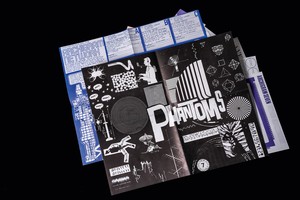
Inside of Archigram: The Magazine
After the first issue came out, Cook, Greene, and Webb met Chalk, Crompton, and Herron, who were a little older and worked for the LCC. The friends sensed something was in the air. They had in common a dissatisfaction with the watered-down modernism of postwar Britain and with the raw concrete “honesty” of New Brutalism. Genuflecting to Mies van der Rohe and Le Corbusier didn’t interest them. Cities were dense and unpredictable, not machines serving tidy idealizations of human behavior. Prefab technology from World War II and drawings of cities in science-fiction comics interested the group. They looked to the American philosopher-architect Buckminster Fuller, with his prefabricated Dymaxion houses and geodesic domes, and, further back, to the Weimar-era architect Bruno Taut, who worked with color and gardens. The group admired the pod structures that the Japanese Metabolists were exploring. Early issues of the magazine nodded to Yona Friedman in France—he had envisaged a “mobile city” in the 1950s—and to the Dutch artist Constant, an ally of the Situationists in Paris, who conceived of an evolving, borderless metropolis of leisure and self-discovery that he called New Babylon.
Cook, Greene, and Webb invited the older trio to contribute to Archigram 2. This second issue came out a year later and was sharper than the first—landscape format, black and white, staple bound, spreads alternating between project descriptions and designs. Issue 1’s idea-fragments were now glued into complete sentences. There were murmurings about “expendability,” “flexibility,” and “throw-up throw-away structures.” Opinionated but not doctrinaire, the group opened their pages to fellow travelers. Issue 2, for instance, featured a contribution about new farm design from Andrew Anderson, one of the so-called “Christian Weirdies” who had studied at the Architectural Association in London in the late 1950s. The architect Cedric Price wrote about the “expandable house.” Price, Archigram’s brandy-swilling, cigar-chomping uncle, was a paper visionary; almost all of his ideas would remain unrealized during his lifetime, but he was influential and he sang in the same key as the younger architects. His Fun Palace was designed with theater director Joan Littlewood as a flexible, interactive culture complex where visitors could “try starting a riot or beginning a painting—or just lie back and stare at the sky,” while his Potteries Thinkbelt was a plan to redevelop Staffordshire’s dilapidated ceramics factories as a vast rail-connected education zone. So the story goes, a wealthy couple once consulted Price about designing a new house. He advised them to get a divorce.
The third issue of Archigram arrived in the autumn of 1963—portrait format, navy on yellow, subtitled “Towards throwaway architecture.” People were beginning to use the name of the magazine to refer to the group, and they decided to adopt it officially. Issue 3 came on the heels of Living City, an exhibition staged by Archigram at the Institute of Contemporary Arts (ICA), London, the previous July. Living City attempted to bottle the energy of urban life under the new ruling signs of pop, consumerism, and technology. Architecture could be about the way you lived your life—about housing, infrastructure, and telecommunications, sure, but also about music, fashion, food, entertainment, travel. Subjective experiences and fleeting happenings were as vital as brick and mortar. “All are important,” they declared, be it “the triviality of lighting a cigarette, or the hard fact of moving two million commuters a day.” Chalk put together a “Living City Survival Kit” for the show; items included Daz detergent, Player’s No. 3 cigarettes, and an Ornette Coleman album. (The kit also included a copy of Playboy; this “survival” seemed more geared to men than to women.) Talk of transience and invisible experience upset some in the sober British architecture world. “The idea of an expendable environment is still somehow regarded as akin to anarchy,” wrote Cook in the issue 3 editorial. “As if, in order to make it work, we would bulldoze Westminster Abbey. WE SHALL NOT BULLDOZE WESTMINSTER ABBEY.”
The show came about through Theo Crosby, formerly associated with the Independent Group, which had been based at the ICA. (Crosby also happened to be a manager at Taylor Woodrow Construction Company, where the Archigram six now held day jobs.) The Independent Group had included Pop artists Richard Hamilton and Eduardo Paolozzi, architecture critic Reyner Banham, and others. Like them, the Archigram team was fascinated by the new products of consumer society. They liked movies, jazz, Ivy suits, and other signals of America. Readers of the magazine now started to see bold modern typefaces and photomontages appear increasingly in its pages. Following Hamilton and Paolozzi, Archigram collaged adverts, diagrams, comics, and illustrations into plans for buildings that resembled engine cross-sections, spaceships, and container ports. Archigram, wrote Banham, “make no bones about being in the image business—like the rest of us they urgently need to know what the city of the future is going to look like.”
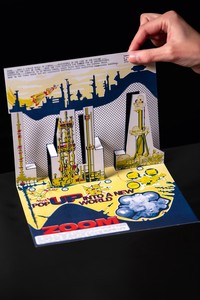
Inside of Archigram: The Magazine
With AMAZING ARCHIGRAM 4 in 1964, the group entered their imperial phase. Chalk, the driving force behind the issue, saw “space comics” as a goldmine of architectural ideas produced “outside the conventional closed architect/aesthete situation,” and AMAZING ARCHIGRAM 4 drew lines between early modernists such as Taut, his contemporary Carl Krayl, and DC’s Superman comics. The cover was silk-screened in bright yellow, red, and blue and gridded with benday dots. A superhero with a jet pack and laser soared across a forest of high-tech towers. The issue’s theme word, “zoom,” exploded next to him. Inside, a loosely organized cartoon strip reproduced frames from science-fiction comics—moon bases and futuropolises made of “geodesic nets, pneumatic tubes, plastic domes and bubbles”—and led to a pop-up centerfold of exotic skyscrapers.
Banham took copies of issue 4 to the United States, where he spread the word among the architecture commentariat. Orders began to come in from Europe and Japan. Archigram 5, the “Metropolis” issue, returned to a conventional format. It looked like a little blue-and-white sales prospectus but its tone was strident: “Are cities still necessary?” asked the editorial. They weren’t going to wait for an answer from the drearies. “Archigram 5 shows schemes with guts, schemes in which decisions have been made.” This was the issue that featured the famous Computor City and the Walking City. There was a breezy tour that took in Piranesi and projects by the Metabolists, Hans Hollein, and others. Underwater architecture was discussed. Strangest of all was a polemic from the critic Martin Pawley that stood out for being either deeply ironic or cruelly Darwinian, it was hard to tell. He called the metropolis “a cage” in which “tortured spirits observe the decline of the social contract into a savage duel between tear gas and napalm laden policemen.” Plus ça change. “Turn the cage into a new kind of jungle,” he went on, “not a reserve for the degenerate survivors of a dying species.” Did someone mention a Living City Survival Kit?
By the time No 6 appeared, in the fall of 1965, there were listings for stockists in Helsinki, Los Angeles, and Paris. Webb and Chalk left for the United States to teach; Archigram went international. Curiously, the magazine was not easy to read. It was small. The layouts were often dense, the type cramped, and thick ink on thin paper blotted detail from the images. There was something ration-era about it, as if optimistic in vision but hamstrung by poor materials. The texts were oddly punctuated and tended toward insularity, giving the reader the impression of eavesdropping on a private conversation. (Issue 6, for instance, presented with little commentary Chalk’s extensive visual research into 1940s design. Intriguing for architects and designers, but what did it mean to a curious general reader?) If you were lucky, you might productively misunderstand it. There was a certain sprezzatura to the magazine, something attitudinal, take-it-or-leave-it. Cook’s designs beautifully combined a ligne claire precision with a love of curves and soft, almost inflatable-looking forms. Arts and Crafts gone high-tech. (Interviewed for Bloomberg in 2018, Cook remarked that “a lot of Archigram was strangely Victorian, perhaps more so than Modernist. . . . [The Victorians] reproduced foliage in iron and they decorated and shaped and placed funny turrets on corners.”) Herron was a talented collagist working under the influence of Paolozzi and Dada, setting the hand-drawn and the photographic in arresting juxtapositions of scale and texture.
Archigram drawings offered a form of thinking out loud, provocation over planning. They held open a gap between imagination and reality in which you might believe that in an architect’s studio somewhere in London the models had already been built, the first Plug-In City capsules would be on the market in a matter of months, and all you had to do was place your order through the computer console in your kitchen.
Inside of Archigram: The Magazine
Given their radicalism, the Archigram world could seem affluent and male. Critic Jonathan Meades observes that Archigram “always included ‘dolly birds’ and ‘get-away people,’ ‘the fun set’ and ‘people in a hurry’ and other impatient clichés of their hedonistic era” in their designs. “When the dolly birds went from minidresses to Laura Ashley” in the late 1960s, Meades continues, “there was a fundamental disconnect between the collective’s imagined decors and the people inhabiting them.” It’s true that as the sharp, mod 1960s loosened into the Summer of Love, the figures populating Archigram did not grow long hair or appear to drop acid and call for revolution. The group was ostensibly of the left, but what confused their critics was that they were also in thrall to consumerism and technology. They disliked rigid politics: Issue 9, for example, included a terse open letter from Cook to the group ARSE (Architectural Radicals, Students and Educators), accusing them of being “holier-than-thou” leftists—with a name like ARSE, presumably not that holy—but conceding common ground and encouraging the groups to “jostle each other towards the action.”
Archigram was never considered part of the 1960s British underground press, sold on marches and read in squats along with the International Times and Oz. In retrospect the issues weren’t entirely distinct from it either: They were self-distributed, they used innovative graphic design and printing techniques, and advocated for new ways of living. In later issues the group advanced what art historians would come to call “hippie modernism.” Archigram seemed to share with collectives such as Ant Farm, Superstudio, and Haus-Rucker-Co a devotion to finding ways in which technology could service a new global consciousness. Copies of the magazine would not have looked out of place in a California head shop alongside issues of Radical Software and the Whole Earth Catalog. (There was an advert for the latter in Archigram’s last full issue.) Archigram Seven (1967) was themed “Beyond Architecture.” It set the tone for the rest of the magazine’s run. The issue came with a free electric resistor and readers could send off for Archigram-related film strips, lecture tapes, and slides. The next issue, in 1968, included Cook’s Infogonks, precursors to smart glasses. “The printed page is no longer enough,” they wrote in no. 7’s editorial, “magazines will dissolve into hybrid networks of all media at once.” They declared that “the network is ready to be electrified.”
The final edition—Archigram Nine, “fruitiest yet”—arrived in 1970 with a green-and-red cover depicting a man working in a garden wired up to a communications network. A packet of seeds was stapled to the inside pages. Among the ideas proposed was an “Enviro-pill,” a kind of hallucinogen attuned to the user’s surroundings. “We are following our dreams yet further and seeing a gentler, softer more tantalizing environment,” ran the editorial lede. As if predicting the group’s own demise, they wrote, “The Futurist gear of Plug-In City was necessary at the time, in order to make the statement that ‘Architecture does not need to be permanent.’ Later this can be simplified to ‘Architecture does not need to be.’”
Archigram got called utopian. This was either a compliment or an insult depending on how close your feet were to the ground. The group refused the label and argued that they were responding to how people already behaved, dealing with the environment as it existed, not as they wished it to be. Their ideas could be built, they insisted. Herron long maintained that the technology to build his Walking Cities existed; all that was missing was the money and the guts to do it. One idea came close: In 1969, Archigram won a prestigious international competition to design an entertainment center in Monte Carlo. They established an office to produce it. The project was scuppered in the early 1970s by stagflation and the oil crisis. The group disbanded in the mid-1970s. A half-issue coda—number 9 1/2—drifted out in the form of a loose pamphlet in 1974.
In a short film that Postle made about Archigram for the BBC in 1967, a confident voiceover declared that “automation affects our way of thinking more than our way of doing.” How differently those words sound in the age of AI. Be careful what you wish for, may be one of the lessons of the twentieth-century avant-gardes. The Futurists promoted war and those who survived World War I got to see death at an industrial scale. Pop artists praised consumerism; shopping ate the planet. Minimalism was minimized to a shorthand for wellness and wealth. Short of seeing Walking Cities lumber past our windows, we live in a negative version of Archigram’s world. Smart buildings and geolocators track our movements. Wearables transmit information about us to businesses and governments. People are reduced to users. The network has been electrified and dreams of expendability and automation, of a better life through plug-ins and pop-ups, seem part of the empire of enshittification.
A few years ago, Greene said in an interview, “I wonder if the purpose of architecture could actually be to be a point of stasis in an ever-changing world. . . . Why either/or though? Why not both/and? Part of architecture should be permanence and stasis and the resistance to change that the cathedral has, and the rest might allow rapid and easy change.” They said it all along. We do not have to bulldoze Westminster Abbey.
Dan Fox is a writer, musician, and filmmaker. He is the author of the books Limbo and Pretentiousness: Why It Matters, and codirector of the BBC documentary Other, Like Me: The Oral History of COUM Transmissions and Throbbing Gristle. He is a consulting editor for The Yale Review and lives in New York. Photo: Matthew Porter